INDIAN WELLS, CALIFORNIA / MANILA — November 8, 2026 | WWC ONE MEDIA | Global Sports, Tennis and WTA
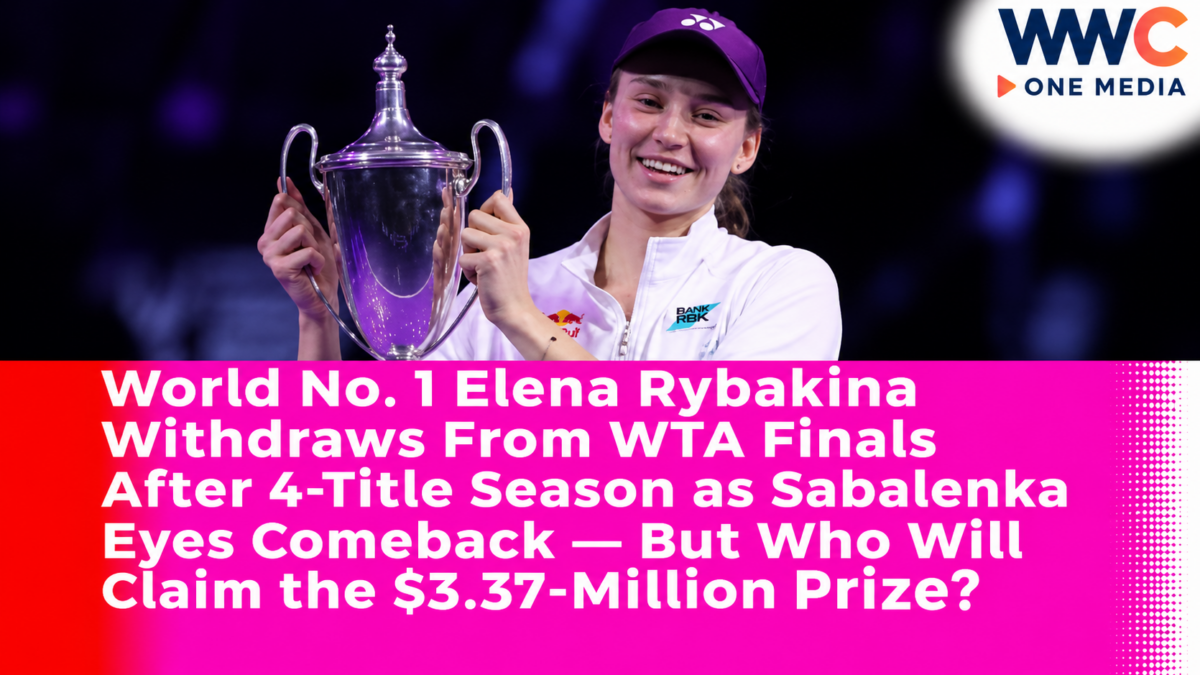
The 2026 WTA Finals have suffered a major blow before the first ball has even been struck, with world No. 1 Elena Rybakina withdrawing from the prestigious season-ending championship after a remarkable year that included two Grand Slam victories.
But while the defending champion’s absence has disappointed fans, tournament director Garbiñe Muguruza insists the competition remains packed with elite talent capable of delivering one of the most unpredictable finishes to the women’s tennis season.
Rybakina, who represents Kazakhstan, announced her withdrawal on Saturday, November 7, just one day before the eight-player singles competition was scheduled to begin at the Indian Wells Tennis Garden in California.
The Women’s Tennis Association confirmed that the 27-year-old had withdrawn because of a viral illness.
Her absence follows a physically demanding season in which she also experienced injury problems, including a neck issue that forced her out of the Tokyo tournament in October.
The decision opens a place for Ukraine’s Marta Kostyuk, who will make her WTA Finals debut after an impressive breakthrough season.
It also removes the world’s top-ranked player from a tournament featuring Aryna Sabalenka, Coco Gauff, Jessica Pegula, Mirra Andreeva and other leading contenders.
With $10 million in total prize money and as many as 1,500 ranking points available to an undefeated champion, the stakes remain enormous.
Could Rybakina’s unexpected withdrawal open the door to a surprise WTA Finals champion—or will Sabalenka seize the opportunity to finish 2026 with one of the biggest victories of her season?
Elena Rybakina Pulls Out Just Before WTA Finals Begin
Rybakina’s withdrawal came at the worst possible moment for tournament organizers.
The world No. 1 was scheduled to begin her title defense on November 8 against Czech player Linda Noskova.
Instead, she confirmed that her physical condition was not sufficient for her to compete.
In her official statement, Rybakina expressed disappointment about missing the tournament and explained that she needed to rest before returning for the 2027 season.
The WTA subsequently identified a viral illness as the reason for her medical withdrawal.
The announcement ends one of the strongest seasons of her career.
Rybakina finishes 2026 with a 54–14 singles record and four titles.
Those championships came at the Australian Open, Stuttgart, the US Open and Ningbo.
Most importantly, she secured the year-end world No. 1 ranking before the WTA Finals began.
That means the top position in the final 2026 year-end rankings is already hers, even though she will not compete in Indian Wells.
Her withdrawal is a disappointment, but it does not erase the achievements that made her the world’s leading player this season.
Garbiñe Muguruza Defends the Strength of the Tournament
Former world No. 1 Garbiñe Muguruza, who serves as WTA Finals tournament director, acknowledged that losing Rybakina was disappointing.
However, she emphasized that the decision was understandable given the physical demands the player had faced.
Muguruza told Reuters that she had spoken with Rybakina and knew that the Kazakh star was struggling to recover in time.
The two-time Grand Slam champion stressed that the tournament did not want Rybakina to compete before she was physically ready.
That position reflects a growing awareness of the importance of player recovery in professional tennis.
Even the world’s best athletes can struggle to maintain their physical condition throughout a demanding season.
Muguruza also rejected the suggestion that Rybakina’s absence would substantially weaken the competition.
She described the remaining players as among the best in women’s tennis and emphasized that the round-robin format would produce several high-quality encounters.
Her confidence is supported by the tournament’s lineup.
The field includes established Grand Slam champions, experienced contenders and emerging stars capable of challenging the sport’s leading players.
For fans, the loss of Rybakina removes one major attraction.
But it also creates a different competitive storyline.
Marta Kostyuk Gets Her Biggest Year-End Opportunity
Rybakina’s replacement is Ukraine’s Marta Kostyuk.
The 24-year-old had already traveled to Indian Wells as an alternate and was practicing at the venue when the withdrawal was announced.
That gave her the opportunity to enter the main draw without needing to make last-minute travel arrangements.
Kostyuk’s selection follows an impressive 2026 season.
She captured the Madrid title, reached the world’s top 10 and demonstrated the consistency required to challenge leading players on the WTA Tour.
Her entry marks her first appearance in the prestigious year-end singles championship.
The opportunity is particularly significant because qualification for the WTA Finals is limited to the season’s highest-performing players.
Kostyuk will replace Rybakina in Group 1.
Her opening match is scheduled against Linda Noskova on Sunday, November 8.
She will also face Coco Gauff and Jessica Pegula during the round-robin stage.
Those matches provide an immediate test of her ability to compete under the pressure of a major international event.
As WWC ONE MEDIA previously reported on Marta Kostyuk and other tennis players bringing their dogs to major tournaments, the Ukrainian star has also spoken about the importance of maintaining a sense of stability during the demanding tennis season.
Now, she faces one of the biggest competitive opportunities of her career.
Rybakina’s Absence Changes the Entire Group Stage
The WTA Finals uses a format that differs from most major tennis tournaments.
Instead of eliminating a player immediately after one defeat, the eight singles competitors are divided into two groups.
Each player faces the other three members of her group.
The top two players in each group advance to the semifinals.
That means a competitor can lose a round-robin match and still have an opportunity to reach the knockout stage.
Following Rybakina’s withdrawal, the confirmed singles groups are:
Group 1
- Coco Gauff
- Jessica Pegula
- Linda Noskova
- Marta Kostyuk
Group 2
- Aryna Sabalenka
- Mirra Andreeva
- Elina Svitolina
- Karolina Muchova
The revised lineup creates several compelling matchups.
Gauff and Pegula will seek to use their experience against younger challengers.
Kostyuk enters with confidence following her breakthrough season.
Meanwhile, Sabalenka and Andreeva headline a second group featuring players with different playing styles and significant international experience.
There is no guarantee that Rybakina’s replacement will be the easiest opponent in Group 1.
Kostyuk’s recent progress suggests she could produce difficult matches for any opponent.
Aryna Sabalenka Sees a Major Opportunity
One player who could benefit from Rybakina’s absence is Aryna Sabalenka.
The Belarusian star entered the tournament as world No. 2.
With Rybakina no longer competing, Sabalenka has an opportunity to collect ranking points without facing the player who defeated her in two Grand Slam finals this year.
However, Rybakina has already secured the year-end No. 1 ranking.
Even if Sabalenka wins the championship, she cannot take that year-end distinction away from Rybakina.
The competition remains important for Sabalenka’s momentum and ranking position heading into 2027.
Muguruza acknowledged that the world No. 2 could see the tournament as an opportunity to strengthen her position.
Sabalenka also has experience winning at Indian Wells.
She captured the tournament’s regular WTA 1000 title earlier in 2026.
That familiarity with the venue could become an advantage.
But other players in her group are capable of presenting significant challenges.
Mirra Andreeva has emerged as one of the most exciting young players in women’s tennis.
Elina Svitolina brings experience, while Karolina Muchova is known for her variety and ability to disrupt opponents’ rhythm.
Sabalenka may be one of the favorites, but a championship is far from guaranteed.
Rybakina’s Historic 2026 Season Ends on a Disappointing Note
Rybakina’s absence is especially frustrating because her 2026 campaign included some of the biggest victories of her career.
She defeated Sabalenka in the Australian Open final in January.
Then, in September, she won the US Open to secure her third career Grand Slam singles title.
The New York triumph also confirmed her position at the top of women’s tennis.
As WWC ONE MEDIA reported on Rybakina’s dramatic US Open semifinal victory over Coco Gauff, the Kazakh star demonstrated her ability to recover from difficult situations against elite opposition.
Her campaign culminated in another high-profile meeting with Sabalenka.
As WWC ONE MEDIA covered in its report on Rybakina ending Sabalenka’s US Open title defense, she defeated the Belarusian to capture the trophy and complete her rise to world No. 1.
Those victories underline how important Rybakina has become to the women’s game.
Her powerful serve, aggressive baseline shots and ability to control rallies make her a dangerous opponent on hard courts.
The WTA Finals would have provided an opportunity to conclude her season with another major title.
Instead, she will turn her attention toward recovery and the 2027 campaign.
Tennis’ Demanding Schedule Raises New Questions
Rybakina’s withdrawal has brought the issue of player fatigue back into focus.
Elite players compete across multiple continents during the season.
They must manage matches, training, travel, recovery and commercial obligations.
Some tournaments also involve difficult scheduling conditions.
As WWC ONE MEDIA reported on late-night matches becoming a major issue at the US Open, athletes have raised concerns about matches that finish after 2 a.m. and leave insufficient time for recovery.
These scheduling issues are not established as the cause of Rybakina’s illness.
Her medical withdrawal should not be attributed to late-night matches or any specific tournament without evidence.
Nevertheless, the broader discussion about player workload is relevant.
Muguruza’s response emphasizes that athletes should not feel compelled to compete when their physical condition is inadequate.
That is especially important at a tournament where every match involves leading competitors and demanding levels of intensity.
For Rybakina, prioritizing recovery may be more valuable than attempting to defend a title while unwell.
The WTA Finals Move From Riyadh to Indian Wells
The 2026 WTA Finals also feature an important change of location.
The tournament had previously been held in Riyadh, Saudi Arabia.
However, organizers moved this year’s event to Indian Wells, California.
Muguruza told Reuters that concerns about regional conflict and player safety played a decisive role in the relocation.
She said officials wanted a setting where athletes could compete in a secure and comfortable environment.
The tournament director described the players’ response to Indian Wells as positive.
She also reported strong ticket sales.
Indian Wells is already an established destination on the professional tennis calendar.
Its facilities regularly host leading players during the BNP Paribas Open.
That experience gives the venue an advantage in organizing a major international tennis competition.
However, strong ticket sales do not necessarily establish that the relocation has generated higher revenue or profit.
Those financial results have not been independently disclosed.
The WTA Finals Offer $10 Million in Prize Money
Despite Rybakina’s absence, the championship remains one of the most valuable events in women’s tennis.
The WTA has confirmed a total prize fund of $10 million.
Of that amount, $8 million is allocated to singles and $2 million to doubles.
An undefeated singles champion can earn up to approximately $3.37 million, including participation payments.
A player who completes the tournament without losing a match can also earn 1,500 ranking points.
The points structure awards:
- 200 points for each round-robin victory
- 400 points for winning the semifinal
- 500 points for winning the final
The maximum assumes a player wins all three round-robin matches before capturing the semifinal and championship.
Players can still win the title after losing a group-stage match, but their total ranking points and prize earnings would differ.
For Kostyuk and the other competitors, the financial and competitive rewards are substantial.
But the $3.37-million figure is a maximum under specific conditions, not the guaranteed payout for every champion.
Ukrainian-Russian Tennis Tensions Remain Part of the Tournament
Kostyuk’s participation also brings attention to the continuing impact of Russia’s invasion of Ukraine on international sport.
The Ukrainian has been outspoken about the conflict.
She has declined to shake hands with players from Russia and Belarus following matches.
That position has created emotionally charged moments at international tournaments.
Muguruza said organizers would respect players’ individual decisions regarding post-match handshakes.
The WTA Finals will include competitors from Ukraine, Russia and Belarus.
The tournament director emphasized that players should be free to decide how they handle these interactions.
That approach reflects the sensitivity of the issue.
Tournament organizers must maintain professional competition while recognizing that athletes may hold deeply personal views about events affecting their countries.
Kostyuk’s participation could bring additional attention to those questions.
However, her refusal to shake hands with certain opponents should not be confused with a refusal to compete against them.
Who Could Win the 2026 WTA Finals?
With the defending champion absent, the competition appears more open.
Sabalenka is one of the leading contenders because of her power, experience and previous success at Indian Wells.
Gauff has the ability to challenge the world’s strongest players with her movement and defensive skills.
Pegula brings consistency and experience on hard courts.
Andreeva represents a younger generation of contenders capable of producing major upsets.
Muchova’s tactical variety makes her another dangerous opponent.
Svitolina has substantial big-match experience.
Noskova and Kostyuk will also have opportunities to make an impact.
However, no player has been guaranteed a place in the semifinals.
The round-robin format can create unexpected results.
Even a favorite may struggle if she loses an early match and comes under pressure in her remaining group fixtures.
For fans, that uncertainty is part of the tournament’s attraction.
Three Possible Outcomes After Rybakina’s Withdrawal
Scenario 1: Sabalenka capitalizes on the opportunity.
The world No. 2 could use her experience and hard-court strengths to make a deep run, potentially closing the ranking-points gap heading toward 2027.
Scenario 2: Marta Kostyuk produces a breakthrough performance.
The Ukrainian could build on her strong season by challenging more established opponents and potentially reaching the semifinals.
Scenario 3: Another contender captures the championship.
Gauff, Pegula, Andreeva or another player could emerge as the tournament’s strongest performer.
These are possibilities, not confirmed results or guaranteed forecasts.
The Bigger Question: Can the WTA Finals Deliver Without Its World No. 1?
Elena Rybakina’s withdrawal has changed the complexion of the 2026 WTA Finals.
The defending champion will not return to compete for another title.
Her absence removes one of the sport’s most accomplished players from the season-ending event.
But tournament director Garbiñe Muguruza remains confident that the competition can deliver exceptional matches.
The remaining field includes Grand Slam champions, experienced contenders and emerging stars.
Marta Kostyuk has gained a valuable opportunity to make her debut.
Sabalenka has an opening to build momentum.
And the tournament still offers millions of dollars in prize money and substantial ranking rewards.
The confirmed development is that Rybakina withdrew because she was not physically ready to compete, with the WTA identifying a viral illness. She will finish 2026 as world No. 1 despite missing the championship.
For Rybakina, the immediate priority is recovery.
For her rivals, the challenge is making the most of an unexpected opportunity.
And as the world’s best remaining players prepare for the opening matches in Indian Wells, one question could define the final chapter of the 2026 women’s tennis season:
Will Aryna Sabalenka take advantage of Rybakina’s absence to claim the WTA Finals crown—or could Marta Kostyuk and a new generation of challengers deliver a stunning upset that changes the balance of power heading into 2027?