SÃO PAULO, BRAZIL / MARANELLO, ITALY / MANILA — November 8, 2026 | WWC ONE MEDIA | Formula 1, Motorsport and Global Sports
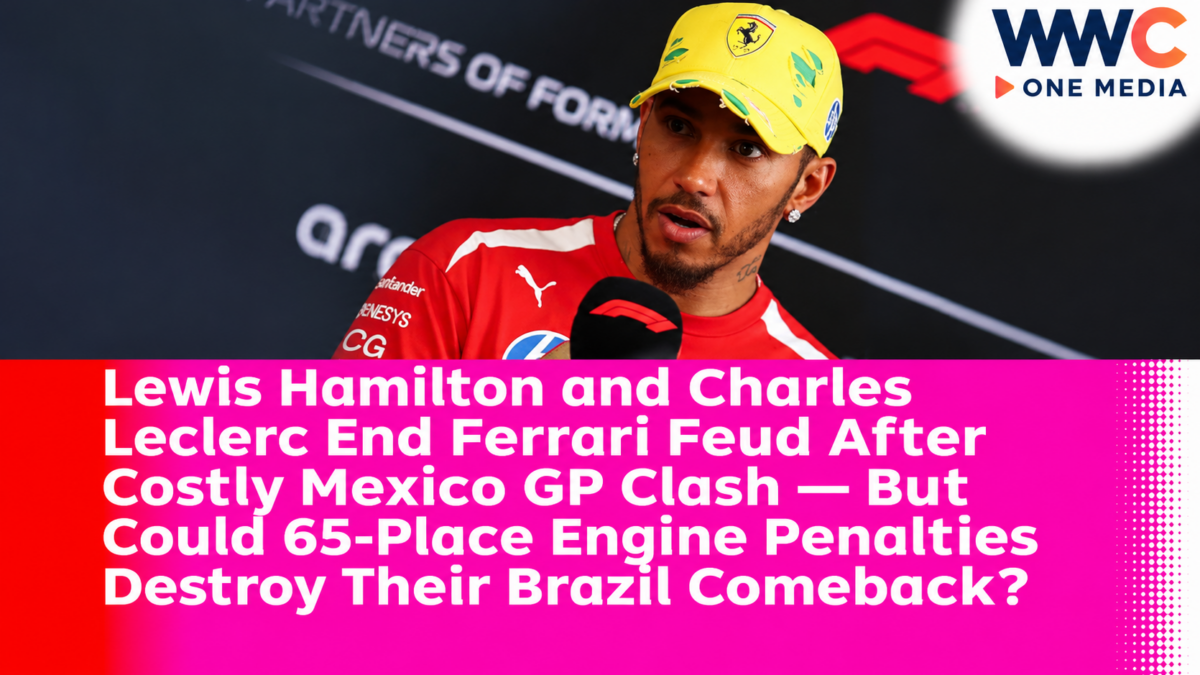
Ferrari’s simmering Formula 1 rivalry has taken a dramatic turn, with seven-time world champion Lewis Hamilton and teammate Charles Leclerc declaring their dispute over the Mexican Grand Prix officially settled.
But just as the Italian racing giant attempts to restore harmony between its star drivers, another crisis threatens its chances at the São Paulo Grand Prix.
Hamilton faces accumulated grid penalties totaling 65 places, while Leclerc will serve a 10-place penalty following changes to their cars’ power units.
The setbacks come only days after an opening-lap confrontation in Mexico City cost Ferrari a potential one-two finish and triggered questions about whether its drivers need stricter rules when racing each other.
According to Reuters, in a report published by Channel News Asia on November 8, both drivers confirmed they had resolved their differences after discussions in Brazil.
Ferrari team principal Frédéric Vasseur also intervened, reminding the drivers that their responsibility to the team must come before individual ambitions.
The reconciliation offers some relief to Ferrari’s leadership.
However, the episode raises a much bigger question about a team trying to maximize its performance while managing two highly competitive drivers.
Can Hamilton and Leclerc turn their renewed understanding into better race results—or could another confrontation destroy Ferrari’s remaining momentum in the 2026 Formula 1 season?
Ferrari’s Mexico GP Disaster Started on the Opening Lap
The controversy began at the Mexico City Grand Prix on November 1 at the Autódromo Hermanos Rodríguez.
Ferrari had appeared to be in an excellent position to challenge for victory.
Hamilton started from pole position, with Leclerc immediately joining the fight at the front.
But the opening lap quickly descended into controversy.
The two Ferrari drivers battled aggressively through the early corners, with both running off the track.
Leclerc cut across the grass and emerged ahead, while Hamilton lost a position to Red Bull’s Max Verstappen.
The stewards later imposed a five-second penalty on Leclerc for gaining an advantage.
Although Ferrari showed strong pace, the team’s opportunity to convert its promising starting positions into a one-two finish slipped away.
Verstappen ultimately won the race.
Hamilton finished second, while Leclerc came home fourth.
Ferrari’s disappointment was intensified by the belief that its car had been competitive enough to win.
A race that began with enormous promise ended with both drivers questioning what could have been achieved.
Hamilton Publicly Questions Ferrari’s Rules of Engagement
Hamilton did not hide his frustration after Mexico.
The British driver believed the opening-lap battle had compromised his chance of victory.
He also questioned whether Ferrari needed clearer rules governing how its teammates race one another.
The issue was especially sensitive because a similar dispute had already occurred earlier in the season.
At September’s Italian Grand Prix in Monza, Hamilton and Leclerc had another difficult opening-lap encounter.
That incident prompted Hamilton to call for more clearly defined internal expectations.
As WWC ONE MEDIA previously reported on Hamilton’s complaints after the Monza clash, the seven-time champion questioned whether Ferrari had sufficiently clear rules for its drivers.
For Hamilton, the issue is not whether teammates should be permitted to compete.
It is whether they can race each other without unnecessarily damaging Ferrari’s overall results.
The Mexico incident brought those concerns back into the spotlight.
Leclerc Believes the Controversy Was Exaggerated
Leclerc viewed the incident somewhat differently.
The Monegasque driver acknowledged the disappointment surrounding the race but suggested the public reaction had become larger than necessary.
Both drivers had been competing for positions at the front of the field.
From Leclerc’s perspective, some degree of tension is inevitable when two ambitious drivers are competing in the same machinery.
He later explained that he wanted the matter to be settled through a direct conversation rather than an extended public disagreement.
There was also a personal reason the meeting did not happen immediately.
Leclerc became a father for the first time during the week between the Mexican and Brazilian Grands Prix.
His wife, Alexandra, gave birth to their daughter Bianca on November 3.
As WWC ONE MEDIA reported on the arrival of Leclerc’s daughter, the driver returned to Monaco after Mexico before traveling to São Paulo.
Those family commitments delayed the opportunity for a face-to-face discussion.
Leclerc did not withdraw from the Brazilian race.
Instead, he returned to the Ferrari operation after the birth of his child.
Ferrari Boss Frédéric Vasseur Calls Both Drivers Into Talks
Vasseur arranged discussions with Hamilton and Leclerc in São Paulo on Thursday evening.
The meeting was intended to review the Mexican Grand Prix incident, clarify the drivers’ perspectives and prevent a similar confrontation.
According to Formula 1’s official website, Vasseur emphasized that neither driver was expected to abandon his competitive instincts.
However, the team principal made clear that Ferrari’s collective interests must remain the priority.
His message was straightforward: both drivers have to respect each other, the team and the employees working behind the scenes.
Vasseur also acknowledged the frustration generated by Ferrari’s failure to win in Mexico.
The Italian team had been in a position to challenge for a highly valuable result.
Instead, its drivers’ opening-lap battle contributed to an outcome that fell short of its expectations.
The meeting did not produce a public announcement of new team orders or a formal rule prohibiting Hamilton and Leclerc from racing each other.
Vasseur’s emphasis was on judgment, respect and avoiding unnecessary damage.
That distinction matters.
Ferrari has not announced that either driver is now required to surrender positions automatically to the other.
The objective is to manage competition more effectively, not eliminate it.
Hamilton Says the Dispute Has Been Resolved
After qualifying for the São Paulo Grand Prix on Saturday, November 7, Hamilton confirmed that he and Leclerc had discussed the incident.
The seven-time world champion said the two drivers had expressed their views and resolved their disagreement.
He also emphasized that their relationship remained respectful.
Neither driver had made demands of the other.
For Hamilton, the priority was learning from what happened and improving their ability to work together.
Importantly, Hamilton clarified that Vasseur’s involvement should not be interpreted as the team principal personally resolving every disagreement between them.
The drivers themselves had a direct conversation.
This supports the conclusion that both now consider the dispute closed.
But it does not mean they will stop competing intensely.
Hamilton remains determined to win races, and Leclerc shares the same ambition.
The challenge is ensuring that competition benefits Ferrari rather than its rivals.
Leclerc Declares the Mexico Controversy a Closed Chapter
Leclerc delivered a similar message.
He said the discussions had been positive and that the drivers had clarified their positions.
The Ferrari star acknowledged that disagreements can arise when teammates are fighting for the same result.
But he indicated that the Mexico incident should no longer dominate the team’s attention.
For Leclerc, the priority is preparing for the races ahead.
His comments are significant because the driver had previously suggested the controversy had been overstated.
The fact that he and Hamilton still agreed to discuss the matter demonstrates their willingness to address the issue internally.
It also offers Ferrari an opportunity to restore its focus on performance rather than interpersonal tension.
Nevertheless, the reconciliation will be judged by future events.
A peaceful meeting is encouraging.
Avoiding another costly clash when both drivers are fighting for the same corner will be the more demanding test.
Ferrari Faces a New Crisis: Hamilton’s 65-Place Penalty
Unfortunately for Ferrari, the end of one controversy has coincided with another setback.
Hamilton’s qualifying campaign in Brazil was compromised by extensive power-unit penalties.
The accumulated grid penalties total 65 places.
Because the Formula 1 grid contains far fewer positions than that number, the penalty does not mean Hamilton will start 65 physical positions behind pole.
Instead, the combined sanctions place him at the back of the starting order under the applicable grid procedures.
Ferrari ended his qualifying participation after the first session.
The result is a particularly frustrating setback for a driver hoping to respond strongly after missing out on victory in Mexico.
Starting at the back significantly increases the difficulty of competing for a podium.
Hamilton will need to gain positions through overtaking, strategy or changing race circumstances.
Even with a competitive car, overtaking a large number of rivals is never guaranteed.
Traffic can damage tires and make race strategy more complicated.
There is also a greater risk of becoming caught in incidents involving cars further down the field.
Leclerc Qualifies Fourth but Faces a 10-Place Grid Drop
Leclerc’s situation is also challenging.
He recorded the fourth-fastest time in qualifying but is due to receive a 10-place grid penalty because of power-unit changes.
That means Ferrari cannot simply rely on his strong qualifying performance to secure a front-running starting position.
Instead, both drivers face difficult races from substantially less favorable grid positions than their outright speed might suggest.
The technical penalties are separate from the Mexico confrontation.
They are not disciplinary sanctions for the teammates’ on-track behavior.
They result from power-unit component changes and the applicable Formula 1 sporting regulations.
This distinction is important because the two stories involve different forms of pressure.
The Mexican controversy concerned driver decision-making and teamwork.
The Brazilian penalties concern technical and regulatory constraints.
Ferrari must manage both if it hopes to deliver stronger results.
Can Ferrari Recover From the Back of the Grid?
Starting further down the field creates a strategic challenge.
Ferrari will need to consider how its drivers can move forward without wasting time in traffic.
Tire selection and pit-stop timing may become especially important.
Track conditions at Interlagos can also change during a race weekend.
Unexpected weather, safety cars or incidents can create opportunities.
But none of those developments should be treated as guaranteed advantages.
Ferrari’s pace in Mexico suggested the car could compete near the front under favorable conditions.
That provides some reason for optimism.
However, qualifying speed alone cannot establish how the car will perform over a full race distance from a compromised starting position.
The team will need to balance aggression with the risk of another costly incident.
And if Hamilton and Leclerc encounter each other on track, the lessons from Mexico could face an immediate test.
Ferrari’s Championship Position Makes Teamwork Even More Important
The latest controversy comes during a 2026 season in which Ferrari has been trying to challenge Mercedes.
At the conclusion of the Mexican Grand Prix, Hamilton was third in the drivers’ standings with 259 points.
Leclerc was fifth with 245.
Ferrari was second in the constructors’ championship, behind Mercedes.
That means the team has substantial competitive incentives to maximize every available result.
The constructors’ standings reflect points scored by both drivers.
A clash between teammates can therefore cost the team far more than an individual driver loses.
It may also give rival teams an opportunity to gain ground.
The Mexico Grand Prix illustrated that danger.
Verstappen benefited from Ferrari’s opening-lap difficulties and went on to win.
With the season approaching its conclusion, avoiding unnecessary losses remains essential.
The Pressure on Hamilton Has a Personal Dimension
For Hamilton, the Ferrari challenge is closely connected to his extraordinary career.
He joined the Italian team after winning six of his seven world championships with Mercedes.
The move created enormous expectations among fans.
Hamilton’s ambition remains to compete for victories and build upon his legacy.
As WWC ONE MEDIA reported on Hamilton’s ambition to race in Africa, the British driver has also indicated that his long-term motivation extends beyond the current championship.
But future ambitions do not reduce the pressure to perform now.
At Ferrari, every result is closely examined.
A missed victory can quickly become a major public controversy.
His partnership with Leclerc is therefore one of the most important relationships in the team’s competitive structure.
They must find a balance between being rivals and working as teammates.
The Rise of Kimi Antonelli Adds Another Challenge
Ferrari’s internal tensions also come during a period of change in Formula 1.
Young Mercedes driver Kimi Antonelli has emerged as one of the sport’s leading competitors.
His strong performances have added pressure on Ferrari and other established teams.
As WWC ONE MEDIA reported on Hamilton’s remarks to his former Mercedes successor, the British champion has publicly acknowledged the younger driver’s talent.
Antonelli’s success also highlights how intense the championship has become.
Ferrari cannot afford to lose opportunities through avoidable mistakes.
Even when its car is competitive, strong rivals can capitalize on strategic errors, technical setbacks and driver clashes.
The challenge is not simply producing a fast racing car.
It is delivering consistently strong results across an entire Grand Prix weekend.
What Ferrari Must Do to Prevent Another Teammate Collision
The most obvious solution is clearer communication.
Drivers need to understand what level of risk is acceptable when battling each other.
That does not necessarily mean banning overtaking attempts.
But there must be a shared understanding of how much room to leave and when a battle becomes too dangerous for the team’s interests.
Strategy also matters.
If one driver is significantly faster, the pit wall may need to make decisions about positioning or race priorities.
Those decisions can be controversial, particularly when both drivers want to win.
Vasseur’s job is to ensure that the expectations are sufficiently clear before a difficult situation develops.
The relationship between drivers is another factor.
Hamilton and Leclerc have publicly emphasized their mutual respect.
Maintaining that respect during high-pressure racing situations will be essential.
The most convincing evidence that the issue is resolved will come when they next compete closely without compromising Ferrari’s result.
Three Possible Outcomes for Ferrari
Scenario 1: The drivers turn reconciliation into stronger teamwork.
Hamilton and Leclerc could use the discussions to improve communication and avoid unnecessary incidents.
Scenario 2: Ferrari continues struggling with technical setbacks.
Power-unit penalties and reliability concerns could limit the team’s results even if its drivers work together effectively.
Scenario 3: Another close battle reignites the controversy.
If the teammates clash again while fighting for position, questions about Ferrari’s internal rules could return.
These are possibilities, not confirmed future developments.
The Bigger Question: Can Ferrari Finally Put the Team Before the Rivalry?
Ferrari has resolved one of the most uncomfortable disputes of its 2026 Formula 1 campaign.
Hamilton and Leclerc have talked.
Both have confirmed that the Mexico City controversy is behind them.
And Vasseur has made clear that Ferrari’s collective interests must remain the priority.
But the Italian team is now facing another challenge.
Hamilton will start at the back of the field in Brazil after extensive engine-related penalties.
Leclerc also faces a grid drop despite qualifying fourth.
That means Ferrari’s immediate task is not simply restoring harmony.
It must find a way to recover from major technical setbacks while competing against some of Formula 1’s strongest teams.
The apparent reconciliation is an encouraging development.
Yet the real test will come under racing conditions, when the drivers have to make split-second decisions with championship points at stake.
The confirmed development is that Hamilton and Leclerc consider their disagreement settled. Whether Ferrari can prevent another collision—and overcome its Brazilian grid penalties—remains unresolved.
And as the Scuderia prepares for a difficult São Paulo Grand Prix, one question may define the remainder of its season:
Will Hamilton and Leclerc’s peace agreement finally unlock Ferrari’s full potential—or could another costly clash, combined with mounting technical setbacks, derail the team’s hopes of ending 2026 on a high?