ESSEN / LUDWIGSHAFEN / MANILA — November 7, 2026 | WWC ONE MEDIA | Global Business, Mergers and Acquisitions, European Industry and Financial Markets
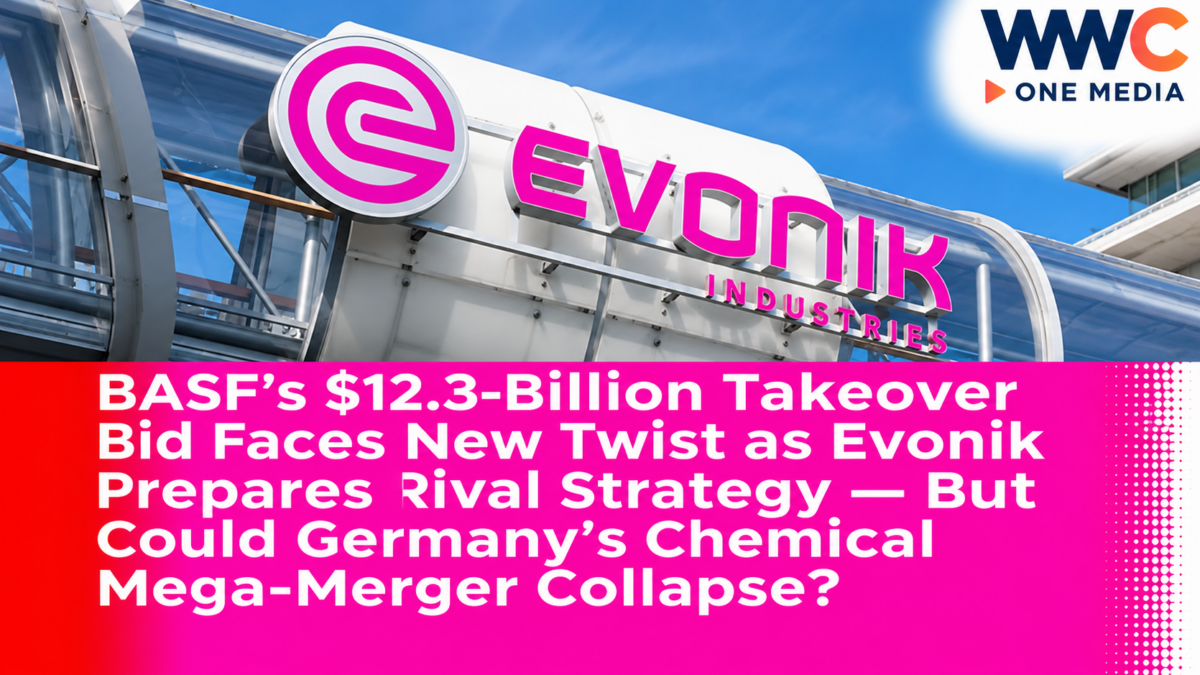
Germany’s chemical industry is approaching a potentially decisive moment as specialty chemicals producer Evonik Industries reportedly prepares to present its medium-term business strategy to rival BASF, the industrial giant seeking to acquire the company in a takeover proposal worth more than €11 billion.
According to Bloomberg’s November 6 report, executives from the two German companies are expected to meet over the weekend to discuss Evonik’s plans for increasing shareholder value.
The reported talks follow Evonik’s rejection of BASF’s improved takeover approach, valued at approximately €24 per share, or €11.18 billion ($12.3 billion).
But the planned meeting does not necessarily mean that merger negotiations are beginning.
Evonik has publicly maintained that it wants to remain independent and implement its own restructuring and growth strategy.
BASF, meanwhile, believes combining the two businesses could create a stronger German chemicals company capable of competing against increasingly powerful producers in Asia and the Middle East.
The disagreement places two of Germany’s best-known industrial groups at the center of a high-stakes battle over corporate control, profitability and the future of European manufacturing.
Will Evonik convince BASF that it can create more value as an independent company—or could the meeting become the turning point in a multibillion-dollar takeover battle?
Evonik and BASF Expected to Meet After Takeover Rejection
Bloomberg reported on November 6 that executives of Evonik Industries AG are preparing to outline new medium-term objectives during a meeting with BASF SE representatives.
The report cited people familiar with the matter.
Evonik’s leadership is expected to explain why it believes its independent strategy can deliver substantial improvements in profitability and shareholder returns.
The prospective discussions follow the company’s formal announcement on October 30 that it would not enter takeover negotiations based on BASF’s existing proposal.
However, Evonik left open the possibility of a confidential exchange of information.
That distinction is central to understanding the latest development.
A confidential discussion allows management teams to explain their positions.
Formal takeover negotiations involve working toward potential transaction terms.
The two processes are not equivalent.
As of November 7, no completed weekend meeting, revised binding offer or agreed merger has been independently confirmed.
BASF’s €24-a-Share Offer Values Evonik Above €11 Billion
BASF’s interest in Evonik first became public in September.
The companies confirmed exploratory contact concerning a potential takeover.
Subsequent reporting indicated that BASF had initially proposed approximately €22.15 per share.
After its approach failed to secure support, BASF reportedly improved its proposal to around €24 per share in October.
That valued Evonik’s equity at approximately €11.18 billion.
According to Reuters and Bloomberg, Evonik nevertheless declined to enter formal negotiations.
The company said it had reviewed BASF’s letter dated October 22 and concluded that the available information did not justify beginning takeover talks.
BASF believes there is strategic and financial logic behind a combination.
But chief executive Markus Kamieth has made clear that the company is unwilling to pursue a transaction at any price.
That creates a difficult situation for both management teams.
BASF must demonstrate that a merger would produce enough additional value to justify the purchase price.
Evonik must show that remaining independent can deliver attractive returns without exposing shareholders to unnecessary risk.
Evonik Unveils 2029 Strategy to Defend Its Independence
Evonik’s strongest argument is its own medium-term restructuring plan.
During its November 3 earnings presentation, interim chief executive Claus Rettig outlined an ambition to achieve a return on capital employed of approximately 11% by 2029.
That represents a substantial improvement from the 6.1% recorded in 2025.
Return on capital employed, or ROCE, measures how efficiently a business generates operating profit from the capital invested in its operations.
A higher return can indicate more productive use of factories, equipment, working capital and other business resources.
Evonik expects to improve its results by simplifying its portfolio, increasing efficiency and concentrating investment in more attractive specialty markets.
The company believes these measures can create substantial shareholder value without surrendering corporate independence.
However, the 11% objective remains a future target.
It is not a profitability level Evonik has already achieved.
Whether the plan succeeds will depend on market demand, cost reductions, investment decisions and operational performance.
Third-Quarter Profit Jumps 40% as Evonik Makes Its Case
Evonik enters the discussions with improving operating results.
On November 3, the company reported third-quarter adjusted earnings before interest, taxes, depreciation and amortization of €629 million.
That represented a 40% increase from the same period in 2025.
Revenue increased 13%, supported by stronger pricing and a modest improvement in sales volumes.
Free cash flow reached €369 million during the quarter.
For the first nine months of 2026, free cash flow totaled approximately €601 million.
Evonik also expects full-year adjusted EBITDA to finish in the upper half of its €2 billion to €2.2 billion guidance range.
These improvements strengthen management’s argument that its current strategy is delivering results.
But the company’s financial picture is not uniformly positive.
Evonik recorded a third-quarter net loss of €53 million, partly reflecting substantial restructuring expenses.
The difference between adjusted operating earnings and net income is important.
A company can report improving adjusted EBITDA while still recording accounting losses after restructuring charges and other expenses.
Investors therefore need to evaluate the complete financial statements rather than rely on a single performance measure.
Evonik’s Restructuring Could Eliminate 3,200 Jobs
The company’s independence strategy carries significant consequences for employees.
Evonik has extended its Evonik Tailor Made efficiency program through 2029.
The program is expected to eliminate approximately 3,200 positions worldwide.
The company has also announced site closures and reductions in staffing.
According to ICIS, more than 700 positions had already been eliminated during 2026 as of the November earnings call.
The restructuring reflects wider pressure on Europe’s chemicals industry.
High energy costs, competition from overseas producers and changing demand have made some manufacturing operations less profitable.
Evonik wants to create a smaller, more focused business that generates stronger returns from its capital.
But cost-cutting alone cannot guarantee long-term success.
The company must also grow revenue, introduce new products and compete effectively in higher-value markets.
That tension between job reductions and future investment is likely to feature in any discussion of the company’s strategic options.
BASF Promises Job Protection if a Merger Goes Ahead
BASF has attempted to make its takeover proposal more attractive to Evonik employees and stakeholders.
Chief executive Markus Kamieth has argued that a combination would strengthen German chemicals manufacturing and help protect industrial employment.
BASF says it would honor existing site agreements and collective bargaining arrangements.
The company has also discussed commitments intended to prevent compulsory redundancies through 2032.
These promises are conditional on a transaction occurring and the relevant commitments being implemented.
They are not evidence that BASF has already acquired Evonik or taken responsibility for its workforce.
Kamieth has also emphasized the importance of preserving research, development and management functions in North Rhine-Westphalia.
The region is home to Evonik’s headquarters in Essen and major chemical manufacturing facilities.
For local employees and policymakers, the future of these operations is an important part of the takeover debate.
Why BASF Wants to Acquire Evonik
BASF is one of the world’s largest chemical producers.
Its businesses supply raw materials and industrial products used in automotive manufacturing, agriculture, electronics, construction and numerous other industries.
Evonik specializes in higher-value chemicals and additives used in products ranging from coatings and consumer goods to advanced materials and nutrition.
A combination could potentially create opportunities involving production efficiency, supply chains and product development.
BASF operates major integrated manufacturing facilities where materials produced by one operation can be used by another.
That structure may provide cost advantages if Evonik’s businesses can make greater use of BASF’s existing manufacturing network.
The potential transaction could also strengthen BASF’s specialty chemicals portfolio.
However, the commercial benefits are not guaranteed.
Integration costs, operational complexity and regulatory scrutiny could reduce the value of any projected savings.
BASF would need to demonstrate that a merger creates more shareholder value than its purchase price and implementation costs.
RAG-Stiftung Holds the Key to the Takeover
Evonik’s ownership structure creates another significant obstacle.
Its largest shareholder, RAG-Stiftung, holds approximately 43% of the company.
The German foundation has responsibilities connected to the long-term financial obligations of the former coal-mining industry.
These include funding continuing environmental and safety-related commitments.
The foundation’s large ownership position gives it substantial influence over Evonik’s future.
A potential takeover would therefore require careful consideration of its interests.
For RAG-Stiftung, the decision would not be based exclusively on whether the offer provides a premium to the current share price.
It would also involve the long-term value of its holdings and its ability to meet financial obligations.
Without sufficient shareholder support, BASF could face considerable difficulty completing a takeover.
Asset Sales Form Another Part of Evonik’s Plan
Evonik is also considering significant changes to its business portfolio.
Management is progressing with plans to divest Oxeno, its C4 chemicals business.
The company expects to identify a buyer in the coming months.
It is also preparing a possible sale of Syneqt, the business associated with infrastructure services at the Marl and Wesseling chemical parks.
Evonik intends to redirect capital toward areas it believes offer stronger growth.
These include additives, biotechnology, specialty ingredients and advanced materials.
The company believes a more focused portfolio can improve profitability and reduce capital requirements.
However, divestitures can create difficult trade-offs.
Selling businesses may generate cash and simplify operations.
But it can also reduce revenue and change the company’s industrial footprint.
BASF has suggested it might approach the Syneqt facilities differently if a takeover were completed.
That disagreement is part of the broader debate over which company can offer the most attractive future for Evonik’s operations.
Europe’s Chemical Industry Faces a Wider Restructuring Crisis
The potential BASF-Evonik combination comes during a challenging period for European chemical manufacturers.
Companies face pressure from energy costs, international competition, environmental requirements and changing global demand.
Producers in China and the Middle East have expanded capacity in several industrial chemical markets.
European companies must therefore decide whether to consolidate, invest in more specialized products or reduce exposure to less profitable businesses.
The pressure is not limited to Germany.
As WWC ONE MEDIA reported on Brazilian petrochemical producer Braskem’s multibillion-dollar financial restructuring, chemical producers in other regions also face difficult decisions involving capital, debt and long-term competitiveness.
Braskem’s debt crisis is separate from the BASF-Evonik takeover proposal.
Evonik is not in the same reported financial position, and the German company has not announced bankruptcy proceedings.
The comparison highlights the capital-intensive nature of the global chemicals business and the importance of sustainable profitability.
Industrial Investment Decisions Are Changing Across Europe
The pressure on German chemical producers also reflects broader challenges facing European manufacturers.
Companies are reassessing where to build factories, how much capital to commit and which businesses offer attractive long-term returns.
As WWC ONE MEDIA reported on Onsemi’s cancellation of a proposed $2-billion semiconductor expansion in the Czech Republic, industrial investment plans can change when market demand or strategic priorities shift.
The semiconductor and chemicals industries have different production structures and investment cycles.
But both require substantial capital and must respond to changing global competition.
For Evonik, the strategic question is whether internal restructuring can deliver sufficient returns.
For BASF, it is whether acquiring an established specialty chemicals business offers better value than investing in its existing operations.
Asian Competition Adds Pressure on German Manufacturers
German industrial companies are also competing more directly with large Asian producers.
China’s manufacturing scale and investment in advanced industrial supply chains have increased competition across several sectors.
As WWC ONE MEDIA examined in its coverage of SK hynix’s proposed $45-billion US semiconductor expansion, industrial investment decisions are increasingly shaped by international competition, technology requirements and geopolitical risks.
The semiconductor project is not directly related to BASF’s takeover proposal.
However, both developments demonstrate why large manufacturers are reconsidering how they allocate capital across regions.
BASF argues that greater scale could help German chemical producers compete internationally.
Evonik argues that specialization and improved capital efficiency can deliver stronger results independently.
Investors must decide which strategy offers the more credible path to long-term value.
What the Takeover Battle Means for the Philippines
A BASF-Evonik combination could also attract attention from businesses in the Philippines.
Both companies operate internationally and supply industrial materials used in manufacturing, agriculture, coatings, consumer products and other sectors.
Their strategic decisions can influence global product portfolios, investment priorities and commercial relationships.
A merger could eventually lead to changes in distribution networks, supply arrangements or product development.
But those outcomes are hypothetical.
No completed takeover has been announced, and no specific change to Philippine operations has been confirmed.
For Philippine businesses, the immediate significance is the broader trend toward industrial restructuring.
International suppliers are trying to improve profitability while managing rising costs and competition.
Local manufacturers that depend on imported specialty materials may benefit from monitoring supplier strategies and maintaining dependable sourcing arrangements.
However, it would be premature to claim that the reported weekend meeting will cause price increases, shortages or layoffs in the Philippines.
Three Possible Outcomes for the BASF-Evonik Takeover
Scenario 1: Evonik remains independent.
Management could convince shareholders that its 2029 strategy will create greater value than BASF’s existing proposal.
The company would continue restructuring, pursuing divestitures and concentrating on its specialty businesses.
Scenario 2: BASF improves its proposal.
If BASF believes the strategic benefits justify a higher price or stronger commitments, it could return with revised terms.
That might encourage Evonik’s board and major shareholders to reconsider negotiations.
However, BASF has explicitly stated that it will not pursue a transaction at any price.
Scenario 3: The companies explore limited cooperation.
The businesses could identify areas of possible commercial cooperation without agreeing to a full takeover.
This is a potential outcome, not an announced plan.
Whether any cooperation develops would depend on commercial considerations and applicable competition rules.
The Bigger Question: Can Evonik Create More Value Alone?
The reported weekend meeting could become an important moment in Germany’s chemical-industry restructuring.
BASF has made a multibillion-euro approach and argues that a combined business would be more competitive.
Evonik has rejected formal takeover negotiations and insists that its own strategy can deliver stronger shareholder returns.
The specialty chemicals producer has outlined a clear financial ambition: approximately 11% return on capital employed by 2029.
Its recent earnings performance gives management an argument for remaining independent.
But achieving that goal will require continued operational improvements, portfolio changes and difficult restructuring decisions.
BASF must decide whether the potential benefits of a merger justify pursuing a company whose management remains resistant.
Shareholders must assess the relative value of immediate takeover consideration and possible future returns.
Employees and regional policymakers will be watching the consequences for German industrial jobs.
As of November 7, BASF has not secured Evonik’s agreement to a takeover, and the reported weekend meeting has not been independently confirmed as completed.
Yet the strategic battle is already reshaping expectations for Germany’s chemicals industry.
And with more than €11 billion potentially at stake, one question could determine the next chapter: Will Evonik’s improving profits and ambitious 2029 strategy persuade BASF to walk away—or could the two German giants ultimately discover that combining forces is their best chance of surviving the next wave of global industrial competition?