
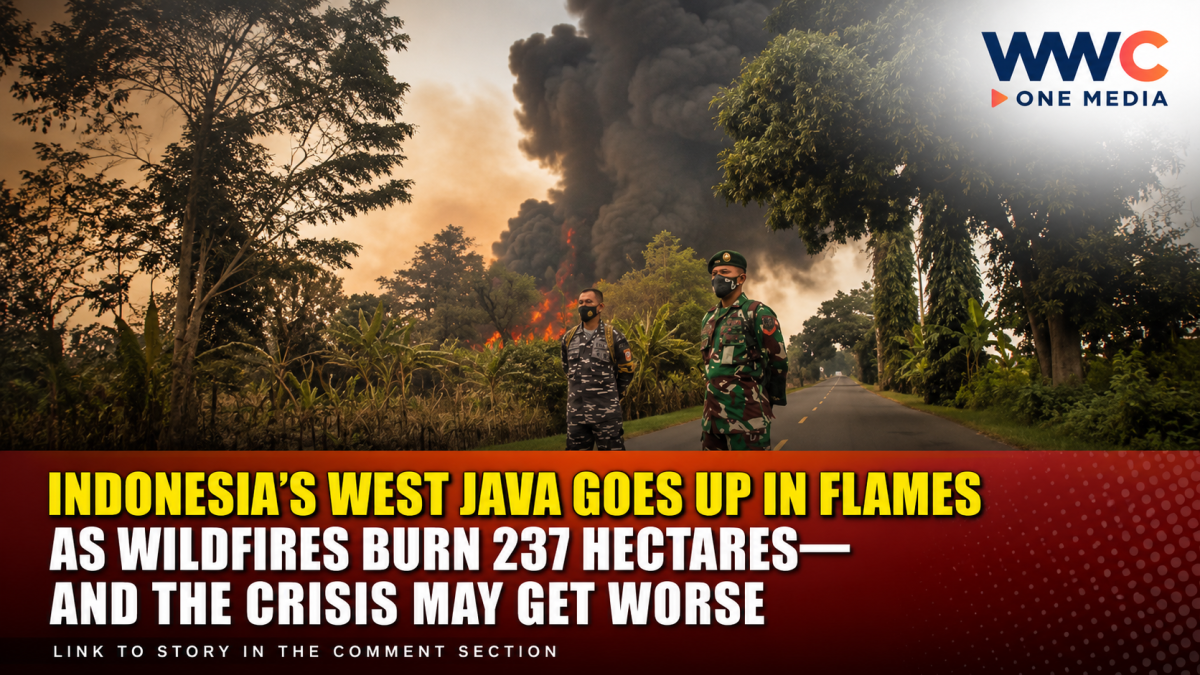
WEST JAVA, INDONESIA — Indonesia’s wildfire crisis is intensifying as forest and land fires in West Java have burned at least 237 hectares, with authorities recording 168 separate fire incidents across the province.
The latest figures, reported as of Thursday, Sept. 3, show that the fires have affected 186 subdistricts spanning 21 districts and cities. Despite the scale of the fires, authorities reported that no residents had been injured as of the latest update.
The situation has been particularly serious in Sumedang Regency, which recorded the highest number of fire incidents at 22.
The latest figure represents a continued increase from the 228.07 hectares of forest and land that had been reported burned across West Java as of Aug. 31, according to the West Java Regional Disaster Management Agency. At that time, authorities had documented 156 fire incidents affecting 178 villages or urban wards in 107 subdistricts.
Prolonged dry season raises the danger
Authorities and climate experts are confronting a dangerous combination of extremely dry conditions and El Niño, which has helped create an environment in which vegetation can ignite more easily and fires can spread rapidly.
West Java Governor Dedi Mulyadi previously ordered temporary closures of mountain hiking areas as authorities sought to reduce the risk of human-caused fires. Officials warned that campfires and discarded cigarette butts could become ignition sources during the dry season.
The problem, however, extends far beyond West Java.
Indonesia recorded nearly 95,000 hectares of land burned in July alone, while the Forestry Ministry estimated that roughly 202,000 hectares nationwide had burned by the end of July.
Reuters reported that the country has been experiencing an exceptionally severe fire season, with thousands of hotspots detected in August. The combination of extreme dryness, heat and human activity has made containing the fires increasingly difficult.
Fire crisis puts wildlife and communities at risk
The environmental consequences are also becoming increasingly visible.
In Indonesia’s West Kalimantan province, an adult male orangutan found in Ketapang Regency was reported to have died after being exposed to thick wildfire smoke for days. A necropsy found pathological changes affecting several organs, including the lungs, heart and kidneys, which authorities said were suspected to be associated with smoke exposure.
Reuters also reported the rescue of another orangutan, named Sampurna, from a fire-affected area in Ketapang. The animal was suffering from respiratory distress believed to be linked to smoke inhalation and was being treated before transfer to a rehabilitation facility.
Smoke becomes a wider public-health threat
The fires are no longer simply an environmental problem.
By early September, hazardous haze had become serious enough in parts of Indonesia to disrupt education. Reuters reported that about 1.4 million students across six provinces were shifted to remote learning because of dangerous air quality associated with forest and land fires.
Indonesia has also been deploying firefighting aircraft and other resources to contain the fires. Reuters reported that authorities have used aerial water bombing and cloud-seeding efforts, although operations have been complicated by smoke, dry conditions and limited water availability.
Authorities are also examining the role of companies in the broader wildfire crisis. Reuters reported that Indonesia was inspecting 19 companies whose concession areas contained fires covering a combined 11,047 hectares, while satellite data had identified additional high-risk concession areas.
The bigger warning behind West Java’s 237 hectares
The 237 hectares burned in West Java represent only a fraction of Indonesia’s nationwide fire emergency.
What makes the latest development especially concerning is the timing. Indonesia’s forestry minister has warned that controlling the fires could become more difficult as El Niño reaches its peak, while officials have also stressed that many fires are linked to human activities.
For West Java, the rapid increase from 228.07 hectares at the end of August to at least 237 hectares by Sept. 3 underscores how quickly conditions can deteriorate.
And with dry weather continuing to create favorable conditions for fires, authorities face a race against time to prevent additional forests, farmland and wildlife habitats from being consumed.
For now, no resident injuries have been reported in West Java—but the expanding fire footprint and Indonesia’s wider wildfire emergency are keeping authorities on high alert.




Leave a Reply