
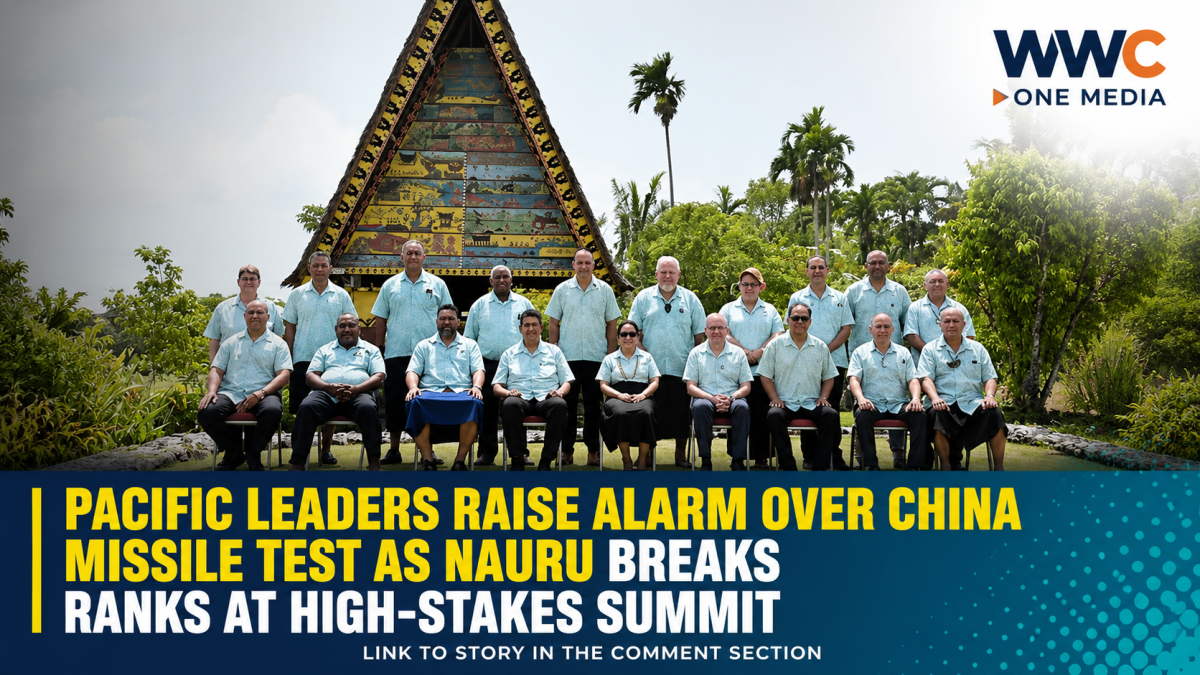
KOROR, PALAU — Pacific Island leaders have expressed collective concern over China’s recent intercontinental ballistic missile test in the Pacific, exposing fresh divisions within one of the world’s most strategically important regions as geopolitical competition between Beijing and Western allies intensifies.
At the Pacific Islands Forum summit in Palau, leaders called for greater transparency and advance warning for future missile tests after China’s July launch passed over or near parts of the Pacific with what regional leaders said was insufficient notice.
But the statement fell short of a unanimous condemnation.
Nauru formally dissented, highlighting the increasingly complex political divisions among Pacific nations as China expands its diplomatic and strategic influence across the region.
Pacific Leaders Demand More Transparency
Palau President Surangel Whipps Jr., host of the summit, said leaders agreed that countries conducting intercontinental ballistic missile tests should provide greater reassurance and transparency.
The forum called for advance notification of missile tests of at least 24 hours, in line with international practice, according to statements made following the leaders’ retreat.
The concern stemmed from China’s July ICBM test, described as Beijing’s first known ballistic missile launch into the Pacific since September 2024. Regional leaders said the missile’s trajectory affected several Pacific island nations and that the warning provided was inadequate.
Nauru Breaks From the Regional Position
The biggest political surprise came when Nauru dissociated itself from the summit’s position.
The dissent is particularly notable because Pacific Islands Forum decisions have traditionally relied heavily on consensus.
Nauru strengthened its relationship with Beijing after switching diplomatic recognition from Taiwan to China in 2024. Its position at the summit has therefore drawn attention amid wider concerns about how great-power competition is influencing political relationships among Pacific nations.
New Zealand Prime Minister Christopher Luxon nevertheless downplayed the significance of the disagreement, arguing that Nauru’s dissent should not prevent the overwhelming majority of Pacific nations from expressing their concerns.
The Summit Stopped Short of Directly Condemning China
Despite strong concern among many leaders, the final position was more cautious than some Pacific governments had initially hoped.
The forum expressed concern and called for transparency but stopped short of issuing a direct, unanimous condemnation of Beijing.
That distinction matters.
The Pacific Islands Forum represents a region increasingly caught between competing global powers. While many governments are concerned about militarisation, they are also reluctant to become openly aligned with either China or Western powers.
The result was a carefully worded compromise: a strong demand for future transparency without a unanimous direct rebuke of Beijing.
Taiwan Dispute Overshadowed the Gathering
The missile controversy was only one part of a much larger geopolitical struggle unfolding at the summit.
The meeting in Palau was also overshadowed by China’s objections to Taiwan’s participation.
Palau remains one of the few countries that maintains formal diplomatic relations with Taiwan, making it a particularly sensitive venue for the regional gathering.
Beijing, which claims Taiwan as its territory, has repeatedly opposed Taipei’s involvement in international forums. Taiwan’s presence at the Pacific Islands Forum triggered renewed diplomatic tension, with China warning of possible consequences and accusing Taiwan-related participation of undermining regional arrangements.
Taiwan, meanwhile, accused Beijing of attempting to interfere with regional unity.
Why the Pacific Has Become a Global Battleground
The Pacific may appear geographically remote, but it has become one of the world’s most important geopolitical arenas.
Its vast waters cover critical shipping routes and contain strategically important territory stretching between Asia and the Americas.
China has expanded its diplomatic, economic and infrastructure relationships throughout the Pacific, while the United States, Australia, New Zealand and their allies have increased efforts to strengthen their own partnerships.
For smaller Pacific nations, the challenge is balancing outside relationships without allowing the region to become a battleground for major powers.
That tension was visible throughout the summit.
Pacific leaders continue to insist that their priority is regional stability and sovereignty—not choosing sides in a geopolitical rivalry. Yet the disagreement over China’s missile test demonstrated just how difficult maintaining a united position has become.
China Pushes Back Against Criticism
Beijing has rejected suggestions that its missile test represented a threat to Pacific nations.
Chinese officials have accused Palau of exaggerating concerns surrounding the launch and argued that the test was conducted safely.
But Palau’s leadership has maintained that the issue is not simply about one missile.
For Pacific nations, the larger concern is whether major military powers respect the sovereignty and security concerns of smaller countries when conducting military activities across their region.
A Crack in Pacific Unity?
The disagreement over the missile test may ultimately be more significant than the statement itself.
The Pacific Islands Forum has long emphasized unity, particularly when confronting issues such as climate change, economic vulnerability and regional security.
But China-related issues are increasingly testing that unity.
A previous meeting of Pacific foreign ministers reportedly failed to reach agreement on a collective statement regarding the missile launch. The leaders’ summit eventually produced a majority position—but not full consensus.
Kiribati’s leadership was also absent from the decisive leaders’ retreat, further complicating the diplomatic picture, according to reporting from the summit.
The Bigger Message Behind the Missile Debate
The controversy is about far more than a single missile launch.
It represents a fundamental question confronting the Pacific:
Can small island nations maintain an independent regional voice while global superpowers compete for influence around them?
For Palau and other Pacific leaders, the answer appears to depend on unity and transparency.
For Nauru, dissenting from the regional position demonstrated that national interests can sometimes outweigh collective consensus.
And for China, the episode shows that its growing presence in the Pacific is being watched increasingly closely.
The summit’s final message may not have been a direct condemnation, but it was still politically significant.
Pacific leaders have made clear that they do not want major powers treating their ocean as an unrestricted testing ground.
The Pacific’s message was cautious—but unmistakable: the region wants a seat at the table when decisions affecting its security are made.
WWC ONE MEDIA J.M.D




Leave a Reply