BRUSSELS / WASHINGTON / KYIV / MANILA — November 7, 2026 | WWC ONE MEDIA | World News, Geopolitics, NATO and Russia-Ukraine War
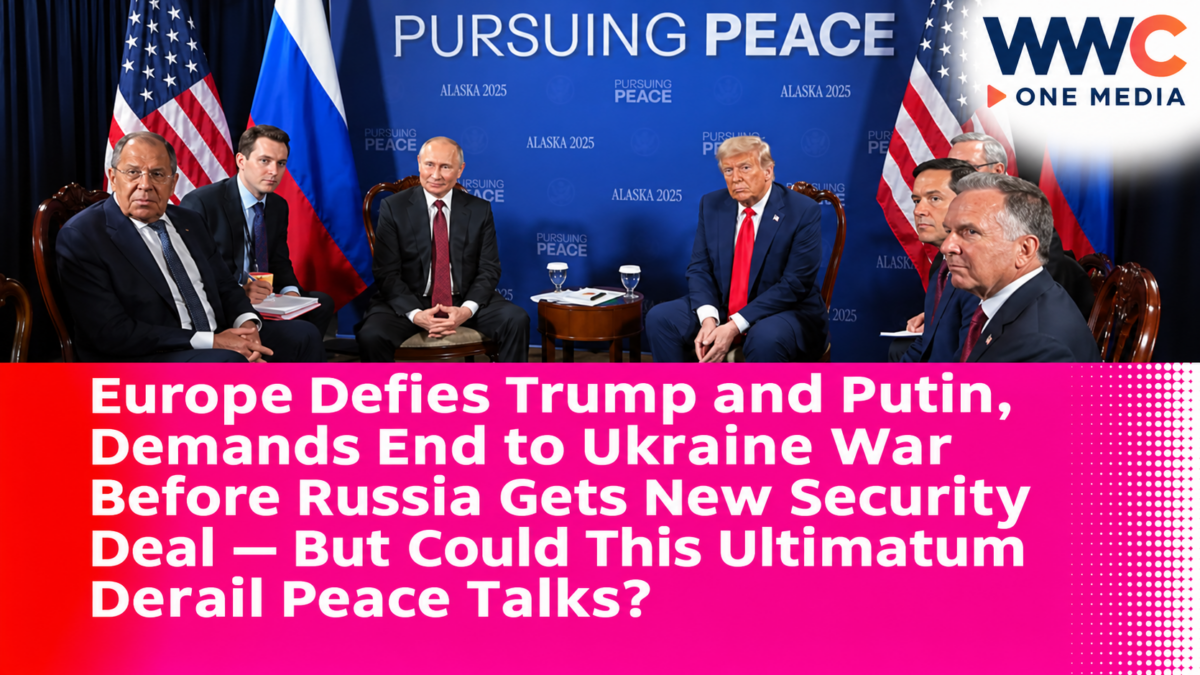
Europe is drawing a firm line against Russian President Vladimir Putin as a new American diplomatic initiative threatens to reshape the security balance across the continent.
European governments are insisting that Moscow must end its war against Ukraine before they will consider negotiations over Russia’s demands for sweeping changes to Europe’s security arrangements.
The position could create a serious disagreement with US President Donald Trump, whose administration is exploring a broader settlement that would address not only the war in Ukraine but also security concerns raised by Russia.
According to Bloomberg’s November 6 report, European officials believe negotiating major changes to NATO’s security framework while Russian forces continue fighting in Ukraine would risk undermining the very system designed to protect the continent from military aggression.
The disagreement comes as Washington prepares to restart negotiations between Russia and Ukraine in Abu Dhabi next week.
Trump has suggested that a potential agreement could extend far beyond Ukraine and involve the security arrangements of Europe as a whole.
But European leaders are pushing back.
Their message is clear: Russia cannot be allowed to dictate Europe’s military and security future while continuing its invasion of Ukraine.
The confrontation creates another obstacle for Trump’s effort to deliver a negotiated settlement.
Can Washington persuade Moscow to end the fighting without accepting demands that European governments consider unacceptable—or could the proposed peace deal expose a widening division between the United States and its NATO allies?
Europe Demands an End to the War Before Security Concessions
The latest disagreement centers on the order in which peace negotiations should proceed.
European officials want Russia to stop its military operations against Ukraine before broader discussions take place over Moscow’s security demands.
According to Bloomberg, officials familiar with the talks believe it would be inappropriate to negotiate changes to Europe’s defense system while Russia continues violating existing international agreements and pursuing military operations in Ukraine.
The approach reflects a fundamental concern.
European governments believe the continent’s existing security arrangements—including NATO’s collective-defense commitments—are essential to preventing further Russian aggression.
Accepting restrictions on those arrangements before the war ends could weaken European deterrence without delivering a durable peace.
EU foreign policy chief Kaja Kallas reinforced that position during a November 6 appearance in Warsaw.
Kallas argued that Europe already has a security architecture and that the central problem is Russia’s repeated violation of the commitments supporting it.
She also insisted that Putin does not possess veto power over European security decisions.
Her comments were supported by Polish Foreign Minister Radosław Sikorski and Ukrainian Foreign Minister Andrii Sybiha.
The officials emphasized that the future security of Ukraine and Europe cannot be determined through negotiations that exclude the countries most directly affected.
The position does not mean Europe refuses all diplomatic engagement with Russia.
Rather, European leaders are challenging the idea that Moscow should obtain major concessions over NATO’s posture before ending the war.
Trump Proposes a Much Bigger Deal Involving All of Europe
The diplomatic dispute intensified after Trump publicly discussed the possibility of a sweeping agreement involving Russia, Ukraine and the wider European security order.
On November 5, the US president suggested that Washington could pursue an arrangement going beyond a ceasefire in Ukraine.
His comments followed a meeting with Kirill Dmitriev, a senior Russian investment official who also serves as a Kremlin envoy.
Trump described the potential agreement in expansive terms but did not provide a detailed framework.
His adviser and son-in-law Jared Kushner subsequently outlined Washington’s interest in addressing broader European security concerns.
Kushner argued that an enduring settlement should attempt to reduce the risk of future conflict by considering security concerns across the region.
The initiative reflects a different negotiating approach.
Instead of treating the Ukraine war and Europe’s security architecture as separate issues, Washington appears interested in discussing them as parts of a larger settlement.
Supporters of such an approach could argue that a comprehensive agreement might address longstanding tensions between Russia and NATO.
But European governments worry that this could give Moscow leverage over the security policies of countries that are not parties to the war.
The details of Washington’s proposed arrangement remain incomplete.
No finalized agreement has been announced.
And there is no verified evidence that NATO members have agreed to surrender their existing defense commitments.
Putin’s Demands Could Roll Back NATO’s Presence in Eastern Europe
The disagreement is rooted in Russian demands that predate the full-scale invasion of Ukraine in February 2022.
In December 2021, Moscow presented proposals seeking major changes to European security arrangements.
Those demands included restrictions on further NATO enlargement and limitations on Western military deployments in countries that joined the alliance after 1997.
If accepted in their broadest form, such restrictions could substantially alter NATO’s military posture in Eastern Europe.
Countries including Poland and the Baltic states have long viewed Russian military activity as a direct security concern.
For those governments, NATO membership provides an essential guarantee of collective defense.
The alliance’s Article 5 states that an armed attack against one member is considered an attack against all, subject to the treaty’s terms and each member’s response.
European governments have repeatedly rejected the idea that Russia should decide which countries may join NATO or where the alliance can maintain defensive capabilities.
They maintain that sovereign countries have the right to determine their own security arrangements.
Russia, by contrast, argues that NATO expansion and Western military infrastructure near its borders threaten its security.
The competing positions have remained central to diplomatic disputes for years.
The latest American proposal has revived this fundamental disagreement at a particularly sensitive moment in the war.
Ukraine Says Its Future Cannot Be Negotiated Behind Its Back
Ukraine has its own concerns about a settlement involving broader concessions to Russia.
President Volodymyr Zelenskyy has repeatedly argued that any peace agreement must provide credible guarantees against another Russian invasion.
Kyiv has opposed proposals that would force it to formally surrender sovereignty over occupied territory.
Ukrainian officials also want a direct role in negotiations affecting their country’s future.
Foreign Minister Andrii Sybiha reinforced that principle during the November 6 discussions in Warsaw.
He argued that European security should focus on protecting countries against future aggression rather than creating spheres of influence controlled by larger powers.
The concern is particularly important because Russia continues to occupy internationally recognized Ukrainian territory.
Moscow has also demanded that Ukraine accept significant territorial and strategic conditions as part of a settlement.
Kyiv regards several of those conditions as incompatible with its sovereignty.
The resulting disagreement extends beyond the immediate question of stopping military operations.
Even if both sides eventually agree to a ceasefire, they would still need to determine how security guarantees, territorial arrangements and future military deployments should work.
As WWC ONE MEDIA previously reported on the US plan to restart Russia-Ukraine negotiations in Abu Dhabi, the upcoming talks are expected to address security arrangements, de-escalation and possible steps toward ending the conflict.
But agreement on the format of negotiations does not mean agreement on the terms of peace.
Abu Dhabi Peace Talks Could Become a Critical Test
The next major diplomatic development is expected in Abu Dhabi.
American, Ukrainian and Russian representatives are preparing for renewed negotiations after earlier rounds failed to produce a comprehensive settlement.
Washington hopes to identify areas where the parties could reach agreement on military de-escalation, humanitarian measures and postwar security.
But the negotiations begin with major disagreements unresolved.
Russia wants its security demands acknowledged.
Ukraine wants protection against renewed aggression.
European governments want to preserve NATO’s defense architecture and prevent Moscow from obtaining a veto over regional security decisions.
The United States is attempting to find a framework capable of accommodating these competing priorities.
That task is extremely difficult.
A ceasefire could reduce immediate military casualties without resolving the underlying security dispute.
Conversely, attempting to negotiate an entirely new European security order before the fighting ends could make a near-term ceasefire harder to achieve.
That is the central dilemma facing Washington.
Should negotiators first focus on stopping the war, or should they attempt to resolve the broader disputes that helped fuel the conflict?
European officials favor ending the fighting before addressing Moscow’s proposed security concessions.
Washington is considering a more comprehensive diplomatic approach.
The two strategies are not necessarily impossible to reconcile, but they currently reflect different priorities.
Finland and Norway Have Already Opened a Channel to Putin
Despite Europe’s firm position, some European leaders have begun communicating directly with Moscow.
On October 27, Finnish President Alexander Stubb and Norwegian Prime Minister Jonas Gahr Støre held a roughly 90-minute telephone conversation with Putin.
The discussion represented a rare direct exchange between European leaders and the Russian president.
According to Reuters, Stubb and Støre urged Putin to de-escalate and end the war.
They later spoke with Zelenskyy, who welcomed efforts to establish additional diplomatic channels.
The Finnish and Norwegian leaders said their contacts had been discussed with allies and were intended to support the broader peace process.
However, they were not speaking as formally appointed representatives of all European governments.
The initiative generated mixed reactions.
Some leaders welcomed direct communication as necessary for diplomacy.
Others warned that fragmented contacts could weaken Europe’s negotiating position.
The Kremlin’s account indicated no meaningful change in Putin’s fundamental demands.
Russian officials continued insisting that any settlement must take Moscow’s interests into account.
A source close to the Kremlin also told Reuters that Russia remained unwilling to compromise on its objective of controlling the entire Donbas region.
That position remains unacceptable to Ukraine.
The episode illustrates how difficult meaningful diplomacy has become.
Europe is increasingly willing to speak with Putin, but it remains unwilling to accept his principal demands simply to secure a negotiating breakthrough.
NATO’s Future Is Emerging as a Major Obstacle
The North Atlantic Treaty Organization has become one of the central issues in the renewed peace initiative.
NATO was established in 1949 as a collective-defense alliance.
Its membership expanded after the Cold War to include several Central and Eastern European countries.
Russia has long objected to that expansion.
But NATO governments maintain that accession decisions belong to the alliance and the countries seeking membership.
For European officials, any proposal that would force NATO to withdraw forces from Eastern Europe or permanently restrict its future development would raise serious security concerns.
It could also affect the relationship between NATO members and the United States.
Washington is the alliance’s most powerful military participant.
A major disagreement between the US administration and European allies over NATO’s future could complicate planning and defense cooperation.
However, a diplomatic disagreement over negotiating priorities does not mean NATO has dissolved or that its collective-defense commitments have been suspended.
The alliance continues operating under its existing treaty framework.
The controversy concerns possible future arrangements that have not yet been agreed upon.
Russian Attacks Continue as Diplomats Discuss Peace
The negotiations are taking place while fighting continues across Ukraine.
Russian missiles and drones have repeatedly targeted Ukrainian cities and energy infrastructure.
The approaching winter has heightened concerns about electricity, heating and essential public services.
As WWC ONE MEDIA previously reported on Russia’s intensifying attacks against Ukraine’s power grid, strikes against generation facilities and transmission networks have increased the risk of blackouts and heating shortages.
Ukraine’s infrastructure has already suffered extensive damage during more than four years of full-scale war.
Repeated attacks can make repairs increasingly difficult.
Replacing large electrical equipment can take months, while restored facilities remain vulnerable to renewed strikes.
The continuing violence adds urgency to ceasefire negotiations.
It also strengthens Europe’s argument that immediate de-escalation should take priority over a sweeping revision of regional security arrangements.
European officials argue that discussing major concessions while attacks continue could reward military pressure.
Russia disputes Western characterizations of the conflict and maintains that its security concerns must be addressed.
These competing interpretations make the diplomatic process more difficult.
But the humanitarian consequences of continuing hostilities are not in dispute.
Civilians remain exposed to attacks, damaged infrastructure and prolonged uncertainty.
Europe’s Next Concern: Can Ukraine Defend Itself During Negotiations?
Another unresolved issue is whether Ukraine will receive sufficient military support while negotiations continue.
Kyiv has repeatedly requested additional air-defense systems and interceptors to protect population centers and infrastructure.
Those systems are especially important during periods of intensified missile and drone attacks.
The United States and European allies have been coordinating equipment purchases and deliveries.
As WWC ONE MEDIA reported on Washington’s renewed NATO funding push for Ukraine’s weapons, the administration has sought additional allied contributions to help finance American-made military equipment for Kyiv.
The issue is closely connected to peace negotiations.
Ukraine’s leaders argue that credible defensive capabilities are necessary both during the conflict and after any ceasefire.
European governments share concerns that an agreement lacking enforceable guarantees could leave Ukraine vulnerable to renewed attacks.
Moscow, meanwhile, has objected to security arrangements it views as expanding Western military influence.
That creates another dilemma.
Ukraine wants enough military strength to deter another invasion.
Russia wants assurances limiting the security threat it says NATO presents.
Both positions are central to their respective negotiating strategies.
Finding an arrangement acceptable to both sides remains one of the greatest challenges to achieving a lasting settlement.
What the Dispute Means for Global Energy Markets
The Russia-Ukraine war continues to influence global energy markets.
Russia is a major producer and exporter of crude oil, natural gas and petroleum products.
Sanctions, shipping restrictions and attacks on energy infrastructure can disrupt international supplies.
Ukraine has also targeted Russian oil refineries and related facilities as part of its strategy to weaken Moscow’s war-supporting economy.
As WWC ONE MEDIA examined in its report on Russian fuel shortages despite the country’s enormous oil reserves, disruptions to refinery operations can create shortages even in countries that produce substantial quantities of crude oil.
A credible peace agreement could reduce some geopolitical risk affecting energy trade.
It might also create a framework for discussing sanctions relief.
But a ceasefire would not automatically remove existing sanctions or restore all interrupted energy flows.
Those changes would require separate political, legal and commercial decisions.
For energy-importing economies such as the Philippines, the diplomatic outcome could matter through changes in oil prices, shipping costs and global inflation.
However, the effects would depend on the actual terms of any agreement and wider market conditions.
What the Disagreement Means for the Philippines
The European position also carries implications for countries concerned about international law, territorial sovereignty and regional security.
The Philippines has its own interests in maintaining international rules that protect the territorial rights of states.
Although the circumstances in Eastern Europe and the Indo-Pacific differ substantially, both regions raise questions about how smaller and middle-sized countries navigate competition among major powers.
A negotiated settlement that protects Ukraine’s sovereignty and provides credible security guarantees could reinforce confidence in international commitments.
An arrangement perceived as granting territorial or strategic concessions under military pressure could raise concerns among other countries.
The Philippines also maintains longstanding relationships with the United States and European partners.
Major shifts in American security policy could influence international defense priorities and diplomatic cooperation.
But no specific change to US-Philippine security commitments has been announced as a result of the latest European disagreement.
The more immediate economic effects would likely involve global energy prices and investor sentiment.
For Filipino households and businesses, those developments could influence transportation costs, imported fuel expenses and broader inflationary pressures.
Three Possible Outcomes for Trump’s Peace Initiative
The next stage of negotiations could produce several different scenarios.
Scenario 1: Russia agrees to meaningful de-escalation.
A reduction in attacks or a broader ceasefire could create conditions for more substantial negotiations over Ukraine’s long-term security.
This would be closer to Europe’s preferred sequence.
Scenario 2: Washington continues pursuing a comprehensive settlement.
The US administration could attempt to negotiate ceasefire terms and broader European security arrangements together.
This might produce a more ambitious framework, but only if Ukraine and European governments accept their roles and the terms.
Scenario 3: Fundamental disagreements prevent a breakthrough.
Russia could maintain demands that NATO and Ukraine consider unacceptable.
The parties might continue diplomatic contacts without reaching an enforceable agreement.
Under that scenario, military operations and political tensions could continue.
None of these outcomes is guaranteed.
The next meetings will provide evidence of whether the parties are moving toward substantive compromises or simply repeating established positions.
The Bigger Question: Can Trump End the War Without Splitting the West?
The latest diplomatic dispute has revealed a difficult reality.
Trump wants a major agreement capable of ending Russia’s war against Ukraine and reshaping the wider relationship between Moscow and the West.
Putin continues to seek recognition of Russia’s security demands.
Ukraine wants a settlement that preserves its sovereignty and protects it from another invasion.
European leaders insist that Russia must end the war before they consider major concessions affecting the continent’s defense arrangements.
Those positions are not easily reconciled.
A negotiated settlement will require more than diplomatic announcements.
It will require meaningful concessions, enforceable commitments and agreement among the governments expected to implement its terms.
For Washington, excluding Europe from decisions about European security would create serious obstacles to implementation.
For Moscow, refusing to alter its central demands could make a settlement impossible.
For Ukraine, accepting weak guarantees could leave the country exposed to renewed conflict.
Europe is not rejecting peace. It is rejecting the idea that Russia should receive sweeping security concessions while its war against Ukraine continues.
That distinction now sits at the center of the latest disagreement with Washington.
As diplomatic preparations continue for the Abu Dhabi negotiations, the fundamental question remains unresolved.
Can Donald Trump secure a peace deal that satisfies Ukraine, protects NATO and persuades Putin to stop fighting—or could his attempt to rewrite Europe’s security rules create an even deeper divide between America and its closest allies?