HOUSTON, TEXAS / WASHINGTON, D.C. / MANILA, PHILIPPINES — November 7, 2026 | WWC ONE MEDIA | US Politics, Immigration Enforcement, Texas Elections and Public Safety
A dramatic political shift in Texas is already changing how America’s fourth-largest city responds to federal immigration enforcement.
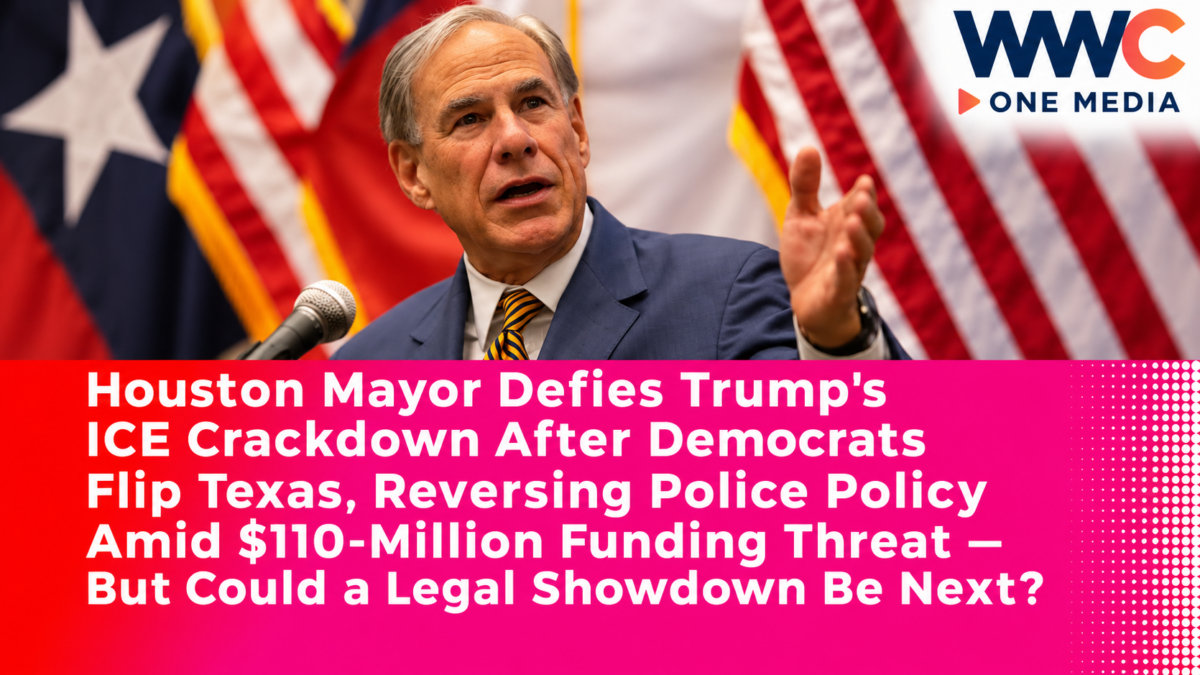
Houston Mayor John Whitmire signed an executive order on November 6 restricting when local police officers contact US Immigration and Customs Enforcement (ICE), reversing a controversial policy just three days after Democrats delivered a historic election defeat to Republican Governor Greg Abbott.
Under the new directive, Houston Police Department officers will generally no longer notify ICE merely because they discover an administrative immigration warrant during a routine encounter that does not result in an arrest.
Instead, officers will focus on individuals arrested for offenses punishable by jail time.
For immigrant families who have feared that ordinary encounters with local police could result in federal detention, the change could be significant.
For the Trump administration, it represents an early challenge to its aggressive immigration-enforcement policies following the November 3 midterm elections.
And for Texas, it raises an unresolved legal question: can Houston maintain restrictions on local police cooperation with ICE without violating state law?
The political stakes are substantial.
Earlier in 2026, Abbott threatened to withhold approximately $110 million in public-safety funding after Houston officials attempted to reduce immigration-enforcement cooperation.
The city subsequently revised its approach.
Now Abbott has lost reelection, and Democrat Gina Hinojosa is preparing to become Texas governor.
Whitmire says the election has created an opportunity to change course.
But while Houston’s new policy could provide relief to immigrant communities, its future may depend on whether state and federal officials accept the limits—or launch another legal and political confrontation.
Houston Mayor John Whitmire Announces a Major ICE Policy Reversal
The new directive was announced during a November 6 news conference attended by Whitmire and Houston Police Chief J. Noe Diaz.
Whitmire said his objective was to reduce fear across Houston while preserving the police department’s responsibility to protect residents.
He also directly acknowledged the impact of the election.
“Elections matter,” Whitmire said.
The mayor’s decision reverses instructions issued earlier in the year that required officers to contact immigration authorities when they encountered people with administrative ICE warrants.
Those earlier instructions had generated criticism from immigrant-rights organizations and local officials concerned about the relationship between Houston police and federal enforcement.
The new policy is narrower.
Police will continue handling criminal offenses.
They may also contact ICE when a person is arrested for an offense punishable by jail and has an administrative immigration warrant.
But ordinary encounters that result only in a citation or warning will not automatically produce an ICE notification solely because of an immigration warrant.
The distinction is central to understanding the announcement.
Houston is limiting specific forms of police cooperation—not declaring that federal immigration law no longer applies within the city.
What Changes During a Routine Traffic Stop?
The most immediate effect concerns minor traffic violations.
Under the revised policy, an officer who stops a driver for a non-jailable traffic offense may issue a citation or warning and allow that person to leave.
The officer will not contact ICE merely because a civil administrative immigration warrant appears during the encounter, provided the circumstances do not involve an arrest for a jailable offense.
Previously, police could notify federal immigration authorities after identifying such a warrant even when the person had not committed a separate offense requiring detention.
Houston Police Chief Diaz said the department had already distributed instructions implementing the new policy.
The change matters because administrative immigration warrants are different from warrants issued by judges in criminal proceedings.
An administrative warrant may be issued by federal immigration authorities in connection with civil immigration enforcement.
It does not automatically establish that the person has been convicted of a crime.
For immigrant families, the distinction can affect whether a routine traffic stop becomes a prolonged encounter involving federal officers.
But the directive does not provide immunity from immigration enforcement.
ICE retains its own federal authority, and local police must still comply with applicable legal requirements.
Democrats’ Texas Election Sweep Changes the Political Environment
The timing of Whitmire’s announcement was closely connected to the November 3 midterm elections.
Democrat Gina Hinojosa defeated Republican Governor Greg Abbott, ending decades of Republican control of the Texas governorship.
Hinojosa is set to become the state’s first Latina governor.
Democrats also scored major victories in other Texas races, including the US Senate contest.
The election results weakened the political position of officials who had strongly supported cooperation between local law enforcement and federal immigration authorities.
Abbott had been one of President Donald Trump’s most prominent allies on border security and immigration.
His administration had opposed local restrictions on ICE cooperation and threatened financial consequences for cities that adopted them.
WWC ONE MEDIA previously examined Texas’s political transformation in Ted Cruz’s Texas Nightmare Comes True as Democrats Oust Greg Abbott and Win Senate Seat — But Could the GOP’s Historic Defeat Endanger His 2028 Ambitions?.
That report detailed the election victories of Hinojosa and Democratic Senate candidate James Talarico.
The change in state leadership is especially important for Houston because the city’s previous immigration-policy decisions had been shaped by pressure from Abbott’s administration.
However, the election does not immediately repeal existing Texas laws.
Abbott remains in office until the new administration takes power in January 2027.
The $110-Million Funding Threat That Forced Houston to Reconsider
The dispute began months before the midterm elections.
In April, Houston’s City Council approved changes intended to reduce the Houston Police Department’s involvement in federal immigration enforcement.
One provision eliminated a requirement for officers to wait 30 minutes for ICE agents to respond during certain police encounters.
The policy prompted a sharp response from Abbott.
His administration threatened to withhold approximately $110 million in state public-safety grants, including funding connected to security for Houston’s World Cup activities.
Abbott argued that the city was attempting to limit cooperation with immigration authorities in violation of Texas law.
Texas Attorney General Ken Paxton also challenged Houston’s policy.
Facing legal and financial pressure, city officials modified the ordinance.
Police subsequently received instructions to contact ICE when administrative immigration warrants appeared and to wait a reasonable amount of time for federal officers to respond.
Those requirements became a major source of criticism from immigrant advocates.
Whitmire’s November 6 order reverses significant parts of that earlier approach.
But the financial dispute has not necessarily disappeared.
The new directive could still face scrutiny under existing state law.
What Is Texas Senate Bill 4?
One of the most important legal issues is Texas Senate Bill 4, enacted in 2017.
The law restricts certain policies by local government entities that prohibit or materially limit cooperation with federal immigration authorities.
Supporters argue that it prevents cities from obstructing immigration enforcement and promotes consistent application of the law.
Opponents contend that such requirements can undermine trust between local police and immigrant communities.
Houston’s earlier policy changes triggered accusations that the city was violating the statute.
The new executive order may renew those disagreements.
However, a court has not been shown to have invalidated the November 6 order.
Its legal status should therefore not be described as already settled.
The question is whether the revised rules can be implemented consistently with the obligations established by Texas and federal law.
Governor-elect Hinojosa’s position could also influence the state’s future enforcement priorities.
But the incoming governor cannot automatically erase existing legislation without going through the relevant legal process.
Houston’s Immigration Enforcement Dispute Follows Deadly Incidents
The policy reversal comes after months of protests and public anger over federal immigration operations in Houston.
One major incident involved the fatal shooting of Mexican national Lorenzo Salgado Araujo by a federal immigration officer in July.
The death prompted demonstrations and intensified criticism of ICE tactics.
Another incident involved Miguel Parra Hernandez, whose leg was broken during a confrontation involving an immigration officer’s vehicle.
A Harris County grand jury subsequently indicted ICE officer Mario Alberto Morales on a charge of aggravated assault with a deadly weapon.
Prosecutors alleged that Morales intentionally struck Parra Hernandez with the vehicle.
ICE disputed that account, asserting that Parra Hernandez ran in front of the vehicle.
Prosecutors have said video evidence contradicts the agency’s explanation.
An indictment is a criminal accusation, not a conviction.
The allegations must be evaluated through the judicial process.
Nevertheless, the incidents became important parts of the public debate about immigration enforcement in Houston.
Immigrant-rights advocates argued that the city’s police policies had contributed to fear among residents.
Why Immigrant Advocates Say the Policy Matters
Organizations supporting immigrant communities have welcomed Whitmire’s order.
Their central concern is that residents may become unwilling to contact police if they believe any interaction could lead to immigration detention.
That hesitation can affect crime reporting.
A person who witnesses a robbery, experiences domestic violence or needs emergency assistance may avoid contacting authorities if they fear immigration consequences.
Houston immigrant-rights organization FIEL has raised concerns about these effects.
Its executive director, Cesar Espinosa, said the previous level of police-ICE cooperation had created anxiety among families.
The group welcomed the new policy as a measure that could help rebuild trust.
However, advocates also cautioned that confidence would not return immediately.
Years of enforcement activity and publicized incidents may continue influencing how residents interact with police.
Restoring trust will require consistent implementation, clear instructions to officers and public understanding of what the new policy does and does not change.
Critics Say the Mayor Acted Too Late
Although many immigrant advocates welcomed the decision, Whitmire also faced criticism from officials who believe the policy should have changed earlier.
Houston Controller Chris Hollins described the reversal as a promising first step.
But he questioned why it had taken an election defeat for Abbott to produce a different response from city leadership.
Other critics pointed to the deadly and injurious encounters involving federal immigration officers.
They argued that those incidents should already have prompted stronger action.
Whitmire had previously defended the city’s cooperation policies in part because of concerns about state funding and legal consequences.
The disagreement therefore extends beyond the substance of the new executive order.
It also concerns whether elected officials should resist policies they believe are harmful even when doing so carries political or financial costs.
The mayor’s supporters may argue that the election fundamentally changed the city’s ability to act.
His critics maintain that residents needed protection regardless of the electoral timetable.
Both perspectives will likely remain part of Houston’s political debate.
ICE Condemns Houston’s New Approach
Federal immigration authorities responded critically to the announcement.
ICE argued that limiting cooperation with local police could make it harder to identify or detain individuals who pose public-safety risks.
The agency emphasized that some offenses classified as nonviolent can still involve serious criminal conduct.
This objection highlights an important complexity in the debate.
The distinction between violent and nonviolent offenses does not always align neatly with the seriousness of an offense.
However, Houston’s announced notification rule also turns on whether a person has been arrested for an offense punishable by jail time.
It is therefore inaccurate to characterize the directive as a blanket prohibition on contacting ICE about everyone accused of a nonviolent crime.
The exact circumstances of an arrest and applicable law remain relevant.
Supporters of closer ICE cooperation argue that local police should assist federal authorities in enforcing immigration law.
Supporters of Houston’s revised policy argue that local policing should focus on criminal conduct and community safety rather than routine civil immigration enforcement.
The debate involves different judgments about how to balance public safety, federal immigration enforcement and public trust.
Could Other Texas Cities Follow Houston’s Example?
Houston’s decision may influence immigration policy discussions elsewhere in Texas.
Cities such as Austin have faced similar debates about their relationships with federal immigration authorities.
Democratic victories in statewide elections could encourage local officials to revisit policies previously maintained because of opposition from the Abbott administration.
But Houston’s executive order does not automatically change the rules in other cities.
Each local government operates under its own policies and must consider applicable state and federal law.
The impact of the election will also depend on whether the incoming Texas administration changes enforcement priorities or supports legislative revisions.
At this stage, a statewide wave of similar executive orders has not been independently established.
Houston is an early example of how the election results may influence local government decisions.
Whether that becomes a wider movement remains uncertain.
Trump’s Immigration Policies Face a Changing Political Landscape
The Houston announcement comes as President Trump confronts a more difficult political environment following the midterm elections.
Democrats won control of the US House of Representatives and Senate, positioning them to increase congressional scrutiny of immigration enforcement once the new Congress convenes in January 2027.
That could involve hearings, investigations and disputes over federal spending.
WWC ONE MEDIA previously examined the national election outcome in Democrats Capture Both Houses of Congress in Sweeping Midterm Victory — Trump Faces Major Political Setback With Two Years Left in Office.
The report explored how Democrats’ victories could complicate the administration’s domestic agenda.
But congressional control does not mean the federal government has immediately abandoned immigration enforcement.
The president retains executive authority, while ICE continues operating under federal law.
Any major national policy change would depend on administrative decisions, legislation, court rulings or a combination of those processes.
Houston’s action is a municipal policy decision within that wider political landscape.
A Previous ICE Policy Dispute Shows the Importance of Verification
Immigration policy can become especially difficult to interpret when federal and local officials issue conflicting statements.
In September, reports suggested that ICE had been instructed to reduce certain arrests of immigrants without criminal records.
The Department of Homeland Security publicly disputed the characterization of a broad halt.
WWC ONE MEDIA examined the disagreement in ICE Reportedly Told to Halt Some Arrests of Non-Criminal Immigrants — But DHS Disputes the Claim.
That case concerned alleged federal agency instructions, while Houston’s latest development is a publicly announced municipal executive order.
The distinction matters.
A city can change when its police department contacts federal immigration officials without determining whom federal agents may arrest under federal law.
Readers should therefore distinguish between restrictions on local cooperation and changes to nationwide immigration enforcement.
They are not the same policy.
Why the 2026 Midterm Elections Matter Beyond Houston
The political implications extend beyond immigration.
Democrats’ victories in Texas and other competitive states have changed expectations about the remaining two years of Trump’s presidency.
Federal spending, investigations, immigration enforcement and the balance of authority between Washington and state governments could all become areas of dispute.
WWC ONE MEDIA examined the broader consequences in Democrats’ Historic 2026 Midterm Landslide Shakes Up the 2028 White House Race — But Could Jon Ossoff Dethrone JD Vance’s Presidential Ambitions?.
Texas’s Democratic breakthrough was particularly significant because the state had been a reliable Republican stronghold for decades.
Still, winning an election does not automatically guarantee that a political party can implement every proposed policy.
Legislatures, courts, existing statutes and administrative procedures can constrain government action.
Houston’s possible confrontation over Senate Bill 4 illustrates those limits.
A dramatic electoral shift may change political incentives before it changes the legal framework.
What Houston’s Decision Means for Filipino and Other Immigrant Communities
Houston is home to diverse immigrant communities, including Filipino Americans and other Asian American residents.
The new policy may be relevant to families concerned about how routine encounters with police could interact with federal immigration enforcement.
But its legal effect should not be overstated.
The order does not change an individual’s immigration status.
It does not cancel federal removal proceedings or prevent ICE from conducting lawful enforcement activities.
It also does not guarantee that an individual will never be detained by immigration authorities.
The change concerns when Houston police initiate contact with ICE during specified law-enforcement encounters.
Filipino nationals and other noncitizens with questions about their immigration circumstances should rely on qualified legal advice rather than assume that a municipal executive order changes federal immigration law.
The distinction between city policy and federal immigration authority remains essential.
Could Houston Face Another Legal Challenge?
The most immediate unresolved issue is whether opponents will challenge Whitmire’s order.
Texas officials previously argued that similar restrictions conflicted with Senate Bill 4.
Attorney General Ken Paxton had also pursued legal action against Houston’s earlier policy.
Although Democrats won the November elections, incumbent Republican officials remain in office until the transition is completed.
A legal challenge could therefore arise before the incoming administration takes power.
But no ruling invalidating the November 6 directive has been established in the reporting reviewed.
Nor has a new court order been confirmed that requires Houston police to return to the former notification policy.
The city’s next steps may depend on how the executive order is implemented and whether state officials seek judicial intervention.
The distinction between a possible legal challenge and an actual court ruling is important.
For now, the confirmed development is Houston’s decision to change its police notification practices.
The Bigger Question: Is Houston the Beginning of a Wider Shift Against ICE Cooperation?
Houston’s November 6 executive order marks an immediate political consequence of the Democratic election sweep in Texas.
Mayor John Whitmire has moved to restrict routine police cooperation with ICE after months of controversy involving immigrant communities, public-safety funding and federal enforcement tactics.
The decision follows Governor Greg Abbott’s defeat and comes as Democrat Gina Hinojosa prepares to assume office.
For immigrant advocates, the directive offers hope that residents will feel safer contacting local police.
For critics, it raises concerns about whether the city is limiting cooperation that could assist federal immigration enforcement.
For state officials, the unresolved issue is whether Houston’s approach complies with Texas law.
And for President Trump’s administration, it demonstrates how local governments may respond to changing political conditions even while federal immigration operations continue.
The policy could become a model for other cities, but that outcome is not guaranteed.
Its significance will depend on implementation, legal challenges and whether public trust improves.
As Houston limits routine police cooperation with ICE after Democrats deliver a historic victory in Texas, one question could define the next stage of America’s immigration battle: Will other major cities follow Houston’s lead—or could a confrontation over state law, federal enforcement and public-safety funding turn the policy reversal into a much larger political showdown?