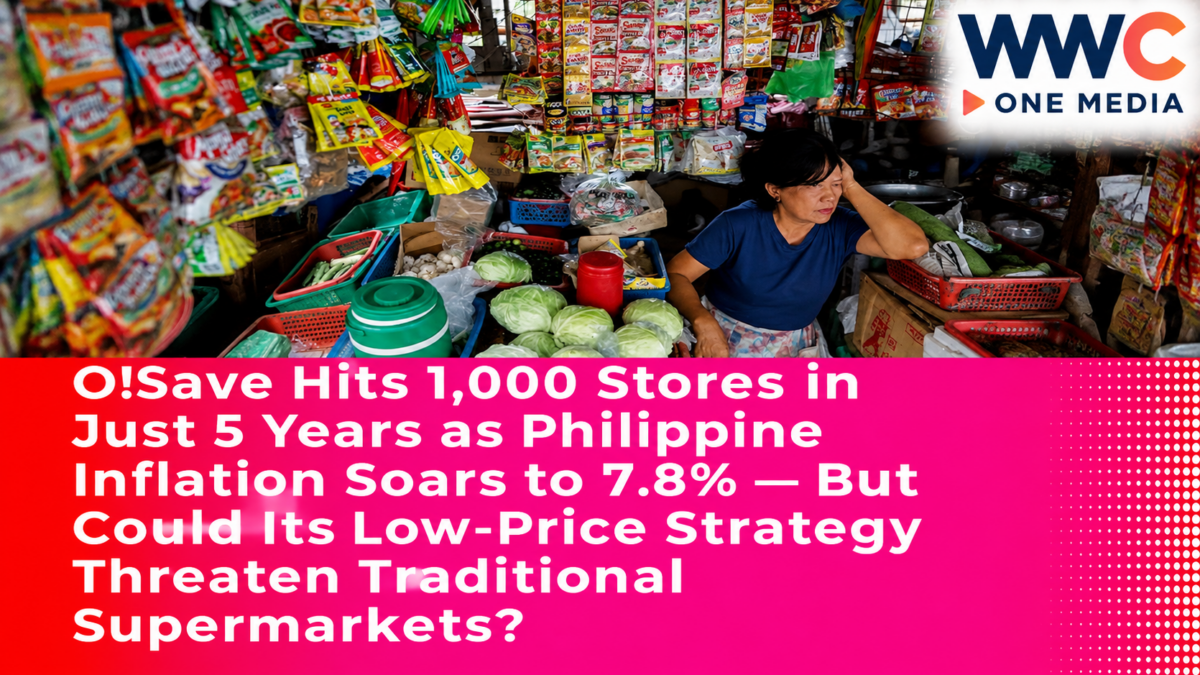
TAGUIG CITY / MANILA, PHILIPPINES — November 7, 2026 | WWC ONE MEDIA | Philippine Business, Grocery Retail, Consumer Spending and Inflation
A quiet revolution is reshaping the way Filipino families buy everyday essentials.
As soaring living costs force households to stretch every peso, hard-discount grocery chain O!Save has officially reached 1,000 stores nationwide, marking one of the fastest expansion stories in Philippine neighborhood retail.
The milestone was celebrated with the opening of its newest branch in Barangay Central Signal Village, Taguig City, just five years after the retailer launched its first outlet in San Fernando, Pampanga, in 2021.
Backed in part by Gokongwei-led Robinsons Retail Holdings Inc., O!Save has built its business around a straightforward promise: affordable groceries, accessible neighborhood locations and fewer unnecessary operating expenses.
Its strategy is strikingly different from that of traditional supermarkets.
Instead of sprawling aisles, elaborate displays and an enormous product selection, O!Save uses compact stores, a carefully chosen assortment of necessities and simple shelving arrangements.
Some products are displayed directly in their shipping boxes or on pallets.
The idea is to reduce costs so the retailer can compete on everyday prices.
According to InsiderPH’s November 7 report, the expansion reflects growing consumer preference for convenience and affordability as Filipinos become increasingly selective about household spending.
The timing is significant.
Official government data released on November 5 showed Philippine inflation accelerating to 7.8% in October 2026, while food prices increased 6.4% from a year earlier.
Rice prices alone climbed 20.7%.
For consumers struggling with food, electricity, transportation and other expenses, low-cost grocery formats are becoming increasingly relevant.
But O!Save’s rapid rise also raises a major question for the country’s retail industry.
Can traditional supermarkets continue attracting customers with bigger stores and wider product choices when a growing number of Filipino households are putting low prices first?
O!Save Opens Its 1,000th Store in Taguig City
The company’s latest milestone took place along Marichu R. Tinga Avenue in Barangay Central Signal Village, Taguig City.
The opening ceremony brought together O!Save executives, local officials, suppliers and leaders of the Gokongwei business group.
Among those attending were Robinsons Retail chair Robina Gokongwei Pe, Robinsons Retail president and chief executive Stanley Co, and JG Summit president and CEO Lance Gokongwei.
O!Save Group CEO Jonas Bley and O!Save Philippines CEO Ramon Greshake also joined the event.
Taguig Mayor Lani Cayetano participated in the celebration.
For the company, the 1,000th store represents a transition from a relatively young retail concept into a nationwide network serving communities across the Philippines.
Greshake said the milestone reflects Filipino consumers’ growing acceptance of value-focused shopping.
He also reaffirmed the company’s commitment to bringing affordable everyday products closer to households.
The announcement did not disclose the new branch’s sales target, staffing count or expected first-year revenue.
Those figures should not be assumed from the size of the national store network.
From One Pampanga Outlet to 1,000 Stores in Five Years
O!Save’s expansion began in San Fernando, Pampanga, in 2021.
The company adopted a hard-discount model similar in principle to those used by international retailers such as Aldi and Lidl.
Rather than trying to offer almost every product imaginable, it focused on essential goods frequently purchased by ordinary households.
That approach proved scalable.
On May 23, 2025, O!Save opened its 500th store in Bulakan, Bulacan.
By December 2025, it had reached 750 stores, according to subsequent business reporting.
Now, in November 2026, the chain has doubled its May 2025 network to reach 1,000 outlets.
The increase amounts to roughly 500 additional stores in less than 18 months.
The pace shows how aggressively O!Save has expanded its physical footprint.
However, store-count growth is not the same as profit growth.
A retailer must still manage rent, inventory, transportation, staffing and the cost of opening new branches.
The long-term success of its strategy will depend on whether each location can generate sustainable returns.
How O!Save Keeps Its Grocery Prices Competitive
O!Save’s competitive advantage begins with a simpler operating model.
Traditional supermarkets often carry thousands of products, maintain large retail spaces and invest heavily in store presentation.
O!Save takes a different approach.
Its stores generally occupy smaller spaces and carry a narrower assortment of fast-moving goods.
Products can remain in cartons or on pallets rather than being individually arranged on elaborate shelves.
The company also says it avoids expensive retail locations and unnecessary operating costs.
Instead of relying primarily on occasional promotional events, it promotes an everyday-low-price strategy.
This approach can reduce overhead and simplify inventory management.
A smaller product assortment can also make replenishment easier and allow the retailer to concentrate purchasing activity on frequently demanded items.
But there is an important qualification.
O!Save’s marketing promise does not establish that every product is cheaper than the same item at every competing retailer.
Actual savings depend on the product, package size, location and prices offered by competitors.
Consumers should compare unit prices and total basket costs rather than assume that one retailer always offers the lowest price.
What Can Filipinos Buy at O!Save?
The chain concentrates on products used regularly in Filipino households.
Its assortment includes packaged food, snacks, beverages, cooking essentials, personal care products, baby care items, cleaning supplies and other household necessities.
The strategy is designed around repeat purchases rather than occasional luxury shopping.
A customer might visit to buy detergent, canned goods, coffee, biscuits, soap or other everyday essentials.
The availability of a particular product may vary by location.
The chain’s smaller assortment also means shoppers may need to visit another store for specialty goods or items not stocked at O!Save.
For many price-conscious households, however, convenience and affordability may matter more than having the widest possible selection.
That is the central calculation behind the hard-discount business model.
Why the 7.8% Inflation Rate Makes Discount Groceries More Attractive
The expansion arrives during a challenging period for Philippine consumers.
The Philippine Statistics Authority reported that headline inflation accelerated to 7.8% in October 2026, compared with 7.2% in September.
Transportation costs increased 20.1% from a year earlier.
Housing, water, electricity, gas and other fuels rose 9.3%.
Food inflation eased slightly from September but remained elevated at 6.4%.
Rice prices increased 20.7%, placing additional pressure on one of the most important items in the Filipino household budget.
These figures help explain why consumers may be paying closer attention to grocery prices.
Even when the inflation rate for food declines slightly, prices can remain substantially higher than they were a year earlier.
A slower rate of price increases does not necessarily mean groceries are becoming cheaper.
WWC ONE MEDIA previously examined these pressures in Philippines Faces Broader, Stickier Inflation Wave as Food, Fuel and Labor Costs Rise.
That earlier report explored how increasing costs across several sectors were threatening household purchasing power.
The latest official inflation figures confirm that price pressures remain significant.
For O!Save, the economic environment reinforces the appeal of its low-cost positioning.
However, the company’s rapid expansion began before the latest inflation surge, so the October inflation figure alone cannot explain its entire growth story.
Robinsons Retail Gains Exposure to the Discount Grocery Market
O!Save’s growth also matters to Robinsons Retail Holdings.
The Gokongwei-led company owns a stake in the hard-discount chain.
Robinsons Retail already operates multiple formats serving different shopping needs, including supermarkets, convenience stores and specialty retail businesses.
Its participation in O!Save gives it exposure to a segment focused primarily on price-conscious consumers.
That positioning is distinct from the group’s premium supermarket concepts.
For example, The Marketplace targets customers seeking a wider range of specialty and imported products.
WWC ONE MEDIA reported on this strategy in Gokongwei’s The Marketplace Opens 2 New South Metro Supermarkets With Up to 50% Off — But a Bigger Grocery Battle Is Heating Up.
The two formats illustrate how a large retail group can participate in different parts of the consumer market.
One shopper may prioritize affordable daily essentials.
Another may value imported goods, specialty products or a broader supermarket experience.
For Robinsons Retail, maintaining exposure to both segments could help diversify its retail business.
But O!Save’s growth should not be described as proof that Robinsons Retail owns all of its shares or controls every operating decision.
The publicly established fact is that Robinsons Retail holds an ownership stake.
Traditional Supermarkets Face a Different Kind of Competition
The growing popularity of hard-discounters is challenging assumptions about what shoppers expect from grocery stores.
For decades, large supermarkets competed through convenience, product variety, fresh-food departments and promotional campaigns.
Discount chains place greater emphasis on controlling operating expenses and keeping prices competitive.
But the two formats are not necessarily direct substitutes for every shopping trip.
Supermarkets often offer fresh meat, seafood, produce, bakery products and specialty merchandise that a compact discount outlet may not carry.
Some customers prefer completing their entire grocery list in one location.
Others are willing to shop at several outlets to save money.
The challenge for traditional supermarkets is determining which customers are willing to pay for a wider assortment and a more elaborate store experience.
WWC ONE MEDIA examined this dilemma in Shopwise Reboots Its First Alabang Store With Global Brands and Bigger Aisles — But Value-Conscious Shoppers May Decide Whether the Makeover Works.
Shopwise’s approach emphasizes shopping experience, improved store design and product selection.
O!Save represents a different bet: that customers increasingly want simplicity, accessibility and competitive everyday pricing.
Both strategies may succeed among different consumer groups.
DALI and O!Save Are Reshaping the Discount Grocery Landscape
O!Save is not alone in pursuing the hard-discount market.
DALI Everyday Grocery has also expanded aggressively across the Philippines, offering customers a compact-store format and competitively priced essentials.
The two chains reflect a wider change in retail competition.
Instead of concentrating exclusively on large shopping centers, discount operators are bringing smaller outlets closer to residential neighborhoods.
This model can reduce travel time and make shopping more convenient for households buying only a few items.
It also increases competition with existing neighborhood retailers.
However, store-count comparisons between O!Save and DALI should be based on current verified figures rather than older expansion announcements.
The available evidence confirms O!Save has reached 1,000 locations.
It does not establish which operator currently leads on revenue, profitability, price competitiveness or customer loyalty.
Those questions require additional company disclosures and comparable market data.
What Does the Rise of Discount Groceries Mean for Sari-Sari Stores?
Small neighborhood stores remain an essential part of Philippine retail.
Sari-sari stores offer convenience, familiar relationships and the ability to purchase products in small quantities.
Their role is particularly important in communities where shoppers may not have easy access to large supermarkets.
Hard-discount chains could compete with sari-sari stores for some everyday purchases, particularly packaged food and household necessities.
But the formats serve customers differently.
A sari-sari store may offer individual sachets or small quantities that fit a customer’s immediate cash budget.
A discount grocer may offer better value on selected packaged products while requiring a larger purchase.
WWC ONE MEDIA previously explored the importance of neighborhood distribution in Piattos Reaches 73% of Filipino Households as Great Taste Hits 317 Million Consumer Choices — But URC’s Next Growth Battle May Be in Sari-Sari Stores.
The report discussed how major consumer brands depend on extensive retail networks to reach Filipino households.
For manufacturers, the rise of hard-discount stores creates another distribution channel.
For small retailers, it may increase the importance of convenience, product availability and maintaining close customer relationships.
Can Low Prices Protect Families From Inflation?
Discount retailers can help consumers find more affordable purchasing options.
But they cannot eliminate the effects of rising fuel, transportation, manufacturing and agricultural costs.
Retailers face those pressures too.
Higher diesel prices can make deliveries more expensive.
Electricity costs can increase store operating expenses.
And changes in wholesale prices can affect the cost of products before they reach supermarket shelves.
WWC ONE MEDIA examined one source of these expenses in Shipping Group Wants RoRo Terminal Fees Scrapped—Could This Finally Bring Down Food Prices in the Philippines?.
That report discussed how shipping and distribution expenses can contribute to higher prices of everyday goods.
O!Save’s streamlined model may help it manage some operating costs more efficiently.
But maintaining competitive prices during prolonged inflation can still require difficult decisions about product assortment, sourcing and margins.
The company has not disclosed enough current information to establish how much its customers save on an average grocery basket compared with competing retailers.
The Next Challenge: Growing Bigger Without Losing the Low-Price Advantage
Reaching 1,000 stores is a major milestone.
Maintaining the economics of a discount chain at that scale may be an even bigger challenge.
As O!Save enters more communities, it must secure suitable locations, maintain reliable supplier relationships and keep distribution expenses manageable.
The company also needs to preserve consistent product quality while controlling costs.
A hard-discount business is particularly sensitive to operational inefficiency because competitive prices can limit the amount of profit earned on each sale.
Expansion can create advantages through higher purchasing volumes and improved distribution.
But opening stores too rapidly can also increase rental, staffing and inventory costs.
O!Save has not publicly disclosed a new nationwide store-count target in the November 7 announcement.
Claims that it has already committed to 1,500 or 2,000 locations would therefore require separate confirmation.
For now, the verified milestone is 1,000 stores.
The Bigger Question: Could O!Save Change How Filipinos Shop?
O!Save’s rapid rise is more than a corporate expansion story.
It reflects a Philippine grocery market where households are increasingly attentive to the cost of everyday necessities.
In just five years, the retailer has grown from one branch in Pampanga into a nationwide network of 1,000 stores.
Its approach is built around smaller outlets, carefully selected products, simpler displays and an emphasis on everyday pricing.
For Robinsons Retail, the investment provides exposure to a growing value-focused market.
For shoppers, the expansion provides another option for buying essential goods.
For competing supermarkets and neighborhood retailers, it raises questions about the future of grocery pricing, store locations and customer loyalty.
But store growth alone does not establish that O!Save is the cheapest grocery chain or the most profitable retailer.
Those claims would require independently comparable pricing, revenue and profitability data.
The real test will be whether the company can maintain its operating discipline while continuing to grow.
As O!Save celebrates its 1,000th store while Philippine inflation reaches 7.8%, one question could define the country’s next retail battle: Will its low-price, no-frills strategy force supermarkets to rethink their prices—or could the rising costs of running a nationwide network eventually threaten the very savings that attracted Filipino shoppers?