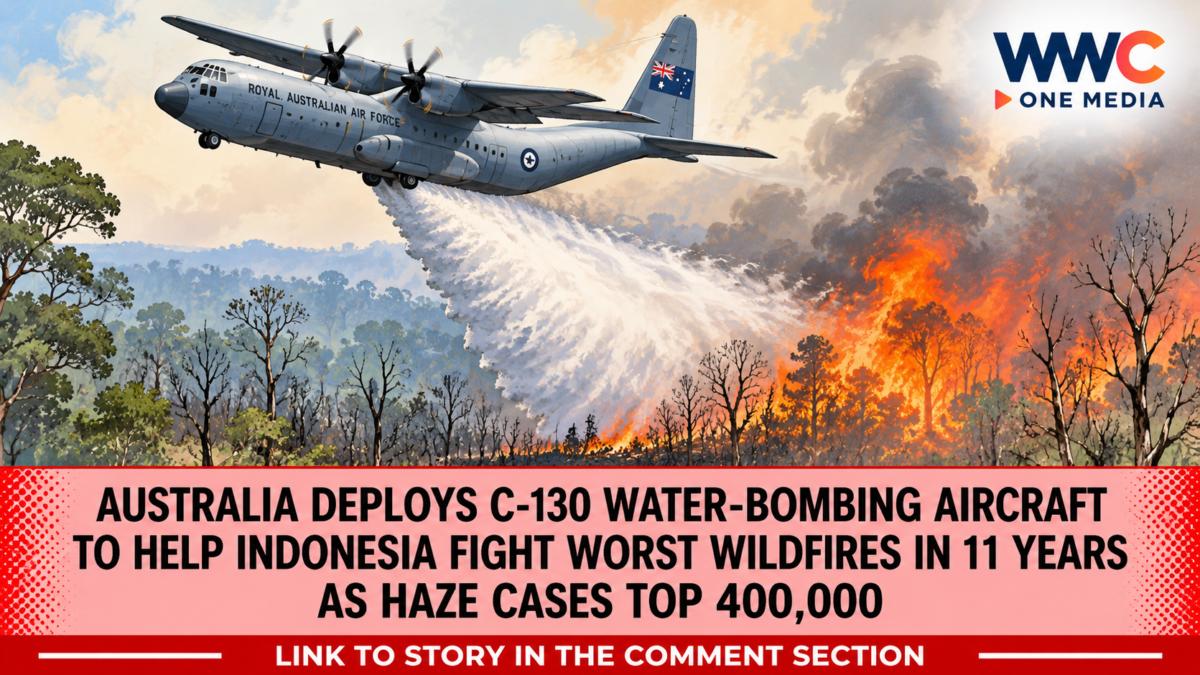
Australia is sending specialist aerial firefighting aircraft and a 20-member team to Indonesia as the country battles an exceptionally severe wildfire season that has scorched parts of Sumatra, Borneo and Papua, polluted the air across several provinces and triggered more than 400,000 reported cases of acute respiratory infections.
The emergency assistance, announced on November 5, 2026, comes as Indonesian authorities intensify efforts to contain fires across the archipelago. The operation will focus on East Kalimantan, where active hotspots remain a major concern, and will combine aerial water-bombing with ground firefighting and weather-modification efforts.
Australia’s deployment also follows a deadly helicopter crash during a firefighting mission in Central Kalimantan, highlighting the dangers faced by crews working to contain the blazes.
The crisis is no longer simply an environmental emergency. With smoke affecting public health and threatening communities across the region, Indonesia’s fires have become a growing Southeast Asian concern. Australian Embassy Indonesia+3
Australia Sends Two Aircraft and 20 Specialists to Indonesia
The Australian deployment is being coordinated by the New South Wales Rural Fire Service (NSW RFS) following a joint technical assessment with Indonesia’s National Disaster Management Agency, known as BNPB.
The assistance includes:
- A C-130 Hercules Large Air Tanker capable of carrying and dropping up to 15,000 litres of water per sortie.
- A Cessna Citation aircraft to guide and support aerial firefighting operations.
- A 20-member specialist team comprising pilots, aviation crew, aerial firefighting experts and paramedics.
The aircraft and personnel are scheduled to support Indonesia’s operations from November 6 to 12, focusing on fire-affected areas in East Kalimantan.
Australian Ambassador to Indonesia Roderick Bruce Brazier said the C-130 could conduct up to six sorties a day, with the assistance expected to deliver more than 100,000 litres of firefighting water daily under the planned operational capacity.
The deployment is intended to complement Indonesia’s ground firefighting teams and weather-modification operations rather than replace existing efforts. Australian Embassy Indonesia+2
Why East Kalimantan Was Selected
East Kalimantan was chosen after Indonesian and Australian technical teams assessed where additional aerial support was most urgently needed.
BNPB said the province still had numerous active fire hotspots and ranked second behind Central Kalimantan in the number of hotspots recorded on November 5.
The agency also reported that the area of land under fire-management operations in East Kalimantan had increased by 53 per cent, according to its operational report as of November 4.
The Australian aircraft will therefore concentrate on locations identified by the joint assessment, allowing water drops to target priority fire zones.
The operation is particularly important because fires in forested areas can be difficult to reach using ground crews alone. Aircraft can deliver water directly to locations where terrain, vegetation or distance makes conventional firefighting more challenging. BNPB+1
Deadly Helicopter Crash Raises Concerns Over Firefighting Risks
The Australian assistance comes after a fatal helicopter crash during an Indonesian firefighting mission in Central Kalimantan on November 4.
The Indonesian Army helicopter crashed while collecting water for an aerial firefighting operation near Sungai Perlu village in Seruyan Regency. The aircraft had been assigned to help protect areas near Tanjung Puting National Park.
Later reports from The Jakarta Post and Reuters said three military personnel were killed and five others injured. The victims were identified as Lieutenant Colonel Anwar Dudi Firmansyah, Captain Nurhafiz Akbar and First Sergeant Heri Prasetyo.
The survivors were receiving medical treatment, according to the Indonesian Army.
There were discrepancies in early reports about the number of fatalities. An initial account from ANTARA reported two deaths and one crew member missing while search efforts continued. Subsequent reporting identified three fatalities.
The crash underscores the dangers facing pilots and ground crews working in difficult conditions during the wildfire emergency. The Jakarta Post+2
More Than 400,000 Respiratory Infection Cases Reported
The consequences of Indonesia’s wildfires extend far beyond the forests.
Health Ministry figures cited by Reuters showed that fire-related haze had contributed to more than 400,000 cases of acute respiratory infections across seven provinces as of November 2.
Smoke from forest and land fires can contain fine particulate matter and other pollutants that irritate the respiratory system. Exposure can worsen existing conditions and increase health risks, particularly for children, older people and individuals with respiratory or cardiovascular illnesses.
The reported cases reflect the scale of the health burden across affected provinces, although they should not be interpreted as proof that every case was caused exclusively by wildfire smoke.
The crisis also raises concerns about the wider regional effects of transboundary haze, which can travel across national borders depending on wind direction and weather conditions.
WWC ONE MEDIA previously examined the regional health and environmental threat in Indonesia’s Wildfires Are Choking Southeast Asia — And the Toxic Haze Could Get Even Worse.
Indonesia Combines Water-Bombing With Cloud Seeding
Australia’s aircraft will join a wider Indonesian firefighting effort involving aerial water drops, ground crews and weather-modification operations.
Cloud seeding is used when suitable atmospheric conditions are available. It involves dispersing particles into appropriate clouds to encourage rainfall, potentially helping firefighters and reducing the dryness that allows fires to spread.
However, cloud seeding cannot guarantee rain, and its effectiveness depends on existing moisture and atmospheric conditions.
Water-bombing operations also have limitations. Aircraft can help suppress flames and cool affected areas, but repeated drops may be necessary, particularly when fires continue burning beneath the surface.
Peatland fires are especially difficult to extinguish because combustion can persist underground even after visible flames disappear. Without sustained ground operations and favourable weather, fires may reignite.
Earlier reporting by the Associated Press described Indonesia’s use of extensive firefighting teams, aircraft and weather-modification operations as the country confronted severe fires across Sumatra and Kalimantan. AP News+1
Indonesia and Australia Repay Each Other’s Disaster Assistance
The deployment also reflects a history of cooperation between the two neighbouring countries during major natural disasters.
Australia’s ambassador recalled Indonesia’s assistance during the devastating Australian bushfires of 2020. Indonesian personnel from BNPB and the military supported Australian communities through Operation Bushfire Assist.
The latest operation reverses that support, with Australia now providing specialist aircraft and personnel to help Indonesia manage its wildfire emergency.
Both governments have described the deployment as part of their longstanding disaster-management partnership.
For Indonesia, the assistance comes at a critical moment as authorities attempt to contain fires that have continued for months. For Australia, it is also an opportunity to deploy its specialised aerial firefighting capabilities in support of a regional neighbour. Australian Embassy Indonesia+1
Could the Haze Become a Wider Southeast Asian Emergency?
Indonesia’s wildfire crisis has repeatedly raised concerns across Southeast Asia because smoke can cross borders and affect communities far from the original fire locations.
Singapore, Malaysia and other neighbouring countries have experienced haze during previous Indonesian fire seasons. The severity of any cross-border impact depends on the location of fires, wind direction, rainfall and atmospheric conditions.
The issue has also become a diplomatic concern. Reuters recently reported that Singapore was preparing for possible haze impacts while relations with Indonesia were strained by disagreements over several regional issues, including the fires.
The consequences can extend to schools, transport, tourism, outdoor work and public health. Persistent haze can also affect businesses and increase pressure on governments to coordinate environmental monitoring and emergency responses.
WWC ONE MEDIA has previously reported on the wider regional consequences in Indonesia’s Wildfire Emissions Surge to World’s Highest as Haze Crisis Worsens.
The threat to Indonesia’s forests and future development has also been highlighted in Wildfires Close In on Indonesia’s Future Capital — Authorities Turn to Water Bombing as Flames Spread.
A Seven-Day Operation With a Much Bigger Challenge Ahead
Australia’s seven-day deployment is an important boost to Indonesia’s firefighting capacity, but it is not a permanent solution to the country’s recurring forest and land-fire problem.
The C-130 can deliver substantial amounts of water, while the Cessna Citation will help guide the aerial operation. The 20-person team will provide specialist expertise that can strengthen coordination with Indonesian authorities.
Still, the success of the mission will depend on whether the aircraft can reach priority fire zones, whether ground teams can contain the flames after water drops and whether weather conditions become favourable enough to reduce the risk of further outbreaks.
The health impact is already significant, with more than 400,000 acute respiratory infection cases reported across seven provinces. The deadly helicopter crash has also demonstrated the risks faced by those working to protect communities and forests.
Australia and Indonesia are now working together to contain the immediate emergency. But as long as dry conditions, vulnerable peatlands and new fire outbreaks remain a threat, the challenge will extend well beyond the seven-day deployment.
The key question is whether this international intervention can help bring the fires under control before the haze creates an even greater public-health and environmental crisis across the region.
Two Alternative Cliffhanger Headlines
1. Australia Sends a 15,000-Litre Water-Bombing Aircraft to Indonesia as Wildfires Rage — But Can Seven Days of Help Stop a Disaster Already Sickening Hundreds of Thousands?
2. Indonesia Calls in Australian Firefighting Aircraft After Deadly Helicopter Crash — But the Country’s Worsening Haze Crisis Could Be Far From Over
Accuracy note: The Australian government and BNPB confirm the aircraft, 20-person team, East Kalimantan deployment and November 6–12 operating window. The helicopter death toll was updated using subsequent Indonesian reporting; earlier accounts gave a different preliminary figure. The respiratory-infection figure is the Health Ministry total reported as of November 2, not a count of cases independently confirmed to have been caused solely by haze.