
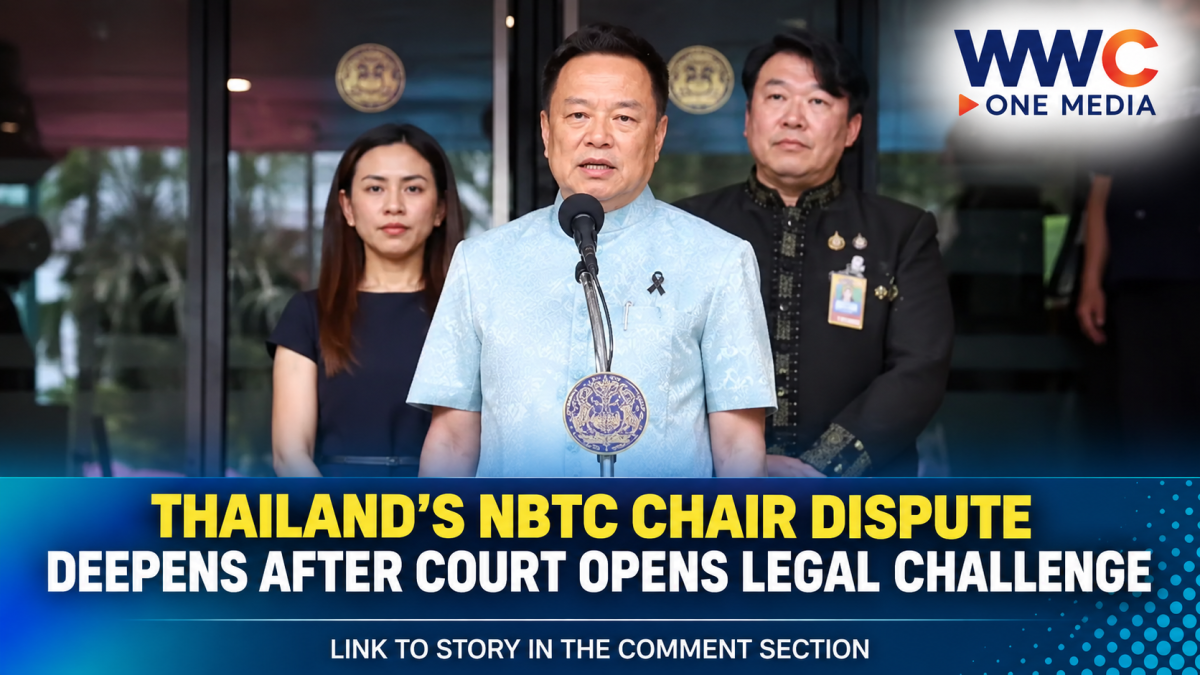
Supreme Administrative Court allows Sarana Boonbaichaiyapruck’s lawsuit to proceed — but the ruling does not reinstate him, leaving Thailand’s telecom regulator facing continued uncertainty.
Thailand’s long-running dispute over who has the legal authority to lead the National Broadcasting and Telecommunications Commission (NBTC) has entered another dramatic phase after the Supreme Administrative Court ordered that a lawsuit by NBTC chairman Sarana Boonbaichaiyapruck be accepted for consideration.
The decision is significant — but it does not mean Sarana has won the case or has automatically been restored to the chairmanship.
Instead, the Supreme Administrative Court has overturned the lower court’s decision not to accept his lawsuit and ordered that the case proceed. The court’s official announcement confirms that the dispute concerns Sarana’s challenge to a decision by the NBTC selection committee.
⚖️ What did the Supreme Administrative Court actually decide?
The Supreme Administrative Court issued Order No. 952/2569, dated August 31, 2026.
Sarana had challenged the NBTC Selection Committee’s July 21 decision, which found that he possessed a prohibited characteristic and treated him as having waived his right to take up the NBTC commissioner position.
The dispute centers on his previous work as an hourly-paid physician at Ramathibodi Hospital, Mahidol University. The selection committee concluded that this employment status conflicted with the statutory qualifications for an NBTC commissioner.
The Central Administrative Court had initially refused to accept Sarana’s lawsuit.
He appealed.
The Supreme Administrative Court has now reversed that procedural decision, meaning his challenge can proceed through the Administrative Court system.
But there is a crucial catch
Accepting a lawsuit is not the same as winning it.
Legal experts have stressed that the latest order does not establish that Sarana is legally entitled to return to the NBTC chairmanship. The underlying dispute over whether the selection committee acted lawfully still has to be examined.
That distinction is critical because the dispute has already created uncertainty inside the country’s communications regulator.
🚨 Why the NBTC is now facing a leadership crisis
The controversy has spilled directly into the NBTC’s ability to conduct its business.
Several commissioners have refused to participate in meetings chaired by Sarana because they believe the selection committee’s decision means he can no longer exercise the powers of chairman.
As a result, NBTC meetings have repeatedly failed to reach a quorum.
On September 3, the board meeting was reportedly postponed for the eighth time, with the next meeting scheduled for September 9. Three commissioners subsequently sought an urgent meeting of the remaining six commissioners.
The stalemate is no longer merely an internal personnel dispute.
It could affect major decisions involving Thailand’s broadcasting and telecommunications sectors.
📺 Digital TV decisions caught in the middle
Thailand’s digital television operators have already warned that uncertainty over Sarana’s status could expose important NBTC decisions to future legal challenges.
Among the issues affected is the Digital TV Roadmap, along with plans involving a national streaming platform.
Broadcasters have argued that the NBTC needs a legally secure decision-making process so companies can make long-term business and investment plans without worrying that regulatory decisions could later be challenged or overturned.
That makes the leadership dispute much bigger than a question of who occupies one chair.
Thailand’s entire broadcasting and telecommunications regulatory system could feel the consequences if the deadlock continues.
🏛️ Government says the process is still moving
The government has also taken a position in the dispute.
Deputy Prime Minister Pakorn Nilprapunt has said that the Supreme Administrative Court’s decision to accept Sarana’s lawsuit does not, by itself, stop the government’s previously initiated process concerning his removal.
The government has said it will follow the eventual court orders and judgments.
This creates the central tension in the case:
Sarana is challenging the decision that led to his removal, while other officials and commissioners argue that the selection committee’s decision remains legally operative unless and until it is overturned.
🔥 Sarana wants the board to keep working
Following the Supreme Administrative Court’s order, Sarana called on NBTC commissioners to return to board meetings.
But some commissioners have maintained the opposite position.
They argue that the court’s decision to accept his lawsuit does not erase the selection committee’s July decision and that the remaining commissioners should be able to continue performing the NBTC’s duties.
The disagreement has therefore produced an unusual situation in which both sides say they are acting to protect the regulator’s legal authority.
What happens next?
The next major question is whether the Administrative Court will grant any interim protection requested by Sarana while his case is being considered.
The Supreme Administrative Court’s order opened the way for the case to proceed and directed consideration of his request concerning interim measures before judgment.
Until the underlying legal dispute is resolved, the NBTC faces a difficult balancing act:
- Who has authority to chair the board?
- Can the six remaining commissioners conduct business without Sarana?
- Will decisions made during the dispute face future legal challenges?
- What happens to Thailand’s digital-TV and telecommunications roadmap?
- And ultimately, does Sarana remain legally entitled to lead the regulator?
For now, none of those questions has received a final answer from the court.
The bigger picture
This is why the latest court development should not be described simply as “Sarana wins” or “Sarana returns as NBTC chairman.”
He hasn’t.
What the Supreme Administrative Court has done is open the courtroom door for his challenge.
The substantive battle over his qualifications, the selection committee’s authority and his legal status remains ahead.
And while the lawyers prepare for that fight, Thailand’s communications regulator is already struggling to function.
The next court order could determine far more than one man’s position — it could decide who has the authority to steer one of Thailand’s most powerful regulators.
WWC ONE MEDIA J.M.D



Leave a Reply