
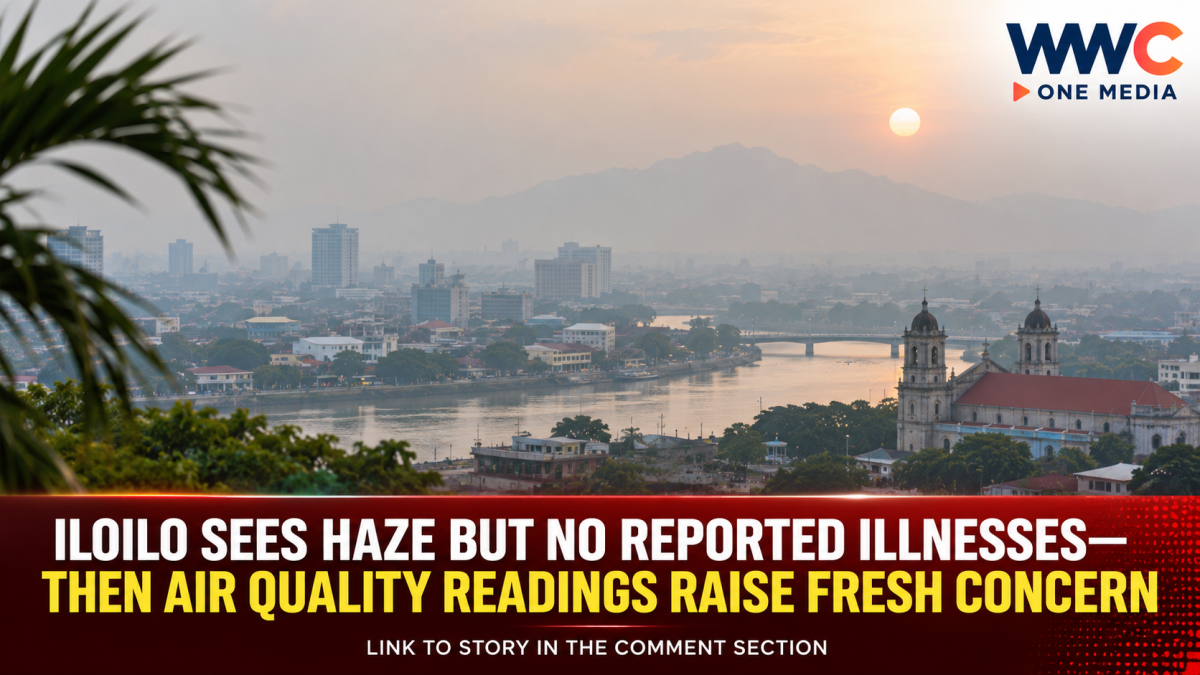
ILOILO — No residents in Iloilo province have been reported ill or affected by the haze being monitored across several municipalities, even as smoke linked to forest fires in Indonesia continues to affect parts of Western Visayas.
The Iloilo Provincial Disaster Risk Reduction and Management Office (PDRRMO) said in its 10:30 a.m. monitoring report on Friday, Sept. 4, that none of the province’s five congressional districts had reported individuals affected by the haze.
The latest development offers some relief amid growing concern over air quality in the region. However, authorities continue to monitor conditions because fine particulate pollution can pose health risks, particularly to vulnerable groups.
Haze remains visible in several Iloilo areas
The haze has been reported in several municipalities, with Alimodian, Miagao, Igbaras and Tubungan among the areas previously identified by the provincial disaster office as experiencing haze linked to forest and land fires in Indonesia.
The phenomenon is being associated with transboundary smoke from fires in Kalimantan, Indonesia, carried toward parts of the Philippines by prevailing winds associated with the southwest monsoon, or habagat.
While no haze-related illnesses have been reported in the province as of the latest PDRRMO update, air-quality measurements show why officials remain cautious.
On Sept. 3, the Department of Environment and Natural Resources–Environmental Management Bureau (DENR-EMB) Region 6 reported a PM2.5 rolling 24-hour Air Quality Index (AQI) average of 150 at its Garden of Love monitoring station in Barangay Nabitasan, La Paz, Iloilo City, a level classified as “unhealthy for sensitive groups.”
What the haze could mean for residents
PM2.5 refers to extremely small airborne particles measuring 2.5 micrometers or less. Because they can penetrate deep into the lungs, exposure can be particularly concerning for people with existing respiratory or cardiovascular problems.
Health authorities have warned that haze exposure may cause coughing, throat irritation, chest discomfort, difficulty breathing and watery or irritated eyes, while potentially worsening conditions such as asthma and cardiovascular disease.
The Department of Health has advised people to minimize prolonged outdoor exposure during periods of poor air quality. Vulnerable groups—including children, older adults, pregnant women and people with respiratory or heart conditions—have been urged to take extra precautions.
Residents who need to go outside during periods of significant haze have been advised to use a properly fitted N95 mask or another mask capable of filtering fine particles.
Iloilo’s air situation has changed rapidly
Recent monitoring illustrates how quickly conditions can change.
Earlier in the week, Iloilo City officials reported that air-quality conditions had deteriorated as haze moved into Western Visayas. The Iloilo City Operations Center warned that weaker surface winds could allow pollutants to remain closer to the ground, potentially worsening exposure.
The city also urged residents—especially vulnerable individuals—to reduce strenuous outdoor activity and take precautions when haze is visible.
The situation contrasts with earlier monitoring in Iloilo, when air quality remained within good-to-fair levels despite haze affecting other parts of the country.
Indonesia fires continue to fuel regional concern
The haze affecting the Philippines is part of a much larger wildfire situation in Indonesia.
Reuters reported that Indonesia has been battling extensive forest and land fires in Sumatra and Kalimantan, with authorities inspecting companies whose concession areas were found to contain fires. The country’s dry conditions have contributed to the spread of the fires, while firefighting operations have been expanded.
The regional impact has already been significant. Reuters reported that about 1.4 million Indonesian students across six provinces shifted to remote learning because of hazardous air quality associated with the fires.
No reported illnesses does not mean residents should ignore the haze
For Iloilo residents, the absence of reported haze-related illnesses is encouraging—but authorities continue to stress prevention.
Air-quality conditions can change depending on wind direction, atmospheric circulation and the concentration of fine particles near ground level. Residents are therefore advised to follow official air-quality updates and limit exposure whenever pollution levels rise.
Anyone experiencing persistent coughing, breathing difficulty or chest pain should seek medical attention, particularly if symptoms are severe or the person has an existing respiratory or cardiovascular condition.
For now, the key message from Iloilo authorities is clear: there are no reported haze-related illnesses in the province as of the latest monitoring update, but the haze and changing air-quality readings remain under close watch.

Leave a Reply