SINGAPORE — November 6, 2026 — Singapore motorists have received their first sign of relief at the petrol pumps in nearly seven weeks after Caltex reduced its posted prices for petrol and diesel by three cents per litre.
The adjustment, introduced at 1pm on Wednesday, November 4, makes Caltex the first major fuel retailer in Singapore to lower its prices since the latest wave of increases began on September 14.
The reduction covers the company’s 92-octane, 95-octane, premium petrol and diesel offerings.
However, the three-cent cut does not mean fuel has suddenly become cheap again. As of November 5, Caltex’s 95-octane petrol was still priced at S$3.60 per litre before discounts, while several competing major retailers were charging S$3.63.
The latest development comes amid a volatile international oil market shaped by the conflict in the Middle East, uncertainty over energy supplies and changing expectations about the possibility of diplomatic progress.
There is also a notable contrast: international crude oil prices have fallen sharply, but Singapore’s retail fuel prices remain substantially higher than they were before the September increases.
For motorists, the question is whether Caltex’s decision marks the beginning of a wider price reversal—or simply a small adjustment in an otherwise expensive fuel market.
Caltex Becomes First Major Retailer to Cut Prices Since September
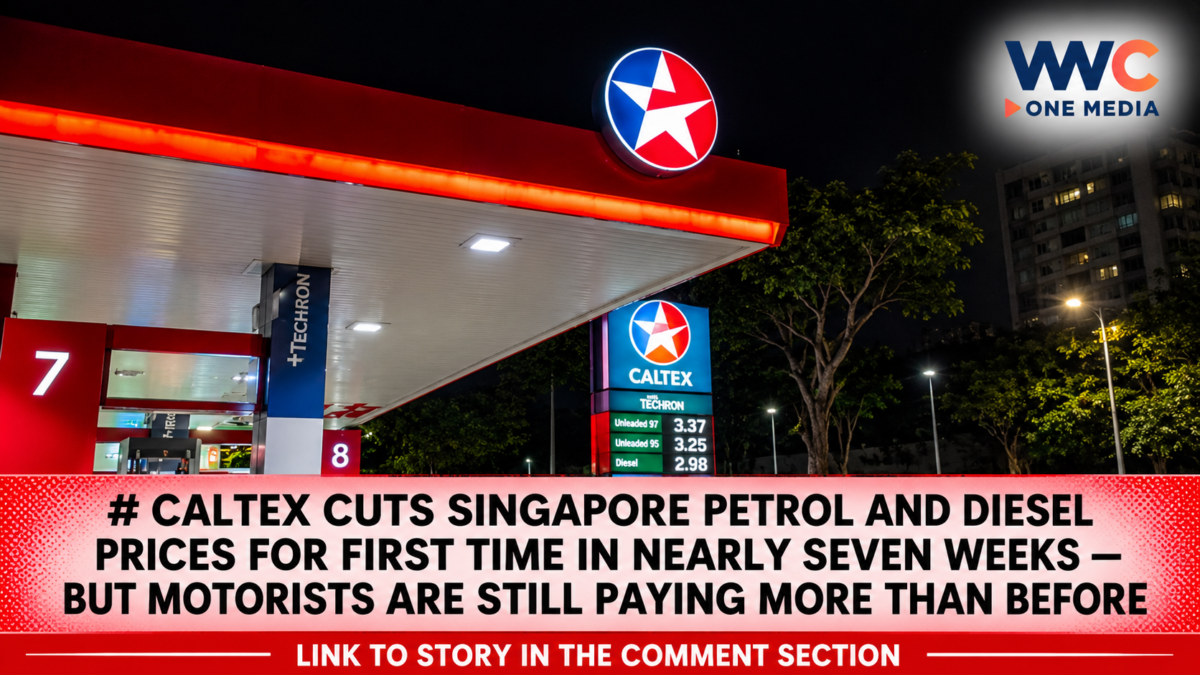
Caltex announced its latest price adjustment on November 4, reducing its posted prices by S$0.03 per litre across four fuel categories.
The company had previously raised its prices during the recent round of increases, including a three-cent adjustment on October 30.
The November 4 reduction therefore reverses that latest three-cent increase for the affected products.
According to AsiaOne’s November 5 price comparison, Caltex’s revised posted prices were:
- 92-octane petrol: S$3.57 per litre
- 95-octane petrol: S$3.60 per litre
- Premium petrol: S$4.30 per litre
- Diesel: S$4.04 per litre
Caltex does not offer the same 98-octane grade listed by some competing retailers.
As of November 5, no other major fuel company had matched Caltex’s latest reduction.
SPC had also kept its posted prices unchanged since October 16, according to the report.
Singapore Petrol Prices: How Much Are Drivers Paying Now?
The November 5 comparison shows that Caltex is no longer charging the highest posted price for 95-octane petrol among the major retailers.
However, its price remains above SPC’s S$3.56 per litre.
Here is the comparison of posted prices before discounts, as reported by AsiaOne at 10pm on November 5:
| Fuel retailer | 92-octane | 95-octane | 98-octane | Premium | Diesel |
|---|---|---|---|---|---|
| Caltex | S$3.57 | S$3.60 | — | S$4.30 | S$4.04 |
| Esso | S$3.60 | S$3.63 | S$4.15 | — | S$4.07 |
| Shell | — | S$3.63 | S$4.15 | S$4.37 | S$4.07 |
| Sinopec | — | S$3.63 | S$4.14 | S$4.27 | S$4.01 |
| SPC | S$3.54 | S$3.56 | S$4.08 | — | S$4.00 |
| Cnergy | — | S$2.74 | S$3.00 | — | S$3.00 |
| Smart Energy | — | S$2.62 | S$2.99 | — | S$2.69 |
All figures are Singapore dollars per litre and represent posted prices before discounts. A dash means the grade is not listed for that retailer in the comparison.
The table highlights a substantial difference between the prices offered by major brands and those listed by smaller operators.
For example, 95-octane petrol ranged from S$2.62 at Smart Energy to S$3.63 at several major retailers.
That is a difference of S$1.01 per litre before discounts.
Motorists should still check the applicable fuel grade, station availability, payment conditions and promotional terms before comparing their actual costs. A posted price is not necessarily the final amount every customer pays.
Why Are Singapore’s Fuel Prices Still High?
The latest price movement cannot be understood by looking at Caltex alone.
Singapore’s fuel market has been affected by international oil-market volatility following the escalation of the Middle East conflict.
The latest round of major fuel-price increases began on September 14, ending a period of approximately two months of relative stability.
The Straits Times reported that major fuel retailers raised their posted prices by between eight and 12 cents per litre that day.
The increases pushed diesel above S$4 per litre at several major brands, while 95-octane petrol also became more expensive.
At the time, Shell moved first, followed by Caltex and Esso. Sinopec and SPC had not immediately matched the increases.
Since then, fuel companies have made further adjustments as international energy markets responded to developments in the conflict and concerns about supply disruptions.
The result has been several weeks of higher pump prices for Singapore motorists.
Middle East Conflict Continues to Influence the Energy Market
The Middle East remains an important source of crude oil and refined petroleum products for Asian markets.
Disruptions to shipping routes, production and refinery operations can affect not only the availability of crude oil but also the supply of finished products such as petrol and diesel.
This distinction is important.
Crude oil must still be refined, transported and distributed before it becomes the fuel sold at petrol stations. A recovery in crude supply does not automatically mean that refined fuel becomes available at the same speed or price.
Reuters reported on November 2 that Asia’s crude oil imports had recovered to approximately 26.39 million barrels per day in October, approaching the pre-conflict average of around 27 million barrels per day.
However, imports of refined products—including petrol and diesel—remained approximately 10 per cent below their pre-conflict average.
Reuters also reported that Singapore’s gasoil and gasoline prices remained significantly above pre-conflict levels.
The figures underline why the fuel market can remain under pressure even when crude oil shipments begin to recover.
Oil Prices Fall Sharply as Markets React to US Political Developments
Another major development came on November 4, when international oil prices fell sharply.
According to the market figures reported by Reuters and carried in AsiaOne’s November 5 coverage, Brent crude futures settled at US$94.62 per barrel, down US$8.98 or 8.7 per cent.
US West Texas Intermediate crude futures fell US$7.97, or 8.3 per cent, to US$88.12 per barrel.
Both benchmarks closed at their lowest levels since August 31.
The decline followed the US midterm election results, which saw the Republican Party lose control of Congress.
Investors interpreted the political shift as a possible factor that could increase pressure on the Trump administration to seek a negotiated way out of the conflict with Iran.
However, market expectations should not be confused with a confirmed end to the war.
Reuters reported that the possibility of diplomatic progress had influenced investor sentiment, while the longer-term outlook remained uncertain.
The fall in oil prices may offer some relief to energy markets, but it does not guarantee that Singapore petrol stations will immediately lower their prices.
Why Lower Crude Oil Prices Do Not Immediately Mean Cheaper Petrol
The relationship between international crude oil prices and retail petrol prices is not always immediate.
Petrol and diesel prices are affected by several factors, including:
1. Refined fuel supply
Crude oil must be processed into finished petroleum products. If refinery capacity or refined-product supplies remain constrained, petrol and diesel can stay expensive even when crude prices decline.
2. Shipping and transportation costs
Disruptions to major shipping routes can increase the cost and time required to move energy supplies to importing countries.
3. Regional fuel-market prices
Singapore’s fuel market is exposed to international refined-product prices, not simply the daily price of crude oil.
4. Retail pricing decisions
Fuel companies adjust their posted prices according to their procurement costs, market conditions and commercial decisions.
5. Timing
Changes in international markets may take time to filter through supply contracts, inventories and retail price adjustments.
This explains why a sharp decline in crude prices does not necessarily result in an immediate equivalent reduction at Singapore petrol stations.
Malaysia Also Sees Changes in Unsubsidised Fuel Prices
The developments in Singapore come alongside a separate adjustment in Malaysia.
According to AsiaOne’s November 5 report, Malaysia’s Finance Ministry announced reductions to unsubsidised fuel prices for the week of November 5 to 11.
The ministry cited signs of moderation in the regional petroleum market following an increase in refined fuel supplies.
The comparison is relevant to motorists who travel between Singapore and Malaysia, but the two markets operate under different pricing arrangements.
Malaysia’s subsidised fuel policies and weekly price-setting system mean that its pump prices cannot be directly compared with Singapore’s market-based posted prices.
The direction of the latest adjustments nevertheless shows how regional fuel markets can respond differently to the same international developments.
What Caltex’s Price Cut Means for Singapore Motorists
Caltex’s three-cent reduction is a relatively small adjustment, but it is significant because it breaks a prolonged period in which major retailers had been raising prices.
For motorists who regularly purchase 95-octane petrol, the latest comparison places Caltex at S$3.60 per litre, three cents below the S$3.63 listed by Esso, Shell and Sinopec.
SPC remains lower among the major traditional retailers at S$3.56 per litre.
Smaller operators are listing lower prices, although motorists should consider location, fuel availability and any applicable conditions.
The difference between posted prices and final discounted prices also matters. Loyalty programmes, payment-card promotions and station-specific offers can change the amount paid at the pump.
The Consumers Association of Singapore’s Price Kaki app is one resource motorists can use to compare listed fuel prices.
Will Petrol and Diesel Prices Continue to Fall?
Caltex’s move has opened the door to the possibility of further price reductions, but there is not yet enough evidence to say that a sustained downward trend has begun.
The sharp decline in international crude prices is an encouraging development for consumers.
However, refined fuel supplies in Asia remain below their pre-conflict levels, and the geopolitical situation remains uncertain.
If diplomatic efforts lead to a lasting reduction in tensions and energy supplies continue to recover, international fuel-market prices could come under further downward pressure.
But renewed escalation or fresh supply disruptions could reverse those gains.
For now, motorists should distinguish between one company’s price adjustment and a broader market trend.
Caltex has made the first move among the major retailers. Whether Shell, Esso, Sinopec and SPC follow will be an important indicator of what happens next.
The Bottom Line: A Small Reduction, but Not Yet a Return to Cheaper Fuel
Singapore motorists finally have a reason to welcome a change at the pumps.
After weeks of increases, Caltex has reduced its petrol and diesel prices by three cents per litre, becoming the first major retailer to make a downward adjustment since September 14.
But the broader picture remains challenging.
The price of 95-octane petrol at Caltex is still 23 cents per litre higher than its pre-September 14 level, according to AsiaOne’s comparison.
Meanwhile, refined fuel supply constraints and uncertainty surrounding the Middle East continue to influence the regional energy market.
The next few price adjustments will therefore matter.
If other retailers follow Caltex, motorists may finally see a wider reversal of the increases accumulated over recent weeks.
If they do not, the latest reduction may remain a limited break in an otherwise expensive period for Singapore drivers.
For now, Caltex has taken the first step. The bigger question is whether the rest of Singapore’s fuel retailers will follow.