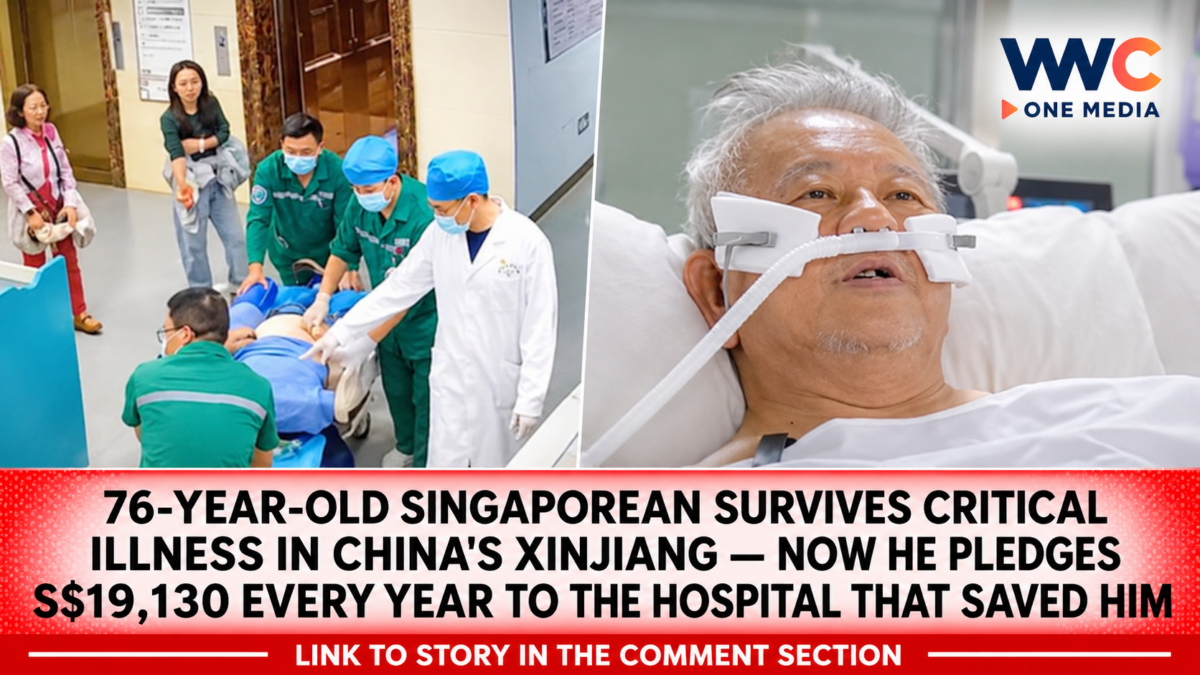
SINGAPORE / XINJIANG, CHINA — A 76-year-old Singaporean tourist who nearly lost his life after becoming critically ill during a trip to China’s Xinjiang region has made an extraordinary decision following his recovery: he will donate 100,000 yuan, approximately S$19,130, to the hospital that treated him every year.
The man, identified as Xu Senfu (许森福), developed severe breathing difficulties while travelling in Xinjiang on October 14, 2026. His condition deteriorated rapidly, prompting his family to seek emergency medical assistance at Shache County People’s Hospital.
Doctors discovered that he was suffering from several serious medical conditions, including left heart failure, acute pulmonary oedema, respiratory failure and cardiogenic shock.
He was immediately admitted to the intensive care unit, where medical personnel worked to stabilise his condition.
According to reports by China Daily, 8world, Lianhe Zaobao and AsiaOne, Xu eventually recovered after intensive treatment involving local medical teams and specialists from Shanghai.
But his experience left a lasting impression on him and his family.
Rather than simply thanking the doctors and nurses who treated him, Xu and his family decided to make a long-term contribution to help other patients facing financial difficulties.
The annual donation will be directed towards economically disadvantaged patients receiving treatment at the hospital, marking the first individual targeted donation of its kind received by the institution, according to reports.
Singaporean Tourist Develops Life-Threatening Breathing Difficulties During Xinjiang Trip
Xu’s medical emergency began on October 14 while he was travelling from Taxkorgan towards Shache County in Xinjiang’s Kashgar region.
According to an account released by the Xinjiang regional government’s official social-media platform, Xinjiang Fabu, Xu suddenly developed severe breathing difficulties, accompanied by a rapid decline in his blood oxygen levels.
The official account attributed the emergency to acute high-altitude pulmonary oedema.
His condition was particularly complicated because of several existing medical conditions.
Medical examinations at Shache County People’s Hospital identified left heart failure accompanied by acute pulmonary oedema, Type I respiratory failure and cardiogenic shock.
He also had underlying health problems, including severe hypertension, Type 2 diabetes and impaired liver function.
The combination of these conditions placed him in a critical state.
Xu was urgently admitted to the hospital’s intensive care unit, where doctors began emergency treatment and continuous monitoring.
Recalling the frightening experience, Xu said that he had become so breathless during the ambulance journey that he could barely breathe.
His wife, Chen Lifang, also described how frightening the situation had been as her husband’s oxygen readings deteriorated.
She recalled being extremely worried when the readings reportedly dropped from around 50 to 38.
For the family, what had started as a holiday in China’s northwestern region had suddenly become a medical emergency.
Intensive Care Team Works to Stabilise His Condition
The hospital’s intensive-care specialists immediately began treating Xu’s life-threatening conditions.
According to Lianhe Zaobao’s November 4 report, an emergency and critical-care specialist from Shanghai’s Pudong New Area People’s Hospital, Zou Hai, helped lead the medical assessment and coordinated with local medical personnel.
The treatment involved cooperation between the visiting specialist team and doctors from Shache County People’s Hospital.
Their immediate priority was to stabilise Xu’s breathing and cardiovascular condition while addressing the complications associated with his existing illnesses.
His condition gradually improved under intensive treatment.
One significant milestone came on October 17, when Xu was taken off ventilator support, according to the Xinjiang government’s account reported by Lianhe Zaobao.
His recovery represented a major turning point after several days of critical illness.
However, his medical challenges were not completely over.
Although his vital signs had stabilised, he continued experiencing persistent digestive problems, including watery diarrhoea, abdominal bloating and severe thirst.
The medical team therefore had to address these additional complications before his recovery could progress further.
Shanghai Specialist Introduces an Additional Treatment Approach
As Xu continued experiencing gastrointestinal symptoms, the hospital sought additional medical expertise.
According to 8world’s November 4 report, the hospital consulted Hu Xinmin, a traditional Chinese medicine specialist from Fudan University-affiliated Pudong Hospital in Shanghai who was assisting medical teams in Xinjiang.
A personalised herbal treatment plan was developed based on Xu’s condition.
After six days of taking the prescribed herbal preparation, his diarrhoea and abdominal bloating reportedly improved significantly.
His persistent thirst also gradually eased.
The improvement helped support his continuing recovery.
It is important to distinguish this treatment from the initial emergency intervention: the intensive-care team first worked to stabilise his critical condition, while the subsequent consultation addressed symptoms that continued after his vital signs improved.
The case involved a combination of intensive medical care and additional treatment approaches under medical supervision.
It should not be interpreted as evidence that herbal medicine alone treated his life-threatening heart and respiratory conditions.
From Receiving Life-Saving Treatment to Making an Annual Donation
After recovering, Xu began considering how he could express his gratitude to the medical team.
For him and his family, the hospital’s assistance had become something they would remember long after the trip ended.
According to the Xinjiang government’s account, Xu decided to donate 100,000 yuan every year to Shache County People’s Hospital.
At the November 2026 exchange rate cited by AsiaOne and 8world, the amount is equivalent to approximately S$19,130.
The donation is not intended as a one-time contribution.
Instead, it is a recurring annual pledge designed to help patients who cannot easily afford their medical expenses.
The donation agreement was signed on October 29.
The funds are intended to support economically disadvantaged inpatients, particularly those receiving care from the hospital’s intensive-care department.
For the hospital, the commitment also carries institutional significance.
Reports said this was the first time it had received an individual targeted donation of this kind.
The hospital expressed appreciation for the gesture, saying that the contribution represented recognition of its medical services and would help more patients facing financial difficulties.
Xu reportedly described the donation as a way of contributing within his means after experiencing the care and attention of the medical team.
Why the Donation Matters to Patients Facing Financial Difficulties
The significance of Xu’s pledge extends beyond the amount of money involved.
Hospital treatment can place considerable financial pressure on families, particularly when patients require intensive monitoring, specialist consultations and extended medical care.
For economically disadvantaged patients, the cost of treatment may become an additional source of stress during an already difficult period.
By directing his annual donation towards patients who need financial assistance, Xu is helping create a source of support for people facing similar circumstances.
The contribution also reflects a different approach to expressing gratitude.
Rather than limiting his appreciation to the doctors who treated him, he has chosen to extend that gratitude to future patients who may never meet him.
The hospital’s commitment to directing the money towards financially struggling patients is particularly important because it gives the donation a defined purpose.
Its potential impact will depend on how the funds are administered and distributed, but the intention is clear: to help patients receive medical care without facing the full financial burden alone.
Singaporean’s Experience Highlights the Importance of Emergency Medical Care While Travelling
Xu’s experience also raises an important reminder for Singaporeans travelling overseas, particularly to destinations with high-altitude environments.
Xinjiang covers a vast geographical area, including mountainous regions and locations at considerable elevations.
Travellers moving between different altitudes may face health challenges, particularly if they have existing medical conditions.
In Xu’s case, the Xinjiang government’s account attributed his emergency to acute high-altitude pulmonary oedema.
The condition can be serious and requires prompt medical assessment and treatment.
His existing heart and other health conditions added further complications.
The incident highlights the importance of recognising serious breathing difficulties during travel and seeking emergency medical attention immediately.
It also underlines why older travellers and people with existing health conditions should discuss travel suitability and appropriate precautions with qualified healthcare professionals before visiting high-altitude destinations.
Travel insurance with appropriate medical coverage is another consideration, particularly for trips involving remote areas or destinations where medical transfers may be complicated.
Xu’s case demonstrates how quickly a holiday can turn into a medical emergency, even when travellers are not expecting any problems.
His Family Says the Medical Team’s Care Left a Lasting Impression
Xu’s wife and son also expressed gratitude towards the hospital personnel.
For his wife, watching her husband become critically ill in an unfamiliar location was an especially frightening experience.
His son reportedly said that the family was impressed by the hospital’s medical equipment, technical capabilities and the attention provided by the healthcare workers.
The family’s appreciation extended beyond the immediate treatment.
They recognised the cooperation between the local medical team and visiting specialists who contributed to Xu’s recovery.
The annual donation therefore became a family decision, allowing them to turn a frightening personal experience into something that could benefit other people.
It is also a reminder that healthcare workers’ contributions are often remembered long after patients leave the hospital.
A Wider Look at Singaporeans Giving Back to Communities in Need
Xu’s decision comes amid other examples of Singaporeans using their resources and personal experiences to help people facing difficult circumstances.
In July 2026, Singaporean singer Wang Leehom supported Epworth Community Services through an English-language song titled “Hope”, released in connection with the organisation’s fundraising efforts.
The initiative demonstrated how public figures can use their influence and creative work to support social-service organisations.
Read more from WWC ONE MEDIA:
Another example of generosity involved two Singaporeans who received unexpected assistance from a migrant worker after struggling to find transportation late at night.
The worker’s willingness to help strangers despite having his own responsibilities attracted widespread appreciation online.
Singapore has also recently expanded its organised humanitarian efforts through the launch of SG for Humanity, a network bringing together established aid organisations and community partners to strengthen assistance for civilians affected by the Gaza crisis.
The initiative provides opportunities for people to contribute through donations, volunteering, professional expertise and other forms of support.
Although these initiatives involve different circumstances and beneficiaries, they share a common theme: people choosing to use what they have to make life better for others.
A Hospital’s First Individual Targeted Donation Could Help More Patients in the Years Ahead
For Shache County People’s Hospital, Xu’s annual commitment represents more than a financial contribution.
It is also a recognition of the work performed by its doctors, nurses and other healthcare professionals.
The donation could provide continuing support for patients who face financial difficulties, particularly those requiring intensive treatment.
For Xu, the decision is rooted in a personal experience that changed the course of his journey.
He travelled to Xinjiang as a tourist, experienced a critical medical emergency and received treatment from healthcare workers who helped him recover.
His response was to make a commitment that extends beyond his own recovery.
Rather than allowing the experience to end when he left the hospital, he chose to help future patients who might find themselves in similarly difficult circumstances.
The story also highlights the importance of cooperation between medical teams, especially when patients require complex treatment in regions far from their homes.
As Xu prepares to honour his annual donation pledge, his experience leaves a powerful message about gratitude, generosity and the lasting impact of compassionate medical care.
One medical emergency changed the course of his holiday. But his decision to donate 100,000 yuan every year could help change the lives of many other patients who have yet to walk through the hospital’s doors.