WASHINGTON, UNITED STATES / MANILA, PHILIPPINES — November 5, 2026 | WWC ONE MEDIA | US Politics, 2026 Midterm Elections and Global Affairs
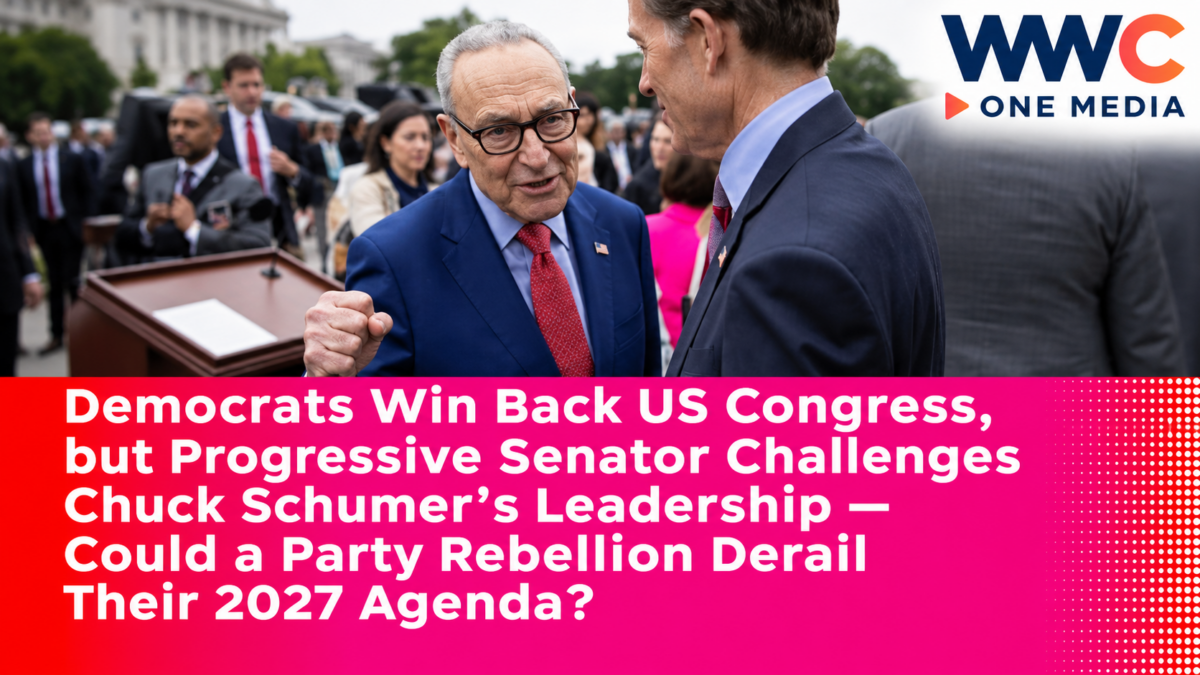
The Democratic Party’s stunning victory in the 2026 US midterm elections has unleashed an unexpected political battle inside its own ranks, as progressive Senator Chris Van Hollen demands sweeping economic commitments before supporting Chuck Schumer for another term as Senate Democratic leader.
Just hours after Democrats secured control of both chambers of Congress, questions began emerging about who should lead the party’s newly empowered Senate majority—and what policies that leadership should prioritize.
Van Hollen, the Maryland Democrat who has emerged as a prominent advocate of a more economically populist party, is urging fellow senators not to automatically endorse Schumer or any other leadership candidate without first agreeing on an ambitious legislative agenda.
According to Bloomberg’s November 4 report, Progressive Senator Demands ‘Bold Agenda’ Before Backing Schumer, Van Hollen wants Democrats to challenge entrenched corporate interests, confront the influence of billionaires and prioritize working-class Americans.
His demand comes at a crucial moment.
Democrats have just won a major electoral victory over President Donald Trump’s Republican Party, gaining enough seats to control both the House of Representatives and the Senate.
But the party now faces a fundamental question: Was the election primarily a rejection of Trump—or a mandate for a more aggressive economic agenda?
Schumer insists he expects to retain his leadership position.
Van Hollen, meanwhile, is warning that the party must not waste its newfound political influence on incremental changes.
The emerging confrontation could determine whether Democrats enter 2027 united behind a common program—or become divided over how aggressively to challenge corporate power, the Trump administration and the economic status quo.
Chris Van Hollen Demands a Bold Democratic Agenda Before Supporting Schumer
Van Hollen’s message is straightforward: Democratic senators should agree on what they intend to accomplish before choosing who will lead them.
Speaking to Bloomberg after the midterm results, he argued that leadership decisions must be tied to meaningful policy commitments.
Rather than focus solely on defeating Republicans, he wants Democrats to advance proposals that improve the lives of working families.
His priorities include confronting powerful corporate interests, reducing the influence of wealthy donors and making the economy more responsive to ordinary Americans.
The senator views the election as an opportunity to redefine the Democratic Party’s economic message.
But his position should not be mistaken for an announced leadership challenge.
Van Hollen has indicated that he does not intend to run against Schumer for the Senate’s top Democratic position.
Instead, he wants the leadership selection process to create leverage for an agreement on the party’s future agenda.
The distinction matters.
Van Hollen is challenging the direction of Democratic leadership, not formally contesting the position himself.
Chuck Schumer Says He Will Remain Senate Majority Leader
Schumer responded to questions about his future with confidence.
The New York Democrat, who has led Senate Democrats since 2017, predicted that he would win another leadership term.
His argument is strengthened by the party’s sweeping electoral success.
Democrats regained the Senate despite entering the election cycle facing a difficult political map and substantial Republican spending advantages.
Schumer played an important role in candidate recruitment, fundraising and campaign strategy.
Several Democratic victories occurred in states where Republicans had been considered strong favorites.
But his leadership is not universally popular within the party.
Progressive lawmakers and newly elected senators have criticized the Democratic establishment for moving too cautiously on economic inequality, healthcare and corporate influence.
The disagreement is becoming more visible now that Democrats are preparing to exercise congressional power.
Schumer’s supporters point to the election results as evidence that his strategy worked.
His critics argue that victory creates a responsibility to pursue more ambitious policies.
Democrats’ Historic Midterm Victory Creates a New Political Reality
The leadership debate follows a remarkable reversal in Washington.
Democrats captured both chambers of Congress in the November 3 elections, dealing President Trump one of the most significant political setbacks of his second term.
The party won competitive Senate races in states including Texas, Ohio, North Carolina and South Carolina.
Democratic candidates also made gains in the House of Representatives.
WWC ONE MEDIA previously examined the national results in Democrats Capture Both Houses of Congress in Sweeping Midterm Victory — Trump Faces Major Political Setback With Two Years Left in Office.
The election gives Democrats greater authority over congressional committees, spending negotiations, federal investigations and the legislative agenda.
However, the new Congress will not convene until January 2027.
The president will also retain his veto power, meaning Democratic control of Congress does not guarantee that every proposed law can be enacted.
That reality makes the party’s internal debate especially important.
Progressives want ambitious legislation, while party leaders must determine which proposals can actually advance through a divided federal government.
Michigan’s Abdul El-Sayed Victory Strengthens the Progressive Wing
One of the most important developments for Van Hollen’s political argument came from Michigan.
Progressive Democrat Abdul El-Sayed defeated Republican Mike Rogers to win the state’s open Senate seat.
The former public-health official campaigned on universal healthcare, reducing corporate influence and addressing the financial pressures facing working families.
His victory was especially significant because the Democratic establishment had initially favored a different candidate during the primary.
Van Hollen publicly supported El-Sayed, while Schumer backed Representative Haley Stevens.
El-Sayed ultimately won the nomination and went on to defeat Rogers in the general election.
His success challenges the assumption that progressive economic candidates cannot win competitive states.
However, one election does not prove that the same strategy will succeed everywhere.
Candidates, local political conditions and voter priorities differ from state to state.
For Van Hollen, Michigan demonstrates that a strong populist message can attract voters beyond traditional progressive strongholds.
For Schumer, the same result strengthens his party’s Senate majority regardless of the earlier primary disagreement.
El-Sayed and Other New Senators Want Fresh Leadership
El-Sayed is not alone in questioning whether Schumer should automatically retain his position.
During the campaign, he expressed support for Van Hollen as a potential Senate Democratic leader.
After winning, El-Sayed indicated that he wanted an open leadership discussion and a stronger focus on removing money from politics, improving household finances and expanding healthcare access.
Other incoming Democratic senators have also expressed reservations.
Minnesota’s Peggy Flanagan has called for new leadership.
Maine’s Troy Jackson has indicated that he would prefer someone other than Schumer.
New Hampshire’s Chris Pappas has emphasized voters’ desire for a new generation of leaders.
These differences could complicate the caucus election.
But there is currently no confirmed challenger with sufficient support to defeat Schumer.
The final vote will take place through an internal Democratic process, rather than a public election.
Brad Lander’s New York Victory Adds Momentum to Progressive Politics
The national election also produced victories for progressive candidates in major urban centers.
In New York, Brad Lander won a congressional seat after defeating an incumbent Democrat during the primary campaign.
His success reinforced the growing influence of the city’s progressive political movement.
WWC ONE MEDIA reported on the result in Brad Lander Wins New York House Seat After Crushing Democratic Incumbent in Primary — But Could Mamdani’s Progressive Movement Reshape Congress?.
The development reflects a broader argument within Democratic politics.
Progressive lawmakers believe voters are increasingly receptive to proposals centered on affordability, public services and challenging concentrations of economic power.
Moderates counter that Democrats must maintain broad coalitions capable of winning suburban and politically competitive states.
Both perspectives will influence congressional strategy.
The key challenge is determining whether the party can translate different approaches into a coherent legislative program.
What Does Van Hollen’s Bold Economic Agenda Actually Mean?
Van Hollen’s message is rooted in the belief that Democrats must move beyond criticizing Trump and explain how they intend to improve everyday economic conditions.
Several policy areas are likely to feature prominently in the debate.
Cost of living: Democrats want to address expenses associated with housing, food, transportation, healthcare and electricity.
Healthcare: Progressive lawmakers support major changes to insurance coverage and medical affordability, although Democrats disagree about the appropriate scope of reform.
Corporate power: Some senators favor stronger antitrust enforcement and policies intended to reduce the influence of large corporations.
Campaign finance: Progressives want to limit the role of wealthy donors and political organizations in federal elections.
Government accountability: Democratic lawmakers plan to increase scrutiny of the Trump administration and its relationships with corporate and political interests.
These priorities overlap with the themes that helped Democrats win in November.
However, Van Hollen’s demand for a bold agenda does not mean every proposal has already been adopted by the Senate Democratic caucus.
Detailed legislation, spending commitments and leadership agreements still need to be negotiated.
The Election May Have Been a Rejection of Trump, Not an Endorsement of Every Democratic Policy
One of Van Hollen’s most important arguments concerns how Democrats interpret their victory.
He has warned that voters were rejecting Trump’s policies and leadership, rather than necessarily endorsing every aspect of the Democratic Party’s platform.
That distinction could shape the next two years.
A sweeping electoral victory can encourage a political party to conclude that voters support substantial policy changes.
But voters often choose candidates for multiple reasons.
Some may support an ambitious progressive agenda.
Others may primarily oppose the incumbent administration.
Still others may vote based on concerns about inflation, healthcare, foreign policy or government accountability.
WWC ONE MEDIA explored those competing pressures in US Midterms 2026: Six Things That Could Decide Control of Congress — Is Trump Facing a Political Turning Point?.
The analysis highlighted affordability, voter turnout, political strategy and public frustration as major factors in the election.
For Democrats, the challenge now is transforming electoral dissatisfaction into a positive governing program.
Why the Fight Against Billionaire Influence Is Becoming Central
The growing focus on wealthy political donors follows an election in which technology executives and industry-backed organizations spent enormous sums attempting to influence congressional outcomes.
Elon Musk and other prominent donors committed substantial resources to Republican candidates.
Cryptocurrency and artificial intelligence groups also invested heavily in key races.
Despite that spending, Democrats won several major contests.
Progressive lawmakers argue that these outcomes show voters are increasingly skeptical of wealthy interests attempting to shape public policy.
Van Hollen’s call for economic reform fits that argument.
However, campaign spending remains influential across both major parties, and financial support does not automatically determine election results.
The policy debate will concern whether Congress should strengthen transparency requirements, reform campaign financing or introduce other restrictions.
Any changes would need to comply with constitutional protections and relevant court rulings.
Schumer’s Leadership Is Stronger Than the Headlines May Suggest
Despite the public disagreements, Schumer remains the favorite to lead Senate Democrats.
The party’s victory strengthened his standing among lawmakers who credit his campaign operation with helping secure the majority.
The Associated Press previously reported that Schumer retained broad support among Democratic senators even as some members declined to endorse him publicly.
Roll Call’s November 4 reporting likewise indicated that no formidable challenger had emerged.
That matters because the caucus leadership election will be decided by senators, not by national opinion polls or social media campaigns.
A vocal group of dissatisfied lawmakers can pressure the leadership without having enough votes to replace it.
Schumer could also address criticism by negotiating policy commitments or creating greater roles for progressive members.
The outcome may therefore involve internal compromise rather than a change in leadership.
A Democratic Majority Still Faces Trump’s Presidential Veto
Even if Democrats reach agreement on an ambitious legislative agenda, major obstacles remain.
Trump will continue serving as president through January 2029.
Congress can pass legislation, but most bills require the president’s signature to become law.
If Trump vetoes legislation, overriding that veto requires a two-thirds majority in both chambers.
Democrats currently do not have that level of support.
The Senate’s legislative filibuster also remains an important procedural obstacle for many bills, although certain measures and nominations are subject to different rules.
Consequently, Democratic lawmakers may achieve some goals through oversight, budget negotiations and selective bipartisan agreements while struggling to enact others.
The limits of congressional power are particularly relevant to healthcare, taxation and large-scale spending initiatives.
A leadership candidate can promise an aggressive agenda, but implementation will depend on political and procedural realities.
Could the Democratic Leadership Debate Shape the 2028 Presidential Race?
The internal struggle could also influence the Democratic Party’s next presidential nomination.
Van Hollen has been discussed as a potential 2028 contender and is considering his future political options.
His refusal to challenge Schumer directly allows him to focus on the party’s broader national direction.
Other Democrats may also use the next two years to establish their leadership credentials.
The debate between economic populism and more moderate coalition-building could become a major feature of the presidential primary campaign.
But Van Hollen has not formally announced a presidential candidacy.
Similarly, Schumer’s anticipated reelection as Senate leader remains a prediction until the caucus votes.
The immediate issue is the party’s congressional leadership, not a confirmed contest for the White House.
What This Political Fight Means Beyond the United States
The Democratic leadership debate could influence America’s approach to trade, foreign policy, technology regulation and government spending.
For countries such as the Philippines, developments in Washington can affect international economic relationships and regional security discussions.
A more economically populist Democratic agenda could increase scrutiny of corporate concentration and certain international commercial arrangements.
However, specific effects on Philippine businesses, investors or diplomatic relations would depend on legislation that has not yet been enacted.
It would be premature to conclude that Van Hollen’s demands will produce immediate changes to US trade policy or foreign assistance.
The most direct consequence at present is political: Democrats must decide what they want to accomplish with their new congressional power.
Georgia’s Jon Ossoff Victory Shows the Importance of Party Unity
While progressive candidates achieved significant victories, Democrats also relied on candidates who could win in politically competitive states.
Georgia Senator Jon Ossoff secured reelection against Republican Mike Collins, preserving a crucial Democratic-held seat.
WWC ONE MEDIA examined the contest in Democrat Jon Ossoff Defeats Trump’s Senate Pick in Georgia, Securing a Crucial Battleground Victory — But Can Democrats Turn It Into Control of Congress?.
Ossoff’s victory illustrates the value of maintaining a broad electoral coalition.
The party’s new Senate majority includes members representing states with different political and economic priorities.
A successful leadership strategy must accommodate those differences.
That is why the debate over Schumer is not simply a contest between personalities.
It concerns how Democrats will balance progressive demands, moderate concerns and the expectations of voters who helped deliver their majority.
What Happens Next in the Senate Leadership Battle?
Senate Democrats are expected to conduct their leadership election in early December.
Newly elected senators will participate in the caucus process.
Schumer is expected to seek another term.
Van Hollen has indicated that senators should first discuss the policies they expect the leadership to advance.
Some incoming members have already expressed dissatisfaction with Schumer, but no credible leadership challenge has been formally established.
The coming weeks will reveal whether those disagreements produce a competing candidate, negotiated policy commitments or a largely uncontested Schumer victory.
Regardless of the outcome, Democrats must prepare for the beginning of the new Congress on January 3, 2027.
Their ability to remain united will be tested by disagreements over legislation, spending negotiations, investigations and relations with the White House.
The Bigger Question: Will Democrats Turn Their Victory Into Real Change—or Fight Among Themselves?
The 2026 midterms gave Democrats an extraordinary opportunity.
The party recaptured Congress, defeated several Trump-backed candidates and demonstrated that it could win in states previously considered difficult terrain.
But victory has also exposed differences over what comes next.
Chris Van Hollen wants Democratic senators to demand an ambitious economic agenda before choosing their leader.
Chuck Schumer believes he can retain the position and guide the caucus toward its priorities.
New progressive lawmakers want changes to healthcare, economic policy and the influence of money in politics.
Other Democrats are focused on maintaining the broad coalition that delivered the election victory.
The disagreement does not necessarily signal an imminent party collapse.
Internal debate can produce clearer priorities and stronger political compromises.
But prolonged leadership conflict could also distract Democrats from the issues that helped them win.
For voters, the ultimate test will be whether their newly elected representatives can deliver meaningful results.
As Chris Van Hollen demands bold commitments and Chuck Schumer prepares to reclaim the Senate majority leader’s office, one question could determine the Democratic Party’s future: Will its historic midterm victory launch a new era of economic reform—or could a battle over leadership and ideology undermine the very majority voters just handed it?