NEW YORK, UNITED STATES / MANILA, PHILIPPINES — November 5, 2026 | WWC ONE MEDIA | Global Business, US Stock Market, Wall Street and Financial News
Wall Street’s biggest trading desks are preparing for a potentially powerful year-end stock market rally after the Democratic Party’s sweeping victory in the US midterm elections triggered an extraordinary rebound that sent the Dow Jones Industrial Average soaring more than 1,500 points in a single session.
The rally followed weeks of anxiety over artificial intelligence valuations, elevated interest rates, geopolitical tensions and the possibility that political uncertainty could trigger another market selloff.
Now, leading financial institutions are arguing that the very conditions that previously frightened investors could create opportunities for another advance.
According to Bloomberg’s November 4 report, Wall Street Trading Desks Bet on US Stock Rally After Midterms, some of the world’s largest trading operations are encouraging clients to increase their exposure to US equities.
Their argument is that cautious institutional positioning, renewed corporate share buybacks, persistent retail buying and the removal of election uncertainty could create substantial demand for American stocks through the remainder of 2026.
The optimism comes after a dramatic trading session.
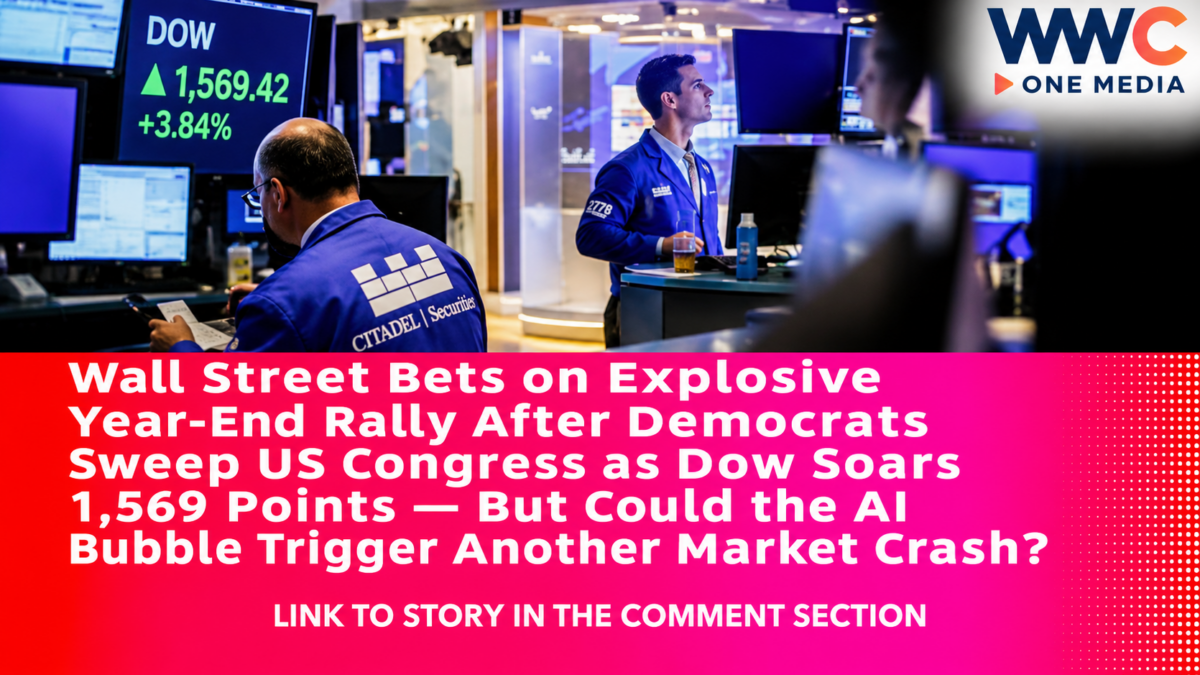
The Dow Jones Industrial Average surged 1,569.40 points, or 3.03%, to close at 53,356.12 on Wednesday, November 4.
The S&P 500 advanced 1.58% to 7,688.62, while the Nasdaq Composite gained 1.44% to 25,736.51.
Smaller companies also participated, with the Russell 2000 rising approximately 1.6%.
The gains followed the Democrats’ capture of both chambers of Congress, a political outcome that investors increasingly believe could restrain some of President Donald Trump’s more disruptive economic proposals.
But the growing optimism comes with substantial risks.
Artificial intelligence spending remains under scrutiny, interest rates are elevated, and Washington’s changing political balance could introduce new restrictions on technology companies.
The central question confronting investors is whether the November election has opened the door to a powerful year-end rally — or whether Wall Street is preparing to repeat the speculative mistakes that triggered its recent technology selloff.
Wall Street’s Biggest Trading Desks Turn Bullish After US Midterm Elections
The November 3 elections created a surprising shift in market sentiment.
Democrats captured the House of Representatives and the Senate, ending Republican control of Congress and creating the prospect of divided government during the final two years of Trump’s presidency.
US stock futures initially fell sharply as investors considered potential changes to technology regulation, government spending and energy policy.
However, that pessimism quickly reversed.
Traders began focusing on the possibility that congressional gridlock could limit aggressive policy changes and reduce uncertainty surrounding Washington’s economic agenda.
Reuters reported that investors welcomed the prospect of greater legislative checks on the administration.
The Financial Times similarly described the rally as a response to expectations that a divided government could restrain fiscal expansion and market-disrupting policy decisions.
For investors, political gridlock can sometimes be attractive because it makes sweeping legislative changes more difficult.
However, divided government does not eliminate presidential executive authority, regulatory action or the risk of disputes over federal spending.
The bullish Wall Street argument is therefore based on expectations of greater policy predictability, not a guarantee of political stability.
Citadel Securities Says US Stocks Could Rally Into the End of 2026
One of the strongest bullish assessments comes from Citadel Securities.
Scott Rubner, the firm’s head of equity and equity derivatives strategy, argued that the market’s current positioning creates favorable conditions for additional gains.
In a November 4 research note titled November: The Setup Improves, Citadel Securities identified several potential sources of renewed stock demand.
These include continued purchases by individual investors, corporate share buybacks and the possibility that systematic trading strategies will rebuild positions after reducing exposure.
According to Citadel’s research, retail investors on its platform purchased approximately $33 billion in US equities over 22 consecutive trading sessions beginning October 5.
The buying streak averaged approximately $1.5 billion per session.
That is significant because the purchases continued despite weakness in the broader market.
Rather than withdrawing entirely, individual investors were using falling prices as opportunities to accumulate shares.
Citadel also identified unusually low positioning among commodity trading advisers, or CTAs, whose systematic strategies often adjust exposure in response to price trends.
Its model placed aggregate US equity positioning approximately 3.3 standard deviations below normal, among the lowest levels in its recorded history.
If the stock market continues recovering, these strategies could be prompted to increase equity exposure.
That buying could reinforce an existing rally.
However, the same strategies can reduce exposure when market trends weaken.
Their potential participation should therefore be understood as a conditional source of demand rather than guaranteed future buying.
JPMorgan Sees a Technology Rebound — But Wants More Than AI Stocks
JPMorgan Chase has also expressed optimism about the market’s near-term prospects.
According to separate Bloomberg reporting, JPMorgan’s US Market Intelligence team, led by Andrew Tyler, remains tactically bullish following the election.
The team sees an opportunity for technology shares to recover after their recent decline.
However, JPMorgan is not recommending that investors focus exclusively on artificial intelligence companies.
Instead, the trading desk favors combining exposure to technology companies with cyclical businesses that can benefit from stronger economic activity.
Its preferred strategy places greater emphasis on cyclicals.
This approach reflects concerns about the extraordinary concentration of market gains in a relatively small number of technology companies.
Artificial intelligence remains a major growth opportunity, but investors have become increasingly sensitive to the cost of building data centers and the uncertain timing of financial returns.
Companies operating in industrials, financial services and consumer-related sectors may provide alternative sources of market performance.
The strategy also reflects an important distinction between a broad market recovery and a rebound concentrated entirely in technology giants.
For a sustained bull market, investors generally look for improvements across a wider range of industries.
Nasdaq’s 10% Correction Creates a New Buying Opportunity — Or a Warning Sign
Wall Street’s renewed optimism follows one of the most difficult periods of 2026 for technology stocks.
The Nasdaq-100 entered technical correction territory earlier in November after falling more than 10% from its October peak.
A technical correction generally refers to a decline of at least 10% from a recent high.
The downturn was driven partly by disappointing earnings reactions, concerns about debt-financed AI infrastructure and growing questions about the profitability of enormous technology investments.
WWC ONE MEDIA previously examined this selloff in Nasdaq-100 Crashes Into 10% Correction as AI Giants Lose Trillions — But Is Wall Street’s Biggest Tech Bubble Finally Bursting?.
That analysis highlighted the risk of investors paying extraordinary valuations for future AI revenue before companies can demonstrate sufficient returns.
For bullish traders, the decline may have created more attractive entry prices.
For cautious investors, the same correction raises concerns that valuations remain disconnected from financial fundamentals.
Both interpretations remain possible.
Lower share prices do not automatically mean a stock has become inexpensive relative to its earnings potential.
Likewise, a correction does not necessarily signal the beginning of a prolonged bear market.
The next phase will depend on corporate profits, market expectations and the cost of financing further growth.
The $33-Billion Retail Buying Streak Signals Continued Investor Appetite
Citadel Securities’ retail-flow data provides another important perspective on the market.
According to its November 4 analysis, retail traders had accumulated nearly $33 billion in US shares on the firm’s platform over 22 sessions.
The company described the streak as one of the longest and largest recorded on its platform since 2017.
What makes the buying noteworthy is that it occurred while the S&P 500 declined approximately 2% over the same period.
That suggests some investors were willing to add exposure despite negative market momentum.
However, the figure does not represent total purchases across the entire US market.
It reflects activity observed through Citadel Securities’ trading network.
Retail buying alone also does not guarantee that prices will rise.
Share prices are determined by the interaction of buyers and sellers, and institutional selling can offset demand from individual investors.
Nevertheless, the data suggests that the recent technology correction has not eliminated investors’ appetite for American equities.
Corporate Buybacks Could Become Wall Street’s Next Major Catalyst
Corporate share repurchases represent another potential source of demand.
Large US companies frequently buy back their own stock, reducing the number of shares outstanding and returning capital to shareholders.
Repurchase activity can become more significant as companies emerge from restrictions associated with quarterly earnings announcements.
Citadel Securities noted that corporate buyback windows were reopening as the market entered November.
That could allow some companies to resume purchases after reporting financial results.
Buybacks can provide additional demand for equities and may support earnings per share by reducing the share count.
But their effects depend on how much capital companies actually commit and when purchases occur.
Authorized repurchase programs do not require companies to buy every share immediately.
They can be reduced, delayed or suspended.
Therefore, the existence of large buyback authorizations does not guarantee that the stock market will experience a sustained rally.
History Suggests Strong Post-Midterm Stock Gains — But There Is a Catch
Wall Street’s bullish outlook is also supported by historical market patterns.
Citadel Securities reported that, since 1950, the S&P 500 has risen over both the six-month and 12-month periods following every US midterm election in its historical sample.
Its analysis found a median 12-month gain of approximately 14.5%.
The firm also reported that the S&P 500 has historically gained an average of 5.6% during the fourth quarter of midterm election years, compared with an average of 2.9% across all fourth quarters.
November has historically been particularly favorable.
According to Citadel’s research, the S&P 500 averaged a gain of approximately 2.2% during November in midterm years.
These statistics help explain why some strategists believe the recent selloff could create a favorable entry point.
However, investors should avoid treating historical patterns as guarantees.
Bloomberg separately reported that market performance has been less impressive under some political configurations.
According to Carson Investment Research, periods featuring a Republican president and Democratic control of both chambers have produced an average annual S&P 500 gain of approximately 4.9% since the early 1950s.
The difference between the figures reflects different historical samples and measurement approaches.
Importantly, the 14.5% historical median gain is a backward-looking statistic — not a forecast that stocks will rise by the same amount after the 2026 election.
Wall Street’s AI Debate Is Far From Over
The recovery comes at a time when some of the world’s most influential investors disagree about the future of artificial intelligence.
Optimists believe AI infrastructure spending could deliver substantial long-term economic benefits.
They point to rising demand for computing power, cloud infrastructure and enterprise automation.
Skeptics warn that companies may be investing too aggressively before the financial returns become clear.
WWC ONE MEDIA previously explored this disagreement in State Street CEO Rejects AI Bubble Fears as Wall Street’s Trillion-Dollar Tech Gamble Grows — But Could Investors Be Ignoring the Next Market Crash?.
The debate has become more important as major technology companies commit enormous sums to data centers, advanced processors and electricity infrastructure.
Even highly profitable businesses can face valuation pressure when investors begin demanding stronger evidence that future spending will generate adequate returns.
A technology rebound after the midterms may therefore be possible without resolving the deeper questions surrounding AI profitability.
Big Tech Faces a Political Threat From Democratic Control of Congress
While divided government may help reduce some policy uncertainty, it could also create new challenges for the artificial intelligence industry.
Democratic lawmakers are expected to increase scrutiny of data-center construction, electricity affordability and environmental concerns.
The issue became especially prominent during the November 3 elections, when dozens of local ballot measures produced outcomes favoring additional restrictions on data-center development.
For companies building large AI computing facilities, local permitting and electricity infrastructure are essential.
Additional restrictions could delay construction, increase expenses or encourage developers to reconsider locations.
However, new legislation would still need to navigate Congress and the president’s veto authority.
Consequently, the election does not automatically establish a nationwide prohibition on AI data centers.
The more realistic risk is that companies could face greater scrutiny, additional negotiations and varying restrictions across individual states and communities.
Investors must assess those potential costs against continuing demand for computing infrastructure.
Goldman Sachs Still Sees Enormous Demand for AI Investment
Despite technology-sector volatility, demand for AI-related financing and corporate transactions remains substantial.
Goldman Sachs Chief Executive David Solomon recently emphasized the continued appetite for major artificial intelligence deals.
WWC ONE MEDIA examined his assessment in Goldman Sachs CEO Sees Explosive Demand for AI Megadeals Despite Tech Stock Selloff — But Could a Trillion-Dollar Financing Boom Turn Into Wall Street’s Next Crisis?.
The report highlighted how corporations and investors continue exploring substantial financing arrangements even as public markets become more cautious about AI valuations.
This creates an important distinction.
Strong demand for financing does not necessarily mean every investment will produce an attractive financial return.
A company can raise billions for infrastructure development while still facing uncertainty about future profits.
For Wall Street, the central challenge is balancing the long-term opportunity created by AI with the near-term financial risks of funding its expansion.
Falling Oil Prices Add Another Boost to US Stocks
The market’s November 4 rally was not driven solely by election results.
A dramatic collapse in oil prices also improved sentiment.
Brent crude plunged 8.7% to settle at $94.62 per barrel, while West Texas Intermediate fell 8.3% to $88.12.
The decline followed expectations that Democratic control of Congress could intensify pressure for negotiations to end the Iran conflict.
Lower oil prices can reduce costs for consumers, transportation companies and businesses dependent on petroleum products.
They may also help ease inflation expectations.
The Associated Press reported that falling energy prices contributed to lower US Treasury yields and stronger demand for stocks.
However, the war has not formally ended.
A failure in diplomatic negotiations or renewed disruption to Middle Eastern oil infrastructure could send crude prices higher again.
That creates another potential source of volatility for equities.
Could Political Gridlock Actually Help the Stock Market?
For investors, the prospect of divided government presents both opportunities and risks.
Democrats will control Congress beginning in January 2027, while Trump will remain president.
That arrangement could make major legislative changes more difficult.
Some Wall Street analysts believe the resulting constraints could reduce fiscal uncertainty and lower the risk of abrupt policy shifts.
However, divided government can also create challenges involving federal budgets, debt-ceiling negotiations and government funding.
Regulatory investigations and legislative confrontations could generate uncertainty for particular industries.
Technology, energy, healthcare and defense companies may experience very different consequences.
The election result is therefore not uniformly positive for every sector.
Indeed, the November 4 rally was uneven.
Healthcare and consumer-related companies benefited from expectations of policy changes, while some energy producers, defense contractors and AI infrastructure businesses experienced declines.
The market’s broad gain concealed substantial differences between industries.
JPMorgan’s Earlier Midterm Strategy Shows Why Sector Selection Matters
Investors were already preparing for different possible congressional outcomes before the election.
WWC ONE MEDIA examined those scenarios in JPMorgan Maps the Stocks That Could Win After the Midterms — But Gridlock May Be Wall Street’s Favorite Outcome.
The earlier analysis highlighted how healthcare, defense, technology, energy and infrastructure shares could respond differently depending on which party controlled Congress.
That framework remains relevant after the Democratic sweep.
Rather than assuming that every stock will benefit equally, investors are considering which industries face improving earnings prospects and which may encounter new political or regulatory obstacles.
The November 4 market action illustrates why such distinctions matter.
The Dow posted a dramatic gain, but individual AI-related and politically sensitive companies did not necessarily participate.
A broad market rally can coexist with substantial losses in particular sectors.
What the Rally Means for the Philippines and Asian Investors
The US stock market’s rebound could have implications for financial markets across Asia.
American equities are an important influence on global investment sentiment, international capital flows and technology-sector valuations.
A sustained Wall Street recovery could encourage investors to increase exposure to other markets perceived as offering attractive growth opportunities.
Philippine investors may also benefit indirectly from improved international risk appetite.
However, foreign equity flows depend on local economic conditions, corporate earnings, valuations and currency expectations.
A US rally does not automatically guarantee a rise in the Philippine Stock Exchange Index.
The decline in crude prices could be relevant to the Philippines because the country depends heavily on imported petroleum.
If lower energy prices persist, they may eventually help reduce transportation costs and some inflationary pressures.
But domestic fuel adjustments also depend on refined-product prices, exchange rates and distribution costs.
For regional investors, the most useful lesson is that political events can influence market sentiment quickly, while longer-term returns depend primarily on earnings and economic fundamentals.
Five Risks That Could Derail Wall Street’s Year-End Rally
Despite the renewed optimism, several obstacles could still reverse the market’s recovery.
First, AI spending could disappoint investors. Large technology companies may continue committing substantial capital before generating the profits needed to justify their valuations.
Second, interest rates could remain elevated. Persistent inflation may limit the Federal Reserve’s ability to loosen monetary policy, keeping financing costs high.
Third, the Iran conflict could escalate again. Renewed military tension could reverse the decline in oil prices and increase inflation concerns.
Fourth, political gridlock could become confrontation. Disputes over federal budgets, spending priorities or regulatory policy could create fresh uncertainty.
Fifth, corporate earnings could weaken. Even favorable investor positioning cannot sustainably support stock prices if company profits fall short of expectations.
These risks do not establish that another crash is imminent.
They demonstrate why traders’ bullish positioning forecasts should be evaluated alongside financial fundamentals.
The Bigger Question: Is Wall Street Entering a New Bull Market — Or Another Dangerous Trap?
The November 4 rally has transformed the mood across US financial markets.
The Dow surged more than 1,500 points.
The S&P 500 and Nasdaq posted substantial gains.
Citadel Securities identified approximately $33 billion in retail purchases on its platform over 22 sessions.
JPMorgan’s trading desk remained optimistic about a technology rebound while favoring broader exposure to cyclical stocks.
And analysts pointed to the historical tendency for equities to perform well after midterm elections.
Together, those developments have strengthened the case for additional gains before the end of 2026.
But the market’s recent experience offers an important warning.
Only days earlier, technology stocks were struggling with a sharp correction driven by concerns about AI investment costs and valuations.
The fundamental questions surrounding profitability, borrowing expenses and financial-market concentration have not disappeared.
The political environment has also become more complicated.
Democratic control of Congress may constrain some presidential policies, but it could introduce new scrutiny of technology investment and create conflict over government spending.
For investors, the most important development will be whether the rebound broadens into sustained earnings-supported gains across multiple industries.
As Wall Street’s biggest trading desks position for a year-end rally and the Dow celebrates a 1,569-point surge, one question could determine the direction of global markets heading into 2027: Will renewed buying, corporate profits and political stability fuel another historic bull run — or could the unresolved risks of the AI boom turn Wall Street’s latest comeback into another painful trap?