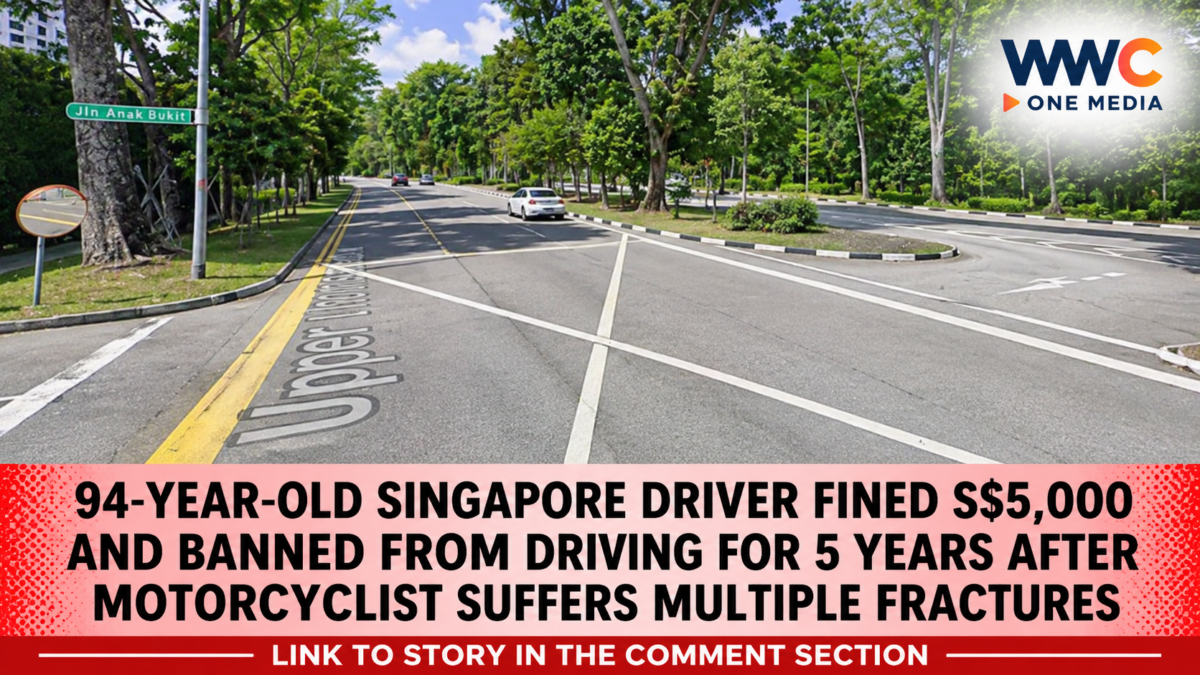
A 94-year-old motorist in Singapore has been fined S$5,000 and disqualified from driving for five years after a road accident left a 58-year-old motorcyclist with multiple leg fractures.
The case has renewed attention on road safety, elderly motorists and the medical requirements for retaining a driving licence in Singapore.
Goh Boon Kang, who will turn 95 in mid-November, was sentenced on November 4 after pleading guilty to one charge of driving without reasonable consideration for other road users and causing grievous hurt.
The accident happened at approximately 9.45am on September 2, 2025, along Upper Thomson Road, near the junction of Jalan Angklong.
According to court proceedings reported by The Straits Times and AsiaOne, Goh was making a discretionary right turn when he failed to give way to a motorcyclist approaching from his left.
The motorcyclist had the right of way.
The collision threw the 58-year-old rider from his motorcycle, leaving him with multiple fractures in his legs. He was admitted to Tan Tock Seng Hospital, where he remained for 32 days before being transferred to a hospital in Malaysia for further treatment.
The court heard that Goh had failed to give way before the collision. He subsequently admitted the offence.
What Happened at the Upper Thomson Road Junction?
The accident occurred near Jalan Angklong, where Goh was attempting to make a discretionary right turn.
A discretionary right turn requires a driver to give way to oncoming traffic before proceeding. In this case, the motorcyclist was travelling from Goh’s left and had the right of way.
Court footage shown during proceedings captured the motorcyclist being thrown from his motorcycle following the impact.
Another motorcyclist also narrowly avoided colliding with Goh’s car, managing to stop in time.
The injured rider suffered multiple leg fractures and required an extended hospital stay.
His 32-day admission at Tan Tock Seng Hospital was followed by a transfer to Malaysia for continued medical care.
The severity of the injuries meant the case was dealt with under an offence involving grievous hurt, rather than a minor traffic violation.
Driver, 94, Receives Maximum Fine and Five-Year Driving Ban
Goh was fined S$5,000 and disqualified from driving for five years.
The fine was the maximum financial penalty for the offence he admitted to.
Under Singapore law, driving without due care or reasonable consideration for other road users and causing grievous hurt can carry a fine of up to S$5,000, imprisonment of up to two years, or both. A driving disqualification may also be imposed.
The prosecution sought the maximum fine and a driving disqualification of between five and six years, according to Lianhe Zaobao’s report.
The defence also sought a S$5,000 fine and a five-year driving ban.
The court ultimately imposed the five-year disqualification.
The sentence means Goh cannot legally drive during the disqualification period. It is important to distinguish this from a permanent driving ban: the reported order was for five years.
Does Singapore Have a Maximum Age for Drivers?
One of the biggest questions raised by the case is whether Singapore has an age limit for motorists.
The answer is no.
Singapore does not automatically revoke a person’s driving licence simply because they reach a particular age.
However, motorists aged 65 and above who wish to retain their driving licences must undergo medical examinations every three years.
These assessments are intended to determine whether drivers remain medically fit to operate a vehicle safely.
The examination considers factors including:
- Medical history and existing health conditions.
- Vision and hearing.
- Physical movement and mobility.
- Physical or mental abnormalities that could affect driving ability.
The assessment is conducted by a Singapore-registered medical practitioner using a checklist developed by the Traffic Police, based on Singapore Medical Association guidelines.
Drivers who fail to obtain the required medical certification must surrender their driving licences.
This system is designed to assess individual fitness rather than impose a blanket ban on everyone above a certain age.
The Upper Thomson Road case does not establish that Goh’s age or medical condition caused the accident. The court finding reported by the media concerned his failure to give way and the resulting grievous hurt.
Singapore’s Road Safety Problem Is Getting More Attention
The case comes as Singapore continues to face concerns over traffic accidents and serious injuries.
According to the Singapore Police Force’s 2025 Annual Road Traffic Situation report, the country recorded:
- 7,560 traffic accidents resulting in injuries in 2025, up from 7,053 in 2024.
- 147 fatal traffic accidents in 2025, compared with 139 in 2024.
- 149 road traffic deaths in 2025, up from 142 in 2024.
- 9,955 people injured in traffic accidents, compared with 9,342 in 2024.
The figures show that both fatal and injury-causing accidents increased.
The police identified failure to keep a proper lookout, failure to maintain adequate control of vehicles and changing lanes without due care among the common causes of accidents.
The authorities have also signalled tougher enforcement, including expanded traffic-camera coverage and increased efforts to deter dangerous driving.
These figures provide a wider picture of the road-safety challenges facing Singapore, although they do not establish a direct connection between the national accident trend and Goh’s individual case.
Motorcyclists Remain Among Singapore’s Most Vulnerable Road Users
The injuries suffered by the 58-year-old motorcyclist also highlight the risks faced by riders on Singapore’s roads.
Motorcyclists and pillion riders accounted for a disproportionate share of traffic accidents and fatalities in 2025.
According to the Traffic Police:
- Motorcycles made up approximately 15% of Singapore’s total vehicle population.
- Motorcyclists and pillion riders were involved in 54.8% of all traffic accidents.
- They accounted for 53% of traffic fatalities.
- Motorcycle-related accidents increased from 3,973 in 2024 to 4,227 in 2025.
- Motorcyclist and pillion rider casualties increased from 4,510 to 4,844.
The figures demonstrate why collisions involving motorcycles can have particularly serious consequences.
Unlike car occupants, motorcyclists have limited physical protection when struck by another vehicle. Even a collision at a junction or during a turning manoeuvre can result in severe injuries.
The police have repeatedly highlighted the need for motorists to keep a proper lookout, check for motorcycles and give way when required.
The Bigger Question: How Should Singapore Assess Elderly Drivers?
The case has brought renewed attention to the balance between mobility and road safety for older motorists.
For many elderly people, driving provides independence and makes it easier to attend medical appointments, visit family members and carry out daily activities.
At the same time, driving requires the ability to see clearly, react promptly, judge distances and control a vehicle safely.
These abilities can change with age, but not every older person experiences the same physical or medical limitations.
That is why Singapore’s existing system relies on periodic medical assessments rather than an automatic age-based driving ban.
The case also illustrates why the medical fitness assessment and the responsibility to follow traffic rules are separate issues.
Passing a medical examination does not remove a driver’s obligation to give way, observe road signs or exercise reasonable care around other road users.
Likewise, a traffic accident involving an elderly motorist should not automatically be treated as proof that all older drivers are unsafe.
The focus remains on the specific conduct established in each case.
What This Case Means for Singapore Motorists
The five-year driving disqualification sends a clear reminder that traffic offences causing serious injuries can carry substantial consequences, regardless of a driver’s age.
For motorists approaching junctions, the case highlights the importance of checking for oncoming traffic before making a discretionary turn.
For motorcyclists, it reinforces the risks of travelling through busy junctions where drivers may be turning across their path.
And for elderly drivers, it highlights the importance of keeping up with required medical assessments and honestly evaluating whether they remain comfortable and capable behind the wheel.
Singapore’s road-safety challenge cannot be addressed through enforcement alone. It also requires responsible driving, awareness of vulnerable road users and regular attention to individual fitness to drive.
Goh’s case is a reminder that one failure to give way can have consequences that last far beyond the moment of impact — for both the injured victim and the driver responsible.