
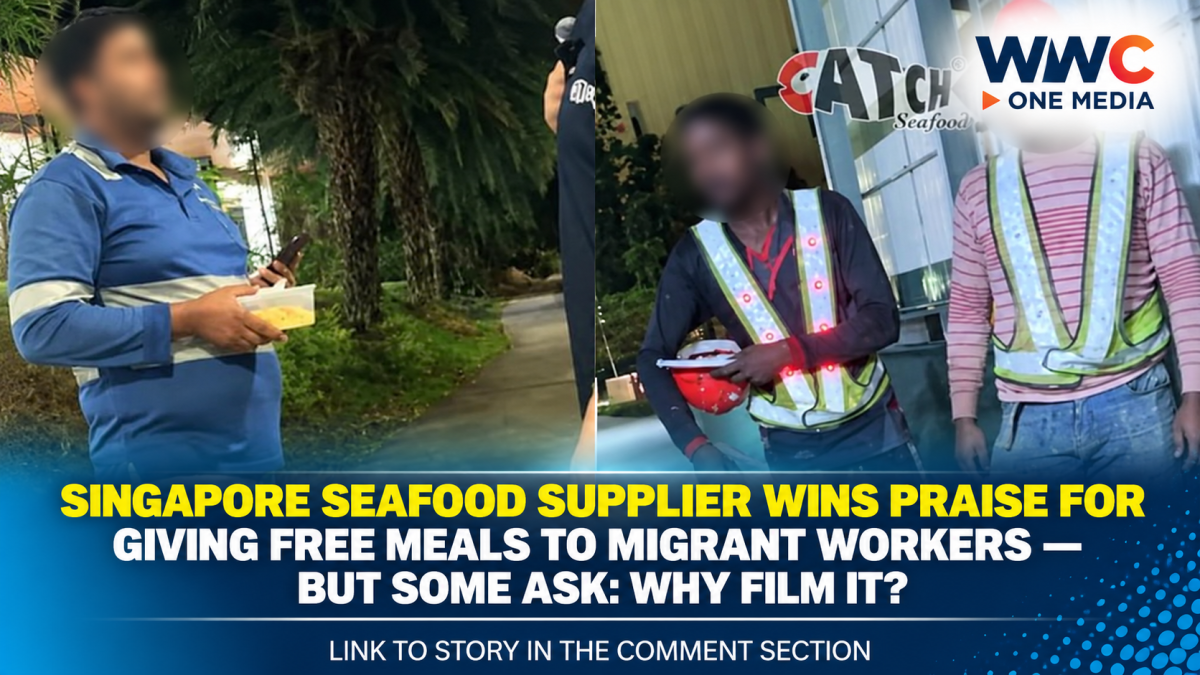
A Singapore seafood supplier is drawing widespread attention online after its staff began approaching migrant workers during their breaks to offer them free meals — while also sitting down to hear about their lives in Singapore.
The initiative by Catch Seafood has gone viral after a series of TikTok videos showed staff members cycling around Singapore, meeting construction workers and offering them freshly prepared food.
The latest video, posted on Sept. 2, shows a staff member approaching two construction workers and asking whether they would like free pasta. After they agreed, he checked whether they had seafood allergies and whether they could eat spicy food before handing over two packed meals.
A simple question: “You want free food?”
The latest video features two workers, one from India and one from Bangladesh, who were taking a break from construction work.
After receiving their meals, the workers also spoke with the Catch Seafood staff member about their experiences living and working in Singapore.
One worker said Singapore had been good to him and described his pay as “ok”. He also shared that he hoped to return home, get married and start a family.
What began as a food giveaway quickly became something more personal: a conversation about work, family, safety and life away from home.
It is already the third video
The Sept. 2 video wasn’t a one-off.
AsiaOne reported that it was the third video in a series documenting Catch Seafood staff giving free meals to migrant workers.
The first video was posted on Aug. 25 and featured a Bangladeshi worker who said he had been working in Singapore for 15 years.
He explained that he normally returns to Bangladesh every one or two years to visit his family.
Asked about Singapore, he praised the country’s rules and safety but acknowledged that the work can be difficult.
His message was straightforward: the work is hard, but the income is one reason he continues working in Singapore.
A second video, posted on Aug. 28, featured another Bangladeshi worker discussing the difficulty of being separated from his wife and family.
Despite that hardship, he said he preferred working in Singapore because he considered it safer than his home country.
Why is Catch Seafood doing this?
According to replies from Catch Seafood to commenters, the company’s motivation is to show appreciation to the migrant workers who help build Singapore.
That message has resonated strongly online.
By the time AsiaOne published its report, the latest video had attracted more than 66,000 views, while commenters encouraged the company to continue the initiative.
Some viewers even suggested locations where the team could find more workers who might appreciate a meal.
One suggestion pointed toward workers involved in the North-South Corridor project, where employees can work long hours outdoors and late into the night.
Catch Seafood responded that it would look around that area during a future outing.
But not everyone is comfortable with the videos
The initiative has overwhelmingly received positive reactions, but there is another side to the conversation.
Some commenters questioned whether acts of kindness need to be filmed and uploaded to social media.
That raises an important question about the line between charitable gestures and social-media content.
The videos do not necessarily prove that the workers objected to being filmed, but the criticism highlights a broader issue: when people are receiving help, particularly workers in a potentially vulnerable position, consent and dignity matter alongside the good intentions behind the gesture.
AsiaOne said it had contacted Catch Seafood for more information.
Migrant workers are a major part of Singapore’s workforce
The story also comes against the backdrop of Singapore’s wider migrant-worker community.
The Ministry of Manpower’s 2024 Migrant Worker Experience Survey found that 95.3% of migrant workers surveyed were satisfied with working and living in Singapore, the highest level recorded since the survey began in 2011.
The survey also found that 92.3% would recommend Singapore as a place to work, with safety, salary and worker protection among the reasons cited.
Food is another important part of migrant workers’ daily lives.
MOM said in April 2026 that only about 13% of migrant workers have meals catered by employers, while roughly eight in 10 cook or purchase their own meals.
Under Singapore’s Employment of Foreign Manpower Act, employers must ensure that migrant workers living in dormitories have access to food. Employers can meet this requirement through catering, allowing workers to purchase cooked food or providing cooking facilities.
That makes a free meal from a stranger more than just a plate of food for some workers spending months or years away from their families.
Catch Seafood is not the only initiative helping workers
Singapore has a number of organisations providing food assistance to migrant workers.
For example, The Cuff Road Project, operated by Transient Workers Count Too, provides free meals to eligible migrant workers who are out of work while pursuing employment claims.
In 2025 alone, the programme said it served approximately 45,500 meals to 1,088 workers.
Meanwhile, Krsna’s Free Meals, highlighted by The Straits Times, provides meals to migrant workers in Little India. The organisation has grown from serving around 80 workers a day when it began to about 4,000 today, according to the newspaper’s 2025 report.
These initiatives show that food support for migrant workers in Singapore isn’t new — but Catch Seafood’s approach is distinctive because it combines the meal with an informal conversation about the workers’ experiences.
From seafood supplier to unexpected community outreach
Catch Seafood is the home brand of The Fish Net, a Singapore seafood supplier established in 2003.
The company says it supplies seafood to hotels, restaurants, retail outlets and consumers across Singapore, alongside ready-to-cook meals and other food products.
Its latest social-media campaign therefore represents an unusual shift from simply selling food to using food as a way of connecting with people working on the streets of Singapore.
The company’s own message is simple: sometimes a small gesture can make a difference.
But the reaction also shows that the public is watching not only what companies do, but how they do it.
The bigger story
The viral videos aren’t really about free pasta or seafood.
They are about two groups of people who might otherwise never stop to speak to each other: the people supplying food to Singapore and the migrant workers helping construct the city around them.
For the workers featured in the videos, the meal lasts minutes.
The conversation may last a little longer.
But for someone far from home, being asked how life is going may be just as meaningful as what is inside the food container.
At the same time, as the videos continue to attract attention, the question about filming acts of kindness is unlikely to disappear.
The challenge for Catch Seafood may now be keeping the focus on the workers themselves — not simply on the viral videos.
WWC ONE MEDIA J.M.D




Leave a Reply