
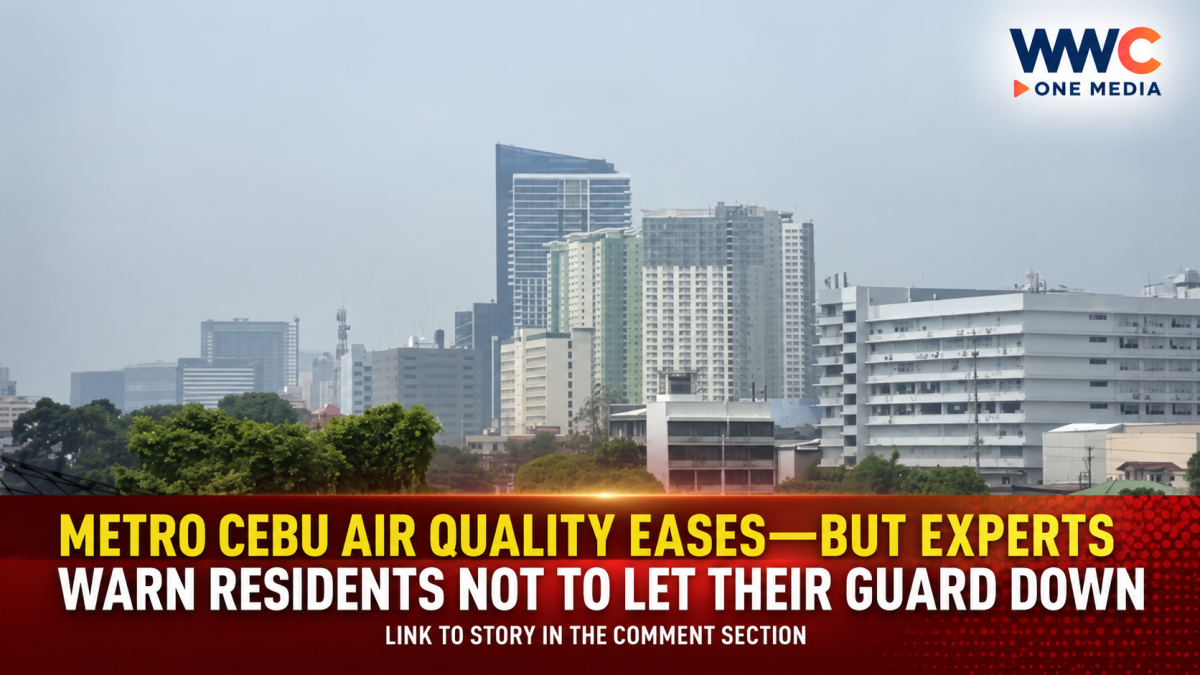
CEBU CITY, Philippines — Metro Cebu’s air quality has shown signs of easing, but residents are being urged not to become complacent as haze linked to wildfires in Indonesia continues to affect the region.
The latest development comes after several days of deteriorating air quality that pushed Metro Cebu into the “Acutely Unhealthy” category, prompting class suspensions and heightened preparations by health authorities.
The situation is now being closely watched by environmental and health officials as the direction of the haze remains dependent on wind patterns and the continuing wildfire activity in Indonesia.
From very unhealthy to acutely unhealthy—and back
Air quality in Metro Cebu deteriorated sharply earlier this week.
On September 1, the monitoring station in Talisay recorded AQI readings ranging from 152 to 173, already within the “Very Unhealthy” range.
By September 2, readings climbed above 200, reaching 203, 208 and 215, placing Metro Cebu in the “Acutely Unhealthy” category.
The situation became even more serious on September 3.
The Metro Cebu monitoring station recorded an AQI of 241 at 4 a.m., rising to 252 at 11 a.m. The reading eased only slightly to 251 by 4 p.m., but remained “Acutely Unhealthy.”
The 252 reading was reported as the highest recorded during the current haze episode.
What is causing the haze?
Environmental officials have linked the worsening air quality primarily to transboundary haze associated with ongoing fires in Kalimantan, Indonesia.
According to DENR-EMB 7, prevailing winds can transport smoke and fine particulate matter across borders and into the Philippines.
The haze has not been confined to Metro Cebu. Authorities have reported effects in other parts of the Visayas and Mindanao, while monitoring and trajectory models indicate that areas of Cebu, Bohol and parts of Eastern Visayas may also be affected.
Importantly, officials have stressed that the haze is different from volcanic emissions. The primary concern in this episode is fine particulate matter, particularly PM2.5, rather than volcanic sulfur dioxide.
Why PM2.5 is a serious concern
PM2.5 consists of extremely small particles capable of penetrating deep into the respiratory system.
Health authorities warn that prolonged exposure can aggravate respiratory conditions and may cause symptoms even among people who do not normally suffer from respiratory illnesses.
DENR-EMB 7 specialist Arthur Niño Calupig warned that the health effects may not always be immediately noticeable, which is why residents should continue taking precautions even when visibility or the smell of smoke improves.
DOH puts Central Visayas hospitals on heightened alert
The Department of Health in Central Visayas has also stepped up preparations.
DOH-7 placed hospitals and other health facilities on heightened alert in anticipation of a possible increase in respiratory cases associated with prolonged haze exposure.
Hospitals were advised to prepare equipment and medicines, maintain the capacity of emergency rooms and ensure that patients can be referred efficiently if cases increase.
As of September 4, DOH-7 said there had not been a surge of respiratory illnesses directly attributed to the haze, although Cebu City officials reported some minor cases associated with poor air quality.
Who should be extra careful?
Health authorities are particularly concerned about vulnerable groups, including:
- Young children
- Older adults
- Pregnant women
- People with asthma or other respiratory conditions
- People with chronic lung or heart conditions
- Workers who spend long hours outdoors
DOH-7 advised vulnerable individuals to limit unnecessary outdoor activities while air quality remains poor.
For people who must go outside, authorities recommend a well-fitted N95 mask, with KN95 masks also recommended by environmental officials.
Residents are likewise advised to avoid strenuous outdoor activity, stay hydrated and minimize exposure to other sources of air pollution such as cigarette smoke and burning garbage.
Schools already feeling the impact
The hazardous air conditions have also disrupted education.
Cebu City suspended face-to-face classes after the air quality deteriorated, while other local government units in Metro Cebu followed with their own suspensions as the haze persisted.
Lapu-Lapu City, for example, suspended face-to-face classes in public and private schools for September 4 because of the hazardous air quality.
The danger may not be over yet
Despite the latest improvement, environmental officials are warning against assuming that the haze is about to disappear.
DENR-EMB 7 said there is no definite timetable for when the air quality will return to safer levels because conditions depend heavily on the intensity of the Indonesian fires and prevailing winds.
Officials have also warned that Cebu’s air quality could potentially reach the “Emergency” category if wildfire activity intensifies and elevated PM2.5 levels persist.
For now, the message from authorities is straightforward: a slight improvement does not necessarily mean the air is safe.
Residents are urged to continue checking official DENR-EMB air-quality advisories, reduce unnecessary outdoor exposure and take additional precautions until pollution levels return to safer conditions.
Metro Cebu may be seeing some relief—but the haze remains a developing public-health concern.




Leave a Reply