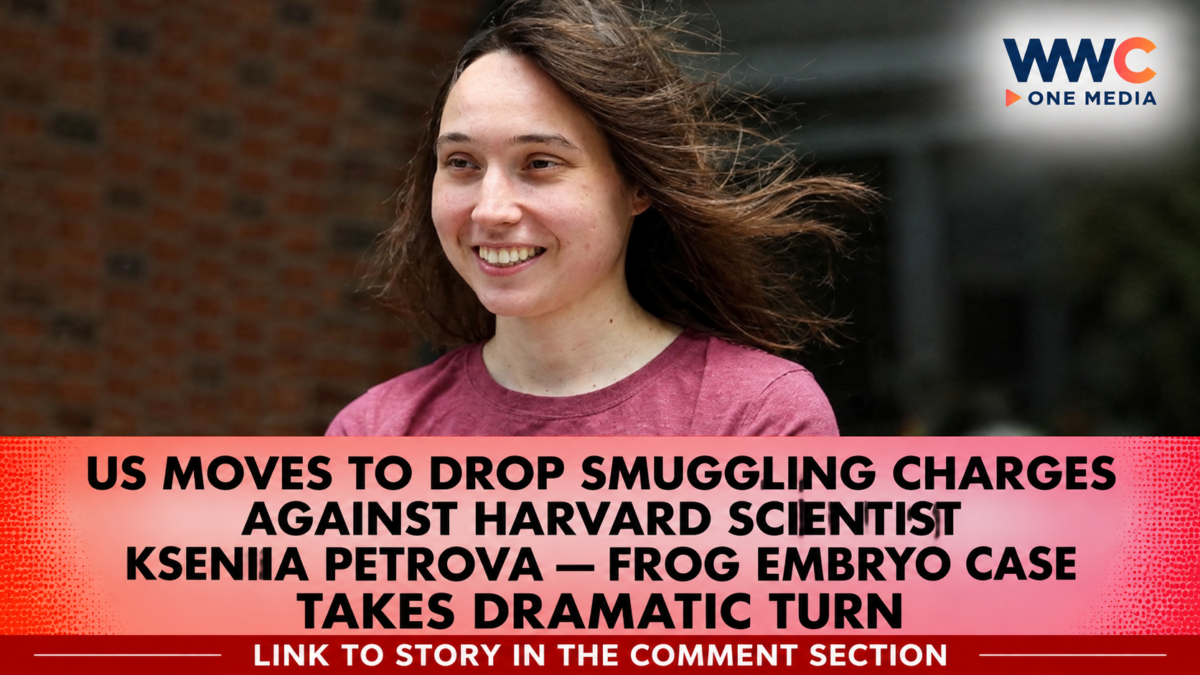
A controversial criminal case involving a Russian-born Harvard Medical School researcher accused of smuggling frog embryos into the United States is approaching a possible end after federal prosecutors moved to dismiss the charges against her.
The case against Kseniia Petrova attracted international attention after she was detained at Boston Logan International Airport in February 2025, had her US visa cancelled and subsequently faced federal criminal charges over undeclared biological samples found in her luggage.
Now, prosecutors in Boston have asked to end the criminal case, following court decisions that allowed Petrova to seek government records supporting her claim that she was selectively and vindictively prosecuted.
The government’s latest move represents a major development in a case that has raised questions about immigration enforcement, academic research, the treatment of foreign scientists and the limits of federal prosecutorial authority.
However, an important distinction remains: prosecutors have moved to dismiss the charges, but the latest reports do not establish that a judge has already formally granted the request.
The decision also does not mean prosecutors have admitted that the case was politically motivated. In their filing, they described Petrova’s claims as meritless, while arguing that continuing the prosecution after the judge’s order would divert significant time and attention from more substantial federal interests.
Who Is Kseniia Petrova and Why Was She Arrested?
Petrova is a Russian-born biomedical researcher who worked at Harvard Medical School.
Her legal troubles began on February 16, 2025, when she arrived at Boston Logan International Airport after travelling from France.
According to court records, US Customs and Border Protection officers inspected her luggage and discovered biological samples involving frog embryos that had not been declared.
The samples were intended for scientific research. Petrova said her supervisor had asked her to bring them back for experiments at Harvard.
The government alleged that the materials should have been declared to customs officials and that Petrova had made false statements during the inspection.
Petrova’s lawyers maintained that she had no intention of illegally importing dangerous materials and argued that she was unfamiliar with the customs requirements governing the samples.
The case involved clawed frog embryos, including inert formalin-fixed embryonic material, according to court documents. The dispute was not simply about whether the samples were in her luggage, but also about the legal classification of the materials and whether her conduct justified felony criminal charges.
The distinction became central to the legal proceedings that followed.
Visa Cancelled, Researcher Detained for Months
After the airport inspection, immigration authorities cancelled Petrova’s J-1 exchange visitor visa.
She was subsequently detained by US immigration authorities and transferred between detention facilities, including one in Louisiana.
Her lawyers challenged the detention and the cancellation of her visa.
The criminal case moved forward in May 2025, when prosecutors brought charges involving smuggling and making false statements.
Petrova pleaded not guilty.
She was eventually released on bail on June 12, 2025, after spending several months in custody. Her release did not immediately end the criminal proceedings or resolve her immigration dispute.
The case became particularly controversial because Petrova’s lawyers argued that a customs violation involving research samples had escalated into a serious criminal prosecution with significant consequences for her career and immigration status.
Her detention also attracted attention from academics and researchers concerned about how foreign scientists might be treated when transporting biological materials for legitimate research.
Federal Judge Ruled That Her Visa Was Unlawfully Cancelled
One of the most significant developments came in April 2026, when US District Judge Christina Reiss ruled that Customs and Border Protection had unlawfully cancelled Petrova’s J-1 visa.
The judge found that the agency had not established legal authority to cancel the visa on the grounds used in her case.
The ruling said the cancellation was based on the frog embryo samples and that the action exceeded the agency’s statutory authority.
This was an important legal victory for Petrova, but it did not automatically dismiss the separate criminal charges.
The immigration dispute and the criminal prosecution were separate legal proceedings, each involving different questions.
The visa ruling addressed the government’s authority to cancel her immigration document. The criminal case concerned the allegations that she had illegally brought undeclared materials into the country and made false statements.
That distinction is essential to understanding why the case continued even after the visa cancellation was ruled unlawful.
Another Judge Found Grounds for Petrova to Seek Evidence of Selective Prosecution
The latest move by federal prosecutors followed another important development in the criminal proceedings.
In April 2026, US Magistrate Judge Judith G. Dein considered Petrova’s request for access to government records that could support her claim of selective and vindictive prosecution.
The judge found that Petrova had presented sufficient evidence to pursue discovery related to those allegations.
Among the issues raised was whether her status as a Harvard researcher influenced how authorities handled the case.
The judge also examined the circumstances surrounding the decision to bring felony charges after Petrova challenged her immigration detention.
The government disputed the allegations and sought to overturn the discovery ruling.
However, US District Judge Leo T. Sorokin rejected the government’s challenge in October, allowing the discovery decision to stand.
That development placed prosecutors in a difficult position: continuing the case would mean proceeding after a court had allowed Petrova to seek records relevant to her claims about the government’s conduct.
It was against this background that prosecutors moved to dismiss the criminal charges.
Importantly, the discovery ruling was not a final finding that Petrova had been vindictively prosecuted. It meant she had presented enough evidence to obtain relevant records and pursue the claim.
Why Prosecutors Now Want to Drop the Charges
In their November 3 court filing, federal prosecutors said they were moving to dismiss the charges against Petrova.
They maintained that her allegations of vindictive prosecution were meritless.
However, prosecutors argued that continuing the case after the judge’s order would divert significant time and attention from more substantial federal interests.
Their filing described the decision as a matter of allocating government resources.
The move is particularly notable because prosecutors had previously pursued the case despite Petrova’s legal challenges and the separate ruling that her visa had been unlawfully cancelled.
Petrova’s lawyer, William Fick, welcomed the development, saying his client had shown tremendous courage throughout the proceedings and expressing relief that the ordeal appeared close to ending.
A spokesperson for US Attorney Leah Foley declined to comment, according to Reuters.
The next procedural step is for the court to address the prosecution’s request. Until the request is formally granted, the safest description is that prosecutors have moved to dismiss the charges rather than that the case has conclusively been dismissed.
Harvard Researcher Was Back in Her Laboratory Before the Latest Development
Despite the criminal and immigration proceedings, Petrova had returned to her Harvard laboratory before the latest announcement.
Her lawyer previously told The Washington Post that she had been back at work since January 2026 after successfully petitioning the court for permission to return.
The case nevertheless continued to affect her professional and personal life.
For researchers, the controversy raised concerns about whether international scientific collaboration could become more difficult if transporting biological samples across borders exposed academics to severe criminal and immigration consequences.
Universities regularly rely on international research partnerships, and scientists may need to transport biological materials for experiments, testing and collaborative projects.
Such materials can be subject to customs declarations, permits and other regulatory requirements. Researchers are expected to comply with those rules, even when samples are intended for legitimate academic work.
But Petrova’s case has also raised questions about whether the government’s response was proportionate to the circumstances and whether the legal process was applied consistently.
The Case Comes Amid Wider Tensions Between Trump and Harvard
Petrova’s prosecution unfolded during a broader confrontation between the Trump administration and Harvard University.
Washington has challenged the university over federal research funding, international student enrolment, campus policies and other institutional matters.
Harvard has contested several government actions in court, arguing that the administration has exceeded its authority in attempting to pressure the university.
The Petrova case is legally separate from those disputes. There is no court finding that her prosecution was part of a coordinated campaign against Harvard.
Nevertheless, her lawyers argued that the wider political environment contributed to the way authorities treated her.
The issue has become part of a broader debate about whether universities and international researchers can operate independently amid growing political scrutiny.
WWC One Media previously examined the wider confrontation in Trump’s Harvard Battle Could Give Hong Kong a Rare Opportunity in Global Education.
That report explored how political and regulatory uncertainty surrounding American universities could influence international students considering other education destinations.
Another related development involved the federal government’s attempt to obtain sensitive student admissions records from Harvard. Read WWC One Media’s coverage: Trump Administration Loses Harvard Admissions Data Lawsuit as Judge Throws Out Case.
The admissions lawsuit and Petrova’s criminal case are separate proceedings, but both illustrate the extent of the legal confrontation between Harvard and the federal government.
Foreign Researchers Face Growing Scrutiny Over International Academic Work
Petrova’s case also comes at a time when governments are paying closer attention to international research partnerships and the movement of biological and technological materials.
Scientific collaboration can involve sensitive research, valuable intellectual property and materials subject to national security or public health regulations.
Authorities in several countries have raised concerns about the possibility that legitimate academic relationships could be exploited to obtain sensitive technologies or information.
In the United Kingdom, for example, intelligence officials have warned universities about research partnerships they believe could be linked to foreign intelligence activities.
WWC One Media covered the issue in UK Accuses China of Using Academic Research to Boost Espionage Capabilities.
The British warning is a separate matter and does not establish any connection to Petrova’s case. It does, however, demonstrate how research security has become an increasingly important issue for universities and governments.
Similarly, WWC One Media reported on the Pentagon’s allegations involving China-funded Confucius Institute networks at US universities.
That controversy concerns foreign influence and university partnerships, not the importation of frog embryos. Both developments nevertheless reflect the growing pressure on academic institutions to balance international cooperation with regulatory and security concerns.
Why the Case Matters Beyond Harvard
The outcome could have implications beyond one researcher and one university.
For foreign academics working in the United States, the case highlights the importance of understanding customs rules governing biological samples, research materials and other regulated items.
Even materials intended for non-commercial scientific work may require declarations, permits or specific documentation.
Universities also have a responsibility to ensure that researchers receive clear guidance before travelling with laboratory samples.
The controversy raises several important questions:
- Were the customs requirements sufficiently clear to the researcher?
- Was the legal classification of the frog embryo samples properly established?
- Did the circumstances justify felony charges?
- Were immigration and criminal procedures applied within the limits of federal law?
- How should courts evaluate claims that a researcher was selectively or vindictively prosecuted?
The latest prosecutorial move may prevent the criminal case from proceeding further, but it does not automatically resolve every question about the government’s handling of Petrova’s immigration and criminal proceedings.
What Happens Next?
The immediate issue is whether the court will grant the prosecutors’ request to dismiss the indictment.
If granted, the criminal prosecution would end, although separate immigration-related matters and any other legal claims would need to be considered independently.
Petrova’s legal team has also pursued issues connected to the consequences of her detention and the unlawful visa cancellation.
Cambridge Day reported that her immigration lawyer had filed a separate request seeking approximately US$245,000 in legal fees, arguing that Petrova had prevailed in parts of the immigration litigation.
That request is separate from the criminal charges and should not be confused with compensation already awarded.
The government’s response and the court’s decision on that matter remain separate procedural questions.
For now, the most significant development is that federal prosecutors have moved to end the criminal case after losing their challenge to Petrova’s request for discovery.
The Bottom Line
The US government is moving to dismiss the smuggling and false-statement charges against Harvard Medical School researcher Kseniia Petrova, whose case began after customs officers found undeclared frog embryo samples in her luggage at Boston Logan International Airport in February 2025.
Petrova spent months in custody, had her J-1 visa cancelled and faced federal criminal charges. A judge later ruled that the visa cancellation was unlawful, while another judge allowed her to seek government records supporting her claim of selective and vindictive prosecution.
Federal prosecutors have described those allegations as meritless but said continuing the criminal case after the discovery ruling would divert resources from more substantial federal interests.
The latest move is a major development, but it is important not to overstate what has happened: prosecutors have requested dismissal, and the available reporting does not confirm that the court has formally granted it.
Beyond Petrova’s personal ordeal, the case raises wider questions about immigration enforcement, academic freedom, research security and the treatment of foreign scientists in the United States.
After months of detention and a legal battle over her visa and criminal charges, will the court finally bring Kseniia Petrova’s case to an end — or will the controversy over how the US government handled her prosecution continue?