SAINT-MALO, France — November 4, 2026 | WWC ONE MEDIA | International Sports, Sailing & Maritime Technology
A dream of back-to-back victories has ended in the middle of the Atlantic Ocean.
French sailing champion Charles Caudrelier has withdrawn from the 2026 Route du Rhum after his cutting-edge, 32-meter racing yacht suffered a major technical failure just two days into the prestigious solo transatlantic race.
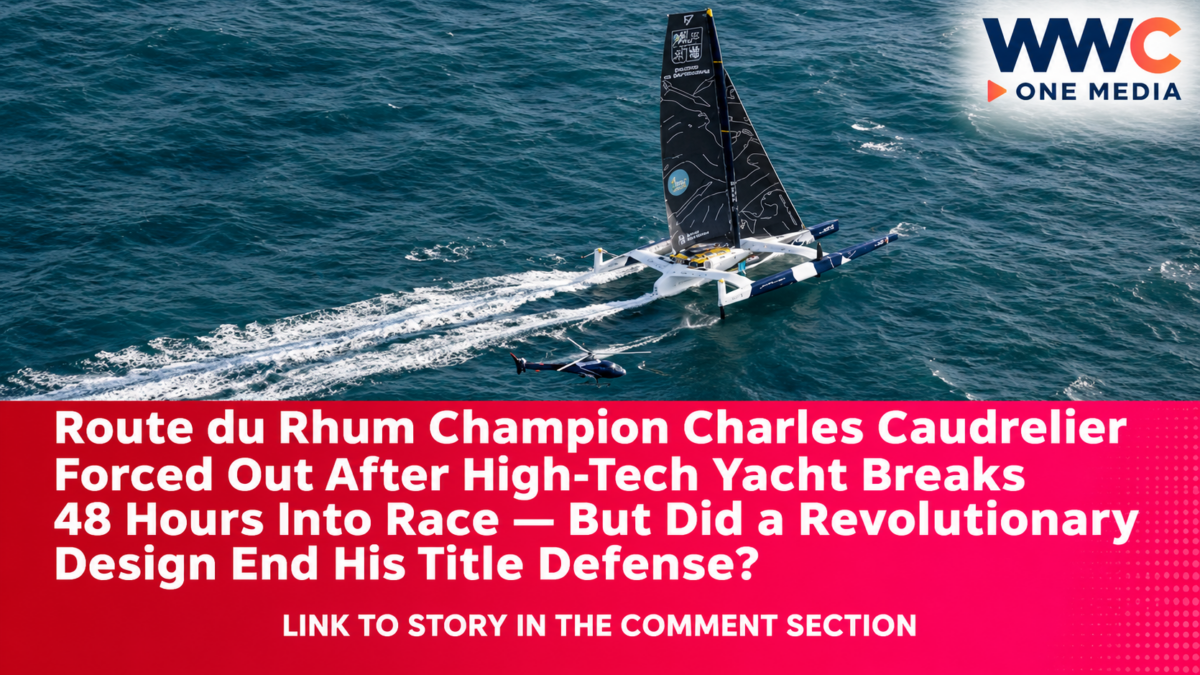
The 52-year-old defending champion was forced to abandon his title defense after serious damage was discovered in the port-side foil of the Maxi Edmond de Rothschild, also known as Gitana 18.
The incident occurred on November 3, approximately 400 nautical miles north of the Azores, as Caudrelier competed against some of the world’s fastest offshore racing yachts.
At the time, he was among the leading competitors in the Ultim class.
But the yacht suddenly stopped performing as expected.
Despite favorable conditions for high-speed foiling, the vessel was struggling to lift above the water.
An onboard inspection revealed extensive damage to one of the structures responsible for generating that lift.
After assessing the situation, Caudrelier and his technical team determined that the damage could not be repaired safely during the race.
He abandoned the competition and began returning to Lorient, France, where his team maintains its technical base.
The withdrawal ends Caudrelier’s attempt to become a consecutive Route du Rhum champion and raises fresh questions about the reliability of increasingly complex racing yachts.
But was the failure simply an unfortunate mechanical incident—or a warning about the risks of introducing revolutionary technology before it has been tested under the toughest conditions at sea?
A Title Defense Ends After Just Two Days
The 2026 Route du Rhum began on Sunday, November 1, from Saint-Malo on France’s Brittany coast.
Competitors were racing across the Atlantic toward Pointe-à-Pitre in Guadeloupe, a French overseas territory in the Caribbean.
For Caudrelier, the event represented an opportunity to repeat his historic victory in 2022.
But his campaign ended less than 48 hours after leaving France.
According to a November 3 statement from Gitana Team, Caudrelier noticed unusual behavior from his yacht shortly before 5 a.m.
The vessel was unable to achieve the performance expected under the prevailing wind and sea conditions.
He inspected the yacht’s hydrofoils and discovered serious damage to the port-side structure.
The team then began evaluating whether repairs were possible.
Their conclusion was that the damage was too extensive to resolve during the competition.
Returning to Lorient became the safest and most practical option.
What Went Wrong With Gitana 18?
Gitana 18 is a state-of-the-art Ultim-class trimaran designed to achieve extraordinary speeds by reducing resistance from the water.
The yacht uses large hydrofoils, underwater lifting structures that help raise parts of the hull above the sea surface.
At sufficient speed, the reduced contact between the hull and water can significantly lower drag.
This allows advanced racing multihulls to travel much faster than conventional displacement sailing vessels.
But the technology places substantial loads on the foil structures.
According to Gitana Team, the composite layers along the trailing edge of the damaged port foil were torn away.
Hydraulic hoses connected to the structure were also damaged.
The failure affected the yacht’s ability to operate normally.
Caudrelier had to secure the damaged component and isolate affected hydraulic systems to protect the vessel during the return journey.
The team confirmed that the incident was not the result of a collision with an external object.
However, it has not identified a definitive underlying engineering cause.
That distinction is important.
The incident establishes that a major structural failure occurred, but it does not establish whether the failure resulted from manufacturing, design, fatigue, maintenance or another technical factor.
Rough Atlantic Conditions Complicated the Situation
The incident occurred in demanding offshore conditions.
Gitana Team reported waves reaching approximately three meters and northerly winds of 20 to 25 knots.
Caudrelier was sailing roughly 400 nautical miles north of the Azores.
Despite the difficult conditions, his team confirmed that the skipper was safe.
The immediate priority was securing the damaged yacht and ensuring it could return without exposing Caudrelier to unnecessary danger.
Offshore racing is especially challenging because competitors must manage complex vessels while sailing alone.
They must navigate, monitor weather, operate sails and respond to technical emergencies without another crew member physically aboard.
A problem that might be manageable with a larger crew can become much more difficult during solo competition.
For Caudrelier, the extent and location of the damage made continuing toward Guadeloupe impractical.
Why the Team Chose Lorient Instead of the Azores
After examining the damage, Gitana Team considered different options.
One was to head south toward the Azores, approximately 400 nautical miles away.
The other was to return to Lorient, roughly 1,500 nautical miles from the yacht’s position.
Although Lorient was farther away, it offered access to the team’s technical facilities and personnel.
The weather forecast also supported the decision to head back toward Brittany.
The team did not provide a precise arrival time, saying progress would depend on the yacht’s performance in its damaged condition.
It hoped Caudrelier could reach Lorient during the weekend.
As of the November 4 reporting snapshot, the return voyage was underway.
There was no confirmed report that the yacht had already reached port.
Caudrelier’s 2022 Victory Was Historic
The withdrawal is particularly painful because Caudrelier entered the race as the defending champion.
In 2022, he won the Route du Rhum aboard Gitana 17, also named Maxi Edmond de Rothschild.
He completed the Atlantic crossing in a record 6 days, 19 hours, 47 minutes and 25 seconds.
The achievement broke the previous event record held by Francis Joyon.
It also established Caudrelier as one of the leading figures in modern offshore racing.
His 2022 victory was his first attempt in the Route du Rhum.
The result demonstrated his ability to manage both the physical demands of solo sailing and the extraordinary performance potential of Ultim-class yachts.
Returning in 2026 with an even more advanced vessel, Caudrelier hoped to defend his championship.
Instead, his campaign ended before he could reach the middle stages of the Atlantic crossing.
A Revolutionary New Yacht Came With Serious Challenges
Gitana 18 was launched in February 2026, only eight months before the Route du Rhum.
Its development was intended to push the limits of offshore racing performance.
But the yacht’s innovation also created uncertainty.
In an interview with Reuters before the race, Caudrelier acknowledged that the vessel was extremely complex and that his team was still learning how its systems behaved.
He estimated that further development could require two or three years.
He also said the yacht would compete below its full performance potential during the Route du Rhum because the crew had not yet accumulated enough time operating every system.
Those comments now appear particularly relevant.
However, they do not prove that the team knowingly overlooked a specific defect.
Advanced racing yachts undergo testing, adjustment and development throughout their service lives.
A technical failure can occur even when reasonable preparation has been undertaken.
The investigation will need to determine why Gitana 18’s foil failed and whether changes are necessary before future races.
The Cost of Innovation in Elite Sport
Elite racing frequently involves a trade-off between higher performance and technical reliability.
New equipment can deliver substantial speed advantages.
But increasing complexity can also introduce additional points of failure.
That challenge is familiar across motorsport, aerospace engineering and high-performance sailing.
In ocean racing, the consequences are especially serious because mechanical breakdowns may occur hundreds of miles from shore.
WWC ONE MEDIA previously examined a different example of technology and competition in Ha Jee-min Reclaims Asian Games Sailing Gold as South Korea Finally Lands First Sailing Title.
That report focused on dinghy sailing rather than advanced offshore trimarans.
Nevertheless, both events demonstrate how competitive sailing combines athlete judgment with the performance and reliability of equipment.
At the highest level, even an exceptionally skilled competitor remains dependent on the vessel being able to complete the race.
Other Route du Rhum Competitors Have Faced Emergencies
Caudrelier was not the only sailor experiencing difficulty during the opening days.
Reuters reported that French sailor Violette Dorange had to abandon her first Route du Rhum campaign following a collision involving another yacht shortly after the start.
Her vessel sustained serious damage to its foil and hull.
Other competitors experienced dismastings, collisions and equipment problems.
Francis Joyon was also involved in a capsize incident.
These developments underscore the risks facing sailors competing in a demanding transatlantic event.
However, each incident had different circumstances.
Caudrelier’s team specifically stated that Gitana 18’s foil failure was not caused by an external collision.
It would therefore be inaccurate to attribute his withdrawal to contact with another vessel or floating debris.
Maritime Safety Remains the First Priority
High-performance sailing can attract attention for its extraordinary speeds and engineering.
But safety remains essential.
When vessels suffer major structural or propulsion problems, skippers must assess whether continuing is realistic.
The decision may depend on weather, available repairs, communications and distance from assistance.
WWC ONE MEDIA previously covered maritime safety considerations in Singapore Yacht Company Director Charged After Sailing Into SAF Live-Firing Zone Twice.
That report concerned alleged navigational violations involving a recreational yacht, not a sporting equipment failure.
The circumstances are unrelated to Caudrelier’s withdrawal.
The common principle is that safe vessel operation depends on appropriate judgment, compliance with relevant requirements and awareness of maritime hazards.
Caudrelier’s decision to abandon his title defense reflected the immediate safety and technical considerations identified by his team.
Sailing Continues to Attract Interest Across Different Levels
The Route du Rhum represents one of the most demanding forms of professional sailing.
Its participants use specialized vessels built for speed and long-distance endurance.
Elsewhere, maritime competitions take very different forms.
WWC ONE MEDIA recently explored a Filipino community tradition in Bangkaripas Returns to Bulacan—But the Story Behind These Tiny Racing Boats Is Even Bigger.
The Bulacan competition involves homemade toy boats rather than full-sized ocean racing yachts.
The events are not comparable in scale or technical difficulty.
However, both reflect the appeal of boat design, mechanical ingenuity and competition on water.
From local racing traditions to international sailing championships, participants continually explore ways to improve vessel performance.
The consequences of equipment failure, however, become far more serious in offshore competition.
What Happens to Gitana 18 Next?
The team’s immediate objective is to return the yacht safely to Lorient.
Once the vessel arrives, engineers will be able to conduct a detailed inspection.
That investigation should help establish the extent of the damage and the repairs required.
It may also provide information about the behavior of the foil system under demanding offshore conditions.
Gitana Team has emphasized that the yacht remains a long-term project.
Although its first major race has ended prematurely, the team intends to continue developing the vessel.
That work could involve changes to components, operating procedures or testing schedules.
However, no confirmed repair timetable or return-to-racing date has been announced.
It would therefore be premature to claim that Gitana 18 will compete in any specific upcoming event.
What Reuters and International Sailing Outlets Confirm
Bilyonaryo’s November 4 article reproduced Reuters reporting about Caudrelier’s withdrawal.
Reuters confirmed the major port-foil damage, the decision to abandon the race and the return toward Lorient.
Gitana Team independently provided more detailed information about the incident, including the damaged composite structure and hydraulic connections.
Sailing publication Sailweb reported the difficult Atlantic conditions and Caudrelier’s position among the leading Ultim competitors.
French sports outlet Eurosport confirmed that the champion would not defend his title and that the yacht’s new technology had not yet reached full maturity.
El País also reported the withdrawal and detailed the circumstances surrounding the failure.
The official Route du Rhum website confirms Caudrelier’s 2022 record time.
Together, these sources establish the circumstances of the withdrawal and its sporting significance.
They do not establish a final engineering explanation for the foil failure.
The Bottom Line: A Championship Lost, but the Technology Race Continues
Charles Caudrelier entered the 2026 Route du Rhum hoping to achieve something extraordinary.
After setting a transatlantic race record in 2022, he returned with one of the sport’s most advanced racing trimarans.
But just two days after departure, serious foil damage brought his title defense to an end.
His withdrawal is a major disappointment for Gitana Team and an important development in the Ultim-class competition.
The skipper is safe, and the team has chosen to prioritize bringing the damaged yacht home for inspection.
The incident demonstrates the challenge of combining extraordinary speed with the reliability necessary to survive a transatlantic crossing.
For Caudrelier, the 2026 Route du Rhum is over. But for Gitana 18, its development journey may only be beginning.
As engineers prepare to investigate the failure that ended the defending champion’s race, will Gitana 18 emerge stronger and redefine high-speed ocean sailing—or could its revolutionary design require major changes before it can fulfill its enormous potential?