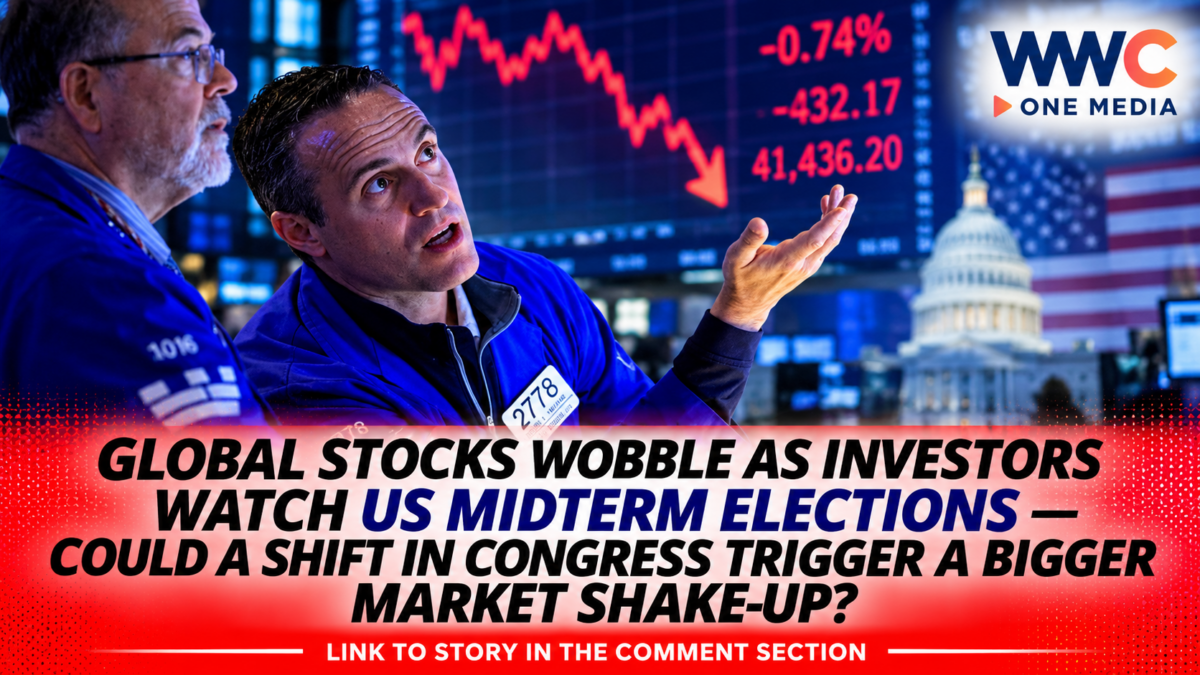
NEW YORK/SINGAPORE — Global financial markets are experiencing renewed uncertainty as investors assess the potential economic consequences of the 2026 US midterm elections, with control of Congress emerging as a major factor in expectations for technology regulation, government spending, interest rates and international trade.
The November 3 elections have drawn particular attention from investors because a change in congressional control could influence the direction of President Donald Trump’s economic agenda and the regulatory environment facing major American companies.
Before voting, most polls and nonpartisan analysts expected Democrats to regain control of the House of Representatives, while the Senate contest remained less certain.
The first market reaction was mixed. On November 3, the Dow Jones Industrial Average declined 0.38%, while the S&P 500 gained 0.36% and the Nasdaq Composite advanced 0.83%.
European shares and the broader global equity market moved lower.
However, markets shifted again on November 4 as early Democratic victories in Senate races raised expectations of a more competitive fight for control of Congress. US stock futures declined, Treasury yields fell and the dollar weakened.
The developments have placed investors in a difficult position: they must assess not only the election results but also what a potentially divided government could mean for artificial intelligence, corporate regulation, government borrowing and global economic growth.
US MIDTERM ELECTIONS PUT INVESTORS ON ALERT
The US midterm elections determine which political party controls the House of Representatives and the Senate during the second half of a presidential term.
Unlike presidential elections, midterms do not decide who occupies the White House. However, they can significantly influence how much legislative support a president has to implement policies.
The 2026 vote is particularly important because Republicans currently hold the presidency under Donald Trump, and the balance of power in Congress affects the administration’s ability to advance legislation.
A Democratic victory in the House could increase congressional scrutiny of the administration and create obstacles for some legislative priorities.
If Democrats also gain control of the Senate, the political consequences could extend further, affecting legislative negotiations, government appointments and oversight.
For financial markets, the question is not simply which party wins more seats. Investors are trying to determine how the resulting political balance could affect company earnings, government spending, taxation and the regulatory environment.
The uncertainty has encouraged investors to reassess positions across equities, currencies, bonds and commodities.
EARLY DEMOCRATIC WINS SHAKE UP MARKET EXPECTATIONS
By November 4, early election results were already influencing financial markets.
In North Carolina, Democrat Roy Cooper defeated Republican Michael Whatley to flip a Republican-held Senate seat, according to media projections.
Democrat Jon Ossoff also won re-election in Georgia.
Cooper’s victory represented one of the four net gains Democrats would need to secure a Senate majority.
Democrats were also favoured to capture the House, while the Senate contest remained closely contested.
Investors interpreted the early results as increasing the possibility of a stronger-than-expected Democratic performance.
Charu Chanana, chief investment strategist at Saxo, said markets appeared to be pricing in the possibility that a stronger Democratic showing could reduce expectations for additional fiscal stimulus.
The immediate reaction included a decline in US equity futures.
Futures tracking the S&P 500 fell 0.8%, while Nasdaq futures dropped 1.8%.
The yield on the benchmark 10-year US Treasury note also declined by six basis points to 4.906%.
The dollar weakened against major currencies, reflecting changing expectations about the political and economic outlook.
These movements were early reactions rather than a final assessment of the election’s long-term effects. The Senate outcome remained uncertain, and investors continued to monitor the remaining contests.
WHY A DEMOCRATIC CONGRESSIONAL MAJORITY COULD AFFECT BIG TECH
One of the biggest areas of concern for investors is the artificial intelligence industry.
American technology companies have invested enormous amounts in data centres, advanced computing infrastructure and semiconductor technology to support the expansion of AI services.
The investment boom has also benefited companies across Asia, particularly semiconductor manufacturers in South Korea and Taiwan.
However, a stronger Democratic presence in Congress could lead to increased scrutiny of AI developers and the companies building large data-centre facilities.
Potential areas of attention include AI safety, energy consumption, data-centre development and the financial responsibilities of companies operating large computing facilities.
Lawmakers could examine whether technology companies should bear more of the costs associated with electricity demand and infrastructure expansion.
They could also increase oversight of how advanced AI systems are developed and deployed.
For investors, the concern is that additional regulatory requirements could increase operating expenses or delay some projects.
Technology companies already face questions about whether the enormous amounts being spent on AI infrastructure will eventually generate sufficient financial returns.
Greater regulatory uncertainty could therefore add another challenge for companies whose valuations depend heavily on expectations of continued AI growth.
However, a stronger Democratic presence in Congress would not automatically mean that all AI investments would be restricted.
The direction and scope of any new policies would depend on legislation, political negotiations and the administration’s response.
ASIAN CHIPMAKERS COULD FEEL THE EFFECTS
The election is not just a domestic American political event.
Asian technology companies are deeply connected to the US AI investment cycle.
South Korea and Taiwan are important suppliers of advanced semiconductors, memory chips and other components used in data centres.
Companies such as Taiwan Semiconductor Manufacturing Co., Samsung Electronics and SK Hynix are closely linked to global demand for advanced computing technology.
If US policy changes make data-centre development more expensive or complicated, investors may reassess the future growth prospects of companies supplying the infrastructure.
A slowdown in AI-related capital spending could affect semiconductor orders, equipment demand and investment plans throughout the regional technology supply chain.
Business Standard’s pre-election analysis also identified companies such as Hon Hai Precision Industry, Quanta Computer, Advantest and Delta Electronics as businesses investors may monitor because of their connections to AI hardware and infrastructure.
Nevertheless, analysts have noted that demand for AI computing power could remain strong regardless of which party controls Congress.
The global expansion of AI is supported by commercial demand, enterprise adoption and long-term investment plans that are not necessarily determined by one election.
The key issue is whether changes in US policy will significantly alter the pace, cost or structure of that investment.
GOVERNMENT SPENDING AND THE US DEFICIT REMAIN IMPORTANT CONCERNS
Another major factor influencing market expectations is the future direction of US fiscal policy.
Investors are already monitoring government borrowing, interest expenses and the country’s large budget deficits.
A divided Congress could make it more difficult to pass major spending legislation.
That could limit expectations for additional fiscal stimulus and potentially reduce some pressure on government borrowing.
Lower expectations for government spending can influence bond yields because investors reassess how much additional debt the government may need to issue.
However, a divided government could also create political confrontations over spending bills, government funding and debt-limit negotiations.
Such disputes can introduce uncertainty into financial markets, particularly if investors become concerned about the possibility of a government shutdown or delays in important fiscal decisions.
The effect on markets will depend on the balance between reduced spending expectations and the possibility of political gridlock.
Investors will also need to consider whether congressional negotiations lead to changes in defence spending, healthcare programmes, subsidies and other major budget priorities.
TREASURY YIELDS AND THE US DOLLAR RESPOND TO THE VOTE
The bond and currency markets have also reacted to changing expectations surrounding the election.
On November 3, the yield on the 10-year US Treasury note rose by 5.36 basis points to 4.948%.
The following day, the yield fell to 4.906% as early Democratic gains increased expectations of a possible change in congressional control.
Treasury yields are important because they influence borrowing costs across the economy.
They affect mortgage rates, corporate financing, government debt servicing and the returns investors demand from other financial assets.
A decline in yields can ease some financing pressures, although it does not automatically mean that borrowing costs will fall immediately for every household or business.
The US dollar also weakened on November 4.
The dollar index, which measures the currency against a basket of major currencies, declined 0.32% to 101.39.
The euro strengthened 0.4% to US$1.1239, while the British pound gained 0.37% to US$1.3464.
Currency movements reflect changing expectations about interest rates, government finances, economic growth and investor demand for relatively safe assets.
The election is one part of that calculation, rather than the only factor determining the dollar’s direction.
ASIAN STOCK MARKETS TURN LOWER DESPITE STRONGER AI EARNINGS
Asian markets also experienced pressure on November 4.
MSCI’s broadest index of Asia-Pacific shares outside Japan fell 0.5%.
South Korea’s KOSPI declined 1.6%, while Japan’s Nikkei dropped 3% after returning from a market holiday.
The declines came despite encouraging earnings from semiconductor company Advanced Micro Devices (AMD).
AMD’s stronger-than-expected third-quarter results and forecast provided some support for the argument that demand for AI computing infrastructure remains strong.
However, investors were still concerned about the sustainability of the broader AI investment boom.
The market has been weighing the enormous capital expenditure commitments made by major technology companies against questions about future profitability.
The concerns intensified after disappointing results and outlooks from some major technology companies, including Intel and Apple.
Apple’s forecast of lower gross margins for the crucial holiday quarter, partly reflecting higher memory-chip costs, added to investor concerns.
These developments show that election uncertainty is arriving at a time when technology shares are already facing questions about valuations, financing and the returns from AI-related spending.
OIL PRICES ADD ANOTHER LAYER OF UNCERTAINTY
Energy markets are also influencing the investment outlook.
On November 3, Brent crude futures fell 1.12% to settle at US$103.60 a barrel.
The decline followed US President Donald Trump’s announcement that Washington had agreed to stop US$4 billion in funding to Israel at the end of the year.
Trump said the funding was no longer necessary, while also discussing the political debate surrounding US support for Israel.
Oil prices were additionally influenced by developments in the Middle East, including the ongoing conflict involving the United States and Iran.
A senior Iranian official said the two countries remained far from an agreement to end their conflict.
A US official also said American forces had carried out defensive strikes against surface-to-air missile targets on Iran’s Qeshm Island.
By November 4, oil prices were fluctuating as investors weighed diplomatic developments against the possibility of further supply disruptions.
The Strait of Hormuz remains particularly important because it has historically carried roughly one-fifth of global oil supplies.
Disruptions around the waterway can affect international energy flows and increase concerns about inflation.
Higher oil prices can raise transportation and production expenses, potentially placing pressure on businesses and household budgets.
For central banks, energy-driven inflation can complicate decisions about interest rates.
This means investors are monitoring geopolitical developments alongside the election rather than treating the political outcome as the only market-moving event.
CHINA’S CURRENCY AND GOLD ALSO FEATURE IN THE MARKET PICTURE
Other financial assets have responded to changing global conditions.
On November 3, the Chinese yuan weakened 0.35% against the US dollar to 6.67 per dollar.
The movement followed a decision by the People’s Bank of China to raise the foreign-exchange reserve ratio, a measure intended to slow the yuan’s recent appreciation.
Gold edged higher by 0.05% to US$3,930.04 an ounce during the same trading session.
Bitcoin remained relatively stable at approximately US$77,835.07 after the previous week’s Binance hack.
These movements illustrate how investors are managing several sources of uncertainty simultaneously.
The election, US monetary policy, geopolitical tensions and concerns about technology valuations are all influencing decisions across different asset classes.
WHAT THE ELECTION COULD MEAN FOR CHINESE CLEAN-ENERGY COMPANIES
The consequences of a potential shift in congressional control may extend beyond American technology companies.
Some analysts believe Chinese clean-energy businesses could benefit from a stronger Democratic presence in Congress because Democrats have generally supported policies promoting renewable energy and low-carbon infrastructure.
Companies involved in solar panels, batteries and electric vehicles could therefore attract attention from investors assessing possible changes in US energy policy.
However, the impact is not straightforward.
Trade policy toward China has bipartisan support in several areas, meaning a change in congressional control would not necessarily lead to a reduction in trade restrictions.
Tariffs, technology controls and competition over strategic industries remain important issues in Washington.
A more divided political environment could also create uncertainty over how the administration uses its existing executive powers.
For Chinese companies, the election may therefore create opportunities in some sectors while leaving significant trade and geopolitical risks unresolved.
WHY THE 2026 MIDTERMS MATTER BEYOND THE UNITED STATES
The US remains a major driver of global financial markets.
Changes in American fiscal policy, interest rates, technology regulation and international trade can affect businesses and investors across continents.
Asian economies are particularly exposed because many depend on exports, semiconductor manufacturing and supply chains connected to American technology companies.
A change in US policy affecting AI infrastructure could influence orders for Asian chipmakers.
Changes in trade policy could affect manufacturers and exporters.
A shift in government borrowing expectations could influence bond yields and currency markets worldwide.
Energy-market developments can also affect countries that rely heavily on imported fuel.
For Singapore, the regional financial centre, changing US interest-rate expectations and currency movements can influence investment sentiment and financing conditions.
For the Philippines and other emerging Asian economies, movements in the US dollar, Treasury yields and oil prices can affect capital flows, import costs and inflation expectations.
However, the actual effects will depend on domestic economic conditions and how markets respond after the election results become clearer.
WHAT INVESTORS WILL WATCH NEXT
The immediate focus is on the remaining Senate contests and the final balance of power in Congress.
Investors will also monitor how the results influence discussions over AI regulation, government spending, corporate oversight and fiscal policy.
Several developments will be particularly important:
The final congressional balance: Whether Democrats gain control of both chambers or face a divided Congress will shape expectations about legislation and oversight.
AI and technology regulation: Investors will watch for proposals affecting data-centre development, electricity costs, semiconductor supply chains and major technology companies.
Treasury yields: Changes in government borrowing expectations and interest-rate forecasts could influence global financing conditions.
The US dollar: Currency markets will continue to react to political uncertainty, economic data and expectations for Federal Reserve policy.
Oil and geopolitical developments: Events in the Middle East could have a substantial impact on energy prices, inflation and market sentiment regardless of the election outcome.
Corporate earnings: Technology companies will need to demonstrate that their substantial AI investments can translate into sustainable financial returns.
These factors will determine whether the initial market reaction develops into a longer period of volatility or fades as investors adjust to the new political environment.
THE BOTTOM LINE
The 2026 US midterm elections have become an important test for global financial markets, with investors trying to understand how a possible change in congressional control could affect American economic policy and international business.
The November 3 trading session produced mixed results, with the S&P 500 and Nasdaq rising while the Dow and European markets declined.
By November 4, early Democratic victories had changed market expectations. US stock futures fell, Treasury yields declined and the dollar weakened as investors considered the possibility of a more competitive congressional balance.
Technology regulation, AI infrastructure spending, government borrowing and energy prices remain central concerns.
But the election is only one part of a much larger market picture. Corporate earnings, interest-rate expectations and geopolitical developments are also shaping investor decisions.
For Asian economies, the consequences could extend through semiconductor supply chains, export demand, currency markets and energy costs.
The full impact will become clearer as election results are confirmed and policymakers reveal their next steps.
Could a change in control of the US Congress trigger a major shift in global investment trends, or will corporate earnings and economic fundamentals ultimately matter more than politics?