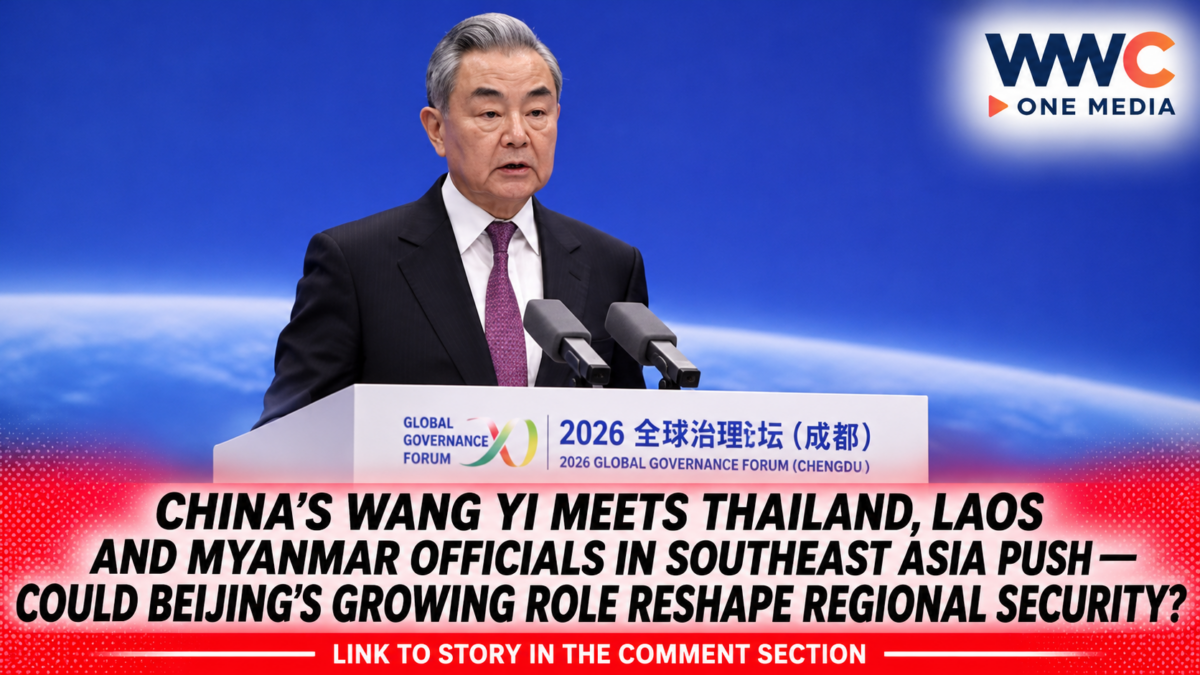
SHANGHAI, China — China is stepping up diplomatic engagement with Southeast Asian neighbours as Foreign Minister Wang Yi held separate meetings with officials from Thailand, Laos and Myanmar, discussing regional cooperation, Myanmar’s ongoing political crisis and efforts to combat cross-border criminal networks.
The meetings, held on November 3, come as Beijing seeks to strengthen its relationships across Southeast Asia, a strategically important region for trade, investment, infrastructure development and security cooperation.
Two issues featured prominently in the discussions: China’s support for political reconciliation in Myanmar and closer cooperation with Thailand against gambling operations and telecommunications fraud.
The conversations also highlight China’s continuing involvement in regional affairs at a time when Southeast Asian governments are dealing with political instability, transnational crime and competing international interests.
Although the meetings did not produce a publicly announced regional agreement, they demonstrate Beijing’s intention to maintain direct diplomatic engagement with neighbouring governments.
WANG YI HOLDS SEPARATE TALKS WITH THREE SOUTHEAST ASIAN COUNTRIES
Chinese Foreign Minister Wang Yi met separately with officials from Thailand, Laos and Myanmar on Tuesday, November 3.
The meetings form part of China’s broader effort to strengthen diplomatic relationships with Southeast Asian countries.
Beijing has long maintained economic and political connections across the region, with cooperation covering infrastructure, trade, investment, energy and security.
The latest discussions focused on issues requiring coordination between neighbouring governments.
For Myanmar, the central concern was political reconciliation amid an ongoing civil war.
For Thailand, the discussions included cooperation against gambling operations and telecommunications fraud, particularly criminal networks operating near the country’s borders with Myanmar and Cambodia.
China’s engagement with Laos was also part of the diplomatic outreach, although the publicly reported details of that particular meeting were limited.
The separate meetings illustrate how Beijing is pursuing country-specific discussions rather than relying exclusively on broader multilateral forums.
CHINA OFFERS SUPPORT FOR POLITICAL RECONCILIATION IN MYANMAR
One of the most significant subjects raised during Wang’s meetings was Myanmar’s continuing political crisis.
According to statements released by China’s Foreign Ministry, Wang said Beijing supported Myanmar’s government in pursuing political reconciliation.
China’s position is particularly important because Myanmar remains in the middle of a prolonged conflict that began after the military coup in February 2021.
The coup removed the elected government led by the National League for Democracy and brought the military back into direct control of the country.
The takeover triggered widespread resistance, followed by escalating fighting involving the military, pro-democracy resistance groups and established ethnic armed organisations.
The conflict has created a serious humanitarian emergency.
The United Nations estimates that approximately 100,000 people have been killed and more than 3.5 million displaced.
Millions of people have also faced insecurity, economic disruption and difficulties accessing essential services.
China’s support for political reconciliation reflects Beijing’s interest in stability along its border and in maintaining relationships with Myanmar’s authorities and other influential actors.
However, supporting reconciliation does not automatically mean that the country’s competing political and armed groups have reached an agreement.
The conflict remains complicated, with different organisations pursuing different political objectives and territorial interests.
WHY MYANMAR MATTERS TO BEIJING
Myanmar occupies an important geographical position between China and the Indian Ocean.
Its location provides potential access to regional trade routes and energy infrastructure, making political stability an important consideration for Beijing.
China also has substantial economic and strategic interests in Myanmar, including infrastructure projects and transport connections that form part of its broader regional development ambitions.
Instability in Myanmar can create problems beyond its borders.
Fighting can disrupt trade, threaten border communities, increase displacement and complicate the movement of people and goods.
The conflict has also contributed to the growth of criminal operations in parts of the country, including scam centres that have attracted international attention.
For Beijing, a more stable Myanmar could help protect economic interests while reducing security risks along China’s southwestern border.
Nevertheless, China’s diplomatic influence does not mean it can independently resolve Myanmar’s civil war.
Any sustainable political settlement would involve difficult negotiations among the country’s military authorities, resistance movements, ethnic organisations and other stakeholders.
THAILAND AND CHINA SEEK STRONGER ACTION AGAINST SCAM NETWORKS
Another major issue discussed during Wang’s diplomatic meetings was the fight against gambling and telecommunications fraud.
Wang said Thailand and China should intensify cooperation against these criminal activities.
The two countries have already been working to disrupt illegal call-centre operations along Thailand’s borders with Myanmar and Cambodia.
These networks are often associated with online scams, fraudulent investment schemes and other forms of telecommunications crime.
Many operations rely on trafficked workers who are forced or pressured to participate in fraudulent activities.
Victims may be recruited through misleading job advertisements promising legitimate employment overseas. After arriving, some are reportedly confined in compounds and forced to contact people through messaging applications, social media or telephone calls.
The operations can target victims across different countries, making them difficult to investigate through the law enforcement systems of a single government.
The networks can also generate significant financial losses for individuals and businesses.
By strengthening cooperation, Thailand and China hope to improve their ability to identify criminal organisations, disrupt their operations and address the movement of people and money associated with the scams.
WHY THE THAI-MYANMAR AND THAI-CAMBODIAN BORDER ARE IMPORTANT
The border areas between Thailand, Myanmar and Cambodia have become significant points of concern for authorities investigating online fraud and human trafficking.
Some criminal operations have established compounds in areas where law enforcement access is complicated by local security conditions and political instability.
Myanmar’s conflict has made the situation particularly difficult.
In some border areas, control is divided among different armed groups and authorities, complicating efforts to conduct investigations and rescue victims.
Criminal networks can exploit these conditions to move people, establish operations and evade enforcement.
Thailand has become an important location for regional efforts to identify victims and disrupt cross-border criminal activity.
Its cooperation with China is significant because many scam victims and financial targets are located outside the countries where the operations are physically based.
The challenge requires cooperation on several fronts, including intelligence-sharing, border management, financial investigations and victim protection.
However, enforcement operations must also distinguish between people organising criminal activity and individuals who may themselves have been trafficked and forced to participate.
THE HUMAN TRAFFICKING DIMENSION OF ONLINE SCAMS
The growth of telecommunications fraud has created a serious human rights problem.
Some people working inside scam compounds are not voluntary participants.
They may have been deceived into travelling abroad with promises of legitimate jobs, only to discover that they are expected to participate in illegal activities.
Others have reportedly faced threats, physical abuse, confinement or restrictions on their freedom.
This makes the issue more complicated than a conventional crackdown on online fraud.
Authorities must identify the individuals directing the criminal operations while ensuring that trafficked workers are treated as potential victims rather than automatically classified as offenders.
International cooperation is essential because victims may come from different nationalities, while the people controlling the operations, the compounds and the financial networks may be based in separate jurisdictions.
Thailand and China therefore have shared interests in disrupting the networks and strengthening the processes used to identify and assist affected individuals.
CHINA’S REGIONAL DIPLOMATIC PUSH COMES AT A SENSITIVE TIME
The meetings also reflect the broader diplomatic environment in Southeast Asia.
China is one of the region’s most important economic partners, but its relationships with neighbouring countries involve a wide range of interests and concerns.
Trade, infrastructure investment, security and maritime issues all shape relations between Beijing and Southeast Asian governments.
Countries in the region also maintain relationships with other major powers, including the United States, Japan, Australia and India.
As a result, Southeast Asian governments frequently pursue cooperation with multiple international partners rather than relying exclusively on one country.
China’s latest diplomatic engagement should therefore be understood within this wider regional environment.
The meetings with Thailand, Laos and Myanmar provide Beijing with opportunities to discuss immediate security and political concerns while maintaining direct communication with neighbouring governments.
However, the discussions do not establish that the three countries have adopted a common foreign policy or agreed to align their regional positions with Beijing.
Each government continues to have its own domestic priorities, security concerns and diplomatic calculations.
WHAT THE MEETINGS COULD MEAN FOR ASEAN
The developments also carry implications for the Association of Southeast Asian Nations (ASEAN).
ASEAN has long promoted regional dialogue and cooperation on political, economic and security matters.
Myanmar’s crisis, however, has tested the organisation’s ability to maintain a common position.
ASEAN’s Five-Point Consensus, adopted in April 2021, called for an immediate cessation of violence, constructive dialogue among relevant parties, mediation by an ASEAN special envoy, humanitarian assistance and a visit by the special envoy to meet relevant stakeholders.
Implementation has remained difficult, with violence continuing and disagreements persisting over how the crisis should be addressed.
China’s separate engagement with Myanmar adds another diplomatic channel to an already complicated situation.
Beijing’s support for political reconciliation could contribute to discussions about stability, but it does not replace ASEAN’s own diplomatic processes.
The effectiveness of any effort will depend on whether it can encourage meaningful engagement among the parties involved in the conflict.
For ASEAN members, the central concern remains finding ways to reduce violence, address humanitarian needs and prevent Myanmar’s instability from creating further regional problems.
WHAT HAPPENS NEXT?
The latest meetings establish that China, Thailand, Laos and Myanmar remain engaged in direct diplomatic discussions.
But several important questions remain unanswered.
Will China’s support for political reconciliation translate into concrete progress in Myanmar?
Can Thailand and China disrupt scam networks that operate across difficult border areas?
Will regional cooperation lead to better protection for people trafficked into criminal compounds?
And can the different diplomatic efforts complement ASEAN’s existing approach to Myanmar?
The public information available so far does not provide detailed agreements, implementation schedules or measurable targets from the separate meetings.
Their longer-term significance will therefore depend on what the governments do after the diplomatic discussions.
For now, the immediate areas to watch are Myanmar’s political situation and the regional campaign against cross-border fraud and human trafficking.
THE BOTTOM LINE
China’s latest diplomatic meetings with Thailand, Laos and Myanmar show Beijing’s continued effort to strengthen its relationships with Southeast Asian neighbours.
The discussions covered two major regional challenges: Myanmar’s continuing civil war and the expansion of criminal networks involved in gambling and telecommunications fraud.
China expressed support for Myanmar’s pursuit of political reconciliation, while Wang Yi urged Thailand and China to increase cooperation against scam operations near the borders of Myanmar and Cambodia.
These issues are closely connected to regional stability. Myanmar’s conflict has displaced millions, while cross-border scam networks have created financial and human trafficking risks that extend far beyond the countries where they operate.
However, diplomatic engagement alone will not resolve these problems. Progress will depend on concrete cooperation, effective enforcement, humanitarian protection and meaningful political dialogue.
As China expands its diplomatic engagement across Southeast Asia, will its growing involvement help address the region’s security challenges — or will the complex political interests of neighbouring countries make lasting progress difficult?