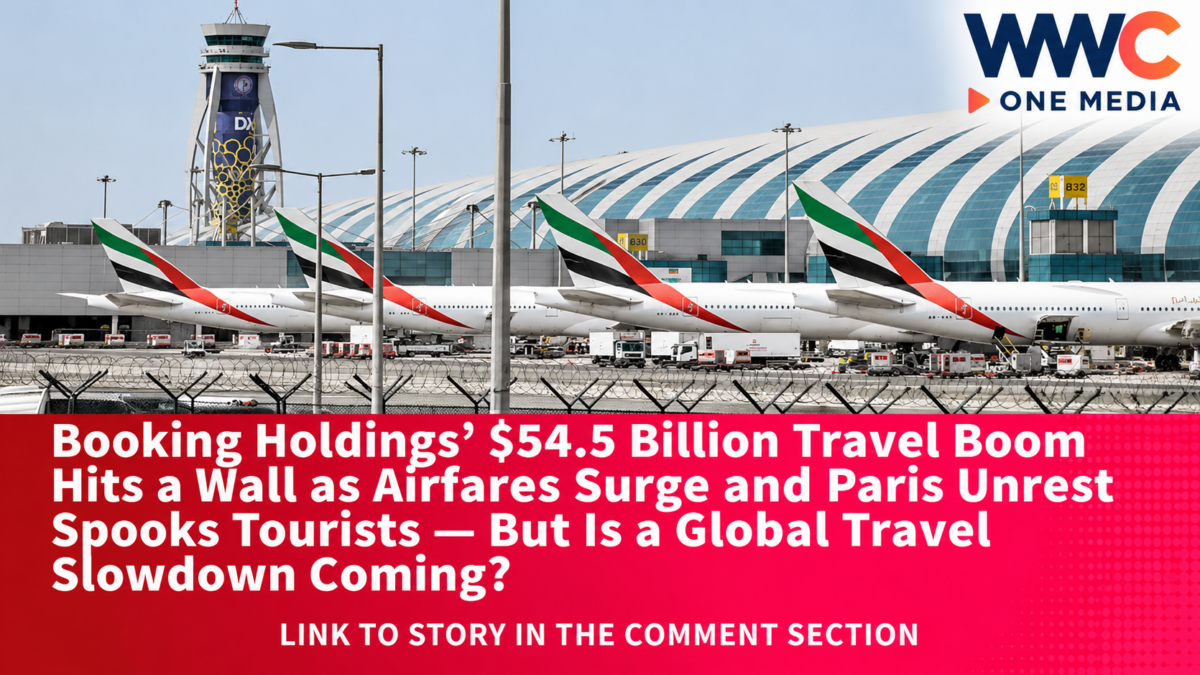
NEW YORK / SINGAPORE / MANILA — The global travel industry’s powerful recovery is facing a new reality as Booking Holdings, the company behind Booking.com, Agoda, Priceline and KAYAK, warned that rising airfares, geopolitical instability and unrest in parts of Europe are weakening international travel demand ahead of the crucial year-end holiday season.
The warning came despite the online travel giant recording $54.5 billion in gross bookings during the third quarter of 2026, a 10% increase from a year earlier.
According to Bloomberg’s November 3 report and Booking Holdings’ latest earnings announcement, the company expects a sharp slowdown in booking activity during the final three months of the year.
Room-night growth is projected to decelerate to just 1% to 3% in the fourth quarter, compared with 7% during the third quarter.
Gross bookings are expected to increase by only 2% to 4%, while adjusted revenue growth could slow to between zero and 2%.
The forecast fell short of Wall Street’s expectations and raised fresh concerns about whether consumers are beginning to pull back on expensive international holidays.
For millions of travelers worldwide, the implications could extend beyond hotel reservations.
Rising airline fares, security concerns and changing travel preferences are reshaping where people go, how long they stay and how much they are willing to spend.
The central question: Is Booking Holdings experiencing a temporary slowdown caused by international disruptions—or is the world’s tourism industry entering a more difficult period?
Booking Holdings Warns Holiday Travel Growth Could Slow Sharply
Booking Holdings reported solid third-quarter operating results, demonstrating that consumer demand remained substantial during the summer travel season.
Travelers reserved approximately 345 million room nights through the company’s platforms, representing 7% growth from the same quarter in 2025.
Gross bookings climbed 10% to $54.5 billion.
Flight-ticket reservations also increased, reflecting the company’s expansion beyond traditional hotel bookings.
However, management warned that travel demand began moderating toward the end of September.
The slowdown became more noticeable in October.
International travel was particularly vulnerable, while domestic travel remained comparatively resilient.
In its official earnings release, Booking attributed the weaker outlook to several overlapping factors, including disruptions affecting travel to and from the Middle East, elevated airline ticket prices and localized unrest in European cities.
The company assumed that the direct and indirect effects of the Middle East conflict would continue through December.
That assumption is important because it helps explain why Booking expects a much weaker fourth quarter despite reporting substantial growth during the preceding three months.
Booking’s Fourth-Quarter Forecast Disappoints Wall Street
The company’s outlook indicates a significant deceleration in key operating measures.
Booking expects fourth-quarter room nights to increase only 1% to 3% compared with the same period last year.
Gross bookings are projected to rise between 2% and 4%, or 4% to 6% after adjusting for currency fluctuations.
Adjusted revenue is expected to increase by zero to 2%, while adjusted EBITDA is projected to remain approximately flat.
These forecasts contrast with the stronger third-quarter performance.
However, a slower growth rate is not necessarily the same as a decline in total travel activity.
Booking is still forecasting year-over-year growth in room nights and gross bookings.
The concern is that expansion is losing momentum.
For investors accustomed to the company’s historically strong performance, the slowdown raises questions about consumer spending and the sustainability of premium travel demand.
Booking also identified challenging comparisons with the fourth quarter of 2025 as a contributing factor.
The company nevertheless maintained its full-year outlook, including high-single-digit growth in gross bookings and adjusted revenue.
Rising Airfares Are Becoming a Major Obstacle for International Tourism
One of the biggest threats to global tourism demand is the rising cost of flying.
The continuing conflict in the Middle East has disrupted important air corridors and increased operating expenses for carriers.
Higher aviation fuel costs can contribute to more expensive airline tickets, particularly on long-haul international routes.
Changes to flight paths, reduced capacity and additional operational requirements can also influence fares.
For travelers, these pressures can make an overseas holiday substantially more expensive even before accommodation, meals and activities are considered.
A family planning a European vacation may face significantly higher transportation costs than expected.
Business travelers may reconsider nonessential trips, while leisure travelers could choose destinations closer to home.
Booking’s management has observed this shift toward shorter trips and domestic travel.
The Philippine market provides a clear example of how fuel prices can influence the cost of air travel.
In its earlier report, Airline Fuel Surcharge Jumps to Level 17, Pushing Philippine Airfares Higher in October, WWC ONE MEDIA examined the Civil Aeronautics Board’s decision to raise the allowable fuel surcharge for the first half of October.
The adjustment allowed Philippine airlines to impose higher fuel surcharges on domestic and international flights.
Those surcharges can increase the total price of a ticket, although actual fares still depend on the airline, route, availability and travel date.
For the wider tourism industry, the danger is that persistently high airfares could reduce demand even among travelers who remain financially capable of taking holidays.
Paris Unrest Adds Another Challenge to Europe’s Tourism Recovery
Europe is also becoming a source of uncertainty for international travelers.
Booking Holdings cited localized unrest in certain European cities as another factor affecting demand.
Bloomberg specifically highlighted protests in Paris among the developments weighing on the company’s outlook.
Civil unrest can influence travel decisions even when disruption is geographically limited.
Travelers may worry about transportation interruptions, demonstrations near popular attractions or unexpected changes to itineraries.
However, it is important not to interpret localized protests as evidence that all of France or Europe has become inaccessible to tourists.
The effects depend on where demonstrations occur, their duration and whether transport services and attractions are affected.
For travel platforms, even temporary uncertainty can influence booking behavior.
Some travelers postpone reservations until conditions become clearer.
Others select alternative destinations or book accommodation with more flexible cancellation policies.
The resulting changes can affect hotels, restaurants, transportation companies and tourism-dependent businesses.
Booking’s warning therefore reflects not only the direct effects of international conflict but also the importance of traveler confidence.
US Holiday Travelers Are Facing a Similar Price Squeeze
The changing travel environment is not limited to Europe or the Middle East.
American travelers are also confronting higher costs during the year-end holiday period.
WWC ONE MEDIA previously reported on the increasingly divided US airfare market in U.S. November Airfares Split Between Bargain Routes and Sky-High Tickets — But Thanksgiving Could Be the Real Budget Killer.
The report cited travel platform Hopper’s estimate that average round-trip domestic airfare for Thanksgiving 2026 had reached approximately $402, up 31% from the previous year.
The figures highlighted how holiday travel expenses can vary sharply depending on destinations, departure airports and timing.
These conditions create a difficult choice for consumers.
Some travelers may continue with their holiday plans despite higher prices.
Others may reduce their travel budgets, select cheaper accommodation or shorten their vacations.
Booking’s latest earnings suggest that the underlying desire to travel remains substantial, but price sensitivity is increasingly affecting purchasing decisions.
Booking’s $54.5 Billion Performance Masks a Complicated Financial Picture
Despite the weaker outlook, Booking’s third-quarter results showed considerable underlying strength.
The company reported approximately $8.89 billion in revenue, a decline of roughly 1% from the previous year.
Net income fell slightly to about $2.72 billion.
However, adjusted revenue increased 9% to approximately $9.8 billion.
Adjusted net income rose 8% to $3.5 billion, while adjusted earnings per share increased 17% to $4.66.
That adjusted per-share result exceeded analysts’ expectations of approximately $4.49 to $4.50.
The difference between reported and adjusted performance is particularly important.
Booking recorded a $900 million reduction in revenue related to a matter involving the US Federal Trade Commission.
It also accrued a separate $100 million loss associated with that matter.
The two items had a combined accounting effect of approximately $1 billion.
Therefore, the decline in reported revenue should not be attributed entirely to weaker consumer travel demand.
The company’s core operating metrics continued expanding during the quarter.
But the regulatory issue added another layer of uncertainty for investors already concerned about slowing travel growth.
A $1 Billion FTC Matter Creates a Separate Risk for Booking
According to Reuters, Booking’s regulatory exposure involves an investigation into Priceline’s relationship with Guest Reservations.
The FTC has examined whether certain hotel advertisements could mislead consumers about their relationship with hotel operators and whether some pricing and fee practices violate consumer-protection requirements.
Booking has been discussing a potential resolution with regulators.
However, no completed settlement had been announced as of the November 3 earnings disclosure.
The matter could result in financial payments, consumer restitution or additional legal proceedings, depending on the final outcome.
The distinction matters because Booking faces two separate challenges.
The first is an operating challenge: softer international travel demand and a weaker fourth-quarter forecast.
The second is a regulatory challenge: a consumer-protection investigation affecting its reported financial results.
Although both have financial consequences, they should not be confused.
The FTC matter is not evidence that travelers booked $900 million less in accommodation because of the Middle East conflict.
It is a separate accounting adjustment associated with regulatory exposure.
Domestic Travel Remains a Bright Spot as Travelers Stay Closer to Home
While international travel growth is moderating, domestic tourism is proving comparatively resilient.
Booking’s management reported that travelers are increasingly choosing shorter trips and destinations closer to home.
This pattern can benefit local hotels, restaurants and attractions even when long-haul travel faces pressure.
For cost-conscious travelers, domestic holidays may provide a more affordable alternative to overseas vacations.
They can eliminate international airfare expenses, reduce travel time and simplify planning.
This changing behavior is particularly relevant to the Philippines, where domestic tourism remains an important source of economic activity.
WWC ONE MEDIA previously highlighted the strength of urban staycations in BGC Luxury Hotel Rates Hit ₱17,360 a Night — But Metro Manila Staycation Travelers Still Prefer It Over Cheaper Destinations.
The article examined the continuing appeal of premium accommodations in Bonifacio Global City despite higher room rates.
At the same time, Metro Manila hotel occupancy had weakened, illustrating that demand and pricing can move in different directions.
The broader lesson is that travelers may continue spending on leisure even when they become more selective about how far they travel.
However, Booking’s results do not establish that every domestic tourism market is experiencing stronger demand.
Regional conditions and consumer spending patterns can differ considerably.
What the Slowdown Means for Philippine Tourism
The implications for the Philippines are particularly significant because the country is seeking to attract more international travelers while managing higher transportation costs.
The country’s tourism performance depends on several factors, including air connectivity, visitor confidence, travel affordability and the availability of competitive destinations.
WWC ONE MEDIA previously reported that the Philippines welcomed approximately 4.11 million international visitors during the first eight months of 2026.
The figures were examined in Philippines Welcomes 4.11 Million Visitors in Eight Months — But the Race to 7 Million Just Got Much Harder.
The report highlighted the challenge of sustaining visitor growth amid regional competition and changing international travel patterns.
Booking’s weaker global outlook adds another reason to monitor inbound tourism closely.
If airfares remain elevated, some foreign travelers may delay trips or choose destinations with cheaper flight connections.
However, the impact on the Philippines cannot be determined from Booking’s worldwide guidance alone.
Some Asian travel routes may remain comparatively resilient, while new flight services and tourism promotions could create additional demand.
For Philippine hotels and tourism operators, offering competitive packages and flexible reservations may become increasingly important.
Airlines Continue Expanding Selected Routes Despite Global Uncertainty
Even as international travel demand faces pressure, not every market is contracting.
Some airlines are expanding services to destinations where they anticipate stronger passenger demand.
A recent example is AirAsia Philippines’ decision to increase Manila–Kaohsiung flights to daily service.
WWC ONE MEDIA covered the development in AirAsia Philippines Expands Manila–Kaohsiung Flights to Daily Service — But Could Southern Taiwan Become the Next Big Destination for Filipino Travelers?.
The expansion illustrates how airlines continue identifying opportunities in regional tourism.
Shorter international routes may appeal to travelers seeking overseas experiences without the expense of long-haul journeys.
However, route expansion does not guarantee profitability or sustained demand.
Airlines must balance passenger volumes, fuel costs, competition and available capacity.
Booking’s latest results suggest that travel operators increasingly need to understand where customers remain willing to spend rather than assuming demand is rising uniformly across all destinations.
Artificial Intelligence Could Become Booking’s Next Competitive Battleground
Booking Holdings is also investing in artificial intelligence as it works to strengthen its long-term competitive position.
The company’s major platforms include Booking.com, Priceline, Agoda, KAYAK and OpenTable.
Its strategy increasingly involves helping travelers plan, reserve and manage multiple elements of a journey through more integrated digital experiences.
AI can potentially improve destination recommendations, accommodation searches, customer support and itinerary management.
It may also help platforms personalize offers based on travelers’ preferences and budgets.
However, AI introduces new competitive questions.
Technology companies are developing intelligent travel assistants capable of comparing flights, selecting hotels and assisting with reservations.
If those systems become increasingly independent, online travel agencies may need to reconsider how customers discover and book travel services.
Booking is seeking to strengthen its position through investments in AI, connected travel experiences and customer-loyalty programs.
But the benefits will depend on whether those investments improve conversion rates, customer retention and profitability.
At a time when the company’s revenue outlook is moderating, investors will be watching the financial returns from these technology investments.
Could Higher Oil Prices Continue Hurting Travel in 2027?
Energy costs remain an important variable for airlines and travelers.
The Middle East conflict has caused substantial volatility in crude oil and refined petroleum markets.
Higher jet-fuel expenses can increase airline operating costs, although the effects on ticket prices depend on fuel hedging, competition, capacity and demand.
WWC ONE MEDIA previously examined the energy crisis in Oil Surges Again as Middle East Conflict Sends Brent Back Above US$100 a Barrel.
The report described the potential consequences of elevated oil prices for aviation, shipping and consumer inflation.
For Booking Holdings, persistent fuel-related travel costs could continue discouraging some long-haul reservations.
Conversely, a sustained decline in oil prices and improved regional security could support a recovery in international travel.
However, Booking has not issued a definitive prediction that global tourism will contract in 2027.
Its latest formal guidance concerns the fourth quarter and full year of 2026, with longer-term investment plans also discussed.
The possibility of continued weakness in 2027 remains a risk scenario rather than an established forecast.
What Happens Next? Three Critical Signals for the Travel Industry
The next several months will provide important evidence about whether the current slowdown is temporary.
First, international airfare trends.
Sustained reductions in ticket prices could encourage consumers to resume long-haul travel plans.
Continued fare increases could have the opposite effect.
Second, geopolitical developments.
Improved security in the Middle East and reduced disruption to major flight routes could support traveler confidence.
Further unrest or military escalation could create additional uncertainty.
Third, the performance of Booking’s fourth-quarter reservations.
If room-night and gross-bookings growth exceeds management’s cautious forecast, that could suggest demand is more resilient than currently expected.
Conversely, results below the forecast would intensify questions about consumer spending and the outlook for global tourism.
Hotel operators, airlines and investors will also monitor whether domestic tourism continues outperforming international travel.
The Bigger Picture: Is Global Tourism Losing Momentum?
Booking Holdings’ latest results reveal a striking contrast.
The company generated $54.5 billion in gross bookings during the third quarter and continued attracting hundreds of millions of room-night reservations.
Its adjusted earnings grew, and its major travel brands remained commercially active.
Yet the outlook for the final quarter is substantially weaker.
Higher airfares, geopolitical uncertainty, unrest in certain European cities and more cautious international travelers are creating a difficult environment for the world’s largest online travel platforms.
The regulatory issue involving the FTC adds a separate challenge.
None of these developments proves that the global tourism industry is entering a recession.
But they demonstrate that the recovery in international travel is becoming more uneven.
For consumers, destinations offering value, safety and convenient access may become increasingly attractive.
For travel companies, the challenge is maintaining growth while managing higher costs and changing customer preferences.
For investors, the key question is whether Booking’s weaker fourth-quarter forecast marks a short-lived interruption or signals a more persistent change in consumer behavior.
As Booking Holdings warns that room-night growth could slow to just 1% and international travelers confront higher airfares, geopolitical uncertainty and disruptions in Europe, is the global tourism boom simply taking a holiday-season breather—or could a more serious travel slowdown be waiting in 2027?