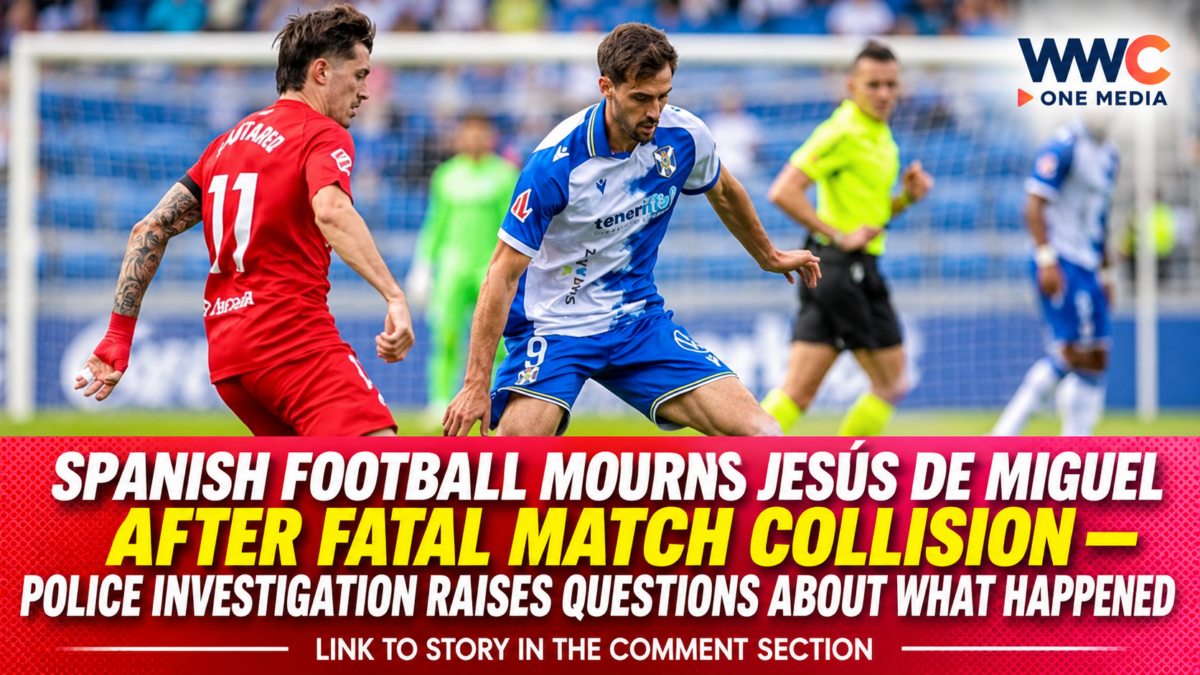
TENERIFE, SPAIN — Spanish football is mourning the death of CD Tenerife striker Jesús de Miguel, who died at the age of 30 after suffering a cardiac arrest following a collision with an opposing goalkeeper during a second-division match.
The tragedy happened on November 2 during Tenerife’s match against FC Andorra at the Heliodoro Rodríguez López Stadium in Santa Cruz de Tenerife. The teams were level at 2-2 when De Miguel collided with Andorra goalkeeper Jesús Owono while both players challenged for a long ball.
The impact left the Tenerife forward unconscious on the pitch. Medical personnel rushed to treat him before he was transported to hospital by ambulance.
Despite emergency treatment and efforts to restore his pulse, De Miguel’s condition deteriorated. CD Tenerife confirmed his death at 8 a.m. on November 3.
He was 30.
The incident has since prompted an investigation by Spain’s National Police, while football organisations, clubs and players across Europe have expressed their condolences.
What began as an ordinary contest for possession became one of the most devastating moments in Spanish football this season.
The Collision That Changed the Match
The incident occurred during the closing stages of the match between CD Tenerife and FC Andorra, which was being played at Tenerife’s home stadium.
With the score tied at 2-2, a long ball was played forward, prompting De Miguel to chase it as Tenerife looked for an opportunity to attack.
Owono, Andorra’s goalkeeper, moved far away from his penalty area to challenge for the ball.
The two players collided near the middle of the pitch.
The impact was severe. De Miguel immediately appeared to be in distress, with players from both teams rushing towards him and signalling for medical assistance.
Owono was shown a straight red card by the referee following the challenge.
The match was subsequently abandoned to allow emergency personnel to attend to De Miguel.
The scene left players, coaching staff and spectators deeply concerned as medical workers attempted to stabilise the injured forward.
The seriousness of the situation quickly became apparent, with the football match becoming secondary to the emergency unfolding on the pitch.
Medical Teams Tried to Save His Life
Following the collision, medical personnel provided emergency treatment before De Miguel was transported to the hospital.
According to reports, he suffered a cardiac arrest during the incident. Medical responders managed to restore his pulse while he was being transported in the ambulance.
He was admitted to the intensive care unit at the Hospital Universitario Nuestra Señora de Candelaria in Santa Cruz de Tenerife.
The club initially reported that he was breathing independently but remained unconscious and in a critical condition.
However, his medical situation later deteriorated.
Tenerife subsequently announced that his neurological condition had worsened before confirming his death the following morning.
The club’s announcement brought an end to the hopes of his teammates, supporters and family members who had been waiting for positive news.
The exact medical cause of death has not been fully detailed in the public information reviewed for this report.
CD Tenerife Confirms His Death
CD Tenerife announced De Miguel’s passing on November 3 through an emotional statement.
The club expressed profound sadness and said it was standing alongside his devastated family, loved ones and the Tenerife community.
The announcement described the news as difficult to comprehend and conveyed the organisation’s grief over the loss of a player who had become part of its sporting family.
The club also acknowledged the messages of support received from supporters, other teams and football organisations.
It requested respect for the privacy of De Miguel’s family during the difficult period.
For Tenerife, the loss was not simply the departure of a player from its squad.
It was the death of a teammate, colleague and member of the football community whose career and life had ended far too soon.
Who Was Jesús de Miguel?
Jesús de Miguel Alameda was born in Madrid, Spain, on September 21, 1996.
He played as a striker and developed his professional career through several Spanish football clubs, spending much of his playing years in the lower divisions.
He began his senior career with Leganés B in 2015 before moving through different teams, including Inter Madrid, Fuenlabrada, Navalcarnero and Unionistas de Salamanca.
He later joined Castellón in 2023.
His performances with Castellón helped the club secure promotion to Spain’s second division in 2024. De Miguel was also among the team’s leading scorers during that campaign.
In the summer of 2025, he moved to CD Tenerife.
The striker became part of the team that achieved promotion to the second division, giving him another opportunity to compete at a higher level of Spanish professional football.
He had been with Tenerife for just over a season when the fatal incident occurred.
His career reflected the journey of a professional footballer who worked through different levels of competition before reaching the second division.
His death has therefore been especially painful for teammates and supporters who had watched his progress.
Spanish Police Open Investigation Into His Death
The circumstances surrounding De Miguel’s death have also prompted a formal investigation.
Spain’s National Police have opened proceedings under the supervision of judicial authorities, with the homicide division involved in examining the case.
The investigation includes consideration of possible involuntary manslaughter.
However, this does not mean that Owono has been charged or found criminally responsible for De Miguel’s death.
Spanish law requires judicial examination of deaths resulting from non-natural causes, including accidents. The opening of an investigation is therefore not, by itself, evidence of wrongdoing.
The chief prosecutor in Santa Cruz de Tenerife has indicated that criminal proceedings are unlikely because the collision occurred during a football match.
The investigation will nevertheless examine the circumstances surrounding the incident and the available evidence.
The distinction is important: the referee’s decision to issue a red card concerns the sporting rules of the match, while any criminal assessment involves separate legal considerations.
At this stage, no criminal conviction has been established in connection with the collision.
What Happened to Goalkeeper Jesús Owono?
Owono, the FC Andorra goalkeeper involved in the collision, was sent off after the challenge.
He had moved away from his penalty area to intercept the ball when he collided with De Miguel.
After the incident, Owono reportedly turned back towards the injured player and joined others who were trying to assist him.
The goalkeeper has also become the subject of intense online attention following the tragedy.
Reports indicated that his Instagram account was deactivated after the incident, amid a wave of online reactions.
The situation has raised concerns about the dangers of directing abuse at individuals before all the circumstances have been established.
Although the challenge resulted in a red card, the sporting decision does not automatically establish criminal responsibility.
The investigation and any subsequent disciplinary process must be allowed to proceed through the appropriate channels.
The Referee Abandons the Match
The match between Tenerife and Andorra was tied at 2-2 when the collision occurred.
The game had already been rescheduled after severe weather concerns in Tenerife delayed its original fixture.
The incident happened during stoppage time, with the referee eventually abandoning the match after medical personnel entered the pitch.
Continuing the game was no longer possible under the circumstances.
Players from both teams were visibly affected as they waited for updates about De Miguel’s condition.
The incident also demonstrated how quickly a sporting event can change when a serious medical emergency occurs.
The final score became almost irrelevant as attention shifted entirely towards the injured footballer.
Football Clubs Across Europe Pay Tribute
News of De Miguel’s death prompted an outpouring of condolences from football clubs, organisations and players.
FC Andorra expressed its deepest sympathy to De Miguel’s family, friends and teammates.
The club’s majority shareholder, former Barcelona defender Gerard Piqué, also shared a message expressing his sadness over the loss.
Several major European clubs, including Real Madrid, Barcelona and Atlético Madrid, joined the tributes.
Other clubs from England and across Europe also expressed their support for the family and Tenerife community.
Players and football organisations acknowledged the tragedy through public statements and moments of silence.
The Spanish football federation also expressed its sorrow and postponed scheduled Copa del Rey and Copa de la Reina matches as a gesture of respect.
UEFA announced that moments of silence would be observed before matches in its competitions during the week.
The tributes showed how the incident had affected the wider football community, extending well beyond the clubs directly involved.
Tenerife Supporters Prepare to Honour Their Striker
The tragedy has deeply affected supporters of CD Tenerife, who have gathered to pay tribute to the player.
Flowers and other messages of remembrance were placed near the club’s stadium following the announcement of his death.
The club also announced plans for a public tribute at the Heliodoro Rodríguez López Stadium on Saturday, November 7, at 6 p.m. local time.
Supporters are expected to join the Tenerife community in remembering De Miguel and expressing solidarity with his family.
The club has also indicated that the family will receive support during the difficult arrangements following his death.
His body is expected to be taken to Navahermosa, in the province of Toledo, where his family has requested that the funeral be held.
The farewell will give teammates, friends and loved ones an opportunity to remember the footballer away from the pressure and attention of the sporting world.
Tenerife Requests Time to Grieve
The death has also affected the club’s immediate sporting schedule.
Tenerife requested the postponement of its upcoming league fixture against Granada as the organisation and its players deal with the emotional impact of the tragedy.
The club’s management acknowledged that the loss could have a significant effect on the squad, coaching staff and their families.
Club president Felipe Miñambres also spoke about the need for support, including professional assistance, for those struggling to process what happened.
The emotional consequences of a teammate dying during a match can extend far beyond the immediate incident.
Players who witnessed the collision may have to cope with shock, grief and difficult memories while continuing their professional responsibilities.
The club’s response highlights the importance of providing support to athletes and staff following traumatic events.
How Rare Are Fatal Incidents in Professional Football?
Football involves physical contact, high-speed movement and aerial challenges, but deaths resulting from on-field collisions remain extremely rare.
Most injuries sustained during matches are treated through established medical procedures, and players generally return to training or competition after recovery.
However, severe incidents can occur when an impact causes life-threatening injuries.
De Miguel’s death has renewed attention on emergency preparedness in professional football, particularly the availability of medical personnel and the ability to respond immediately when a player collapses.
The incident also recalls other rare tragedies in the sport.
In 2025, Spanish goalkeeper Raúl Ramírez died after suffering serious head injuries in a collision during a lower-division match.
Another widely remembered case involved Ukrainian goalkeeper Serhiy Perkhun, who died in 2001 following head injuries sustained during a match for CSKA Moscow.
These cases remain exceptional, but they demonstrate why medical readiness is essential at every level of competitive football.
The response to De Miguel’s emergency also showed the importance of rapid intervention, although even immediate medical treatment cannot guarantee survival in every serious incident.
The Bigger Questions About Player Safety
The tragedy has prompted renewed discussion about the risks professional footballers face during matches.
Goalkeepers regularly leave their penalty areas to intercept long passes, while attackers sprint towards the same ball in an attempt to create scoring opportunities.
These situations can produce high-impact collisions, particularly when both players arrive at the same point at speed.
Football’s disciplinary rules are designed to penalise dangerous challenges and protect players.
But the incident also raises broader questions about how clubs, leagues and governing bodies assess risks and respond to medical emergencies.
Important considerations include:
- The availability of trained medical personnel during matches.
- Access to emergency equipment and rapid transport.
- Clear procedures for suspending or abandoning matches.
- Medical assessments following serious impacts.
- Mental health support for teammates and staff who witness traumatic incidents.
These measures cannot prevent every accident, but they form an important part of protecting players and ensuring that medical emergencies receive immediate attention.
The Bottom Line
The death of Jesús de Miguel at just 30 years old has left CD Tenerife, FC Andorra and the wider football community in mourning.
The Spanish striker suffered a serious collision with Andorra goalkeeper Jesús Owono during a second-division match on November 2. He was rushed to hospital after suffering a cardiac arrest, but his condition deteriorated and he died the following morning.
His death prompted tributes from major European clubs, the Spanish football federation and football supporters across the continent.
Spanish police have opened an investigation under judicial supervision, although prosecutors have indicated that criminal proceedings are unlikely because the incident occurred during play. No criminal responsibility has been established.
For Tenerife, the immediate priority is supporting De Miguel’s family, helping teammates cope with the loss and honouring the memory of a player whose career was cut short.
His death is also a reminder that even in professional sport, where physical contact is expected, a single moment can have devastating consequences.
As football remembers Jesús de Miguel, will this tragedy lead to renewed discussions about player safety, emergency preparedness and the protection of athletes on the pitch?