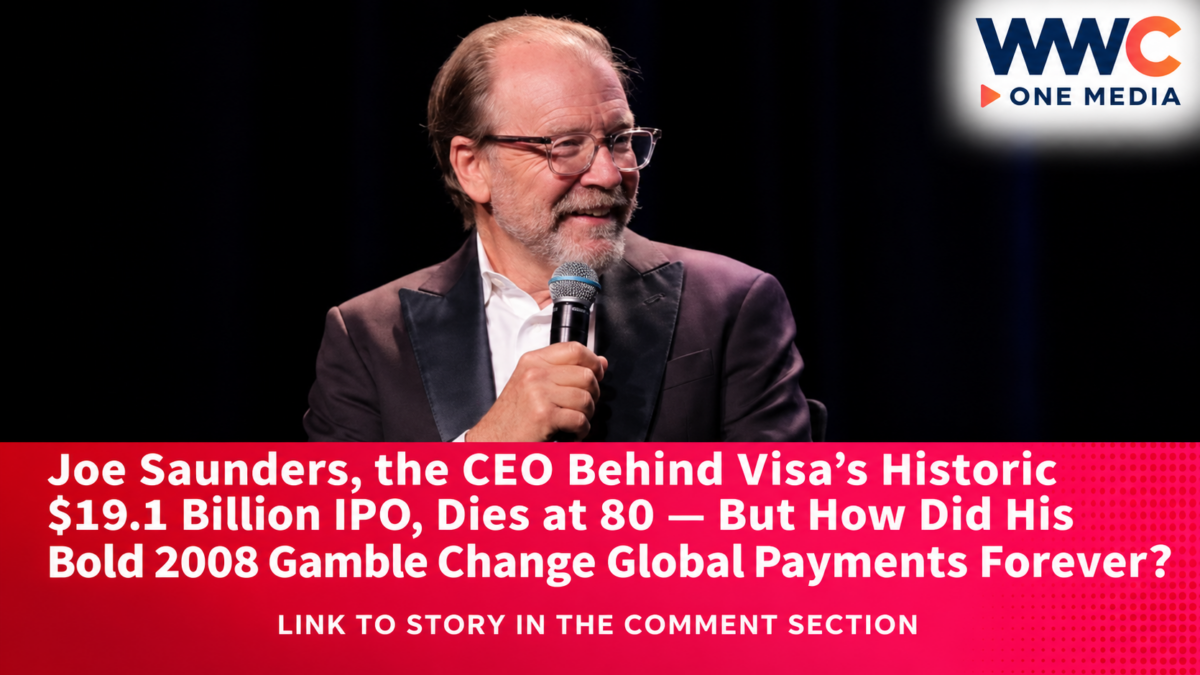
SAN FRANCISCO / NEW YORK — Joseph W. “Joe” Saunders, the former chairman and chief executive officer of Visa who helped transform the global payments network into a publicly traded financial powerhouse during the 2008 financial crisis, has died at the age of 80.
Saunders died on November 2, 2026, according to an obituary published by the San Francisco Chronicle and reporting by Bloomberg on November 3.
His death marks the passing of a major figure in modern financial services whose leadership helped reshape how one of the world’s most recognizable payment networks was owned, financed and positioned for expansion.
Saunders is best remembered for steering Visa through its landmark 2008 initial public offering, an extraordinary transaction completed while confidence in the American financial system was deteriorating.
The offering ultimately generated approximately $19.1 billion in net proceeds after underwriting fees and associated expenses, according to Visa’s regulatory filings.
At the time, it was the largest IPO in United States history.
But Saunders’ influence extended beyond a historic stock-market transaction.
He helped establish the corporate foundation for Visa’s expansion during an era when cash and checks were increasingly giving way to electronic payments.
His legacy remains particularly relevant as Visa faces another major transformation involving digital wallets, cross-border transactions and artificial intelligence.
The Man Who Took Visa Public During the 2008 Financial Crisis
Saunders became Visa’s chairman and chief executive officer in May 2007, assuming leadership during a critical period in the company’s development.
Before the restructuring, Visa operated through a complex association of financial institutions rather than the conventional publicly traded corporate structure familiar to investors today.
Its banking members controlled important aspects of the organization, while the company coordinated an international payment network connecting merchants, consumers and financial institutions.
Visa needed a structure capable of supporting larger investment, more centralized decision-making and continued international expansion.
Saunders was selected to lead that transformation.
His appointment came after decades of senior leadership experience in banking, credit cards and consumer finance.
He joined Visa as financial markets were approaching one of their most turbulent periods in modern history.
By March 2008, mounting problems in the US housing and credit markets were shaking confidence in major financial institutions.
Yet Visa proceeded with its planned public offering.
On March 18, 2008, Visa priced its IPO at $44 per share, initially offering 406 million Class A shares.
The stock began trading on the New York Stock Exchange on March 19 under the ticker symbol V.
Following the exercise of the underwriters’ over-allotment option, Visa issued a total of approximately 446.6 million shares.
The transaction generated about $19.65 billion in gross proceeds, or approximately $19.1 billion after offering expenses.
Saunders had successfully guided one of the payments industry’s largest corporate restructurings through an exceptionally difficult financial environment.
Visa’s Historic IPO Became a Defining Moment on Wall Street
Visa’s public offering attracted intense investor attention.
The company’s original IPO priced at approximately $17.9 billion before the additional shares were included.
The final offering was extraordinary not only because of its size, but because of its timing.
Financial institutions were under increasing stress as credit losses mounted and liquidity concerns spread.
Nevertheless, Visa offered investors exposure to a business whose economics differed fundamentally from those of traditional lenders.
Visa operates a payments network and earns revenue from services connected to transaction processing and related activities.
Unlike the banks that issue Visa-branded credit cards, the company generally does not bear the underlying consumer credit risk associated with those card balances.
That distinction helped make Visa attractive to investors seeking exposure to growing electronic commerce without taking on the same risks as a conventional credit-card lender.
On its first trading day, Visa’s shares climbed from their $44 offering price to close at $56.50, a gain of approximately 28%.
The market response reinforced confidence in the company’s restructuring strategy.
But the IPO was about more than raising money.
It fundamentally changed the ownership and governance structure of a global payments institution.
The proceeds supported payments to former member financial institutions and funded arrangements addressing certain litigation exposures.
The new structure also provided a platform for Visa’s long-term expansion.
How Saunders Helped Transform a Banking Association Into a Public Company
One of Saunders’ most consequential achievements was helping consolidate Visa’s major regional businesses under Visa Inc.
The restructuring brought together key operations covering the United States, Canada and international markets.
Visa Europe initially remained separately organized under a licensing arrangement.
By moving toward a more integrated corporate structure, Visa was better positioned to pursue common strategies across its major businesses.
The company could invest in technology, strengthen operational coordination and pursue opportunities associated with the global transition from cash to electronic payments.
At the time of its stock-market debut, Saunders emphasized the importance of that transition.
He believed Visa’s brand, processing infrastructure and relationships with financial institutions positioned it to benefit from the growing adoption of electronic transactions.
That strategic view became a defining element of his leadership.
Rather than focusing solely on payment cards as physical consumer products, Visa increasingly emphasized the technology and network infrastructure that enabled payments between financial institutions, merchants and consumers.
This distinction remains central to understanding the company’s business model today.
A Career Built Across Major US Financial Institutions
Saunders’ professional career began well before his appointment at Visa.
He was a veteran of the American credit-card industry, having held senior roles at several major financial businesses.
His experience included leadership positions at Household Credit Services, Fleet Credit Card Services, Providian Financial and Washington Mutual’s card operations.
At Household, Saunders helped build a substantial credit-card business and became associated with the launch of the General Motors co-branded credit card.
The GM Card was an important development in the expansion of branded consumer credit products.
These partnerships allowed financial institutions to offer cards connected to established commercial brands, combining consumer spending incentives with payment services.
Saunders subsequently served as chairman and chief executive officer of Providian Financial.
He had also chaired Mastercard International’s board of directors in 1996, giving him experience with Visa’s principal global competitor.
His career reflected decades of changes in the payments industry, from conventional credit-card operations to increasingly sophisticated electronic transaction networks.
That combination of banking experience, corporate leadership and industry relationships helped prepare him for Visa’s major restructuring.
Leadership Transition: Saunders Retired After Guiding Visa Into a New Era
Saunders remained Visa’s chief executive until November 1, 2012, when Charles W. Scharf assumed the position.
Visa announced the leadership succession in October 2012.
Saunders continued as executive chairman during the transition before retiring in March 2013.
The arrangement provided continuity as the company moved from the leadership team responsible for the IPO toward its next stage of development.
His retirement concluded a period in which Visa had undergone substantial organizational transformation and established itself as a major publicly traded payments company.
The company’s later growth would be driven by subsequent executives, evolving technology and the expanding global shift toward digital transactions.
Nevertheless, Saunders’ role in building the public-company structure remained a defining part of Visa’s corporate history.
His Legacy Lives On as Visa Expands Into China and Digital Payments
Saunders’ death comes at a time when Visa is pursuing another important stage of international expansion.
In October 2026, Visa announced a new partnership framework with Chinese technology company Tencent focused on cross-border payments, digital commerce and potential applications of artificial intelligence.
The collaboration aims to connect elements of Tencent’s digital payments ecosystem with Visa’s international network.
It could eventually make selected transactions easier for international travelers, businesses and consumers moving between different financial systems.
The agreement also highlights how the payments business has evolved since Saunders took Visa public.
During the 2008 IPO, investors were focused largely on the transition from cash and checks toward electronic card transactions.
Today, the industry is increasingly focused on digital wallets, embedded finance, cross-border transfers and intelligent software that can help initiate payments.
WWC ONE MEDIA previously examined the latest developments in Tencent and Visa Strike Major China Payments Deal as Citi and Mastercard Expand Their Reach — But Could AI Redefine Who Controls Global Transactions?.
The report detailed how Visa’s efforts to expand access in China reflect the continued importance of international payment infrastructure.
Although Saunders was no longer leading Visa when these developments occurred, they illustrate how the global network he helped restructure continues adapting to changing consumer and commercial needs.
Artificial Intelligence Is Creating a New Payments Revolution
The transformation of digital payments is accelerating as artificial intelligence becomes more capable of performing complex tasks.
Visa, Mastercard and Ant International have been developing systems intended to help merchants identify and verify AI agents authorized to make purchases.
Such technologies could allow consumers to instruct digital assistants to research products, compare prices and complete transactions within predetermined limits.
But the concept raises difficult questions involving security, fraud prevention and consumer consent.
Payment companies must establish ways to distinguish authorized AI systems from fraudulent software.
They also need controls to determine whether an automated transaction falls within the spending permissions granted by a customer.
WWC ONE MEDIA examined this emerging market in Visa, Mastercard and Ant Want AI Agents to Spend Your Money — But One Question Could Decide Whether Anyone Trusts Them.
The development highlights how Visa’s role has expanded beyond the physical payment card.
Its future increasingly depends on secure transaction infrastructure that can operate across different financial technologies.
The company Saunders helped take public must now compete and collaborate within an ecosystem that includes traditional banks, digital wallets, fintech platforms and AI developers.
Visa Faces Competition From Digital Wallets and Alternative Payment Networks
The global payments environment has also changed substantially since 2008.
Digital wallet systems and account-to-account payment networks are becoming major alternatives to conventional card transactions.
India’s Unified Payments Interface, for example, has transformed everyday digital transactions through mobile applications and QR-code payments.
In some markets, consumers can transfer funds or pay merchants directly through their bank accounts without relying on traditional card-based payment flows.
This has created new competition for international payment networks.
WWC ONE MEDIA examined the changing economics of India’s payments market in India Is Ending Zero-Fee UPI for Bigger Merchant Payments — But Visa and Mastercard May Still Be the Losers.
The emergence of alternative payment infrastructure demonstrates why Visa must continue developing products and partnerships beyond conventional plastic cards.
Saunders helped establish the company’s public-market foundation.
The leadership challenge today is to maintain its importance in a rapidly changing financial system.
Cybersecurity Is Now Central to the Future of Payment Networks
The growing scale of electronic transactions has also made cybersecurity a crucial concern.
Payment networks must protect sensitive financial information while handling enormous volumes of transactions across international markets.
Increasingly sophisticated cybercriminal operations and the availability of AI-powered automation create additional risks.
WWC ONE MEDIA explored these threats in INTERPOL Warns Agentic AI Could Automate Cyberattacks as Criminals Scale Scams at Machine Speed.
That report described how autonomous systems could help malicious actors conduct cyberattacks at greater speed and scale.
For Visa and other payment providers, resilience depends not simply on processing transactions quickly but on maintaining security, reliability and trust.
This challenge illustrates another transformation in the industry Saunders helped shape.
Electronic payments have become essential infrastructure for global commerce, making reliability and cybersecurity increasingly important responsibilities.
Visa’s Historic IPO Offers a Lesson for Today’s Fintech Companies
Saunders’ experience also provides a useful comparison for financial technology businesses preparing public offerings.
Visa went public during a period of extraordinary market uncertainty.
Yet the transaction demonstrated that investors could still support a company with an established business model, recognizable brand and extensive commercial network.
For today’s fintech companies, however, a successful IPO remains only the beginning of the public-market journey.
Investors must evaluate business fundamentals, revenue growth, profitability and valuation.
An offering’s size does not guarantee long-term investment success.
This lesson is relevant in the Philippines, where the financial technology sector has generated considerable interest among institutional and retail investors.
WWC ONE MEDIA previously examined the market’s reaction to GCash operator Mynt’s landmark public listing in Globe CEO and GCash Directors Bet ₱77 Million on Landmark IPO Before Share Price Drops — But a Sudden Rebound Changes the Story.
Although Visa and GCash have different business models and operate in different market environments, both illustrate the importance of pricing, investor expectations and long-term execution.
Saunders’ achievement was not merely completing an exceptionally large transaction.
It was helping establish a structure capable of supporting Visa’s continued development after the company became publicly traded.
Beyond Business: Saunders Supported Education and Future Leaders
Saunders’ work extended beyond the financial services industry.
He remained active in investment and advisory roles after retiring from Visa.
These included serving as an adviser to Reverence Capital Partners and holding leadership responsibilities at Green Visor Capital.
He also supported education and leadership development.
In 2018, Saunders and his wife, Sharon, established the Saunders Leadership Academy Endowed Scholarship Fund at the University of Denver.
The initiative was designed to provide financial assistance, mentorship and leadership opportunities to students with significant financial need, including first-generation college students.
Saunders earned both his bachelor’s degree in business administration and MBA from the University of Denver.
The university later awarded him an honorary doctorate in business.
He also served on its Board of Trustees and held a leadership role with Teach For All, an international network focused on expanding educational opportunities.
These activities reflected his continuing interest in developing future business and community leaders.
Family, Personal Life and Memorial Arrangements
According to his published obituary, Saunders was born in Chicago on November 20, 1945.
He died on November 2, 2026, shortly before his 81st birthday.
The obituary did not disclose a cause of death.
He is survived by his wife, Sharon; his son, TJ; his daughter, Christine; three granddaughters; his sister, Laura; and other family members.
A celebration of his life is scheduled for November 20, 2026, in San Francisco.
Those close to him remembered his integrity, generosity, humor and commitment to fairness.
While his professional accomplishments made him a prominent figure in international finance, his family emphasized the importance of his personal relationships and the way he treated others.
The Bigger Picture: A Legacy That Continues to Shape Global Finance
Joe Saunders led Visa at one of the most important moments in the history of electronic payments.
He assumed control as the company prepared to move away from its traditional banking-association structure.
He guided its historic IPO through the financial turmoil of 2008.
And he helped position Visa to pursue opportunities created by the migration from cash and checks toward electronic transactions.
The payments industry he leaves behind is vastly different from the one he entered decades earlier.
Physical cards now operate alongside digital wallets, instant bank transfers, cross-border payment platforms and emerging AI-powered purchasing systems.
Visa continues adapting to those changes, supported by a corporate structure whose development Saunders helped oversee.
His death closes an important chapter in the history of modern financial services.
But the strategic questions that defined his career remain relevant: how payment networks should evolve, how financial institutions can maintain consumer trust and how businesses can prepare for technological transformation.
As the financial world remembers the executive who took Visa public during the 2008 crisis, one question defines the next chapter: Can the global payments giant preserve the competitive strength Saunders helped establish—or will digital wallets and artificial intelligence reshape the industry beyond recognition?