
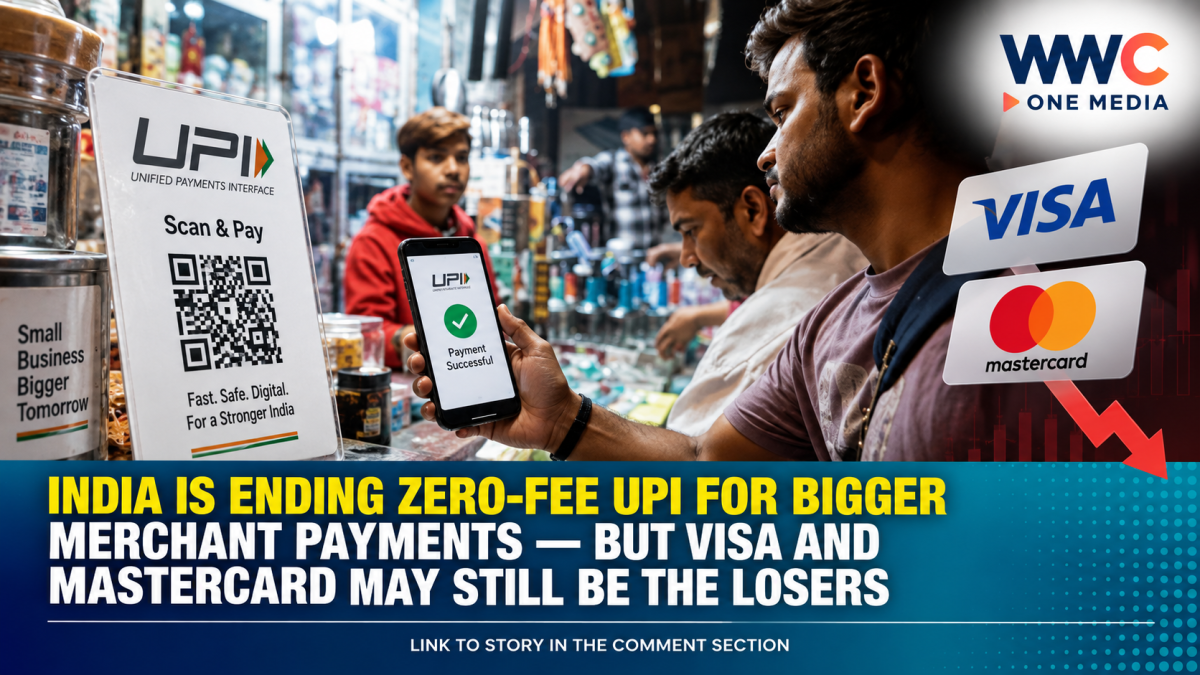
India Is Ending Zero-Fee UPI for Bigger Merchant Payments — But Visa and Mastercard May Still Be the Losers
MUMBAI — India is making the biggest change to its revolutionary Unified Payments Interface in more than six years, putting a price on larger merchant transactions after UPI transformed everything from roadside stalls to online shopping into a scan-and-pay economy.
Beginning October 15, 2026, qualifying UPI payments to merchants above ₹2,000 — roughly US$21 — will attract a 0.4% Merchant Discount Rate, or MDR.
But the headline needs an immediate qualification:
Consumers are not being charged the 0.4%.
The fee is payable by eligible merchants and is intended to compensate the banks, payment applications and infrastructure providers that operate the system. Person-to-person transfers remain completely free, while the Indian government says around 96% of merchant transactions will also remain outside the fee regime.
That distinction matters because the policy has already generated fierce debate in India over whether the country is weakening one of its most successful pieces of digital public infrastructure.
Yet payments analysts say the opposite may ultimately happen.
Rather than driving shoppers back toward Visa and Mastercard, the new fee could finally give companies such as PhonePe, Google Pay, Paytm and banks a sustainable way to make money from UPI — while keeping it dramatically cheaper than most card payments.
How the new 0.4% UPI charge actually works
The standard MDR applies to eligible person-to-merchant transactions above ₹2,000.
For example, if a customer makes a ₹10,000 UPI purchase, the merchant would face an MDR of ₹40.
For very large transactions, however, the charge does not continue rising indefinitely.
The fee is capped at ₹300 per transaction once the payment reaches ₹75,000 or more.
Several important categories receive special treatment.
Payments involving areas such as rail travel, fuel, telecom, utility bills, insurance, agricultural inputs and certain government-related transactions face a much lower flat charge of ₹5, while capital-market payments have a separate concessional structure.
Small merchants are also protected.
Reuters reported that QR-based merchants receiving up to ₹100,000 a month through UPI remain exempt from MDR, shielding many neighbourhood shops and street vendors that helped make the system ubiquitous.
The government has also instructed banks and payment providers not to simply pass the MDR directly to consumers as a visible UPI surcharge.
So is UPI no longer free?
For the ordinary consumer, it largely still is.
India’s Finance Ministry says:
- person-to-person UPI transfers remain free regardless of amount;
- merchant payments of ₹2,000 or less remain free;
- qualifying small merchants remain protected;
- roughly 96% of merchant transactions will be unaffected.
The ministry also stresses that MDR is not a government tax. The revenue is distributed through the payments ecosystem to support banks, payment apps and other participants that keep UPI operating.
That makes headlines describing the measure simply as a “0.4% UPI tax on users” misleading.
The economic burden initially falls on qualifying merchants, although critics argue businesses could eventually recover those higher costs indirectly through product pricing.
Why India is charging now
UPI has become almost unimaginably large.
Official NPCI data show the system processed approximately 24.51 billion transactions in August 2026, worth around ₹29.82 trillion.
Reuters says UPI now accounts for roughly 84% of India’s digital payment transactions by volume and around 49% of global real-time payments.
The Indian government describes it as the world’s largest real-time interoperable payment system.
That extraordinary scale creates equally extraordinary operating costs.
Every payment requires banking infrastructure, telecommunications, cybersecurity, fraud monitoring, dispute management and data-centre capacity.
PhonePe CEO Sameer Nigam said this week that India’s UPI ecosystem is spending roughly ₹10,000 crore to ₹12,000 crore annually at current volumes and argued that the industry could not indefinitely rely on government subsidies to cover those costs.
His argument is straightforward:
UPI succeeded because it was free.
But keeping a system processing tens of billions of transactions every month reliable and secure is not free.
PhonePe is one of the clearest potential winners
PhonePe has strongly backed the new framework.
Nigam estimates that around 96% of UPI transactions will still avoid the new MDR, meaning the revenue will come overwhelmingly from relatively high-value commercial activity rather than everyday small payments.
That matters because PhonePe has enormous scale but, like other UPI apps, historically had limited ability to directly monetise basic payment processing under the zero-MDR system.
CNBC cited an Ambit Capital analysis estimating that PhonePe and Google Pay together account for nearly 85% of UPI transaction value and about 81% of transaction volume.
A direct merchant revenue stream could therefore dramatically change the economics of operating India’s largest payment apps.
Reuters reported that Citi estimates the overall MDR system could generate approximately ₹160 billion to ₹170 billion annually, with banks potentially receiving about 60%, application providers around 25%, and payment aggregators the remainder.
Ambit Capital’s estimate cited by CNBC is even larger, suggesting the addressable industry revenue pool could reach as much as ₹245 billion — about US$2.5 billion.
Those are analysts’ estimates, not guaranteed revenue.
But they explain why payment-industry companies have welcomed the move.
Amazon Pay says the zero-cost foundation is largely preserved
Amazon Pay has also supported the structure.
Girish Krishnan, Amazon Pay’s director of payment experience, told CNBC that UPI’s growth had depended on zero-cost access for consumers, small shops and micro-businesses, and said the new framework preserves that foundation.
Amazon Pay chief Vikas Bansal had been making a similar argument even before the latest policy announcement.
He said last year that some form of reasonable MDR could create a healthier exchange of value among merchants, consumers, banks and payment providers — while warning that fees should not be so high that they damage adoption.
Amazon’s position is particularly interesting because it operates on multiple sides of the ecosystem.
Amazon.in can be a large merchant accepting UPI payments, while Amazon Pay is itself a payments platform.
So the new system could create both processing costs in one part of the Amazon ecosystem and additional payment-industry economics in another.
Why Visa and Mastercard may not get the windfall some expect
The new charge has created a politically explosive question:
If UPI is no longer completely free for merchants, will stores simply push customers back toward Visa, Mastercard or American Express?
Payments specialists interviewed by CNBC largely said no.
The basic reason is price.
A 0.4% UPI MDR remains substantially below typical credit-card merchant costs, which commonly sit around 1.5% to 2.5%.
Debit-card MDR can also reach approximately 0.9%.
Neil Shah of Counterpoint Research told CNBC that the 0.4% price still “severely undercuts” card economics, leaving merchants with a strong financial incentive to keep encouraging UPI.
Take a ₹10,000 transaction.
At 0.4%, UPI costs the merchant about ₹40.
At a hypothetical 2% credit-card MDR, the same sale would cost ₹200.
That ₹160 difference gives merchants little reason to abandon UPI solely because zero-MDR has ended.
The fee targets only 4% of transactions — but they represent most of the money
One of the smartest elements of India’s new framework is where the ₹2,000 threshold sits.
Transactions above ₹2,000 represent only around 4% of merchant UPI transaction volume, according to data cited by Reuters and CNBC.
But those relatively few transactions account for approximately 67% of transaction value.
That allows policymakers to monetise a disproportionately large amount of spending without charging most everyday transactions.
The strategy effectively says:
Keep coffee, groceries and small street purchases free.
Charge merchants on larger purchases such as electronics, travel and higher-value e-commerce.
Whether that balance holds over time will be closely watched.
UPI’s free model changed India’s entire payments economy
The zero-MDR policy began in 2020 as part of India’s attempt to accelerate digital payments.
Its effect was enormous.
Merchants who previously had little reason to install card terminals could display a printed QR code and begin accepting digital money almost immediately.
Consumers did not need cards.
Merchants avoided transaction fees.
Banks could settle funds directly.
And apps such as PhonePe, Google Pay, Paytm and Amazon Pay competed to offer the simplest interface on top of the same underlying infrastructure.
UPI became so convenient that, as the World Bank has observed, it effectively made digital payments behave like cash from the user’s perspective: immediate, widely accepted and free at the point of transaction.
That changed how Indians pay.
It also changed competitive conditions for card networks.
Washington has complained about that competitive landscape
This is where the issue becomes politically sensitive.
The U.S. Trade Representative’s 2026 National Trade Estimate report formally raised concerns about India’s electronic-payment rules.
The USTR said Indian policies appeared to favour domestic suppliers and create an uneven competitive environment for foreign payment firms. It specifically raised concerns about foreign companies’ ability to participate in UPI and compete with domestic RuPay arrangements.
Those complaints are real and documented.
But they do not prove that Washington caused India to introduce the 0.4% MDR.
India’s opposition Congress party has alleged that the policy was introduced under U.S. pressure and could benefit American-linked payments companies.
The Indian government categorically denies that claim.
The Finance Ministry says UPI policy is determined independently and that the MDR was introduced to make the payments system financially sustainable while preserving affordability and financial inclusion.
There is no public evidence establishing a direct causal link between U.S. lobbying and the September MDR decision.
The irony: PhonePe is being described as “foreign” even though it is based in India
The political debate has also become complicated by ownership.
PhonePe is majority-owned by U.S. retail giant Walmart, which has led some critics to group it with American companies.
PhonePe CEO Sameer Nigam has pushed back strongly against that characterisation, arguing that PhonePe is an Indian operating company headquartered and built in India, even though Walmart is its controlling shareholder.
Google Pay is operated by Alphabet’s Google, while Amazon Pay is part of Amazon’s wider ecosystem.
The result is an unusual structure:
India created UPI as domestic public digital infrastructure, yet some of the largest consumer interfaces running on that infrastructure are backed by major global technology corporations.
That tension existed long before the new MDR.
The fee merely makes the question of who profits from UPI much more visible.
Card networks face another challenge: PhonePe is now partnering with Visa
The relationship between UPI and global card companies is also becoming less binary.
Only days before the MDR controversy exploded, PhonePe and Visa announced a major partnership involving cardless payments.
PhonePe is adding Visa-powered features including Tap to Pay, Cross Border Scan to Pay and Smart Accept, giving Indian users and merchants new ways to use Visa infrastructure through the PhonePe app.
That means PhonePe can simultaneously be:
one of the largest interfaces for UPI,
a beneficiary of UPI’s new merchant economics,
and a distribution platform for Visa-powered payment services.
The future of payments may therefore be less about UPI versus Visa than about apps blending multiple payment rails behind a single interface.
UPI is also moving outside India
India’s ambitions for UPI extend far beyond its domestic market.
UPI has already established payment links or acceptance arrangements in markets including Singapore, the United Arab Emirates, France and other countries, while policymakers continue discussing new cross-border connections.
PhonePe’s Visa partnership adds another route for Indian consumers to make overseas QR payments.
Its new Cross Border Scan to Pay feature allows eligible users to scan Visa-supported QR codes internationally, supplementing existing UPI International capabilities.
That international expansion creates another reason India wants the payment system itself to have durable economics.
A network designed to operate at global scale needs continued investment in security, fraud prevention, redundancy and international connectivity.
The biggest risk may be what merchants do next
The new MDR may be far cheaper than card fees, but it still changes merchant economics.
Businesses that built their pricing around completely free UPI acceptance now face a new cost on larger transactions.
Some merchants are already warning they may encourage cash, split payments or other alternatives if the charge significantly squeezes margins.
The government says providers must not directly transfer the MDR to consumers.
But regulators cannot completely eliminate the possibility that businesses eventually adjust general prices or offer informal incentives for lower-cost payment methods.
That makes October 15 a real-world experiment.
Will UPI volumes continue growing almost untouched?
Will merchants try to avoid larger digital payments?
Or will the 0.4% rate prove small enough that behaviour barely changes?
Investors already think somebody is going to make money
Financial markets reacted quickly.
Reuters reported that shares of payment companies and banks rose after the MDR announcement as analysts upgraded expectations for new revenue.
Paytm and several banks gained sharply, while brokerages raised earnings forecasts for businesses positioned to participate in UPI transaction economics.
The excitement comes from something UPI historically lacked:
a direct transaction revenue pool.
Until now, many fintech companies had to monetise users indirectly through advertising, lending, insurance, investment products or other financial services because the core UPI payment generated little direct revenue.
That model is now changing.
And once transaction economics exist, companies have a stronger financial incentive to compete on reliability, fraud detection, merchant services and higher-value payment experiences.
A Supreme Court challenge has already arrived
The controversy is not confined to politics and financial markets.
A public-interest petition has been filed in India’s Supreme Court challenging the new MDR framework.
The petition argues against narrowing the legal zero-charge protection that previously covered UPI transactions more broadly.
As of September 17, the Supreme Court had not yet scheduled the case for hearing.
That means the policy enters its final month before implementation with legal as well as political uncertainty hanging over it.
Unless a court or government decision changes the timetable, however, the October 15 launch remains in place.
India is trying to solve a problem created by UPI’s own success
The central policy dilemma is difficult precisely because UPI worked so well.
Zero merchant fees helped create extraordinary adoption.
But extraordinary adoption produced extraordinary infrastructure costs.
Government subsidies could continue covering those costs.
The system could introduce advertising or cross-subsidisation.
Or the merchants generating the largest commercial payment values could contribute directly.
India has chosen the third option — while protecting low-value payments and small merchants.
That explains why payment companies are celebrating even while some merchants and opposition politicians are objecting.
The real fight is not over 0.4%
The bigger question is what kind of financial network UPI becomes during its second decade.
For consumers, it remains overwhelmingly free.
For neighbourhood shops, most transactions remain protected.
For fintech companies and banks, however, UPI is moving from a scale-at-all-costs public utility toward a system with actual transaction economics.
And despite years of concern from Visa and Mastercard about India’s domestically built payment infrastructure, the first major fee added to UPI may not hand those card companies the advantage critics expect.
At 0.4%, UPI is still dramatically cheaper than a typical credit card transaction.
PhonePe and Google Pay already dominate its consumer interface.
Banks and fintechs now have a direct reason to invest more money in it.
And 96% of merchant transactions are expected to remain free.
So India may indeed be ending the completely free UPI era.
But it may simultaneously be making UPI harder — not easier — for traditional card networks to dislodge.


Leave a Reply