
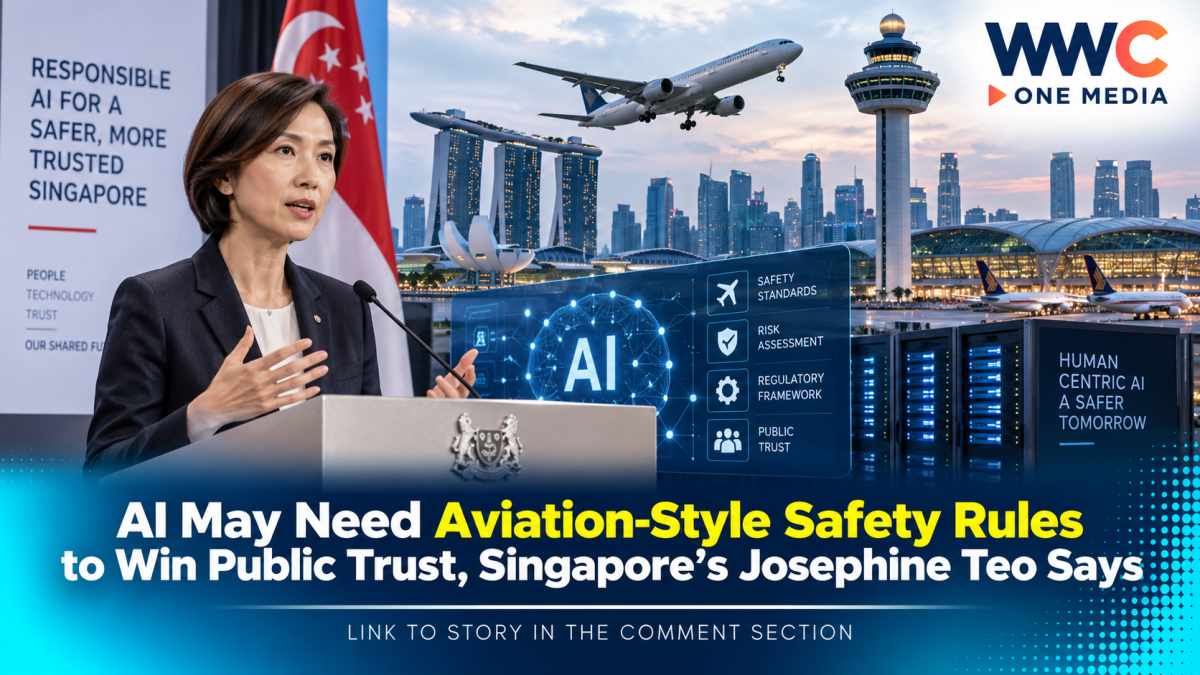
SINGAPORE — Artificial intelligence may eventually need the kind of layered safety standards and safeguards that underpin civil aviation, Singapore’s Minister for Digital Development and Information Josephine Teo said as governments and technology companies grapple with how to keep increasingly capable AI systems trustworthy.
In a Sept. 17, 2026 statement, Teo argued that public trust will be essential if AI is to become a technology people routinely rely on. She compared the challenge to aviation, where aircraft safety depends not on a single rule but on multiple layers covering equipment, maintenance, operations, training, airspace and airports.
Her message was not that Singapore is immediately imposing aviation-style regulations on AI. Rather, she said the systems needed to test, evaluate and govern advanced AI must be developed alongside the technology itself.
Why Teo Is Comparing AI With Aviation
Modern aviation became widely trusted through decades of standards, testing, certification, training and operational safeguards.
Teo said AI may ultimately require a similarly comprehensive safety ecosystem.
The comparison comes as AI capabilities are advancing rapidly while researchers, governments and technology companies continue debating how quickly the technology should be developed and deployed.
“Trust is an essential requirement for a technology to be regularly relied upon,” Teo said, according to The Straits Times. She added that safeguards for advanced AI are still developing and require further research and testing.
The aviation analogy is particularly relevant to Singapore because the country is simultaneously positioning itself as an AI hub and a major international aviation centre.
In May, Teo said Singapore had already begun work on an AI mission focused on aviation, including potential applications for air-traffic management and connectivity. She stressed that future systems would need to prioritize safety rather than simply increasing capacity.
Singapore Is Already Building an AI Safety Framework
Teo’s latest comments build on policies Singapore has been developing rather than representing a completely new direction.
One example is AI Verify, a Singapore-developed testing framework and toolkit intended to help organizations evaluate AI systems for issues including transparency, fairness and robustness.
Singapore has also established the Singapore AI Safety Institute, which focuses on evaluating advanced AI systems and researching potential safety risks.
Another development is the AI Tester Accreditation Programme, announced in May 2026. The initiative is designed to establish standards for companies that test AI systems and probe them for weaknesses before deployment. The AI Verify Foundation describes it as the first programme of its kind in Asia.
Together, these initiatives point toward a model in which AI safety involves testing and assurance as well as regulation.
The Hard Question: How Much Regulation Is Enough?
Teo has previously argued that AI safeguards need to translate into practical guardrails, including standards, regulations and laws where appropriate.
But she has also cautioned against regulation that creates a false sense of security or unnecessarily restricts useful technology.
In remarks at an AI-safety discussion in February, she said Singapore needed to be thoughtful about regulation: policymakers should mitigate genuine risks while preserving the benefits of AI adoption.
That balancing act is becoming more important as AI systems move beyond chatbots and into areas such as healthcare, finance, manufacturing, cybersecurity and critical infrastructure.
Singapore’s updated National AI Strategy also emphasizes sector-specific adoption, research, talent and governance as the country seeks to expand practical AI use. Earlier government plans have included major investments in AI research and talent development.
Global AI Race Adds Urgency to Safety Debate
Teo’s comments arrive during a broader international debate over whether the development of increasingly powerful AI models is moving faster than safety research.
Anthropic chief executive Dario Amodei recently called for AI companies to slow the pace of frontier-model development, arguing that safeguards need time to catch up with rapidly advancing capabilities.
Other technology leaders have also joined the debate, while U.S. President Donald Trump has opposed calls for slowing AI development, arguing that maintaining technological leadership is strategically important. China, meanwhile, has called for international cooperation on AI governance. These positions represent competing policy approaches rather than a settled international consensus.
What an “Aviation Model” Could Mean for AI
If the aviation analogy develops into actual policy, the important lesson would be the system of safeguards, rather than simply copying aviation regulations.
That could involve:
- Independent or third-party testing of AI systems
- Clear safety and performance standards
- Testing before high-risk deployment
- Continuous monitoring after deployment
- Training and accountability for organizations using AI
- Greater transparency around system capabilities and limitations
- Mechanisms for responding when systems behave unexpectedly
- International cooperation on common safety standards
The exact structure, however, remains a matter for policymakers, researchers and industry to develop.
Teo herself acknowledged that the world does not yet have all the answers. Singapore’s approach is therefore focused on testing, learning and strengthening safeguards as AI capabilities evolve.
Why This Matters for Singapore
For Singapore, the issue is particularly significant because the government wants the country to be both a major adopter of AI and a trusted location for AI development and deployment.
That creates a dual challenge: encourage businesses to use AI while convincing citizens and organizations that increasingly autonomous systems can be deployed responsibly.
The aviation comparison captures that dilemma.
People generally do not need to understand every engineering detail of an aircraft before boarding a plane. They rely on an ecosystem of standards, trained professionals, inspections, procedures and regulatory oversight.
Teo’s argument is that AI may eventually require a comparable ecosystem of assurance before people are willing to place the same level of trust in increasingly powerful systems.
FACT-CHECK / EDITORIAL NOTE
What is confirmed: Josephine Teo said on Sept. 17, 2026 that AI may eventually require a safety regime comparable in principle to civil aviation, with multiple safeguards and standards.
What is not confirmed: Singapore has not announced a new law requiring AI to follow aviation regulations. The aviation comparison is a policy analogy describing the kind of mature safety ecosystem that advanced AI may eventually need.
Singapore already has AI governance and testing initiatives, including AI Verify, the Singapore AI Safety Institute and the AI Tester Accreditation Programme.
The broader international debate over AI safety remains unsettled, with governments and technology companies differing over how quickly frontier AI should advance and how regulation should respond.
WWC ONE MEDIA G.A

Leave a Reply