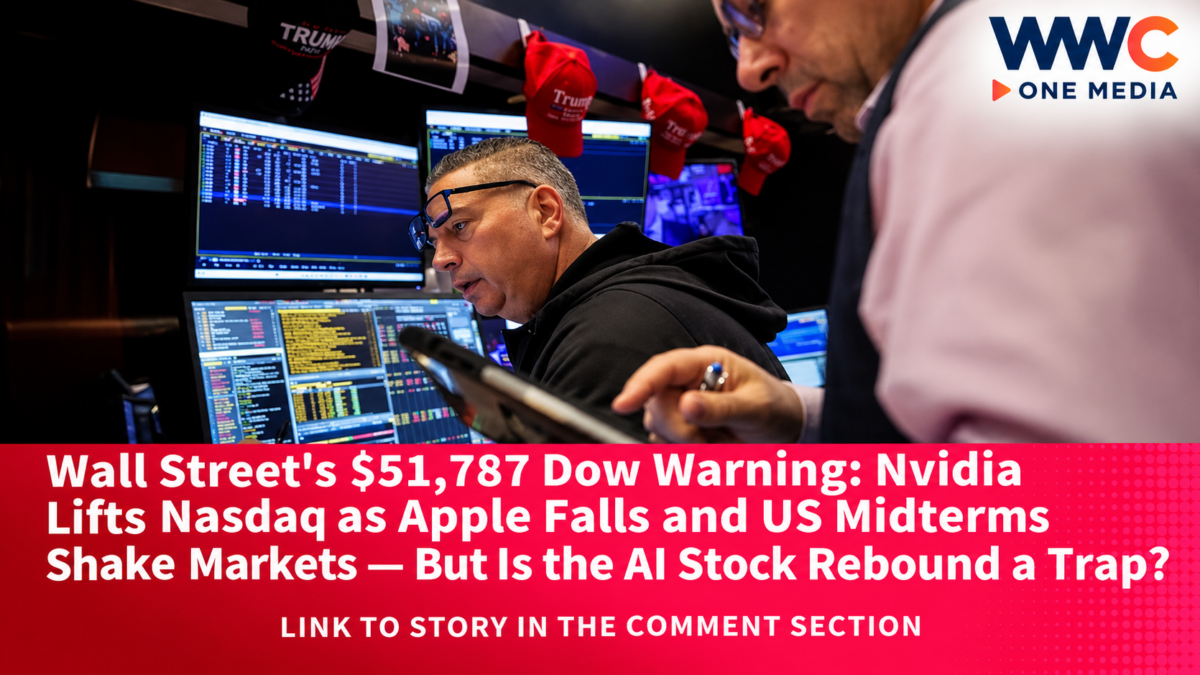
NEW YORK / MANILA — Wall Street staged a highly uneven comeback on Tuesday, November 3, as a rebound in artificial intelligence stocks lifted the S&P 500 and Nasdaq Composite, even while the Dow Jones Industrial Average lost nearly 200 points and most stocks in the broader market finished lower.
The split performance came as Americans voted in the US midterm elections, investors assessed a fresh round of corporate earnings, and concerns about the enormous cost of artificial intelligence continued to unsettle global financial markets.
The S&P 500 climbed 0.36% to 7,568.92, while the technology-heavy Nasdaq Composite gained 0.83% to 25,372.01.
But the Dow Jones Industrial Average fell 197.26 points, or 0.38%, to 51,786.72, reflecting weakness in several major companies, including Apple.
The Russell 2000 index of smaller companies advanced 0.23% to 2,812.45.
According to Bloomberg’s November 3 live market coverage and closing reports from the Associated Press and MarketWatch, gains in Nvidia, Microsoft and other influential technology companies helped offset losses elsewhere.
Yet the rebound exposed a troubling contradiction: Wall Street’s most closely watched indexes were rising even as many individual stocks continued struggling.
The question now confronting investors is whether the rally represents the beginning of a sustainable recovery—or another temporary rebound before the next wave of selling.
Nasdaq Rebounds, but Wall Street’s Recovery Remains Fragile
Tuesday’s gains offered relief following several difficult sessions for technology investors.
The Nasdaq and S&P 500 ended three-session losing streaks as buyers returned to some of the companies that had suffered during the recent AI-driven selloff.
However, the improvement was far from universal.
The Associated Press reported that most S&P 500 stocks declined despite the index finishing higher.
This divergence is significant because the S&P 500 is weighted by market capitalization.
That means companies with exceptionally large market values can exert disproportionate influence over its performance.
A sharp advance in Nvidia or Microsoft can outweigh losses spread across dozens of smaller index constituents.
Consequently, a rising S&P 500 does not necessarily indicate that investors are becoming more optimistic about the entire US economy.
It may instead reveal how dependent the market has become on a small number of companies.
WWC ONE MEDIA previously examined that vulnerability in Nasdaq-100 Crashes Into 10% Correction as AI Giants Lose Trillions — But Is Wall Street’s Biggest Tech Bubble Finally Bursting?.
The report highlighted how weakening confidence in AI-related valuations had pushed the Nasdaq-100 into technical correction territory.
Tuesday’s recovery provided some relief, but one positive session is not enough to establish that the correction has ended.
Nvidia Surges as Investors Return to AI Chip Stocks
Nvidia emerged as one of the most important drivers of the market rebound.
The semiconductor giant gained approximately 2.3% during Tuesday’s session, helping support the S&P 500 and Nasdaq.
Microsoft also advanced, while other technology and semiconductor companies attracted renewed buying interest.
Advanced Micro Devices, Broadcom and Micron Technology participated in the recovery.
The buying followed weeks of uncertainty surrounding artificial intelligence infrastructure spending.
For much of the past several years, investors have rewarded companies supplying the specialized processors, networking equipment and computing infrastructure required to develop advanced AI systems.
But the extraordinary expansion has created increasingly demanding expectations.
Major technology businesses are committing enormous sums to data centers, processors, electricity infrastructure and computing facilities.
Investors are now asking whether those investments will generate sufficient revenue and profitability to justify their costs.
WWC ONE MEDIA examined those concerns in Wall Street’s AI Stock Selloff Enters Third Straight Week as Nasdaq 100 Plunges 3.5% — But Is the Tech Bubble Finally Bursting?.
That earlier reporting described how disappointing corporate outlooks and concerns about AI financing had weakened confidence in technology valuations.
Tuesday’s rebound indicates that investors still see opportunities in leading AI companies.
However, the market remains highly sensitive to earnings forecasts and evidence that AI spending is producing sustainable financial returns.
Apple Falls Nearly 2% as Rising Chip Costs Threaten Margins
While Nvidia lifted the technology sector, Apple moved in the opposite direction.
The iPhone maker declined approximately 1.9%, contributing to the Dow’s weakness.
Apple’s latest quarterly results had shown strong overall revenue performance.
The company reported approximately $114.5 billion in quarterly revenue, exceeding Wall Street expectations.
However, investors focused on the potential impact of rising memory-chip costs on profitability.
Management warned that higher component expenses could pressure gross margins, even as demand for Apple products remained relatively strong.
The concern highlights a growing challenge across the technology industry.
The AI infrastructure boom has increased demand for advanced semiconductors and memory products.
That demand benefits certain chip manufacturers but can also raise component costs for companies producing consumer electronics.
Apple’s decline demonstrates why strong revenue does not always guarantee a positive stock-market reaction.
Investors also evaluate profit margins, future guidance and whether a company’s earnings outlook justifies its valuation.
WWC ONE MEDIA explored these issues in Apple Posts Record $114.5-Billion Quarter, but China Sales Miss Wall Street Forecasts — Could Rising AI Chip Costs Derail the iPhone Boom?.
The company’s performance illustrates how the AI investment boom is creating winners and losers even within the technology sector.
US Midterm Elections Add Another Layer of Market Uncertainty
Tuesday’s trading coincided with the November 3 US midterm elections.
Investors were watching whether the election would change the balance of power in Congress and influence Washington’s approach to regulation, government spending and taxation.
Financial markets often react to elections because political outcomes can alter expectations for future economic policy.
Potential changes to AI regulation, energy policy, healthcare and infrastructure spending were among the issues attracting investor attention.
However, the market’s mixed performance suggests that election uncertainty was only one of several important influences.
Technology earnings, interest rates and corporate valuations remained central concerns.
Historically, US stocks have frequently performed well after midterm elections, partly because the removal of political uncertainty can encourage investors to take additional risks.
But historical trends cannot guarantee future returns.
WWC ONE MEDIA previously examined this issue in Wall Street’s Midterm Rally Faces an AI Reality Check as Tech Stocks Slide — But Could Nvidia Decide Whether the Market Rebounds or Crashes Again?.
That analysis explained why AI-related financial risks could remain significant even after election results become clear.
For investors, the important question is not simply which political party gains control of Congress.
It is how future policy decisions could affect corporate earnings, capital investment and economic growth.
Stronger US Job Openings Push Treasury Yields Higher
Economic data added another complication to Tuesday’s market outlook.
The latest Job Openings and Labor Turnover Survey showed approximately 7.52 million US job openings in September, exceeding market expectations.
The stronger-than-anticipated figure suggested that demand for labor remained relatively resilient.
That can support confidence in economic activity.
However, a strong labor market can also make it harder for inflation to decline as quickly as policymakers would prefer.
Investors consequently reassessed the outlook for US interest rates.
The benchmark 10-year US Treasury yield climbed toward 4.95% during the session.
Higher Treasury yields can put pressure on stock valuations, particularly among rapidly growing technology companies whose expected earnings are concentrated further into the future.
They can also increase borrowing costs for businesses and consumers.
For AI infrastructure companies financing large capital investments, the cost of raising money is especially important.
Expensive debt financing can weaken the economics of projects that require enormous upfront spending.
As a result, even strong technology earnings may not be enough to sustain a rally if bond yields continue increasing.
Palantir, Shopify and AMD Show Why Earnings Matter
Beyond the major indexes, individual corporate results produced substantial movements.
Palantir shares declined approximately 1.7% despite earnings that exceeded expectations.
Investors appeared concerned about aspects of the company’s business momentum and the high expectations already reflected in its valuation.
Shopify experienced a much sharper decline, falling nearly 9% following results that disappointed investors on selected revenue measures.
The contrasting performance reinforced a major theme of the current earnings season.
Wall Street is becoming less willing to reward companies simply for announcing growth.
Investors want evidence that revenue expansion can translate into stronger profits and sustainable cash flows.
Advanced Micro Devices also remained an important focus as investors awaited its quarterly results after the closing bell.
The chipmaker’s performance and guidance were expected to offer further insight into demand for AI computing hardware.
Because AMD competes in parts of the rapidly expanding market for advanced processors, its forecasts could influence investor sentiment across the semiconductor industry.
However, its after-hours earnings developments should be distinguished from the regular-session market closing figures reported above.
Wall Street’s AI Bubble Debate Is Far From Over
The technology sector’s recovery has not eliminated concerns about speculative valuations.
Some market analysts believe recent declines have created more attractive buying opportunities.
Others argue that the enormous spending commitments associated with AI may be difficult to justify if revenue growth fails to accelerate.
The debate is particularly important for companies building or financing data centers.
These projects require considerable spending on processors, networking equipment, electricity supplies, cooling systems and specialized facilities.
Much of that spending occurs before the infrastructure begins generating substantial revenue.
Investors therefore face a difficult task: distinguishing companies that will benefit sustainably from AI adoption from those whose valuations depend on overly optimistic expectations.
WWC ONE MEDIA previously examined the debate in State Street CEO Rejects AI Bubble Fears as Wall Street’s Trillion-Dollar Tech Gamble Grows — But Could Investors Be Ignoring the Next Market Crash?.
The report highlighted differing views about whether the current AI investment cycle represents a long-term technological transformation, a period of excessive speculation, or elements of both.
Tuesday’s performance does not settle that question.
It shows that investors remain willing to buy major AI-related stocks after declines, while continuing to punish businesses whose results or forecasts disappoint.
Oil Prices Decline as US-Iran Negotiations Influence Markets
Energy markets provided another important backdrop.
Brent crude settled at approximately $103.60 per barrel on November 3, while West Texas Intermediate finished near $96.09.
The declines reflected cautious optimism surrounding possible diplomatic progress between the United States and Iran.
Lower oil prices can reduce inflationary pressure and potentially improve the outlook for businesses facing significant fuel and transportation expenses.
For airlines, logistics companies and consumers, sustained reductions in energy prices could provide relief.
But the geopolitical situation remained uncertain.
Military tensions and threats to shipping routes continued to create risks of renewed supply disruption.
Consequently, a short-term decline in oil futures does not guarantee that inflationary pressure from energy prices has disappeared.
The interaction between lower energy costs, higher Treasury yields and AI-related stock volatility created a complicated environment for investors.
What the Wall Street Rebound Means for Philippine Investors
The November 3 market performance also carries implications for investors in the Philippines.
Many international investment funds, retirement products and global equity portfolios have exposure to major American technology companies.
Changes in Nvidia, Microsoft, Apple and other large-cap stocks can therefore influence portfolio performance far beyond the United States.
US Treasury yields are another important consideration.
Higher American bond yields can affect global capital flows and increase the relative attractiveness of dollar-denominated assets.
That may influence emerging-market currencies, including the Philippine peso.
However, movements in US indexes do not translate automatically into identical changes in Philippine stocks.
The Philippine Stock Exchange has a different industry composition, with substantial representation from banks, property developers, telecommunications businesses and consumer companies.
For Filipino investors, the most important lesson is the danger of assuming that a rising headline index means every part of the market is healthy.
Diversification, valuations, corporate earnings and exposure to foreign-exchange movements remain important considerations.
What Happens Next? Three Risks Could Determine Wall Street’s Direction
The next stage of the market’s recovery will depend on several developments.
First, the sustainability of the AI rebound.
Investors will monitor whether Nvidia, Microsoft, AMD and other technology leaders can sustain gains through subsequent trading sessions.
A broader rally involving more sectors would provide stronger evidence of improving market confidence.
Second, corporate earnings and AI spending forecasts.
Investors will continue scrutinizing whether enormous investments in computing infrastructure are generating attractive financial returns.
Weak guidance could trigger renewed selling even among companies reporting growing revenue.
Third, interest rates and post-election policy expectations.
Changes in Treasury yields, inflation expectations and the anticipated policy direction of Congress could influence both equity valuations and investor appetite for risk.
No single development will determine the entire market’s direction.
Instead, the interaction between earnings, financing costs and political developments will shape the outlook.
The Bigger Picture: Is Wall Street Recovering—or Hiding Another Selloff?
Wall Street’s November 3 rebound presents a striking contradiction.
The Nasdaq climbed 0.83%.
The S&P 500 gained 0.36%.
Nvidia and other influential AI companies attracted fresh buying interest.
But the Dow lost nearly 200 points, Apple declined and most S&P 500 constituents failed to participate in the rally.
The result illustrates how a small group of enormous technology companies can create the appearance of broad market strength even when underlying performance remains uneven.
The recent correction has not erased the long-term growth potential of artificial intelligence.
But it has intensified scrutiny of technology valuations, debt financing and the relationship between capital spending and future profitability.
With US political uncertainty, rising bond yields and corporate earnings all influencing investor sentiment, the outlook remains unsettled.
A broader recovery could emerge if economic conditions stabilize and more companies deliver encouraging results.
But renewed weakness in a handful of influential technology stocks could also pull the major indexes lower.
As Nvidia leads another AI-powered rebound, Apple struggles and Wall Street’s gains remain concentrated in just a few corporate giants, is the US stock market preparing for a sustainable comeback—or are investors walking into another dangerous rally before the next major selloff?