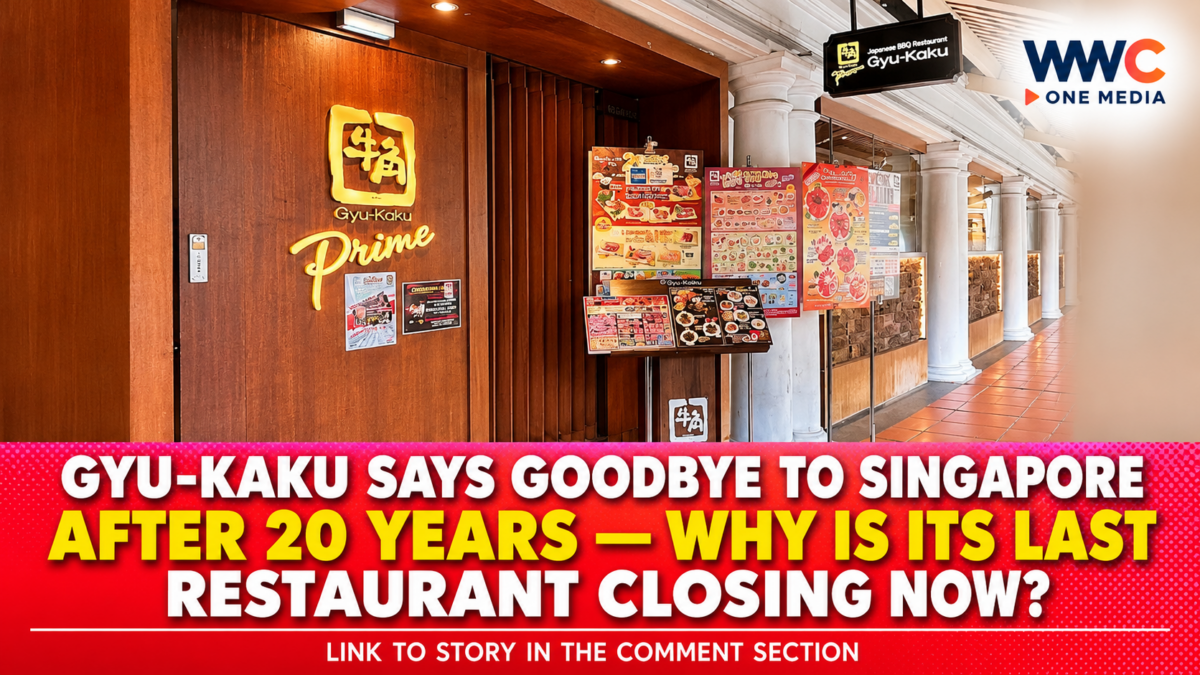
SINGAPORE — One of Singapore’s familiar Japanese barbecue destinations is preparing to say goodbye. Gyu-Kaku has announced that its remaining restaurant at CHIJMES will permanently close on November 15, 2026, marking the Japanese yakiniku chain’s exit from the Singapore market after more than two decades.
The announcement, released on November 3, leaves loyal customers with less than two weeks to enjoy their final meals at the restaurant.
In its farewell message, Gyu-Kaku Singapore thanked customers for their continued patronage, loyalty and support, recalling the gatherings and celebrations shared around its tables.
The closure follows a series of shutdowns across Singapore during 2025 and 2026. The CHIJMES branch had become the brand’s final remaining location after other outlets at VivoCity, Kinex, The Star Vista and Waterway Point closed this year.
For customers, the announcement means more than losing another dining option. It marks the departure of a Japanese restaurant brand that introduced generations of diners to the experience of grilling meat at their own tables.
But with the chain continuing to operate in other international markets, an important question remains: Why is Gyu-Kaku leaving Singapore, and what does its departure reveal about the challenges facing the country’s restaurant industry?
GYU-KAKU CHIJMES WILL SERVE ITS FINAL CUSTOMERS ON NOVEMBER 15
Gyu-Kaku confirmed that its CHIJMES restaurant will permanently close on Sunday, November 15.
The outlet is located at 30 Victoria Street, #01-01/02, Singapore 187996, within the historic CHIJMES complex.
Its farewell announcement expressed appreciation for customers who had supported the restaurant throughout its years of operation.
The company did not provide a specific explanation for the closure.
It is therefore unclear whether the decision was influenced by rental expenses, operating costs, business strategy, changing consumer preferences or other commercial considerations.
What is confirmed is that the closure will mark the end of Gyu-Kaku’s Singapore operations for now.
The restaurant’s final operating day also represents the last opportunity for customers to dine at the brand’s remaining local outlet and redeem eligible rewards under its programme.
A JAPANESE BBQ BRAND THAT SERVED SINGAPORE FOR MORE THAN TWO DECADES
Founded in Japan in 1996, <Entity value=”Gyu-Kaku” category=”brand” disambig=”Japanese yakiniku restaurant chain”/> built its identity around yakiniku, a Japanese dining style in which customers grill meat and other ingredients at their tables.
The concept became popular among diners who enjoy preparing their food while sharing a meal with family, friends and colleagues.
Gyu-Kaku’s menu features Japanese-style grilled meats, seafood, vegetables, side dishes and desserts.
Its buffet options and premium meat selections, including Wagyu offerings, helped establish its appeal among diners looking for a group dining experience.
The restaurant’s interactive format also made it suitable for celebrations, casual gatherings and family meals.
Although its Singapore chapter is ending, the brand continues to operate in Japan and other international markets, including the United States, Hong Kong, Taiwan and Indonesia.
AsiaOne reported that Gyu-Kaku operates more than 700 outlets in Japan, alongside locations in overseas markets.
Its departure from Singapore should not be confused with a worldwide shutdown.
A SERIES OF CLOSURES GRADUALLY REDUCED GYU-KAKU’S SINGAPORE PRESENCE
The CHIJMES announcement follows several outlet closures over the past two years.
In 2025, Gyu-Kaku shut down its restaurants at UE Square, The Centrepoint and Novena Square.
The contraction continued in 2026, when additional branches stopped operating.
The closures included:
- Waterway Point: The Punggol outlet closed on March 9, 2026.
- Kinex: The Paya Lebar branch closed on March 31, 2026.
- The Star Vista: The Buona Vista outlet closed on May 1, 2026.
- VivoCity: The HarbourFront restaurant closed on September 28, 2026.
- CHIJMES: The final remaining outlet is scheduled to close on November 15, 2026.
The sequence of closures shows how the brand’s Singapore footprint gradually narrowed until only one restaurant remained.
The VivoCity closure was particularly notable because the company had encouraged customers to continue visiting its CHIJMES restaurant after that branch shut down.
Less than two months later, the remaining outlet also received a permanent closure announcement.
The company has not publicly explained the reasons behind the broader series of shutdowns.
WHAT CUSTOMERS NEED TO KNOW BEFORE THE FINAL DAY
Customers who still want to visit Gyu-Kaku CHIJMES should take note of its announced final operating date and listed opening hours.
Restaurant details
- Address: 30 Victoria Street, #01-01/02, CHIJMES, Singapore 187996
- Telephone: +65 6333 4001
- Monday to Friday: 12 p.m. to 3 p.m. and 5:30 p.m. to 10 p.m.
- Saturday and Sunday: 12 p.m. to 10 p.m.
- Final operating day: November 15, 2026
Customers should check directly with the restaurant before visiting, particularly as the final days approach and operating arrangements may change.
The company has also confirmed that rewards under its programme can still be redeemed until November 15.
However, customers with outstanding rewards should check the applicable terms and conditions before placing an order. The announcement does not provide a complete explanation of how every reward category, voucher or unused benefit will be handled.
Those holding gift vouchers or other promotional entitlements should contact the restaurant directly rather than assume they will automatically be transferable or refundable.
LOYAL CUSTOMERS HAVE UNTIL NOVEMBER 15 TO REDEEM THEIR REWARDS
One of the most important details in the closure announcement concerns Gyu-Kaku’s rewards programme.
The company confirmed that eligible rewards can still be redeemed through November 15, 2026.
This gives existing members an opportunity to use their accumulated benefits before the restaurant closes.
Customers should review their rewards cards and confirm the redemption requirements with staff.
They should also avoid assuming that every promotional benefit can be combined with buffet packages or other discounts.
The official announcement confirms the final redemption date, but customers with questions about specific rewards should seek clarification directly from the restaurant.
For regular diners, the deadline provides one final opportunity to enjoy the restaurant while using eligible benefits.
GYU-KAKU’S EXIT COMES AS SINGAPORE’S RESTAURANT INDUSTRY FACES CONTINUING PRESSURE
The closure also comes amid broader changes in Singapore’s food and beverage industry.
Restaurant operators face the challenge of maintaining customer demand while managing expenses associated with rent, ingredients, utilities, staffing and daily operations.
Competition is another major consideration.
Singapore has an extensive dining market, with local restaurants, international chains, independent food businesses and new concepts competing for customers.
Consumers also have more choices than ever, ranging from affordable food courts and casual dining establishments to premium restaurants and delivery-focused businesses.
For established brands, maintaining customer loyalty is important, but a recognised name does not automatically guarantee that every outlet remains commercially sustainable.
A restaurant may have a strong international presence and still face difficult decisions about its operations in a particular market.
Gyu-Kaku’s closure does not establish that the entire Singapore restaurant sector is struggling. However, its gradual withdrawal illustrates how international brands may reassess their local presence over time.
The issue is also relevant to other restaurant groups that have faced restructuring and outlet closures.
WWC ONE MEDIA previously reported on Crystal Jade Closes More Singapore Outlets as 120 Workers Face Job Losses — What Happens Next?, examining how restructuring affected the restaurant group’s branches and employees.
That case highlights another important part of restaurant closures: the impact on workers, suppliers and communities that depend on established dining businesses.
WHAT GYU-KAKU’S DEPARTURE MEANS FOR SINGAPORE’S DINING SCENE
The loss of a long-running restaurant chain can change the choices available to regular customers.
Gyu-Kaku’s table-grilling format offered a particular type of social dining experience, especially for groups who preferred preparing their own meat and sharing several dishes.
Its departure leaves customers who enjoyed that experience looking for alternatives elsewhere.
However, Singapore’s Japanese dining market remains broad, with restaurants offering sushi, ramen, tempura, teppanyaki and yakiniku-style meals.
The closure also highlights the importance of restaurant innovation.
Dining businesses must continually assess their menus, pricing, service, locations and customer expectations to remain competitive.
For Singapore, maintaining a diverse dining landscape will require both established restaurant groups and smaller independent operators to adapt to changing conditions.
The country’s hospitality industry also continues to attract international recognition.
WWC ONE MEDIA recently covered the regional recognition of Philippine hospitality establishments in 13 Philippine Restaurants, Bars and Hotels Make Tatler Best Asia Pacific 2026 — But Which Local Venue Earned the Country’s First Regional Best-in-Class Award?.
Although the story focuses on the Philippines, it reflects the wider competition among Asian dining destinations to attract customers through distinctive food concepts, hospitality and memorable experiences.
For restaurants operating in Singapore, the challenge is to translate customer interest into sustainable business performance.
WILL GYU-KAKU EVER RETURN TO SINGAPORE?
The company’s November 3 announcement confirms the permanent closure of its CHIJMES restaurant, but it does not explain whether Gyu-Kaku intends to return to Singapore in the future.
There has been no confirmed announcement of a replacement outlet, a new local operator or a planned relaunch.
For now, the brand’s Singapore operations are scheduled to end after November 15.
Its continued presence in other markets means the restaurant chain will remain accessible to customers travelling abroad, but Singapore diners will lose their local branch.
Whether the company eventually considers another entry into the market will depend on its future business decisions.
Until then, CHIJMES represents the final chapter of its more than 20-year Singapore presence.
THE BOTTOM LINE: THE LAST GYU-KAKU IN SINGAPORE IS CLOSING — WHAT DOES THIS MEAN FOR THE CITY’S RESTAURANT FUTURE?
Gyu-Kaku’s decision to close its CHIJMES restaurant on November 15, 2026, marks the end of a familiar Japanese barbecue destination in Singapore.
The closure follows several shutdowns in 2025 and 2026 that gradually reduced the chain’s local presence.
For loyal customers, the final days offer an opportunity to revisit a restaurant associated with years of meals, celebrations and shared experiences.
For the industry, the departure serves as another reminder that even established international brands must continually assess their operations in competitive markets.
The company has not disclosed the specific reasons for its exit, and its decision should not be attributed to any single economic factor without further confirmation.
What is clear is that Gyu-Kaku’s Singapore story is approaching its conclusion, while its international operations continue.
As customers prepare to say goodbye to the CHIJMES outlet, one question remains:
Will another Japanese yakiniku brand step in to fill the gap left by Gyu-Kaku, or will Singapore’s dining market continue to see established restaurant names disappear as competition and operating challenges reshape the industry?