
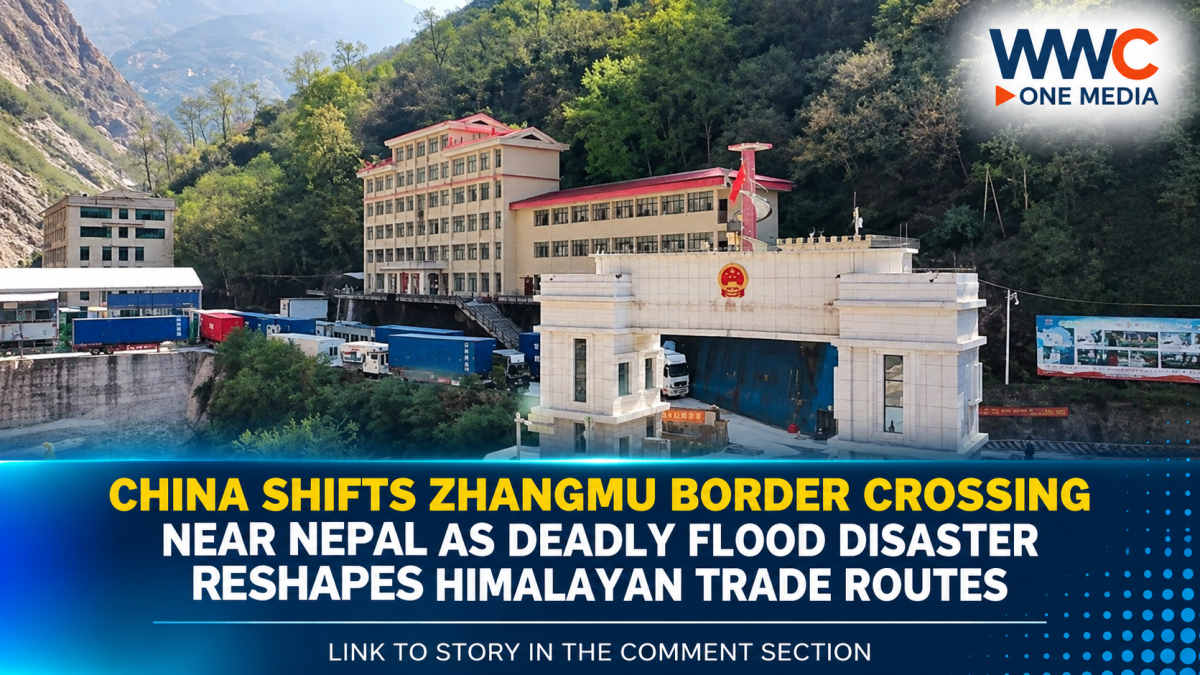
China is changing the operating layout of the Zhangmu customs inspection site, the major border gateway connecting China’s Tibet region with Nepal, with the new arrangement scheduled to take effect on September 5, 2026.
The move comes just days after catastrophic floods and mudslides devastated the Gyirong-Rasuwagadhi border area, killing more than 1,200 people and leaving thousands missing across Nepal and Tibet.
According to a government notice reported by Reuters, the modified Zhangmu customs site is intended to optimise customs operations. From 10am on Sept. 5, the inspection area will extend toward a road connecting to a new border-crossing point in Nyalam county, Tibet.
But the timing is drawing particular attention because China’s northern border trade with Nepal is already under severe pressure following the disaster.
What is changing at Zhangmu?
Under the new arrangement, authorities will impose restrictions on movement within the customs inspection area.
People entering or leaving the site will not be allowed to leave their groups or vehicles or move around freely.
Travellers will also be prohibited from exchanging or discarding goods or personal possessions while inside the designated inspection area, according to the government notice cited by Reuters.
Chinese authorities say the modified layout is designed to improve customs operations.
There is no indication in the reported notice that China is permanently abandoning the Zhangmu crossing.
That distinction is important because separate reports earlier this week said the Zhangmu port had been temporarily or indefinitely suspended amid disaster concerns.
Zhangmu has already faced a major disruption
Zhangmu, known as Tatopani on the Nepali side, has a long and complicated history of interruptions.
The crossing was closed after the devastating 2015 Nepal earthquake, which killed about 9,000 people, before reopening in 2023.
In 2026, the route was again repeatedly disrupted by landslides and flooding.
The Kathmandu Post reported that China closed the Tatopani crossing to imports and exports on Aug. 29, citing landslide risks on the Nepali side. At the time, Nepal’s other major northern gateway, Rasuwagadhi, was already out of operation after catastrophic flooding.
That left traders increasingly dependent on the Korala border point in Mustang.
Why the latest move matters
The timing is significant because Nepal-China trade has already been hit by a chain reaction of natural disasters.
The Aug. 26 Bhotekoshi floods and mudslides devastated the Rasuwagadhi-Gyirong border corridor.
Reuters reported that China’s only road into the Gyirong disaster zone was fully reopened on Sept. 2, allowing heavy rescue equipment to reach the area after sections of the highway were washed away.
The destruction has effectively knocked out one of Nepal’s most important trade gateways with China.
The situation at Tatopani has also remained unstable.
With both routes facing serious disruption, Nepal’s traders have been forced to look for alternative ways of bringing Chinese goods into the country.
Korala is taking on a bigger role
Radio Nepal reported on Sept. 3 that 252 empty containers travelled toward the Korala border point between Aug. 26 and Sept. 3 as cargo was diverted following the devastation of the Rasuwagadhi-Kerung crossing.
But Korala cannot simply replace the two major gateways overnight.
Earlier reporting by the Kathmandu Post found that Nepal’s three principal China trade points were all experiencing operational problems, with Tatopani affected by landslides, Rasuwagadhi constrained by flood damage and Korala handling only limited cargo.
That creates a potentially serious bottleneck for Nepalese importers.
Nepal’s festive shopping season adds pressure
The disruption comes just before major Nepali festivals, including Dashain and Tihar, when demand for imported goods traditionally rises.
Nepali business groups have warned that prolonged disruption at the northern border crossings could affect supplies and increase transportation and import costs.
Reports from Nepal said containers destined for the country were stranded in China’s Nyalam area after the Zhangmu closure.
The economic impact could extend beyond traders.
The Kathmandu Post previously reported that Tatopani and Rasuwagadhi together handled imports worth more than Rs93 billion in the previous fiscal year, while Korala processed about Rs14.4 billion.
The bigger concern: a border already hit by disaster
The Zhangmu development is unfolding against the backdrop of one of the worst disasters ever recorded along the Nepal-Tibet border.
At least 1,114 people had been reported dead in Nepal, while nearly 4,000 remained unaccounted for in reporting published earlier this week. China’s official toll has been considerably lower, highlighting the difficulty of establishing a complete picture across the mountainous disaster zone.
Rescue operations have been complicated by unstable terrain, damaged roads, heavy debris and the possibility of additional landslides.
China has been working to reopen access routes and deploy heavy equipment on its side of the border, while Nepal continues search-and-rescue operations on its side.
Nepal is now looking at stronger early-warning systems
The disaster has also triggered a push to improve warning systems along the Himalayan frontier.
CNA, citing Reuters, reported that Nepal plans to rebuild an early-warning network around the affected border area using seismic sensors, cameras and satellite communications.
The proposed system could give downstream communities only minutes of warning during another major landslide or flood — but officials believe even that short window could be crucial.
The development comes amid renewed calls for stronger real-time information sharing between Nepal and China concerning glacier movements, water levels and potential flooding.
China has said it has shared satellite imagery, hydrological information and warnings about upstream barrier lakes with Nepal.
This is bigger than one border crossing
The latest Zhangmu change should therefore be viewed in a much wider context.
China and Nepal depend heavily on several Himalayan crossings for bilateral trade, but the 2026 disaster has exposed how vulnerable those connections are to extreme weather and difficult mountain terrain.
For Nepal, the immediate challenge is keeping essential goods moving.
For China, the challenge is restoring a functioning border network while managing security, customs control and continuing disaster-response operations.
And for both countries, the disaster has raised a much bigger question:
How do you keep a critical Himalayan trade corridor operating when the landscape itself has become increasingly unpredictable?
For now, Zhangmu is being reorganised while other routes struggle to recover.
The answer could determine not only how quickly Nepal’s northern trade recovers — but how resilient the entire China-Nepal border network becomes after the disaster.
WWC ONE MEDIA J.M.D




Leave a Reply