NEW YORK / MINNESOTA, United States — November 4, 2026 | WWC ONE MEDIA | Global Business, Environment & Corporate Accountability
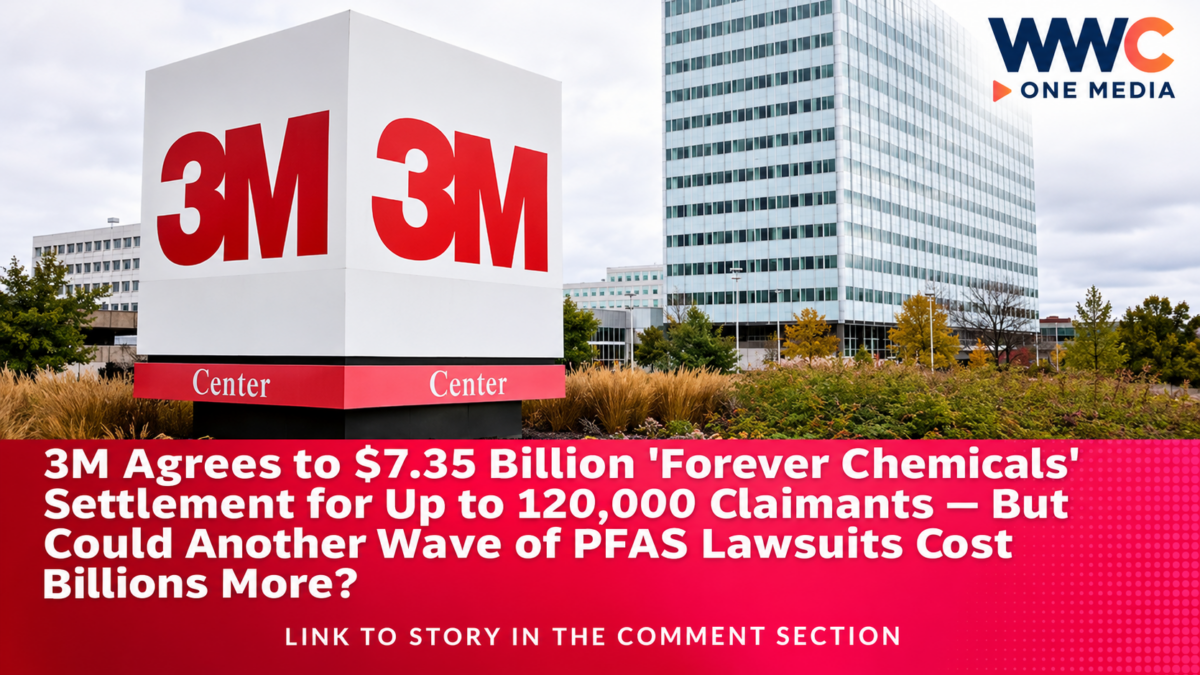
American industrial manufacturing giant 3M has agreed to one of the largest personal-injury settlements in the long-running controversy over toxic chemicals, committing approximately $7.35 billion over nine years to resolve claims involving PFAS, commonly known as “forever chemicals.”
The agreement, announced November 3, is expected to address approximately 99% of the company’s current PFAS-related personal-injury claims, including cases connected to firefighting foam used at airports, military installations and other facilities.
An estimated 115,000 to 120,000 plaintiffs are eligible to participate.
The settlement represents a major development in years of litigation involving allegations that exposure to PFAS-containing products contributed to serious health problems, including certain cancers.
For 3M, the agreement could remove a substantial source of legal uncertainty.
But the financial consequences are enormous.
The company expects to record a $5.8 billion pretax charge in the fourth quarter of 2026, reflecting the present value of its future settlement payments.
The new agreement follows a separate multibillion-dollar settlement involving contamination of public drinking-water systems.
Although 3M has already stopped manufacturing PFAS globally, the company continues to face questions about the environmental and legal consequences of chemicals produced over previous decades.
The biggest question now is whether the $7.35-billion agreement marks the beginning of the end of 3M’s forever-chemicals litigation—or whether environmental cleanup obligations and future lawsuits could generate billions more in costs.
3M Announces $7.35 Billion Settlement After Years of Litigation
3M confirmed that it had reached a broad resolution of personal-injury claims associated with aqueous film-forming foam, known as AFFF.
The litigation has been consolidated in a federal multidistrict proceeding in South Carolina.
AFFF was widely used to suppress fires involving flammable liquids, particularly at airports and military facilities.
Certain formulations contained PFAS compounds valued for their ability to repel water and oil and withstand extreme conditions.
However, their persistence in the environment has become a major concern.
Thousands of plaintiffs have alleged that exposure to these chemicals caused or contributed to serious illnesses.
The new agreement is intended to resolve the overwhelming majority of pending personal-injury claims against 3M.
The company estimates that approximately 99% of existing claims fall within the resolution.
But that figure describes the scope of the agreement under the company’s estimates.
It does not mean that every plaintiff has already received compensation or that every pending legal matter has been conclusively closed.
The settlement remains subject to applicable terms and participation requirements.
Up to 120,000 People Could Be Eligible
The number of potential claimants demonstrates the extraordinary scale of the litigation.
According to 3M, approximately 115,000 to 120,000 plaintiffs may participate in the resolution.
The claims involve people who allege that exposure to PFAS-containing firefighting foam contributed to illnesses or other personal injuries.
Reuters and The Wall Street Journal independently confirmed the estimated participation figures.
The lawsuits have included allegations involving cancers and other health conditions associated with exposure to certain PFAS compounds.
However, inclusion in a settlement does not establish that every claimed illness was individually proven to have been caused by a 3M product.
Personal-injury litigation may involve different exposure histories, medical evidence and legal claims.
The settlement provides a mechanism for resolving eligible cases without requiring every dispute to proceed through a separate trial.
For claimants, the agreement could create a route toward compensation.
But the amount and timing of individual payments will depend on the settlement’s rules and the circumstances of each claim.
Why the Actual Accounting Charge Is $5.8 Billion
One of the most important financial details is the difference between the headline settlement value and the amount 3M will recognize in its financial statements.
The company has committed to nominal payments totaling approximately $7.35 billion over nine years.
Those payments extend through 2034.
Because the money will be paid over time, the company calculates a lower present value for accounting purposes.
That value is approximately $5.8 billion.
3M expects to record the corresponding pretax charge during the fourth quarter of 2026.
The two amounts are therefore not separate financial obligations.
The $7.35 billion represents the scheduled total of payments, while the $5.8 billion reflects their discounted accounting value.
This distinction matters because investors evaluating the company’s future earnings and cash flows need to understand both the reported accounting expense and the actual payment schedule.
The charge will be treated as a special item when calculating adjusted financial results.
3M said it does not change its previously issued 2026 guidance.
However, that does not mean the settlement has no financial consequences.
The scheduled payments will still require cash over the coming years.
Why 3M Is Spreading Payments Over Nine Years
The agreement provides a payment schedule intended to balance compensation obligations with the company’s financial commitments.
According to Reuters and 3M’s announcement, the company is scheduled to pay approximately $50 million in 2026.
No settlement payments are scheduled for 2027.
About 20% of the nominal commitment is expected to be paid during the final two years.
This structure may help reduce immediate pressure on cash flow.
Rather than paying the entire amount at once, 3M can distribute the cost over multiple financial periods.
For investors, the timing is important because large legal settlements can affect capital allocation.
Companies must balance legal obligations with investment in operations, research, manufacturing and shareholder distributions.
A predictable payment schedule can make financial planning easier.
However, the agreement’s terms also matter.
If required participation thresholds or other conditions are not met, the settlement may face complications.
The announcement therefore represents a major legal resolution, not proof that all related obligations have already been discharged.
What Are PFAS or ‘Forever Chemicals’?
PFAS stands for per- and polyfluoroalkyl substances.
They are a large group of manufactured chemicals used in products designed to resist water, grease, stains and heat.
Certain PFAS have been used in industrial applications, nonstick coatings, textiles, packaging and firefighting products.
The substances have attracted growing regulatory attention because many break down slowly in the environment.
Some can move through soil and water, creating concerns about contamination of drinking-water supplies.
The nickname “forever chemicals” reflects their persistence.
However, PFAS is not a single chemical.
Different compounds have different characteristics, uses and scientific evidence concerning potential health effects.
Research has associated exposure to certain PFAS with outcomes including changes in cholesterol levels, altered immune responses, liver effects and increased risks of some cancers.
The strength of evidence varies depending on the compound, exposure level and health outcome.
It would therefore be inaccurate to claim that every PFAS compound causes the same diseases or that any detectable exposure necessarily results in illness.
Nevertheless, the persistence of these chemicals makes preventing contamination and managing existing pollution important public health objectives.
Firefighting Foam Is at the Center of the Lawsuits
The litigation focuses heavily on aqueous film-forming foam.
For decades, AFFF was used to extinguish fires involving petroleum and other flammable liquids.
It was particularly useful in locations where rapid fire suppression was critical.
But some formulations contained PFAS compounds that could contaminate surrounding soil and groundwater.
Firefighters, airport workers, military personnel and communities near affected facilities have raised concerns about potential exposure.
The lawsuits against 3M allege that the company failed to adequately warn users about risks associated with certain PFAS products.
3M has disputed liability.
The new settlement does not include an admission of wrongdoing.
That is an important legal distinction.
A corporation may settle litigation to limit uncertainty and expense without accepting the plaintiffs’ allegations as proven.
Nevertheless, the agreement demonstrates the scale of the financial exposure associated with historical chemical manufacturing.
The New Deal Follows a Separate Water-System Settlement
The personal-injury resolution is not 3M’s first major PFAS settlement.
In 2023, the company entered into an agreement involving US public water systems over contamination-related claims.
That agreement carried an initially reported present-value charge of approximately $10.3 billion.
3M’s subsequent financial filings describe scheduled nominal payments of approximately $10.5 billion to $12.5 billion, depending on applicable settlement terms and adjustments.
The public-water-system settlement and the November 2026 personal-injury resolution address different categories of claims.
The earlier agreement concerns eligible drinking-water suppliers.
The new agreement primarily addresses individuals alleging personal injuries.
The distinction matters because compensation for alleged medical harm does not automatically resolve the costs of treating contaminated water.
Likewise, a settlement with water utilities does not necessarily compensate every affected individual.
3M’s environmental liabilities therefore involve several overlapping legal and financial issues.
New Jersey’s PFAS Settlements Show the Wider Financial Stakes
3M has also faced litigation involving state governments.
In August 2026, a federal judge approved major settlements involving New Jersey, 3M and companies associated with the historical DuPont businesses.
The combined settlements were valued at approximately $2.5 billion.
The 3M component involved payments worth up to $450 million under the relevant terms.
The DuPont-related agreements included environmental restoration and remediation commitments.
These cases demonstrate that the legal consequences of PFAS contamination extend beyond personal-injury claims.
State governments may seek compensation for natural-resource damage, site remediation and other environmental concerns.
For manufacturers, liabilities can continue long after a particular chemical is no longer produced.
The financial exposure depends on the applicable laws, evidence of responsibility and settlement arrangements.
Corporate Environmental Accountability Is Becoming a Global Issue
The 3M settlement also highlights a broader question about industrial responsibility.
Manufacturers frequently produce materials that deliver substantial economic benefits.
But some industrial activities can create environmental consequences that become apparent years later.
The challenge for governments is ensuring that companies meet their legal obligations without confusing allegations with proven violations.
Environmental investigations require evidence of contamination, applicable standards and the source of the pollution.
WWC ONE MEDIA previously examined these principles in Oil Leak at Bangkok Data Centre Raises Pollution Fears and Sparks Calls for Stricter Oversight.
That separate report concerned oil-contaminated wastewater, not PFAS.
However, it illustrated how authorities investigate industrial pollution and determine the measures required to protect nearby communities.
The central connection is accountability.
Environmental protection requires reliable testing, transparent reporting and appropriate remediation.
Cleaning Up Contamination Can Take Years
One of the most difficult aspects of pollution management is that environmental damage may remain after the activity responsible for it has stopped.
Contaminated soil and groundwater can require extensive investigation.
Remediation may involve filtration, treatment systems, removal of affected materials and long-term monitoring.
These measures can become expensive when contamination covers large areas or affects drinking-water supplies.
The importance of long-term responsibility has also featured in Philippine environmental debates.
WWC ONE MEDIA discussed related issues in Philippine Mining Under Scrutiny: Can Damaged Landscapes Become Thriving Communities Again — Or Are the Environmental Costs Too High?.
The mining article concerns a different industry.
But both stories illustrate why corporate environmental performance should be evaluated over the entire life of an industrial operation.
A business may complete production or close a site while leaving remediation obligations that continue for years.
For PFAS contamination, the persistence of certain compounds makes those questions particularly important.
The Public’s Demand for Clean Water Adds Pressure
The controversy also reflects the importance of access to safe drinking water.
When contamination is suspected, communities need reliable information about water testing, health risks and available treatment.
The costs of monitoring and improving water quality can place substantial pressure on local governments and water providers.
WWC ONE MEDIA previously reported on Clean Water Finally Reaches Indigenous Communities in Zamboanga Peninsula — But the Fight for Reliable Access May Not Be Over.
That article dealt with improving water access in underserved Philippine communities, not chemical contamination caused by 3M.
Its relevance is the broader principle that reliable, safe water is essential for public health.
The 3M litigation demonstrates how expensive failures in environmental protection can become when industrial chemicals affect water systems.
3M Says It Has Stopped Manufacturing PFAS Worldwide
The company has emphasized that it has already taken steps to end PFAS production.
In 2022, 3M announced plans to discontinue manufacturing all PFAS globally by the end of 2025.
According to its November 3 statement, the company successfully completed that transition.
3M said it also continues investing in water-treatment technologies at sites where it historically manufactured PFAS.
The decision to stop production is significant.
However, it does not eliminate potential obligations involving products already sold, historical contamination or alleged exposure that occurred in previous years.
Nor does 3M’s decision mean PFAS manufacturing has ceased across the entire global chemical industry.
Other manufacturers and industrial users may continue operating under applicable national regulations.
For 3M, discontinuing PFAS manufacturing changes its future business activities.
The long-term consequences of historical production remain a separate issue.
Could the Settlement Help 3M Regain Investor Confidence?
The legal resolution may provide investors with greater clarity about 3M’s financial obligations.
Large lawsuits can create uncertainty because companies may be unable to estimate when cases will conclude or how much they will cost.
The latest agreement establishes a substantial payment framework for most current PFAS personal-injury claims.
That could help financial analysts evaluate future cash requirements.
But the company must still operate its industrial businesses while meeting settlement obligations.
WWC ONE MEDIA previously reported on 3M’s October earnings performance in Hasbro, Equifax and Northrop Grumman Stocks Surge as GM Tumbles Despite $20-Billion Buyback — But Wall Street’s Biggest Surprise Is in the Earnings.
That report noted that 3M exceeded market expectations with adjusted quarterly earnings of $2.50 per share.
The earlier earnings performance and the new settlement represent different aspects of the company’s financial outlook.
Strong industrial profits can support financial flexibility.
However, a large legal obligation still affects the funds available for other corporate purposes.
Investors should therefore examine operating cash flow, settlement payments, debt and remaining litigation risks together.
The $680 Million Reserve Raises Another Question
Investing.com reported that the agreement includes a reserve mechanism of approximately $680 million for remaining and future personal-injury claims.
The reserve is intended to help manage claims not fully resolved through the primary settlement process.
This is important because the company’s estimate that 99% of existing claims are addressed does not mean every present or future claim disappears.
Some cases may fall outside the settlement’s eligibility criteria.
Other individuals may pursue claims arising from alleged exposure or illness identified later.
The final financial implications will depend on settlement participation, applicable legal rules and future developments.
For 3M, the reserve represents an attempt to manage uncertainty more systematically.
But it should not be interpreted as a guarantee that future litigation expenses cannot exceed the amount reserved.
What Reuters and The Wall Street Journal Confirm
Bloomberg’s November 3 article focused on 3M’s nearly $7.4-billion commitment to resolve PFAS-related claims.
Reuters independently confirmed the $7.35-billion nominal agreement, the $5.8-billion pretax accounting charge, the nine-year payment schedule and the estimated 115,000–120,000 eligible plaintiffs.
The Wall Street Journal reported that the deal addresses personal-injury claims associated with PFAS-containing firefighting foam and described the settlement as a major development for affected claimants.
Investing.com also reported the inclusion of a reserve arrangement for remaining and future claims.
Most importantly, 3M’s own November 3 announcement directly establishes the settlement’s principal financial terms.
The different sources agree on the central figures.
However, the available reporting does not establish a precise average payment for every claimant.
Individual settlement awards may vary, and the total commitment also involves administrative and other settlement-related provisions.
It would therefore be misleading to divide $7.35 billion by the estimated number of claimants and present the result as a guaranteed individual payout.
The Bigger Question: Is This the End of 3M’s Forever-Chemicals Crisis?
The settlement marks a major turning point in the company’s legal strategy.
By agreeing to resolve approximately 99% of current PFAS-related personal-injury claims, 3M could remove a substantial source of uncertainty that has affected its business for years.
The nine-year payment structure may also make its financial obligations more predictable.
But the broader PFAS controversy remains far from simple.
Environmental cleanup can continue long after manufacturing stops.
State governments may pursue separate claims.
And future plaintiffs could raise additional allegations under applicable laws.
For shareholders, the immediate benefit is greater visibility over a large portion of the company’s legal exposure.
For affected communities and claimants, the important question is whether the agreed process delivers appropriate compensation and meaningful environmental protection.
The Bottom Line
3M’s $7.35-billion settlement is one of the most significant developments in the long-running litigation over PFAS-containing firefighting foam.
The agreement addresses the vast majority of current personal-injury claims and creates a defined payment schedule extending through 2034.
But it also requires 3M to recognize a $5.8-billion pretax charge and manage continuing legal and environmental obligations.
The company has not admitted liability.
And the settlement does not establish that every PFAS-related dispute has been resolved.
3M has committed billions of dollars to put much of its forever-chemicals litigation behind it. But as historical contamination and future claims continue to pose questions, will this landmark agreement finally restore investor confidence—or could the next wave of PFAS lawsuits prove even more expensive?