OTTAWA, Canada / EDMONTON, Alberta — November 4, 2026 | WWC ONE MEDIA | Global Sports & International Affairs
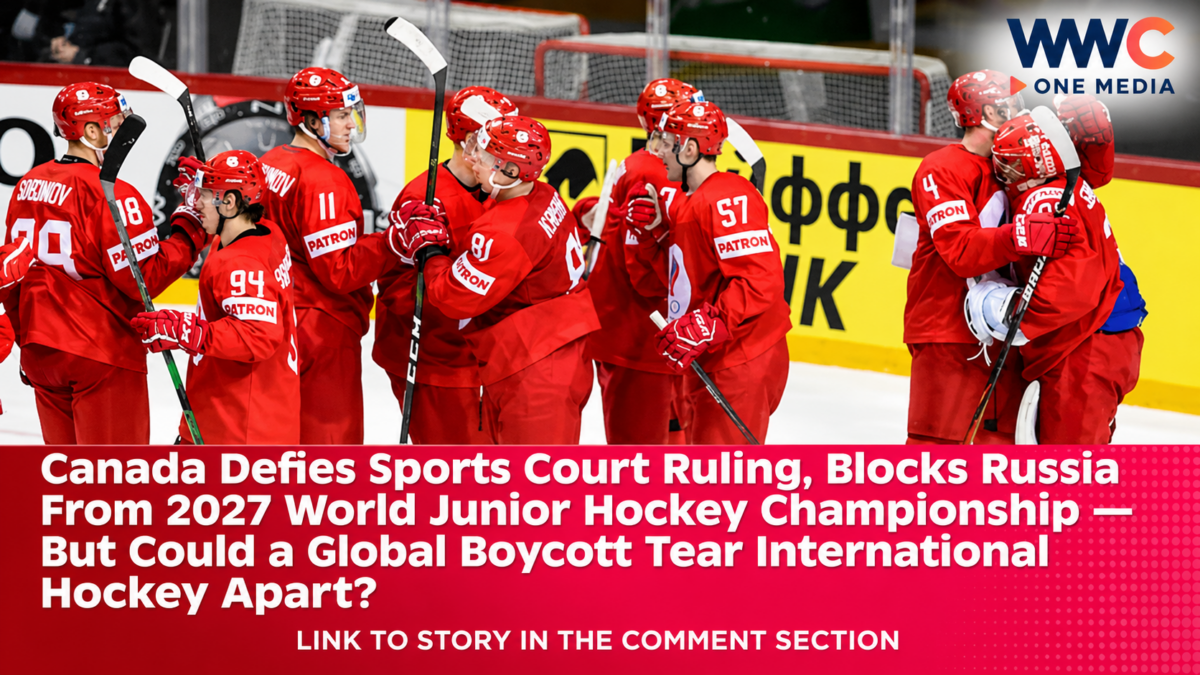
International ice hockey is heading toward a potentially historic confrontation after Canadian Prime Minister Mark Carney declared that Russia will not be allowed to compete in the upcoming World Junior Hockey Championship, despite a ruling from sport’s highest arbitration court ordering the country’s return.
The decision places Canada at the center of a widening dispute involving the Court of Arbitration for Sport (CAS), the International Ice Hockey Federation (IIHF), Russia and several European nations threatening to boycott matches involving Russian teams.
The 2027 IIHF World Junior Championship is scheduled to begin on December 26, 2026, in Edmonton and Red Deer, Alberta, with competition continuing until January 5, 2027.
But preparations have been thrown into uncertainty after CAS ruled on October 30 that the IIHF must reinstate Russian teams following their exclusion from international competition.
Canada has rejected the prospect of Russia’s return while the war in Ukraine continues.
Speaking during a press conference in Antigua on November 3, Carney made his government’s position clear.
“So, if you’re asking specifically about the world juniors, the Russians will not be there,” the prime minister said, according to Reuters.
The announcement represents a serious challenge to the implementation of the CAS decision and raises questions about whether international sporting rulings can be enforced when a host government refuses to accommodate the affected national team.
Meanwhile, six European hockey nations have indicated they will not play Russia at the 2027 men’s World Championship.
With governments, sports federations, sponsors and tournament organizers now taking competing positions, the biggest question is whether Russia’s legal victory will restore its place in international hockey—or trigger a confrontation that could disrupt the sport’s biggest competitions.
Canada Draws the Line Against Russia’s Return
Canada’s decision is closely connected to its longstanding opposition to Russia’s invasion of Ukraine.
Since February 2022, Ottawa has supported Kyiv through sanctions, military assistance and diplomatic measures.
Canadian authorities have also maintained restrictions affecting Russian and Belarusian participation in certain international sporting events.
Carney said his government’s position would remain unchanged while Russia’s war continues and Belarus supports Moscow.
His announcement came after CAS overturned restrictions that had prevented Russian teams from competing in international ice hockey.
The decision is particularly significant because Canada is scheduled to host the next World Junior Championship.
Unlike a country expressing opposition to an event held elsewhere, Canada has practical responsibilities involving entry arrangements, tournament preparations and domestic security.
However, the legal mechanism for excluding Russia has not yet been fully explained.
Canada’s power to control entry into its territory is distinct from the IIHF’s responsibility to determine which national teams are eligible to compete.
How those authorities interact may determine whether the tournament proceeds as planned.
What the Court of Arbitration for Sport Actually Ruled
The dispute began with restrictions imposed after Russia’s full-scale invasion of Ukraine in February 2022.
The IIHF excluded Russian and Belarusian national and club teams from international competitions, citing concerns about safety, security and the integrity of tournaments.
Russian hockey officials challenged the restrictions.
On October 30, 2026, CAS ruled in Russia’s favor, finding that the evidence presented did not sufficiently justify continuing the exclusion on the security grounds advanced by the federation.
The ruling requires the IIHF to restore Russia’s eligibility for competitions affected by the decision.
That includes the World Junior Championship in Canada and other international tournaments scheduled for 2027.
However, the decision should not be interpreted as an endorsement of Russia’s war or a ruling on the legality of the invasion.
The arbitration concerned the sporting body’s exclusion decision and the evidence supporting it.
It did not determine Canada’s foreign policy, immigration rules or broader sanctions regime.
This distinction is at the center of the developing controversy.
A team may establish that it is eligible under international sporting rules while still facing obstacles involving national entry requirements, event logistics and participation by opposing teams.
IIHF Warns That Reinstatement Cannot Happen Overnight
The IIHF expressed disappointment with the CAS ruling.
The federation also warned that restoring Russian participation could create substantial logistical difficulties.
International tournaments are arranged months or years in advance.
Organizers must establish competition formats, schedules, accommodation, transportation, broadcasting plans and security arrangements.
The upcoming World Junior Championship was originally organized around a 10-team competition.
Russia’s reinstatement creates questions about whether another team must be displaced, whether the format must change or whether additional arrangements can be introduced.
The IIHF said the arbitration decision did not account for all the practical difficulties involved in changing tournaments already approaching their scheduled start dates.
Those concerns are particularly important because the World Juniors are less than two months away.
Canada’s refusal adds another complication.
Even if the IIHF develops a revised competition format, organizers must determine whether the participating teams can legally and practically enter the host country.
Hockey Canada Seeks Answers as Alberta Prepares to Host
Hockey Canada has acknowledged the uncertainty surrounding the World Junior Championship.
Following the October 30 ruling, the organization said it was consulting the IIHF and other stakeholders to understand how the decision could affect the tournament.
The event is scheduled to take place in Edmonton and Red Deer.
Both cities have significant hockey infrastructure and experience hosting major competitions.
Preparations involve venues, accommodation, ticketing, security and broadcast arrangements.
However, the political dispute could require substantial changes to those preparations.
There is also a potentially important funding distinction.
Canada’s federal government previously indicated that it would maintain restrictions on Russian participation at sporting events receiving federal funding.
Hockey Canada said the World Junior Championship was not receiving federal funding, while Alberta’s provincial government had previously committed financial support toward hosting hockey events.
That raises questions about which restrictions the federal government would apply and whether they extend beyond federally funded competitions.
The government’s November 3 declaration is clear as a political position.
But the detailed administrative and legal steps needed to implement that position have not yet been fully established in the public reporting.
Alberta’s Government Faces a Different Legal Question
The controversy has also exposed potential differences between Canadian federal and provincial authorities.
Alberta Premier Danielle Smith previously indicated that the province would comply with the CAS ruling.
That position differs from Carney’s announcement that Russian players would not be permitted to represent their country at the tournament.
The disagreement highlights the complexity of hosting international sporting events.
The federal government controls immigration and international relations.
Provincial authorities may provide funding and logistical support.
Hockey Canada manages national hockey interests and works with the IIHF on tournament arrangements.
The IIHF establishes international competition rules.
These organizations have overlapping interests but different legal responsibilities.
The result could be a prolonged dispute over whether compliance with CAS requires Russia’s participation and whether Canada’s federal authorities can lawfully prevent that participation.
No final resolution of those questions was confirmed as of November 4.
Six European Nations Threaten to Refuse Matches Against Russia
Canada is not alone in opposing Russia’s return.
According to the Financial Times, six European national hockey federations have indicated that they will refuse to play Russia at the 2027 men’s World Championship.
The countries include Sweden, Finland, Norway, Denmark, Czechia and Latvia.
Their opposition is based primarily on Russia’s continuing war against Ukraine.
The affected tournament is scheduled for May 13–30, 2027, in Germany.
Sweden, Finland and several other countries have maintained strong public positions against restoring Russian national teams to international competition.
The situation creates a serious challenge for organizers.
If Russia is reinstated but opposing teams refuse to compete, scheduled matches could become impossible to play normally.
Depending on the tournament rules, boycotts could result in forfeits, disciplinary proceedings or changes to the competition.
However, those potential consequences have not yet been finalized.
An announcement that a country will refuse to play is not the same as an officially recorded forfeiture.
The IIHF will need to determine how to respond if the threatened boycotts materialize.
Germany’s 2027 Championship Could Face a Major Crisis
Germany is preparing to host the men’s World Championship in Düsseldorf, Gelsenkirchen and Mannheim.
But the CAS decision has complicated those plans.
Germany’s hockey federation has expressed opposition to Russia’s return, citing political, security and financial concerns.
The possibility of Russian participation could require additional security measures and changes to established tournament operations.
Another sensitive issue is Ukraine’s qualification for the championship.
Ukraine is expected to compete at the event, making the potential presence of Russia especially politically contentious.
Some organizers have warned that Ukraine’s place could be affected if changes are required to accommodate a reinstated Russian team.
However, there is no confirmed final decision removing Ukraine from the tournament.
The IIHF must still address how the CAS ruling affects qualification, scheduling and the rights of participating national federations.
Sponsors Begin Pulling Away From International Hockey
The controversy is also becoming a financial problem.
Swedish furniture and workplace-equipment company AJ Products announced that it would end its sponsorship of the 2027 men’s World Championship following the CAS ruling.
According to Reuters, the company had supported the championship since 1989.
Its chief executive said the business did not want its branding associated with an event that could include Russia under the current circumstances.
The decision illustrates how geopolitical disputes can affect commercial partnerships in international sport.
Sponsors may consider the reputational consequences of associating their brands with controversial events.
For tournament organizers, losing established sponsorship relationships can create financial difficulties.
Czech betting company Tipsport has also criticized Russia’s proposed return and indicated that it would not advertise during games involving Russian teams.
Further withdrawals could affect sponsorship revenue and event marketing plans.
However, the financial value of the affected agreements has not been fully disclosed.
It would therefore be premature to assign a specific monetary loss to the tournament.
Sweden Is Considering Another Way to Restrict Russian Athletes
The Canadian controversy has parallels elsewhere in European sport.
Sweden has been examining whether immigration rules could restrict entry by Russian and Belarusian athletes even when international federations permit them to compete.
WWC ONE MEDIA previously reported on the issue in Sweden Plans Tougher Visa Curbs on Russian and Belarusian Athletes — But Even International Approval May Not Get Them Through the Border.
That report examined possible visa restrictions ahead of the 2027 Nordic World Ski Championships in Falun.
The legal issue resembles the Canadian hockey dispute.
International sporting bodies determine eligibility to participate in competitions.
National governments retain authority over immigration and border entry, subject to applicable laws and international obligations.
These responsibilities can conflict.
An athlete may be eligible under the rules of a sporting federation but unable to travel to the host nation.
However, Sweden’s proposed visa approach and Canada’s announced hockey exclusion are separate decisions involving different laws and events.
Neither establishes the legal outcome of the other.
Russia’s Return Has Already Divided Other Winter Sports
The disagreement over Russian athletes extends beyond ice hockey.
International figure skating has also faced disputes over the eligibility of Russian competitors.
Some governing bodies have established rules allowing selected athletes to compete under neutral status without representing Russia officially.
WWC ONE MEDIA examined one such case in Kamila Valieva Was Just Given a Path Back to International Skating — Then the ISU Reversed Course.
Valieva’s situation involves an individual athlete’s anti-doping suspension and a separate dispute over neutral status.
It should not be conflated with the Russia hockey case, which concerns the eligibility of national teams following the invasion of Ukraine.
Nevertheless, both illustrate how difficult it has become for international sports organizations to resolve eligibility questions involving Russian athletes.
Different federations have adopted different approaches.
Some have allowed participation under neutral designations.
Others have maintained broader restrictions.
The result is an increasingly fragmented international sporting environment.
Russian Athletes Have Already Returned in Other Competitions
Russia’s exclusion has not been universal across every sport.
Some Russian athletes have returned to international competition under neutral conditions or alternative team designations.
WWC ONE MEDIA previously covered this trend in Japan Wins World Gymnastics Gold in a Nail-Biting Finish—But One Final Routine Made All the Difference.
That report described Russian gymnasts competing under a separate designation without the normal national flag and anthem.
The gymnastics arrangements are distinct from those governing international ice hockey.
However, they provide an example of how some sporting organizations have attempted to accommodate eligible Russian athletes while maintaining political restrictions.
Such arrangements may be more straightforward in individual competitions.
National-team sports can present additional difficulties because eligibility decisions affect tournament qualification, group allocations and other participating teams.
In ice hockey, the refusal of multiple nations to face Russia makes compromise particularly challenging.
Why the Ukraine War Remains Central to the Boycott
Russia’s invasion of Ukraine remains the central reason cited by countries opposing its return.
Canada and several European governments argue that restoring Russian national teams to international competition would weaken the response to the war.
Supporters of continued exclusion see participation under a national flag as politically significant.
Those who favor reinstatement argue that athletes should not automatically bear responsibility for government actions and that sporting sanctions require adequate evidence and proportionate justification.
The CAS ruling focused on the evidence supporting the IIHF’s restrictions.
But the political dispute remains unresolved.
WWC ONE MEDIA previously reported on renewed diplomatic efforts in US to Bring Russia and Ukraine Back to the Table in Abu Dhabi — But Can Trump’s New Peace Push Finally Break the Deadlock?.
That report concerned planned negotiations to address the war.
The hockey controversy shows how the conflict continues to affect international institutions beyond conventional diplomacy.
Even if diplomatic discussions progress, future sporting participation would still depend on decisions by federations, governments and, potentially, courts.
Canada’s Support for Ukraine Adds Political Context
Canada has been one of Ukraine’s major international supporters.
Ottawa has provided military and humanitarian assistance and participated in international economic measures aimed at increasing pressure on Russia.
WWC ONE MEDIA previously examined one aspect of that relationship in EU Has a €90 Billion Ukraine Plan — But Brussels Says the Money Still Isn’t Enough.
That report discussed Canada’s potential participation in a European Union financing framework supporting Ukraine.
The initiative is separate from the hockey ruling, but it provides context for Canada’s broader policy toward the war.
Carney’s position on Russian participation is consistent with his government’s stated opposition to Moscow’s actions.
However, political consistency alone does not resolve the legal questions surrounding the CAS ruling.
Those questions remain central to the tournament dispute.
What Happens if Russia Is Allowed to Compete but Canada Refuses Entry?
The possibility of conflicting decisions raises several scenarios.
The IIHF could attempt to revise the championship format while continuing discussions with Hockey Canada and Canadian authorities.
Canada could seek a legally sustainable mechanism to prevent Russian national-team participation.
Russian hockey officials could pursue further clarification or legal remedies.
Other competing nations could refuse matches, creating the risk of forfeits or disciplinary disputes.
Organizers might also consider alternative arrangements if an acceptable solution cannot be reached.
However, no confirmed decision has been announced to cancel or relocate the World Junior Championship.
Nor has the IIHF published a final revised format implementing Russia’s reinstatement.
The tournament remains scheduled for Edmonton and Red Deer.
The next steps will depend on discussions among sporting authorities, government officials and affected national federations.
What Independent News Outlets Confirm
Bloomberg reported on November 3 that Canada intended to prevent Russian participation despite the CAS ruling.
Reuters independently confirmed Carney’s announcement and reported the opposition of Norway, Denmark, Sweden and Czechia to playing Russia in the 2027 men’s championship.
The Financial Times reported that six European nations had declared their refusal to face Russia.
The Associated Press separately documented Finland’s position and the concerns raised by tournament organizers and sponsors.
The Canadian Press and Sportsnet reported that Hockey Canada was seeking clarification from the IIHF concerning the World Junior Championship.
These sources support the central developments.
However, they do not establish that all legal questions have been resolved.
The most important distinction is between Canada’s declared policy, the arbitration ruling, and the practical steps required to determine the final tournament lineup.
The Bigger Question: Who Ultimately Controls International Sport?
The Russia hockey controversy has exposed a fundamental tension in international competition.
Sports federations establish rules governing tournament participation.
Arbitration bodies determine whether those rules are applied lawfully.
National governments control borders and are responsible for domestic security and foreign policy.
Sponsors and broadcasters also influence the commercial viability of events.
When these interests conflict, no simple solution may satisfy every party.
For Russia, the CAS ruling represents an important legal victory.
For Canada and several European nations, the decision challenges their efforts to isolate Moscow while the war continues.
For the IIHF, the immediate priority is maintaining workable tournaments while responding to its legal obligations.
And for athletes, the uncertainty creates the possibility that competitions could be disrupted by decisions beyond their direct control.
The Bottom Line: A Legal Victory That Could Become a Sporting Crisis
Canada has declared that Russia will not participate in the 2027 World Junior Hockey Championship despite a CAS decision requiring the country’s reinstatement to IIHF competition.
The announcement has intensified a dispute already involving European boycotts, sponsor withdrawals and warnings about tournament logistics.
The situation is particularly sensitive because the World Juniors are scheduled to begin on December 26, leaving organizers limited time to reach an agreement.
The stakes extend beyond a single hockey tournament.
The controversy could influence future debates about athlete eligibility, national sovereignty and the relationship between international sporting authorities and host governments.
Russia has won a major legal battle over its return to international hockey, but Canada and several European nations have made clear that they are not prepared to accept that outcome while the war in Ukraine continues.
Will the IIHF find a solution that preserves the championships, or could Russia’s reinstatement trigger a historic boycott that forces international hockey to choose between a court ruling and the governments hosting its biggest events?