
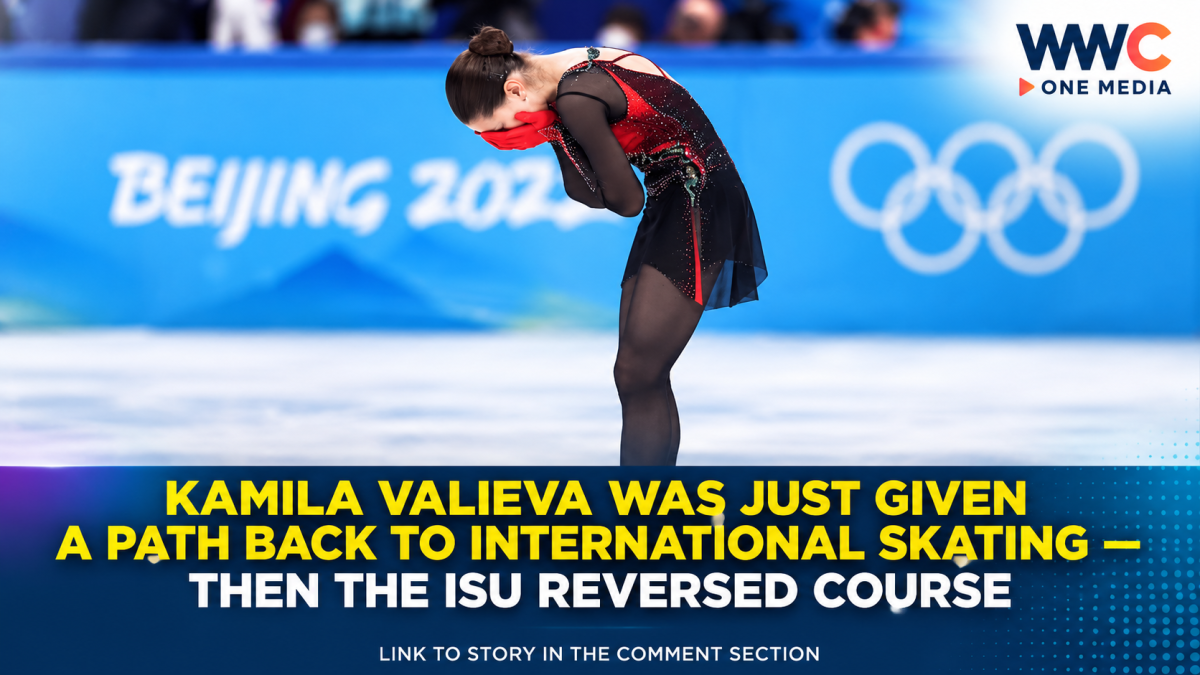
Russian figure skater Kamila Valieva has had her Individual Neutral Athlete (AIN) status revoked by the International Skating Union (ISU), according to a source familiar with the matter, in the latest twist surrounding the former Olympic champion’s controversial return to international competition.
The 20-year-old skater was only recently cleared to compete internationally under neutral status after completing a four-year ban stemming from an anti-doping violation. Now, a decision that appeared to reopen the door to her international comeback has been reversed.
Reuters reported on September 5 that Valieva received a letter informing her that her neutral status had been revoked. The ISU declined to comment on the matter.
The development comes just weeks after the ISU had authorized Valieva to compete internationally as a neutral athlete for the 2026–27 season.
From Olympic sensation to one of figure skating’s biggest controversies
Valieva became one of the most closely watched athletes at the 2022 Beijing Winter Olympics.
At just 15, she helped the Russian Olympic Committee win the team figure-skating event and became the first woman to land a quadruple jump at the Olympics.
But the celebration quickly turned into a global doping controversy.
A sample collected from Valieva at the December 2021 Russian national championships tested positive for trimetazidine (TMZ), a prohibited substance under anti-doping rules.
The positive test emerged during the Beijing Games, after Valieva had already competed in the team event.
The Court of Arbitration for Sport eventually imposed a four-year period of ineligibility, backdated to December 25, 2021, and disqualified her competitive results from that date onward.
CAS rejected Valieva’s explanation
During the legal proceedings, Valieva argued that the prohibited substance could have entered her system through contaminated food prepared using a chopping board on which her grandfather had crushed medication containing trimetazidine.
However, CAS concluded that the explanation was not supported by sufficient concrete evidence and determined that she had failed to establish that she had not committed the anti-doping violation intentionally.
Because of the CAS ruling, Valieva was no longer treated differently from an adult athlete despite having been a minor when the original controversy erupted.
Russia’s Olympic figure-skating gold was also overturned
The consequences extended beyond Valieva herself.
Following her disqualification, the result of the Beijing 2022 Olympic team figure-skating event was revised.
Russia’s original gold-medal result was annulled, with the United States ultimately moved into first place and Japan into second. Russia was left with the bronze medal after the ISU’s reallocation.
The episode became one of the defining controversies of the Beijing Games.
Valieva had already returned to competition
Despite the international ban, Valieva returned to competitive skating in Russia in early 2026 after completing the relevant period of her suspension.
In January, she competed at the Russian Jumping Championships, an unusual competition centered on jumping rather than a conventional full figure-skating program. She landed a quadruple toe loop and advanced to the semifinals.
Her return to international competition, however, remained dependent on obtaining neutral status.
That opportunity appeared to arrive in August.
The ISU initially opened the door
The ISU approved Valieva and fellow Russian skater Alexandra Ignatova, formerly known as Alexandra Trusova, for neutral participation in international competitions.
The authorization followed the ISU’s decision to allow eligible Russian and Belarusian skaters to return to international events beginning with the 2026–27 season, provided they met the requirements for Individual Neutral Athlete status.
By August, Valieva appeared on the ISU’s list of approved neutral athletes. Reports said the list had grown to around 75 skaters.
But the decision immediately attracted scrutiny.
Ukraine had called for Valieva’s status to be reviewed
Just days before the latest development, the Ukrainian Figure Skating Federation called on the ISU to review or revoke the neutral status granted to several Russian skaters.
Valieva was among the athletes named in the Ukrainian federation’s submission.
The federation cited concerns involving her association with the club of Russian figure-skating personality Tatiana Navka, who is under international sanctions, according to reporting by Inside the Games.
The Ukrainian federation argued that the ISU should conduct a more transparent review of Russian athletes seeking neutral status and examine whether individual skaters satisfy the organization’s neutrality requirements.
The ISU had previously established conditions for neutral athletes, including requirements concerning political support for Russia’s war in Ukraine.
The reversal raises bigger questions for Russian skating
Valieva’s case comes as international sports organizations continue to reconsider restrictions on Russian and Belarusian athletes.
The ISU has moved toward allowing eligible Russian and Belarusian skaters back into its competitions while maintaining the Individual Neutral Athlete framework.
That framework is particularly important because athletes competing under the neutral designation cannot simply represent Russia in the normal manner.
The ISU has said approved neutral athletes must meet specific eligibility requirements and that restrictions can be tightened again if integrity or safety concerns arise.
That makes Valieva’s sudden loss of status significant beyond one athlete.
It suggests that neutral status is not necessarily permanent once granted and that the ISU is willing to revisit eligibility.
What happens next?
For now, the most important unanswered question is why Valieva’s status was revoked.
Reuters reported that she received a notification letter, but the ISU has not publicly explained the specific grounds for the decision.
That distinction is crucial.
At this stage, it would be inaccurate to claim that Valieva has received a new doping ban or that the ISU has imposed a new anti-doping sanction. The current reporting concerns the revocation of her neutral-athlete authorization, not a new doping ruling.
Her original four-year anti-doping sanction remains a separate matter and was imposed by CAS in 2024.
The bigger story
Valieva’s career has now entered another uncertain chapter.
Four years after the doping controversy that shook the Beijing Olympics, she completed her suspension, returned to competition in Russia and appeared to receive a route back onto the international stage.
Then, just weeks after being cleared as a neutral athlete, that route was reportedly closed again.
The ISU’s eventual explanation could determine whether this is simply a temporary eligibility dispute — or a much larger test of how international sport handles the return of Russian athletes.
One thing is clear: Kamila Valieva’s international comeback is once again surrounded by uncertainty.
WWC ONE MEDIA M.J.E




Leave a Reply