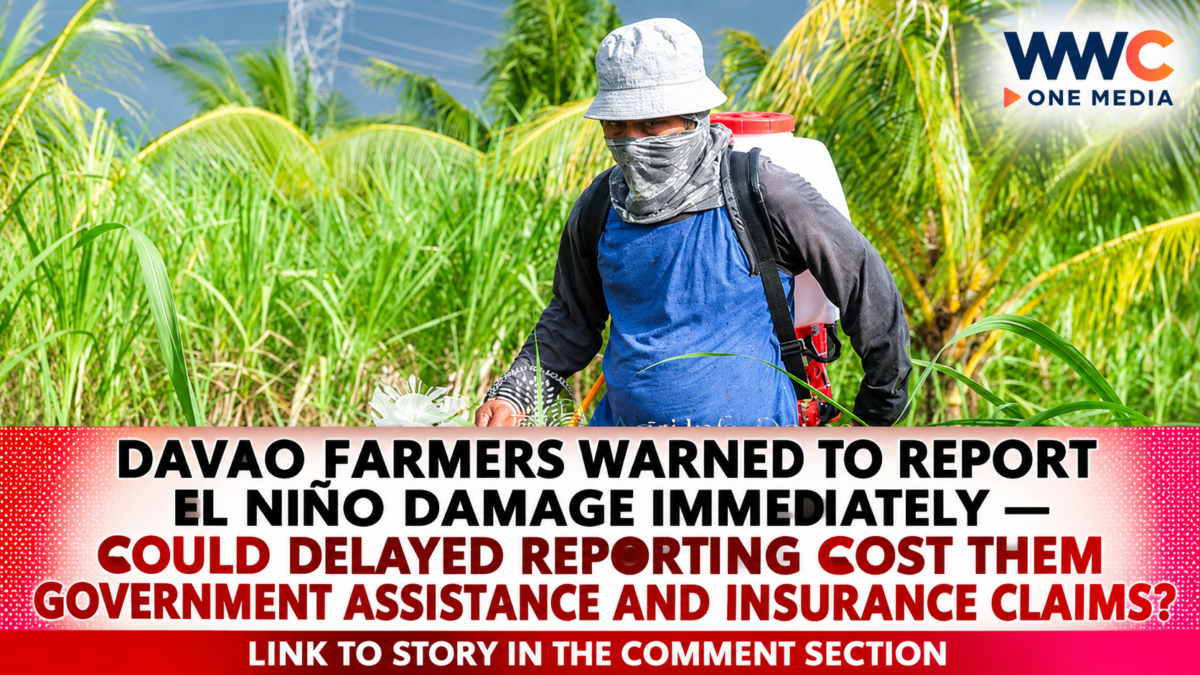
DAVAO REGION, Philippines — The Department of Agriculture in Davao Region is urging farmers to report signs of El Niño-related crop damage immediately, warning that waiting until plants have completely withered or harvests have been lost could delay the assessment and validation needed to access available assistance.
Regional Executive Director Macario Gonzaga also advised farmers not to clear, replace or dispose of damaged crops before agricultural authorities have inspected their farms.
The reminder comes as agricultural losses in Davao continue to rise. The department has reported approximately ₱584.68 million in damage affecting 6,205 farmers and 6,634 hectares of farmland.
Farmers with crop insurance are also being encouraged to coordinate promptly with the Philippine Crop Insurance Corporation (PCIC) and their municipal agriculture offices to begin the claims process.
But the warning goes beyond paperwork. With the Philippine Atmospheric, Geophysical and Astronomical Services Administration (PAGASA) expecting El Niño to intensify and potentially persist through the first half of 2027, early reporting could become critical to protecting the next planting season.
The question now is whether farmers can get their losses documented and assistance moving before worsening drought conditions leave even more agricultural communities struggling.
DA-DAVAO TELLS FARMERS NOT TO WAIT UNTIL CROPS ARE COMPLETELY DESTROYED
Gonzaga delivered the reminder during an episode of the Department of Agriculture’s Estorya sa Kaumahan programme on October 31, 2026.
He encouraged farmers to approach their municipal agriculture offices as soon as they notice signs of moisture stress rather than waiting until crops are severely damaged.
Moisture stress occurs when plants do not receive sufficient water to maintain normal growth. Depending on the crop, its development stage and the duration of the shortage, the condition can reduce yields, weaken plants and eventually cause crop failure.
For farmers, the timing of a report matters because agricultural technicians need an opportunity to inspect the affected areas and document the condition of the crops.
Gonzaga explained that farmers should not immediately replace or clear damaged plants before the required assessment.
Leaving the affected crops in place allows authorities to examine the damage and gather information needed for validation.
This is particularly important when farmers intend to seek crop insurance indemnity or qualify for other government programmes.
The department’s advice is straightforward: report early, preserve evidence and coordinate with local agricultural officials.
WHY FARMERS SHOULD NOT CLEAR DAMAGED CROPS BEFORE INSPECTION
One of the most important instructions from DA-Davao is to leave damaged crops in the field until authorities have completed the necessary assessment.
Farmers may naturally want to remove dead plants, prepare the land and immediately start another planting cycle.
However, doing so before an inspection could make it more difficult for authorities to verify the extent and circumstances of the reported damage.
The assessment process helps establish which crops were affected, how much land was involved and the estimated value of the losses.
Without sufficient documentation, the validation of a damage report or insurance claim could become more complicated.
Farmers should therefore contact their municipal agriculture office before clearing affected areas and ask when an inspection can be conducted.
The department’s warning is especially relevant to insured farmers because PCIC claims require supporting information and evidence.
HOW TO REPORT EL NIÑO CROP DAMAGE IN DAVAO
DA-Davao explained that the reporting process begins at the Municipal Agriculture Office (MAO).
Farmers who notice signs of moisture stress or crop damage should immediately inform their local agriculture office.
The usual process involves the following steps:
- Report the damage to the Municipal Agriculture Office. Farmers should provide the location of the affected farm and explain which crops are experiencing moisture stress or damage.
- Allow agricultural technicians to inspect the farm. Local agriculture personnel and officials assess the reported damage and document the condition of the affected crops.
- Record the information in the DA’s disaster monitoring system. The damage report is entered into the Disaster Risk Reduction and Management Information System.
- Submit the report for provincial coordination. The municipal government forwards the information to the Provincial Agriculture Office, which coordinates with DA-Davao for further validation.
- Complete the required verification. Authorities review the reported damage before it can be used as a basis for assistance or other interventions.
The report should contain photographs, the location of the affected area, the crop’s growth stage, the size of the damaged land and an estimate of the losses.
DA-Davao also monitors standing crops through reports updated every 15 days.
This allows agricultural authorities to track crop conditions and identify areas that may require additional attention as weather conditions change.
FARMERS WITH INSURANCE MUST CONTACT PCIC IMMEDIATELY
Farmers who have crop insurance are being advised to coordinate with both PCIC and their municipal agriculture offices as soon as damage occurs.
The PCIC provides agricultural insurance protection for eligible farmers and other agricultural stakeholders against losses caused by covered risks, subject to policy conditions.
Gonzaga said farmers should prepare documents that may be required when filing claims, including:
- Their insurance policy or proof of coverage.
- Details about the farm and affected crops.
- Photographs and other evidence of damage.
- Information identifying the location and extent of the affected area.
Farmers should contact PCIC directly to confirm the exact documentation requirements, filing procedures and applicable deadlines for their policies.
The department also stressed that farmers should not assume that an insurance payout will automatically be provided simply because their crops were damaged.
Claims must undergo the required assessment and validation process.
For this reason, early coordination is essential.
PCIC INSURANCE PAYOUTS ARE DIFFERENT FROM OTHER GOVERNMENT CASH ASSISTANCE
Another important clarification from DA-Davao concerns the difference between crop insurance payments and other forms of government assistance.
Gonzaga emphasized that PCIC indemnity is separate from emergency financial assistance and other agricultural support programmes.
An insurance payment is governed by the farmer’s policy coverage, applicable conditions and the assessment of the reported loss.
Other government assistance may be provided through separate programmes, depending on eligibility requirements, official approval and available funding.
This means farmers should not automatically expect cash assistance simply because they have reported damage.
The department said emergency financial assistance may be available to qualified farmers, but it cannot be guaranteed before the relevant programme is officially approved.
The distinction matters because farmers facing serious losses may be making financial decisions based on the possibility of receiving government support.
Understanding which assistance is insurance-based and which is programme-based can help them avoid relying on payments that have not yet been approved.
DAVAO’S EL NIÑO DAMAGE HAS REACHED ₱584.68 MILLION
The urgency behind DA-Davao’s warning becomes clearer when looking at the latest agricultural damage figures.
The department reported ₱584.68 million in agricultural losses across Davao Region, affecting 6,205 farmers and 6,634 hectares of farmland.
Rice has suffered the largest reported losses.
According to the agency’s breakdown, the affected sectors include:
- Rice: ₱390.24 million.
- High-value crops: ₱126.90 million.
- Livestock and poultry: ₱35.22 million.
- Corn: ₱32.32 million.
Rice alone accounts for the majority of the reported losses, with damage affecting 3,793 farmers and 5,362 hectares.
Fruit crops have also contributed significantly to the losses among high-value agricultural products.
The figures were presented during a Davao Peace and Security Press Corps briefing on October 28.
DA-Davao said the latest assessment increased the previous estimate of approximately ₱400 million after additional damage validation in Davao del Sur.
The reported figures remain subject to updates as local governments submit and validate additional information.
WWC ONE MEDIA previously examined the scale of the damage in Rice Takes the Biggest Hit as Davao El Niño Losses Near ₱585 Million — Thousands of Farmers Need Help.
MATANAO AND BANSALAN AMONG THE AREAS FACING WATER SHORTAGES
DA-Davao has identified several areas experiencing moisture stress, including parts of Davao del Sur, Davao City, Davao del Norte and Davao de Oro.
Matanao and Bansalan in Davao del Sur were specifically mentioned among the areas reporting serious water shortages.
The effects are not limited to rice fields.
Bananas and other fruit crops have also been affected, while farms that depend heavily on rainfall or have limited irrigation access remain particularly vulnerable.
High-value crops that require consistent water supplies may also face difficulties during extended dry periods.
Livestock raisers are another group being advised to prepare because animals require sufficient drinking water, shade and proper ventilation during prolonged hot conditions.
These challenges show why the agricultural response must cover more than crop insurance claims. Water management, farm planning and livestock protection are also necessary.
DA-DAVAO PREPARES A ₱729-MILLION EL NIÑO ACTION PLAN
To address the worsening conditions, DA-Davao has outlined an El Niño Action Plan with an estimated budget of approximately ₱729 million.
The programme is divided into three major areas:
- ₱678.73 million for increasing agricultural production in areas considered less vulnerable to drought.
- ₱40.41 million for preparatory activities.
- ₱9.97 million for efforts to sustain production in vulnerable areas.
The strategy is designed to protect food production while providing interventions to farmers facing difficult growing conditions.
DA-Davao is also procuring quality seeds and promoting rice and corn varieties suited to local conditions and capable of tolerating moisture stress.
Other interventions include organic fertilizers, biofertilizers and soil conditioners.
The agency is encouraging farmers to consult agricultural technicians before selecting alternative crops or changing planting schedules.
The objective is to help farmers make decisions based on local conditions rather than relying on a single approach across the entire region.
WATER PUMPS, SOLAR IRRIGATION AND CLOUD SEEDING ALSO UNDER CONSIDERATION
Water availability remains one of the biggest concerns as El Niño develops.
DA-Davao is coordinating with the National Irrigation Administration and local governments to monitor dams and irrigation systems.
Where appropriate, authorities may deploy water pumps or solar-powered irrigation equipment to support affected agricultural areas.
Cloud seeding is also a possible intervention, but Gonzaga cautioned that it depends on actual cloud conditions.
Potential operations and suitable locations must first be confirmed through coordination involving the Bureau of Soils and Water Management, NIA, PAGASA and other relevant agencies.
The department said it would not promise a cloud-seeding operation until it had been officially confirmed.
This is an important qualification because cloud seeding is not a guaranteed solution to drought. Its feasibility depends on suitable atmospheric conditions and the availability of the necessary resources.
Farmers are also being encouraged to conserve available water and consider small water-storage facilities where appropriate.
A STRONGER EL NIÑO COULD BRING MORE DIFFICULT CONDITIONS IN 2027
The current agricultural damage is unfolding as PAGASA warns that El Niño could intensify into a very strong event and persist through the first half of 2027.
For farmers, this means the current losses may not represent the full extent of the challenge.
Prolonged dry conditions can affect planting schedules, reduce irrigation supplies and increase the risk of lower harvests.
The consequences can extend beyond farms, potentially affecting food availability, agricultural employment and household expenses.
The situation also reinforces the importance of early preparation.
WWC ONE MEDIA previously reported that up to 85 Philippine provinces face dry spell or drought risk through March 2027 as El Niño strengthens.
The growing threat has also prompted wider discussions about national preparedness, including the need to protect farmers, strengthen irrigation systems and maintain food supplies.
Read our report: DA Backs Nationwide Calamity Declaration as ‘Super El Niño’ Threatens 4.6 Million Filipino Farmers and ₱20-Billion Losses.
WHAT FARMERS SHOULD DO BEFORE THE NEXT DRY SPELL GETS WORSE
DA-Davao’s message is not limited to reporting existing damage. Farmers are also being encouraged to prepare for additional water shortages.
The agency recommends following weather and agricultural advisories, choosing suitable crop varieties and seeking technical advice before making changes to farm operations.
Livestock owners should ensure animals have enough drinking water, shade and ventilation.
Farmers should also maintain communication with their municipal agriculture offices, especially when they notice early signs of moisture stress.
For those with crop insurance, keeping policy documents and farm records accessible can help make the claims process more manageable.
The department’s advice can be summarized in three actions: prepare early, plan ahead and seek assistance immediately.
THE BOTTOM LINE: REPORTING EARLY COULD MAKE A DIFFERENCE FOR THOUSANDS OF DAVAO FARMERS
DA-Davao’s warning comes at a critical time for the region’s agricultural sector.
With ₱584.68 million in reported losses affecting 6,205 farmers and 6,634 hectares, the effects of prolonged dry conditions are already being felt across Davao.
The department is urging farmers not to wait until crops are completely destroyed before reporting damage. They should contact their municipal agriculture offices, allow inspections to take place and preserve damaged crops until authorities complete the necessary assessment.
Those with insurance should also coordinate promptly with PCIC and confirm the documents and deadlines required for their claims.
At the same time, the government’s ₱729-million El Niño Action Plan is intended to strengthen production in less vulnerable areas, support affected farms and prepare the region for potentially worse drought conditions.
But funding and programmes will only make a difference if farmers receive timely information, inspections and assistance.
For thousands of agricultural households, the coming months could determine whether they can recover from current losses and protect their next harvest.
With El Niño expected to persist into 2027, will early reporting and government interventions be enough to protect Davao’s farmers—or could the region face even greater agricultural losses before the dry spell ends?