
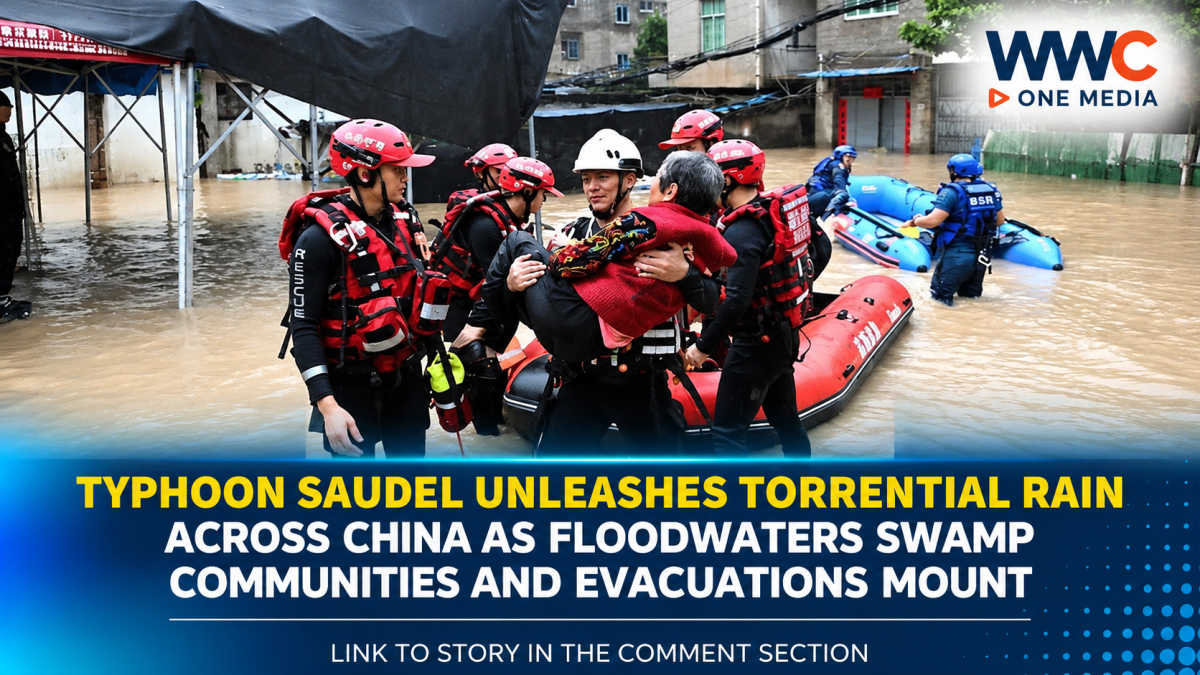
China’s southern and eastern coastal regions are facing another round of dangerous weather as Typhoon Saudel unleashes torrential rain, triggering flooding, evacuations, transport disruptions and warnings of further landslides and flash floods.
The storm made its third landfall in China on Thursday, Sept. 3, striking Zhangpu county in Fujian province at about 6:30am with maximum sustained winds of around 23 metres per second near its centre, according to Chinese authorities.
The latest landfall came after Saudel had already struck Zhejiang province twice, making its path unusually complicated and raising concerns over the cumulative impact of repeated heavy rainfall.
More than 83,000 people had been evacuated in Fujian alone by Thursday morning as the storm moved inland and dumped intense rain across the province.
Floodwaters sweep through towns
The damage has already become visible across affected communities.
In Fuding, Fujian, firefighters were filmed wading through waist-deep floodwaters while carrying elderly residents to safety.
In nearby Jinxi village, floodwaters inundated residential areas and a three-storey brick building collapsed amid the extreme rainfall.
Reuters said the footage had been independently verified.
Vehicles have also been overwhelmed by rapidly rising water, while emergency workers have been deployed to drain flooded roads and rescue people stranded by the storm.
The situation remains dangerous because the ground is already saturated from previous rainfall.
China’s Ministry of Natural Resources has warned that continuing downpours could trigger secondary disasters, including landslides and mudslides.
Schools and transport suspended
Authorities have moved quickly to limit public exposure.
Schools in Fuzhou and Quanzhou suspended in-person activities, while some tourist attractions were temporarily closed.
A total of 24 passenger ferry routes along the Fujian coast were suspended on Sept. 3, according to state broadcaster CCTV.
Emergency flood-control measures have also been activated in several coastal areas.
The disruptions come as residents and businesses are still dealing with the effects of earlier storms that have battered parts of China in recent months.
Saudel’s unusual return
One of the most remarkable aspects of this storm is that Saudel did not follow a straightforward weakening pattern.
After making an earlier landfall in Zhejiang, the system weakened enough to be declassified by China’s National Meteorological Centre.
But after moving back over warm waters, its circulation reorganised and Saudel strengthened again into a typhoon over the South China Sea.
That rare resurgence allowed the storm to make another approach toward China’s coast.
The South China Morning Post described the resulting track as unusual, with authorities preparing for heavy to torrential rain and possible flooding, landslides and mudslides across parts of eastern and southern China.
The seventh typhoon to hit China this year
Saudel is the seventh typhoon to make landfall in mainland China this year, according to Reuters.
It has also struck Yuhuan in Zhejiang three times in less than two months, an extremely unusual sequence according to China’s Meteorological Administration.
Scientists and meteorological officials have linked the unusual storm pattern to El Niño conditions.
During an El Niño year, changes in the western Pacific subtropical high can influence typhoon steering patterns, potentially directing storms toward China’s eastern coastline.
The United Nations has also warned that El Niño could intensify further into 2027, potentially increasing the risk of prolonged extreme weather.
Hundreds of thousands already relocated
The latest evacuations add to a much larger movement of residents away from high-risk areas.
Hundreds of thousands of people have been relocated across Zhejiang and neighbouring provinces since late August, according to Reuters.
Fujian alone had evacuated more than 83,000 people by the morning of Sept. 3.
The scale of the evacuation reflects authorities’ concern that the combination of heavy rainfall, swollen rivers and saturated terrain could produce additional flooding and landslides even after the typhoon itself weakens.
Saudel follows another destructive storm
The region has had little time to recover.
Typhoon Narra brought heavy rainfall to parts of Guangxi, Hainan and Guangdong late last month before Saudel emerged as another major weather threat.
Earlier in August, Narra had already caused widespread flooding in southern China, while other typhoons have repeatedly disrupted transport and forced evacuations along the eastern coast.
That succession of storms has increased concerns about the ability of communities and infrastructure to absorb another round of extreme rainfall.
Hong Kong and the Pearl River Delta were also watching closely
Saudel’s unusual resurgence also raised concerns beyond mainland China’s immediate landfall areas.
Hong Kong’s Observatory previously warned that the system could turn westward and skirt the coast of eastern Guangdong, potentially moving closer to the Pearl River Delta.
The Observatory kept its Standby Signal No. 1 in force as it monitored the storm’s uncertain track.
The uncertainty was particularly significant because relatively small changes in Saudel’s path could affect rainfall and wind conditions across densely populated coastal areas.
The bigger danger may come after the storm
For residents in affected provinces, the immediate threat is not limited to strong winds.
Heavy rainfall can continue producing dangerous conditions after the centre of a typhoon has moved away.
Rivers can rise rapidly, drainage systems can become overwhelmed and slopes weakened by days of rainfall can collapse.
That is why authorities have been warning about flash floods, landslides and mudslides rather than focusing solely on the typhoon’s wind strength.
With large numbers of people already evacuated and schools and ferry services suspended, emergency teams are now racing to protect communities while the latest wave of rainfall continues.
The storm may have already made landfall — but China’s flood danger is far from over.
WWC ONE MEDIA J.M.D




Leave a Reply