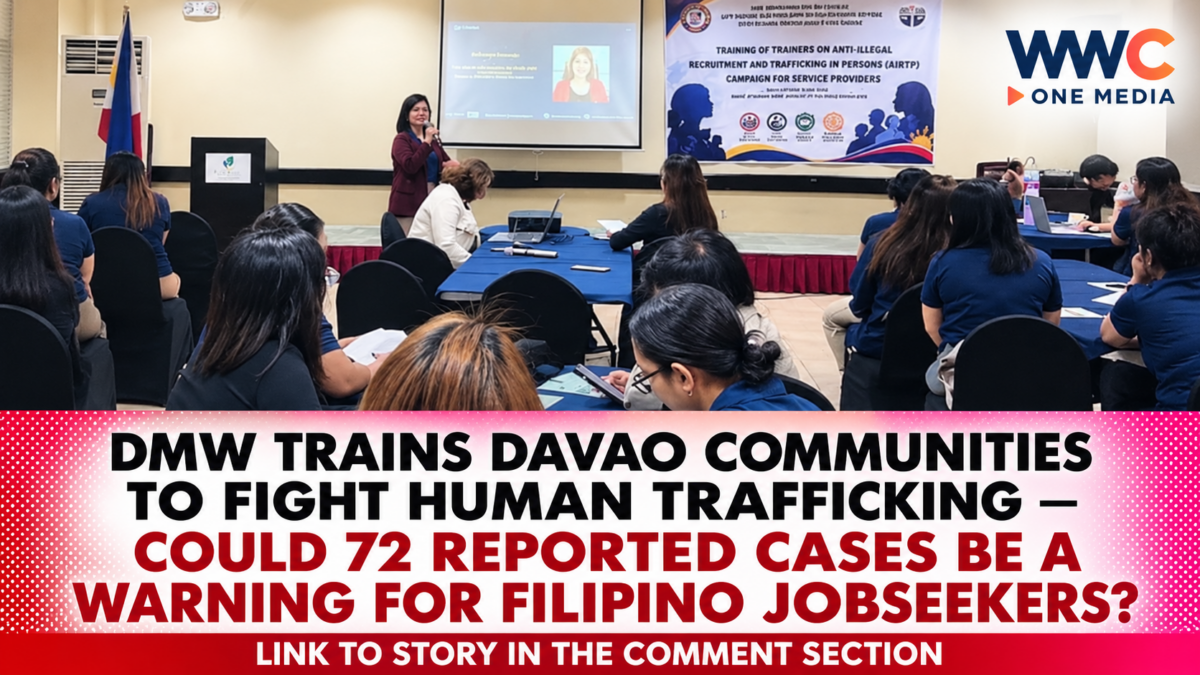
DAVAO CITY, Philippines — The Department of Migrant Workers (DMW) is bringing its fight against illegal recruitment and human trafficking closer to communities in Davao, training local government personnel, nongovernment organizations and barangay leaders to recognize suspicious job offers and help protect aspiring overseas Filipino workers (OFWs).
The two-day Training of Trainers on the Anti-Illegal Recruitment and Trafficking in Persons (AIRTIP) Campaign for Service Providers was held on October 27 and 28 at the Apo View Hotel in Davao City. It was organized by the City Government of Davao through the City Social Welfare and Development Office’s (CSWDO) OFW Families’ Welfare and Crisis Center, in partnership with DMW Region XI.
The initiative comes amid continuing concerns over trafficking and deceptive overseas employment offers. Davao City recorded 72 human trafficking-related cases as of December 31, 2025, the highest number in the Davao Region, according to figures cited by Councilor Rachel Zozobrado.
The training aims to strengthen the ability of frontline workers to identify recruitment red flags, recognize trafficking schemes, follow reporting procedures and refer suspected victims to the appropriate authorities.
But with illegal recruiters increasingly using online platforms and informal networks to approach jobseekers, a bigger question remains: Can stronger community awareness prevent Filipinos from becoming victims before they even leave the country?
DMW TRAINS DAVAO GOVERNMENT WORKERS AND NONGOVERNMENT ORGANIZATIONS
DMW-Davao lawyers and labor officers served as resource persons during the two-day programme.
Charles Roger Raya, attorney III, and Laisa Bucag, senior labor and employment officer, both from the agency’s Migrant Workers Protection Division, led discussions covering the DMW’s programmes, the AIRTIP campaign and laws addressing illegal recruitment and human trafficking.
Participants learned how to recognize suspicious recruitment practices, identify common trafficking schemes and understand how unauthorized recruiters operate.
The sessions also covered preventive measures and emerging recruitment trends that could put aspiring OFWs at risk.
Another major component focused on case management and referral procedures. Participants were introduced to reporting protocols, coordination among government agencies and victim-centered, trauma-informed approaches to assisting affected individuals.
Through case analyses, scenario-based exercises and group demonstrations, attendees gained practical experience in handling suspected cases and referring individuals to the appropriate agencies.
The DMW emphasized that frontline service providers often become the first point of contact for people seeking advice about overseas employment. Their ability to recognize warning signs could help prevent exploitation before it escalates.
116 BARANGAY AND COMMUNITY REPRESENTATIVES JOIN THE CAMPAIGN
The information campaign continued on October 29, when Raya joined a separate session in Barangay 76-A, Davao City.
The activity gathered 116 participants, including purok leaders, barangay officials, former OFWs and their families.
It was conducted in partnership with the Mindanao Migrants Center for Empowering Actions Inc.
The community-based session aimed to make information about illegal recruitment and human trafficking more accessible to residents.
Barangay officials and purok leaders can play an important role because they often know the circumstances of residents seeking employment abroad. They may also be among the first people approached when someone encounters a suspicious recruiter or experiences problems involving an overseas job offer.
Former OFWs can contribute by sharing their experiences and helping other applicants understand the importance of verifying employers, recruitment agencies and employment documents.
By bringing the campaign directly to communities, the DMW is seeking to make prevention a shared responsibility rather than an activity limited to regional government offices.
DAVAO CITY RECORDED 72 HUMAN TRAFFICKING-RELATED CASES
The campaign comes against the backdrop of trafficking-related concerns in the region.
Councilor Rachel Zozobrado cited figures showing that Davao City recorded 72 human trafficking-related cases as of December 31, 2025, the highest number in the Davao Region.
In July 2026, the City Council approved on first reading her privilege speech on a proposed Safe Migration Ordinance.
The proposed measure seeks to establish a referral system connecting the city’s OFW Families’ Welfare and Crisis Center, Safe Migration Desk, Department of Social Welfare and Development and the police’s Women and Children Protection Desk.
The objective is to strengthen coordination among offices that may encounter people affected by illegal recruitment or trafficking.
The 72 cases represent reported trafficking-related incidents and should not automatically be interpreted as the total number of victims or all incidents occurring in the city. Cases that remain unreported may not appear in official figures.
Nevertheless, the number highlights the importance of accessible reporting channels, early identification and coordinated assistance.
DMW PREVIOUSLY SHUT DOWN A DAVAO TRAINING CENTER OVER ALLEGED ILLEGAL RECRUITMENT
Davao has also experienced cases involving establishments accused of using training programmes as a channel for unauthorized overseas recruitment.
In February 2025, the DMW shut down a language training center in Bajada, Davao City, over alleged illegal recruitment.
The case demonstrated why applicants must verify whether an organization is legally authorized to recruit workers for overseas employment.
A language school, skills-training center or private individual cannot automatically offer legitimate overseas recruitment services simply because it provides training or claims to have connections with foreign employers.
Jobseekers should establish whether the organization is licensed and whether the specific overseas position has an approved job order.
The DMW’s latest training is intended to help community service providers recognize these warning signs and guide applicants toward legitimate verification channels.
HOW ILLEGAL RECRUITERS TARGET FILIPINO JOBSEEKERS
Illegal recruitment can take different forms, but many schemes rely on promises that appear more attractive than legitimate employment opportunities.
Recruiters may advertise high salaries, quick deployment or jobs abroad without providing clear information about the employer, workplace or actual duties.
Others may demand questionable payments, ask applicants to surrender important documents or instruct them to misrepresent their travel purpose.
Common warning signs include:
- Job offers promising unusually high salaries without clear qualifications.
- Recruiters who cannot provide verifiable company information.
- Requests for suspicious or excessive payments.
- Pressure to submit passports or personal documents without a clear legal process.
- Employment offers that cannot be matched with an approved job order.
- Instructions to bypass official recruitment procedures.
- Refusal to issue receipts for payments or documents submitted.
An unusual advertisement does not automatically prove that trafficking has occurred. However, applicants should verify suspicious offers before paying money, surrendering documents or agreeing to travel.
The risks are not limited to one destination. In a recent case, a 50-year-old Filipino bound for Russia was intercepted at Mactan-Cebu International Airport after immigration officers questioned the circumstances surrounding an overseas security-related job offer.
ONLINE RECRUITMENT IS CREATING NEW RISKS
Social media and messaging applications have made overseas employment advertisements easier to access. They have also created opportunities for unauthorized recruiters to contact jobseekers directly.
Some fraudulent offers use professional-looking advertisements, company logos and attractive salary packages to appear legitimate.
Others may promise customer service, administrative or technical positions before revealing that the actual work is different from what applicants were told.
The risks can become especially serious when workers are recruited into operations involving forced labor or criminal activity.
WWC ONE MEDIA previously reported on Filipino workers allegedly deceived into joining online scam operations in Myanmar, where some victims described having their passports confiscated and their movements restricted.
Read more: Filipinos Lured by High-Paying Jobs in Myanmar — What Really Happens Inside Scam Compounds?.
These cases demonstrate why applicants should independently verify recruitment agencies and employers rather than relying solely on information supplied through online conversations.
Jobseekers should also be cautious about instructions to conceal their actual employment destination or pretend to be tourists when their real purpose is to work abroad.
THE PHILIPPINES’ ANTI-TRAFFICKING EFFORTS FACE CONTINUING CHALLENGES
The Philippines has maintained its Tier 1 ranking in the United States Department of State’s Trafficking in Persons Report for 11 consecutive years, reflecting its continued efforts to meet the minimum standards for eliminating trafficking.
However, maintaining that classification does not mean trafficking has been eliminated.
The country continues to face challenges involving deceptive recruitment, online exploitation, forced labor and trafficking networks operating across international borders.
The government’s response includes stronger victim-identification procedures, investigations, prosecution and coordination among agencies responsible for protecting vulnerable individuals.
WWC ONE MEDIA examined the country’s standing and the continuing enforcement challenges in its report, PH Retains Top US Anti-Trafficking Ranking for 11th Straight Year — But the Fight Is Far From Over.
The report highlights why international recognition must be accompanied by consistent enforcement and effective protection for people vulnerable to exploitation.
For Davao, the latest training represents one part of that broader effort: strengthening the ability of local communities to identify suspicious activity and connect potential victims with appropriate assistance.
THE REGIONAL TASK FORCE HAS ASSISTED HUNDREDS OF COMPLAINANTS
The work against trafficking also involves law enforcement and prosecution.
According to information from the Department of Justice Regional Prosecution Office XI, the Regional Anti-Child Abuse, Exploitation and Trafficking Task Force XI has assisted 231 complainants and filed 402 cases before regional courts since 2003.
These figures reflect the long-term work required to investigate complaints and pursue cases through the justice system.
They also highlight why cooperation between government agencies is necessary.
A suspected trafficking incident may require more than an initial report. Affected individuals may need legal assistance, protection, social welfare services and coordination with investigators.
The DMW training therefore emphasizes not only identifying suspicious recruitment but also understanding how to refer affected individuals to agencies equipped to respond.
A victim-centered approach is especially important because people who experience trafficking may have faced threats, deception, financial loss, intimidation or exploitation.
THE DMWS’ APAT DAPAT GUIDELINES: FOUR THINGS EVERY OFW APPLICANT SHOULD CHECK
The DMW continues to remind aspiring overseas Filipino workers to follow its Apat Dapat guidelines before applying for jobs abroad.
1. Apply only through a DMW-licensed recruitment agency.
Applicants should verify whether the agency is authorized to recruit workers for overseas employment. A company name appearing online does not automatically establish that it is legitimate.
2. Check whether the agency has an approved job order.
Even a licensed recruitment agency must have the appropriate approved job order for the specific position being offered.
3. Transact personally at the agency’s office.
Jobseekers are encouraged to deal directly with the licensed agency instead of relying entirely on unofficial representatives, intermediaries or social media contacts.
4. Demand a receipt for every payment or document submitted.
Receipts and proper documentation provide records that may become important if a dispute or suspected illegal recruitment case arises.
These precautions are particularly important for applicants pursuing their first overseas job or those unfamiliar with the recruitment process.
WHERE CAN FILIPINOS REPORT SUSPECTED ILLEGAL RECRUITMENT?
The DMW encourages jobseekers, OFWs and their families to report suspicious recruitment activity rather than waiting until someone has already been exploited.
The agency’s 24-hour hotline is 1348. Callers outside Metro Manila may also use (02) 1348.
People seeking assistance should also contact the DMW through its official regional offices and communication channels.
When reporting a suspected case, applicants should preserve relevant information when it is safe to do so, including:
- Messages exchanged with the recruiter.
- Copies of job advertisements.
- Payment records and receipts.
- Names and contact details of recruiters.
- Employment contracts and travel documents.
- Details about the promised employer and destination.
Anyone who believes they or someone they know may be in immediate danger should seek assistance from the appropriate authorities.
Potential victims should be treated with care, particularly when they may have experienced threats, coercion or exploitation.
THE BOTTOM LINE: DAVAO’S FIGHT AGAINST HUMAN TRAFFICKING STARTS BEFORE FILIPINOS LEAVE THE COUNTRY
The DMW’s latest training initiative represents an effort to strengthen the first line of protection for aspiring overseas Filipino workers.
By educating local government personnel, nongovernment organizations, barangay officials, purok leaders and former OFWs, the agency wants communities to recognize suspicious recruitment practices before they develop into more serious cases of exploitation.
The figures underline the urgency. Davao City recorded 72 human trafficking-related cases as of December 31, 2025, while regional authorities have continued investigating suspected illegal recruitment operations and assisting complainants.
The training also addresses a major weakness in public awareness: many jobseekers may not know where to verify overseas employment offers or how to report suspicious recruiters.
The DMW’s Apat Dapat guidelines provide a starting point, but lasting protection will require consistent information campaigns, accessible reporting channels, effective investigations and coordination between national agencies and local communities.
For Filipinos hoping to find better opportunities abroad, the promise of a higher salary should never come at the cost of personal safety and legal protection.
As illegal recruiters continue to adapt their methods, one question remains:
Can Davao’s newly trained community leaders become the first line of defense against human trafficking—or will more Filipino jobseekers continue to fall for deceptive overseas employment offers before authorities can intervene?