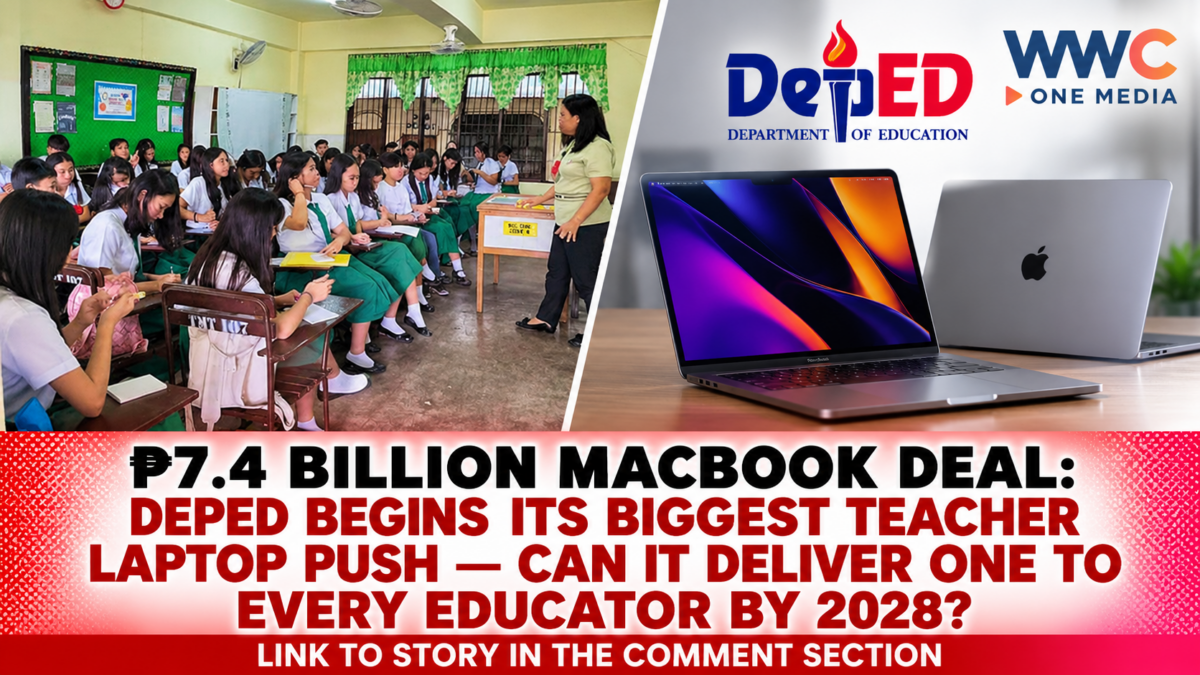
MANILA, Philippines — Thousands of Filipino public school teachers are set to receive new Apple laptops as the Department of Education (DepEd) moves forward with one of its largest technology procurement initiatives, securing 172,654 MacBook Neo units for teachers and administrative personnel nationwide.
The distribution is scheduled to begin in November 2026 and continue through March 2027. Each laptop package was procured for approximately ₱43,000 and includes a five-year warranty, productivity tools, delivery services and professional development for recipients.
Education Secretary Sonny Angara said the initiative is intended to ease the financial burden on teachers who have historically purchased their own computers or relied on outdated equipment to prepare lessons and complete administrative work.
The announcement also attracted international attention after Apple Chief Executive Officer John Ternus described the agreement as the company’s biggest education deal ever for Mac.
But while the procurement represents a significant investment in teachers’ digital capabilities, it raises another important question: Will 172,654 laptops be enough to address the technology shortage affecting hundreds of thousands of Filipino public school educators?
DEPED SECURES MORE THAN 172,000 APPLE MACBOOK NEO LAPTOPS
DepEd announced on November 3 that it had successfully completed competitive bidding for 172,654 Apple MacBook Neo laptops under its Computerization Program.
The procurement covers two categories of beneficiaries:
- 169,008 units intended for public school teachers.
- 3,646 units intended for administrative officers.
The department said deployment is scheduled from November 2026 through March 2027, with distribution activities planned across Luzon, the Visayas and Mindanao.
The procurement is part of the government’s broader effort to modernize public education by providing educators with reliable technology for lesson preparation, classroom activities and administrative responsibilities.
Angara emphasized that teachers should not have to shoulder the expense of purchasing and maintaining their own equipment simply to perform their professional duties.
For educators who have spent years working with aging computers or personal devices, the new procurement could provide a substantial improvement in their working conditions.
HOW MUCH DID DEPED PAY FOR EACH MACBOOK?
One of the most closely watched details of the procurement is its price.
DepEd secured each MacBook Neo package for approximately ₱43,000, around ₱6,900 below the laptop’s Philippine suggested retail price of ₱49,900.
Based on the announced per-unit price and the total number of units, the procurement represents an estimated package value of approximately ₱7.42 billion.
However, the department’s published announcement did not disclose the exact final contract amount.
The package also includes more than the physical laptop.
According to DepEd, the procurement covers:
- Built-in productivity tools.
- Delivery and logistics services.
- A five-year warranty.
- Professional development and training for recipients.
The extended warranty is particularly notable because ordinary retail purchases typically include one year of coverage.
For a government procurement involving more than 172,000 devices, longer warranty protection could help reduce the risk of unexpected repair expenses and provide a longer period of support.
The actual value of the package, however, will depend not only on the purchase price but also on the quality of delivery, technical support, warranty service and training provided to recipients.
WHY THE FIVE-YEAR WARRANTY MATTERS
Teachers rely on computers for responsibilities that extend beyond preparing classroom presentations.
Their work can include preparing lesson plans, developing instructional materials, encoding grades, communicating with parents, organizing student records and completing administrative reports.
A laptop that frequently breaks down or becomes unusable can interrupt several of these responsibilities.
That is why the five-year warranty could become one of the most important parts of the procurement.
Instead of providing only the standard one-year retail coverage, DepEd said the new package offers five years of protection.
The longer coverage may help schools and teachers manage equipment-related problems over a longer period, although its practical benefits will depend on the warranty’s service conditions and how efficiently repairs and replacements are handled.
The department has presented this arrangement as a first for its laptop procurement initiatives.
APPLE CALLS THE AGREEMENT ITS BIGGEST EDUCATION DEAL FOR MAC
The procurement has also become significant for Apple.
During the company’s fourth-quarter 2026 financial results conference call, Apple CEO John Ternus highlighted the Philippine agreement as an example of the company’s growth opportunities in education.
He described the arrangement as Apple’s biggest education deal ever for Mac, with approximately 170,000 MacBook Neo devices expected to be deployed to Philippine teachers and staff.
The announcement demonstrates the scale of the Philippine government’s purchasing commitment and places the country’s education sector among the notable institutional markets for Apple’s Mac business.
It also highlights how government procurement can influence technology companies’ presence in emerging markets.
For Apple, the agreement brings a large number of new users into its computer ecosystem. For DepEd, the challenge will be making sure the devices are properly integrated into the daily responsibilities of educators.
DEPED AND APPLE TO LAUNCH GUROXL TEACHER TRAINING PROGRAM
Providing laptops is only one part of the initiative.
DepEd is also collaborating with Apple to introduce GuroXL, a comprehensive training framework designed to help teachers incorporate technology into classroom instruction and professional activities.
The program will be developed in coordination with the National Educators Academy of the Philippines.
It is intended to guide participating educators toward Apple Teacher certifications and specialized technology leadership credentials.
The training component is important because access to a computer does not automatically translate into effective digital teaching.
Teachers must also know how to use available applications, create instructional materials, manage digital resources and select appropriate technology for different learning objectives.
Without adequate training, even expensive equipment may end up being used mainly for basic administrative tasks rather than improving classroom instruction.
The success of GuroXL will therefore depend on whether teachers receive practical, accessible and continuing support—not simply introductory sessions during the laptop distribution.
THE LAPTOP PROGRAM HAS ALREADY REACHED 231,725 CONTRACTED UNITS
The latest procurement is part of a larger effort under DepEd’s Computerization Program.
As of November 3, the department had awarded contracts for a total of 231,725 teacher laptops nationwide.
The figure includes:
- 169,008 MacBook Neo units.
- 62,717 Windows-based laptops.
The additional 3,646 MacBook Neo units for administrative officers are included in the newly announced 172,654-unit procurement.
These figures show that the government’s laptop initiative is not limited to one particular brand or operating system.
However, the number of contracted units should not be confused with the number of teachers who have already received functioning devices.
Actual distribution, inventory management, technical support and training remain essential stages of implementation.
WHY THE LATEST PROCUREMENT MAY STILL NOT BE ENOUGH
Despite the size of the agreement, the laptop shortage affecting public school teachers remains a major concern.
The Philippines has nearly 900,000 public school teachers. Based on that approximate workforce size, the 169,008 newly procured teacher units would cover only a portion of the total teaching workforce.
Even when combined with the 62,717 Windows-based units previously contracted, the total of 231,725 teacher laptops represents roughly one-quarter of the country’s public school teachers.
That means hundreds of thousands of educators may still need government-provided devices.
The Alliance of Concerned Teachers (ACT) Philippines has also criticized the pace and scale of the government’s laptop distribution efforts.
The group has argued that the latest procurement remains insufficient to meet the digital needs of the entire public education workforce. It has also called for reliable technical support, continuing training and equipment suited to teachers’ actual working requirements.
The concern is not simply whether DepEd can purchase hundreds of thousands of computers.
It is whether every teacher who needs one can eventually receive a dependable device without having to spend personal money to perform essential work.
THE GOVERNMENT’S 2028 LAPTOP COMMITMENT
President Ferdinand Marcos Jr. has previously pledged that every public school teacher would receive a laptop before the end of his administration in 2028.
That commitment makes the latest procurement particularly important.
DepEd had planned additional laptop purchases under its 2026 budget, with reports indicating that more than 250,000 additional units were being targeted for teaching personnel.
The department will need to maintain the pace of procurement and distribution if it intends to meet the nationwide commitment within the remaining period.
The challenge also involves more than buying devices.
DepEd must ensure that laptops reach the correct beneficiaries, that schools have the infrastructure to support digital learning and that teachers receive assistance when equipment encounters technical problems.
The department’s progress will ultimately be measured by how many educators can actually use government-provided computers in their daily work.
DIGITAL EDUCATION STILL FACES A MUCH BIGGER ACCESS PROBLEM
The laptop announcement comes as Philippine education continues to confront unequal access to technology.
A previous assessment cited by the Second Congressional Commission on Education highlighted the extent of the problem: only 37% of teachers had laptops, while just 17% of students had the gadgets needed for online learning, based on DepEd data submitted in October 2024.
Those figures illustrate why technology access remains a serious concern, especially when schools are forced to rely on digital learning arrangements during emergencies or class suspensions.
WWC ONE MEDIA previously examined this challenge in its report, Gatchalian Wants ‘Walang Pasok’ Decisions Made Closer to the Ground — But Could This Finally Stop Learning Loss?.
The report discussed how unequal access to laptops and internet connectivity can make online learning difficult for students when face-to-face classes are disrupted.
The issue also connects to the wider debate over artificial intelligence and technology in education.
As schools gradually introduce more digital tools, teachers need access not only to computers but also to the skills and resources required to use them effectively.
WWC ONE MEDIA has also explored the subject in AI Is Transforming Philippine Classrooms — But Working Students Risk Being Left Behind as Schools Struggle to Keep Up.
The broader lesson is that technology investment must reach both educators and learners if it is expected to reduce rather than deepen educational inequality.
DEPED’S LAPTOP PROCUREMENT MUST DELIVER REAL CLASSROOM BENEFITS
The new MacBook Neo procurement is a major development, but its long-term value will depend on how the devices are used.
A laptop can help a teacher prepare more engaging presentations, organize digital resources, develop learning activities and complete administrative work more efficiently.
It can also support professional development and provide access to digital teaching communities.
However, technology cannot independently solve the country’s longstanding education problems.
Schools still need reliable internet connections, sufficient classrooms, updated learning materials, technical assistance and manageable workloads for teachers.
WWC ONE MEDIA previously reported on the department’s textbook procurement progress in DepEd Secures All 105 Textbook Titles for 2026 — But Nationwide Delivery Still Awaits.
That development highlighted an important distinction: completing procurement does not necessarily mean that learning resources have already reached every classroom.
The same principle applies to laptops.
The government may successfully secure hundreds of thousands of devices, but the real achievement will come when teachers receive them, learn to use them and benefit from them in their daily responsibilities.
THE BOTTOM LINE: 172,654 MACBOOKS ARE A MAJOR STEP — BUT CAN DEPED PROVIDE A LAPTOP FOR EVERY TEACHER BY 2028?
DepEd’s procurement of 172,654 Apple MacBook Neo laptops represents a significant investment in the country’s public education workforce.
With each package costing approximately ₱43,000 and including a five-year warranty, productivity tools, delivery and training, the initiative aims to reduce teachers’ dependence on personal computers and outdated equipment.
The partnership with Apple and the introduction of GuroXL also show that the government wants the initiative to extend beyond hardware distribution and into digital skills development.
But the figures reveal the scale of the remaining challenge.
The 169,008 laptops allocated to teachers represent only part of a workforce approaching 900,000 educators. Even when combined with previously contracted Windows-based units, the total remains far below the number needed to equip every public school teacher.
The next few months will therefore be critical.
DepEd must deliver the devices on schedule, ensure that qualified teachers receive them, provide effective training and establish dependable technical support.
The government must also continue expanding its procurement efforts if it intends to fulfill the promise of providing every public school teacher with a laptop before 2028.
For Filipino educators who have spent years using personal money to purchase the tools needed for their work, the announcement offers a reason for optimism.
But one question remains: Will this historic Apple deal finally mark the beginning of a laptop for every Filipino public school teacher—or will hundreds of thousands of educators still be waiting when the 2028 deadline arrives?