MANILA, Philippines — November 4, 2026 | WWC ONE MEDIA | Business, Real Estate & Retail
A major leadership shake-up is taking shape at one of the Philippines’ biggest property developers as billionaire Andrew Tan’s Megaworld Corporation prepares for an ambitious expansion of its nationwide shopping mall business.
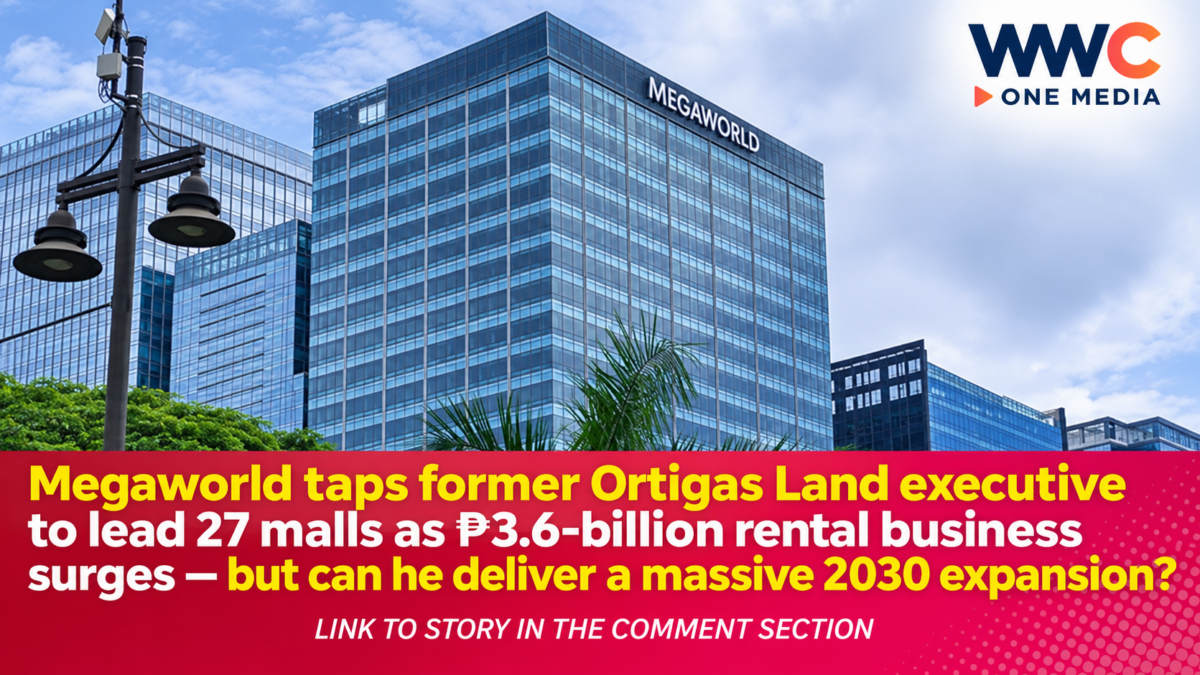
Megaworld’s board approved the appointment of veteran property executive Javier Hernandez, 57, to lead Megaworld Lifestyle Malls, placing him in charge of a portfolio of 27 shopping destinations as the company works toward doubling its retail footprint to one million square meters by 2030.
The November 3 regulatory announcement formalizes a leadership transition first publicly announced in October.
Hernandez, a former executive of Ortigas Land and Ayala Land, succeeds Graham Coates, who will formally retire on December 31, 2026, after eight years leading the mall business.
The appointment comes as Megaworld’s retail operations report stronger rental income, high occupancy and a sharp increase in visitor traffic.
But there is a warning sign buried in the figures.
While Megaworld’s mall traffic has surged 44%, average spending per visitor has fallen 4%.
For Hernandez, the challenge goes beyond constructing additional malls. He must find ways to convert higher foot traffic into sustainable earnings while managing one of the company’s biggest retail expansion programs.
Javier Hernandez Takes Charge of Megaworld’s 27-Mall Portfolio
Hernandez arrives with more than three decades of experience spanning commercial property development, shopping malls, hospitality, leisure and tourism.
Before joining Megaworld, he served as vice president overseeing office and leisure businesses at Ortigas Land.
He also spent much of his career at Ayala Land, where his senior positions included president and chief executive officer of AyalaLand Hotels & Resorts Corporation.
His background includes approximately two decades of experience in the shopping mall industry.
That combination is particularly relevant to Megaworld’s integrated township strategy.
Unlike standalone retail centers, Megaworld’s lifestyle destinations are frequently surrounded by residential communities, office towers, hotels and entertainment facilities.
The company relies on these different property components to attract customers and generate recurring commercial activity.
Hernandez now faces the task of strengthening existing malls while preparing the next generation of shopping destinations.
WWC ONE MEDIA previously examined the appointment and long-term expansion plans in Megaworld Appoints Javier Hernandez to Lead Massive Mall Expansion — But Can the Former Ayala Veteran Deliver 1 Million Square Meters by 2030?.
The latest development adds formal board approval and a clearer retirement timetable to that earlier announcement.
₱3.6 Billion in Mall Rental Income Signals Stronger Business
Hernandez is taking over a retail operation that has demonstrated continued growth.
Megaworld’s shopping mall business generated approximately ₱3.6 billion in rental income during the first six months of 2026, an increase of 8% compared with the same period in 2025.
The company also reported an occupancy rate of approximately 95%.
High occupancy suggests that most of its available retail leasing space is occupied by tenants.
For a mall operator, strong leasing activity provides an important source of recurring revenue.
Unlike residential property sales, which depend on property transactions and project completions, rental operations can generate ongoing income through commercial leases.
However, high occupancy does not guarantee rising profitability.
Mall operators still face electricity costs, maintenance expenses, tenant turnover, capital expenditures and changing consumer spending patterns.
Megaworld’s wider financial position was covered by WWC ONE MEDIA in its report on the company’s Four Golden Arrows recognition and ₱12.7-billion first-half profit.
The company’s consolidated first-half net income increased 5% to approximately ₱12.7 billion, supported by its wider property operations.
That consolidated profit figure is separate from the mall division’s ₱3.6-billion rental income.
Megaworld Attracts 393,000 Daily Visitors — But Spending Falls
One of the most revealing developments involves customer traffic.
Megaworld reported that its shopping malls attracted an average of 393,000 visitors daily during the first half of 2026.
That represented a 44% increase compared with the previous year.
The increase suggests that its retail destinations are successfully attracting more people.
But average spending per visitor declined 4% to approximately ₱661.
The contrast creates an important business question.
Are visitors spending less because of tighter household budgets, changing shopping habits or a greater proportion of customers visiting for entertainment rather than purchases?
The available figures do not establish the exact reason.
They also do not prove that overall retail sales declined. More visitors can potentially offset lower spending per person.
Still, the development highlights the difference between attracting visitors and converting traffic into higher commercial spending.
For Hernandez, that could mean improving tenant selection, strengthening dining and entertainment offerings, and attracting brands that encourage repeat purchases.
These priorities will become more important as the company’s mall portfolio expands.
Megaworld Plans to Double Retail Space by 2030
The biggest responsibility facing the incoming mall chief is Megaworld’s plan to reach one million square meters of retail gross leasable area by 2030.
Gross leasable area, or GLA, refers to commercial space available for lease to tenants.
The company previously reported a retail portfolio exceeding 500,000 square meters, meaning the target would represent a substantial expansion of its existing footprint.
Megaworld plans to pursue the objective by developing new malls, improving existing destinations and introducing additional retail formats within its integrated townships.
However, the one-million-square-meter figure is a corporate development target, not completed space already available for lease.
Construction schedules, regulatory approvals, financing, tenant demand and economic conditions will influence actual delivery.
Hernandez must balance the ambition to expand with the need to ensure new properties generate adequate returns.
Cavite, Rizal, Pampanga and Bacolod Among Expansion Targets
Megaworld has identified several important provincial markets for its next wave of mall construction.
Projects in Cavite, Rizal, Pampanga and Bacolod City are targeted for groundbreaking between 2026 and 2027.
These developments are intended to complement the company’s existing and planned townships.
The strategy reflects a broader effort by Philippine developers to expand commercial destinations beyond traditional Metro Manila shopping districts.
New lifestyle malls can provide space for restaurants, retail shops, wellness businesses, cinemas and other commercial services.
They may also generate opportunities for local entrepreneurs and create employment during construction and operations.
However, job creation and revenue forecasts should not be assumed without specific project-level disclosures.
The broader expansion trend was examined in WWC ONE MEDIA’s report on Philippine mall giants planning ₱184 billion in investments across 46 projects.
The report described how major developers, including Megaworld, SM Prime, Ayala Land and Robinsons Land, are shifting toward experiential retail and destination-based commercial developments.
The challenge is that expanding retail space can also intensify competition for tenants and consumer spending.
A new mall must attract enough customers to support its businesses over the long term.
Graham Coates Leaves Behind Eight Years of Retail Expansion
Hernandez succeeds Graham Coates, who helped steer Megaworld Lifestyle Malls through expansion, the COVID-19 pandemic and subsequent recovery.
During Coates’s leadership, the company developed and enhanced several commercial destinations.
These included the Imperial Wing at Lucky Chinatown, The Shoppes at McKinley West and the redevelopment of Eastwood Mall.
The business also attracted international retailers and introduced new shopping and entertainment experiences.
Among the notable developments were Tesla’s Philippine entry through its Uptown Bonifacio Experience Center and the expansion of retailers KKV and Nitori.
Recent international brand openings have also included MUJI at Eastwood City and Wolfgang Steakhouse at Festive Walk Iloilo.
These additions illustrate Megaworld’s strategy of using international brands and destination restaurants to strengthen the appeal of its properties.
Coates and Hernandez are expected to work together during the transition ahead of Coates’s formal retirement on December 31.
Why Megaworld Wants More Than Traditional Shopping Malls
The Philippine shopping mall business is evolving.
Retail developers are increasingly competing not only with other malls but also with online marketplaces, food-delivery platforms and digital entertainment services.
For physical retail properties, this creates pressure to offer experiences that cannot easily be replicated through a smartphone.
Restaurants, cultural attractions, wellness facilities, entertainment venues and community activities can encourage customers to spend more time at a destination.
Megaworld has been developing this approach through its township projects.
These communities bring together places to live, work, shop and socialize.
For example, the company’s wider commercial development strategy includes projects such as Mactan Expo in Cebu.
WWC ONE MEDIA previously reported on Megaworld’s ₱1.5-Billion Mactan Expo hosting approximately 500 ASEAN defense delegates.
Although Mactan Expo is a convention facility rather than a shopping mall, it demonstrates the developer’s broader strategy of attracting visitors and supporting commercial activity through mixed-use developments.
That strategy may help generate demand for nearby restaurants, hotels, shops and services.
Megaworld’s REIT Expansion Adds Another Financial Dimension
Megaworld’s property expansion also overlaps with the growth of MREIT Inc., its listed real estate investment trust.
MREIT has been expanding its income-generating property portfolio through acquisitions and asset infusions.
In October 2026, MREIT reported third-quarter distributable income of approximately ₱1.93 billion, a 106% increase from the comparable period.
The company attributed the strong performance partly to a larger portfolio following major asset infusions.
The expanded trust now includes a more diverse mix of commercial real estate properties.
For Megaworld, its REIT strategy can provide another avenue for managing mature income-producing real estate assets.
However, investors should distinguish the different expansion targets.
MREIT’s total property portfolio includes multiple asset categories, while Megaworld Lifestyle Malls’ one-million-square-meter 2030 goal refers specifically to retail leasable space.
They are not interchangeable measurements.
Furthermore, REIT transactions involve separate financial and regulatory requirements, including property valuation, shareholder interests and disclosure obligations.
Strong Competition Could Test Megaworld’s Expansion Strategy
Megaworld is not alone in betting on the Philippine mall sector.
SM Prime, Ayala Land and Robinsons Land are also developing or upgrading retail destinations.
The growing investment pipeline suggests that major developers continue to see opportunities in physical retail despite the rise of online commerce.
But continued expansion also creates risks.
More shopping malls can increase competition for retail tenants and consumer spending.
Developers must consider local population growth, purchasing power, transport access, rent affordability and competition from existing commercial centers.
For provincial projects, these factors can be especially important.
A growing township does not automatically guarantee that every retail tenant will be successful.
Hernandez will therefore need to assess where new commercial space can generate sustainable demand rather than relying solely on construction targets.
What Other News Outlets Confirm
InsiderPH reported on November 3 that Megaworld’s board approved Hernandez’s appointment and disclosed Coates’s December 31 retirement schedule.
The outlet also reported the division’s ₱3.6-billion first-half rental income, 95% occupancy, average daily foot traffic of 393,000 and average visitor spending of ₱661.
Earlier coverage from PhilSTAR Property and The Philippine Star confirms Hernandez’s professional background, the 27-mall portfolio and the target of reaching one million square meters of retail GLA by 2030.
The Philippine Star also reported on Kevin Tan’s introduction of Hernandez during an October company event.
These reports establish that the executive’s selection was publicly known before the November 3 formal board action.
The latest development is therefore an update to the leadership transition, not an entirely unexpected appointment.
The Bigger Question: Can More Visitors Become Higher Profits?
Megaworld’s mall division is entering an important period.
Its existing operations have demonstrated rental income growth, strong occupancy and expanding visitor traffic.
At the same time, the company is planning a major increase in retail space across several Philippine growth markets.
Hernandez brings experience from some of the country’s most established property groups.
But credentials alone will not determine whether the expansion succeeds.
The new mall chief must maintain high occupancy, improve customer experiences, attract suitable tenants and ensure that additional commercial space generates sustainable returns.
The 44% increase in daily visitors offers encouragement.
The 4% decline in average spending provides a reminder that more foot traffic does not necessarily translate into greater spending per customer.
The Bottom Line
Megaworld has formally approved Javier Hernandez to lead its 27 lifestyle malls as it pursues a one-million-square-meter retail expansion target by 2030.
His appointment comes amid rising rental revenue, a strong occupancy rate and increasing customer traffic.
But as the developer prepares new mall projects in Cavite, Rizal, Pampanga and Bacolod, its next challenge will be ensuring that ambitious construction plans deliver lasting financial value.