WASHINGTON / TEHRAN — November 3, 2026
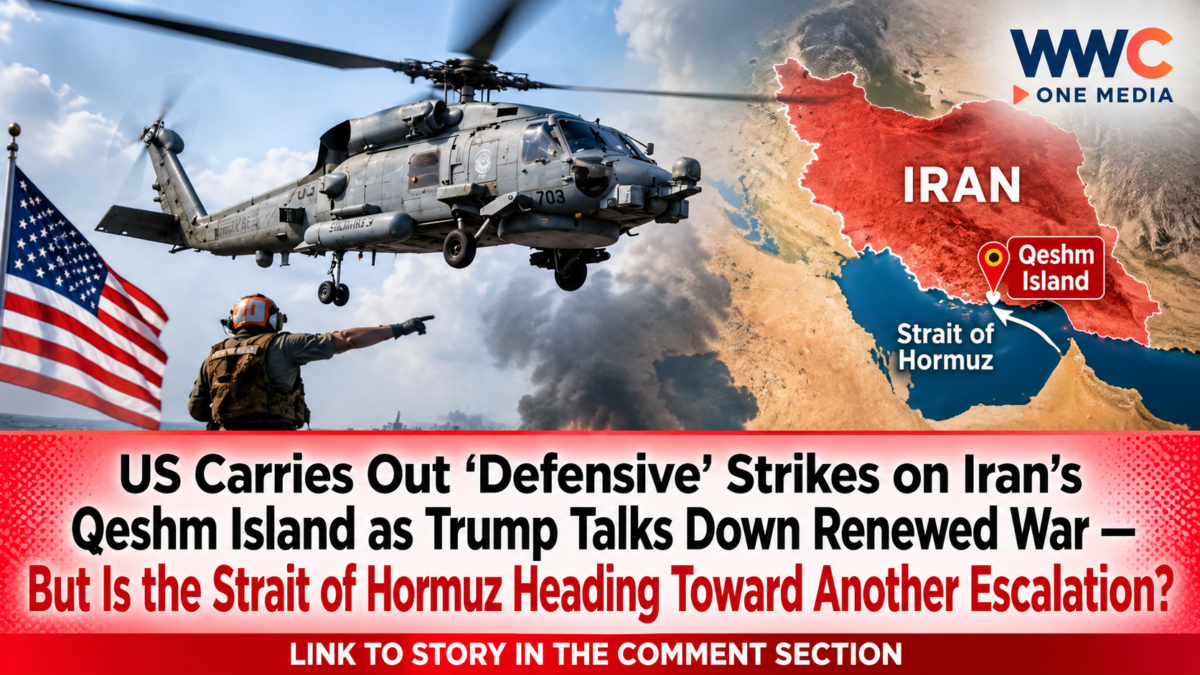
The United States has carried out what American officials described as limited “defensive” strikes on Iran’s Qeshm Island, adding a new and potentially dangerous episode to a conflict that Washington and Tehran have spent weeks trying to contain.
The strikes took place on Monday, Nov. 2, around the strategically important Strait of Hormuz, even as President Donald Trump publicly suggested that he was not planning a renewed major military campaign against Iran after the U.S. midterm elections.
U.S. officials told Reuters that the operation was intended as a defensive response to Iranian forces using surface-to-air missiles against American assets. One official said the action followed Iran firing at a U.S. aircraft. The officials stressed that the strikes did not represent a return to large-scale combat operations.
Iranian state media, meanwhile, reported several explosions on Qeshm Island.
The incident raises an immediate question: if Washington and Tehran are still talking about a possible settlement, why are American forces continuing to carry out military action in one of the world’s most strategically sensitive waterways?
US says strikes were defensive
The strikes were first reported by The Wall Street Journal before being confirmed by U.S. officials to other media organizations.
One U.S. official described the operation as a defensive measure against Iranian personnel using surface-to-air missiles against U.S. assets.
Another official said the action followed Iran firing at an American aircraft.
The United States has not publicly described the operation as the beginning of a new major offensive.
Reuters reported that U.S. Central Command referred questions about the operation elsewhere, while Iranian state media reported explosions on the island.
That distinction matters.
A limited defensive strike and a renewed large-scale military campaign are very different scenarios.
But even a limited strike can create the conditions for retaliation, especially when the two countries remain engaged in an unresolved conflict.
Why Qeshm Island matters
Qeshm is Iran’s largest island and sits close to the Strait of Hormuz, one of the most important maritime chokepoints in the world.
The island is roughly 14 miles from the Iranian port city of Bandar Abbas and occupies a position that gives Iran significant strategic leverage over maritime traffic through the strait.
The Strait of Hormuz connects the Persian Gulf with the Gulf of Oman and the wider Indian Ocean.
Before the current conflict, roughly 20 million barrels of oil per day passed through the waterway, according to CNN’s reporting.
That makes any military incident around Qeshm much more significant than a confrontation on an isolated piece of territory.
A prolonged disruption could affect oil shipments, tanker insurance, shipping costs and ultimately fuel prices in countries far from the Middle East.
Explosions were reported on the island
Iranian state television reported explosions on Qeshm Island following the reported American operation.
Iranian media also reported explosions in the coastal area around Bandar Lengeh.
Witnesses cited by Al Jazeera said they heard multiple blasts and saw aircraft over Qeshm.
The reports provide evidence that explosions occurred, but they do not independently establish the full extent of damage or exactly which facilities were struck.
That distinction is important because information coming from an active conflict zone can be incomplete or contradictory.
At the time of reporting, there was no independently verified public assessment of casualties or the precise physical damage caused by the U.S. strikes.
The operation comes at a politically sensitive moment
The strikes happened only hours before Americans went to the polls for the Nov. 3 midterm elections.
That timing adds another layer of political sensitivity.
President Trump had previously suggested that additional military action against Iran could take place after the elections.
But on Monday, when asked whether he was considering striking Iran after the midterms, Trump reportedly answered “no.”
He also said that a settlement with Tehran could happen.
Reuters reported that Trump’s comments appeared to signal a shift away from publicly threatening immediate renewed large-scale attacks.
The apparent contradiction between diplomatic optimism and continuing military operations is now one of the central features of the conflict.
Washington is simultaneously signaling that negotiations remain possible while maintaining the ability to strike Iranian targets when American officials say U.S. forces are threatened.
Trump says the United States is not fighting a new war
Trump went further during an interview broadcast Monday night.
He argued that the United States was not currently engaged in a conventional war with Iran and described the situation as much less intense than a traditional war.
His comments came even as reports emerged of the Qeshm strikes.
Vice President JD Vance similarly expressed optimism about diplomatic progress.
Vance said the United States and Iran had made some progress toward finding an “off ramp” from the conflict and that he and Trump felt positive about the possibility of a negotiated settlement.
That creates an unusual situation.
Military operations are continuing.
But senior American officials are simultaneously trying to communicate that diplomacy remains possible.
The Strait of Hormuz is becoming the central battlefield
The Qeshm operation cannot be separated from the wider struggle over the Strait of Hormuz.
For months, the waterway has been at the center of military confrontation and economic pressure.
Iran has sought to restrict maritime movement through the strait, while the United States has attempted to maintain pressure on Tehran and protect American and commercial interests.
In September, WWC ONE MEDIA examined how the confrontation was increasingly moving into the maritime domain in “Iran Says It Struck a U.S. Drone Boat in Hormuz — But Washington’s Attack on Three Oil Tankers Raises the Stakes Far Higher.”
That earlier report documented how attacks involving military and commercial vessels were already increasing the risks to global shipping.
The latest Qeshm strikes show that the danger has not disappeared.
The economic stakes are enormous
The Strait of Hormuz is not simply a military chokepoint.
It is an economic artery.
Any sustained reduction in shipping through the waterway can affect crude oil supplies, tanker availability, insurance costs and transportation rates.
Those pressures can eventually reach consumers through higher fuel and transportation prices.
The risk has already been reflected in energy-market volatility during the conflict.
WWC ONE MEDIA recently examined the broader economic burden in “Trump’s Iran War Costs US Taxpayers $47.1 Billion as Hormuz Crisis Drags On — But Could the Next Strike Send the Bill Even Higher?”
The report noted that U.S. Central Command’s latest estimate put the direct American military cost of the conflict at $47.1 billion as of Oct. 16, including roughly $29 billion for replacing expended munitions, $11.9 billion in operational costs and about $6 billion in equipment losses.
Those numbers do not represent the total economic cost of the war.
They also do not capture all potential consequences from disrupted trade, higher energy prices or damage to regional infrastructure.
The financial burden is already becoming a political issue
The $47.1-billion figure has become particularly significant because the United States is holding midterm elections.
The war’s cost is now part of a wider debate over military spending, presidential authority and the future of American involvement in the Middle East.
The Pentagon estimate is also not final.
It was calculated through Oct. 16 and does not include all damage to U.S. military bases in the region.
The Associated Press reported that the Pentagon’s figures include 21 service members killed and 865 wounded, although the military’s tally includes some deaths and injuries not directly caused by combat.
The longer the conflict continues, the greater the pressure will be on Washington to explain both its objectives and the cost of achieving them.
Iran has already warned that Gulf energy assets are vulnerable
Tehran has repeatedly warned that further attacks on Iranian assets could trigger retaliation against American and Gulf energy interests.
In September, Iranian Parliament Speaker Mohammad Bagher Qalibaf warned that energy infrastructure across the Gulf could be vulnerable if Washington attacked Iranian oil and gas assets.
The warning came during another period of escalating maritime confrontation.
WWC ONE MEDIA previously covered those threats in “Iran Warns US Energy Assets in Gulf Are Vulnerable After Latest Clashes.”
The significance of those warnings is not that they prove an attack will occur.
Rather, they demonstrate how the conflict has expanded beyond direct military targets into the wider infrastructure supporting global energy markets.
If energy facilities, ports or shipping routes were seriously disrupted, the consequences could spread rapidly across the global economy.
The United States is trying to prevent Iran from threatening shipping
American officials have described recent operations in the Strait of Hormuz as defensive measures designed to protect U.S. forces and prevent Iran from attacking commercial vessels.
The Qeshm strike reportedly followed an Iranian attempt to use surface-to-air missiles against an American aircraft.
That makes the American justification relatively narrow.
Washington is not publicly saying that the latest strike represents the opening of another major campaign.
Instead, officials describe it as an action intended to neutralize an immediate threat.
But this approach carries a risk.
If every Iranian attack produces an American response, and every American response produces an Iranian retaliation, the conflict can escalate through a chain of individual decisions even when neither side formally announces a new war.
Tehran’s response could determine what happens next
The most important development following the Qeshm strikes may therefore be Iran’s reaction.
A limited response could allow both sides to return to negotiations.
A larger retaliation could force Washington to respond again.
That could create a cycle in which each government claims it is acting defensively while the overall level of violence continues to rise.
This is one reason the language used by officials matters.
Calling an operation “defensive” does not necessarily mean that escalation is impossible.
It means the government is presenting the operation as a response to an immediate threat rather than as an offensive campaign.
Diplomacy is still on the table
Despite the strikes, diplomatic channels have not completely closed.
Vance has expressed optimism about a potential settlement, while Trump has suggested that Tehran wants a deal.
Iran, meanwhile, has indicated that it wants conditions addressed before normal shipping and broader negotiations can resume.
The core disagreement involves more than simply whether fighting should stop.
The two sides must also address sanctions, maritime access, military restrictions and the future of Iran’s nuclear and regional policies.
Those issues are much harder to resolve than agreeing to a temporary pause in fighting.
Why another major escalation would be dangerous
A renewed large-scale conflict would carry risks well beyond the United States and Iran.
Gulf countries could face attacks or disruption to energy infrastructure.
Commercial vessels could face greater security risks.
Oil prices could rise.
Asian economies dependent on imported energy could experience additional inflationary pressure.
And the possibility of a wider regional conflict would increase.
The Qeshm operation therefore matters not because it necessarily signals a new war, but because it demonstrates that the conditions for escalation still exist.
The diplomatic track has not yet produced a durable settlement.
The military track remains active.
What this means for Asia
The Philippines and other Asian economies have a direct interest in the stability of the Strait of Hormuz.
Much of Asia’s energy supply depends on petroleum and gas moving through Middle Eastern maritime routes.
A sustained disruption could increase the cost of crude oil, shipping and transportation.
That can eventually affect gasoline, diesel, airfare, logistics and consumer prices.
For countries such as the Philippines that depend heavily on imported fuel, the effects can be particularly noticeable when international crude prices remain elevated.
The Qeshm strikes therefore have implications that extend far beyond Washington and Tehran.
The bigger question: Is this really a limited strike?
For now, U.S. officials are describing the Qeshm operation as limited and defensive.
There is no confirmed evidence that Washington has launched a new full-scale military campaign.
Trump is also publicly signaling that he remains open to a deal.
But the United States has nevertheless used military force against Iranian targets while negotiations remain unresolved.
That contradiction is the central story.
If Iran chooses restraint, the Qeshm strikes could remain an isolated episode within a larger effort to deter attacks on U.S. assets.
If Tehran retaliates aggressively, Washington could face pressure to respond.
And if the cycle continues, the distinction between “limited defensive action” and renewed war could become increasingly difficult to maintain.
The real question now is whether Washington and Tehran can turn their renewed diplomatic signals into a durable settlement before another exchange in the Strait of Hormuz transforms a supposedly limited confrontation into a much larger regional crisis.