SINGAPORE — November 3, 2026
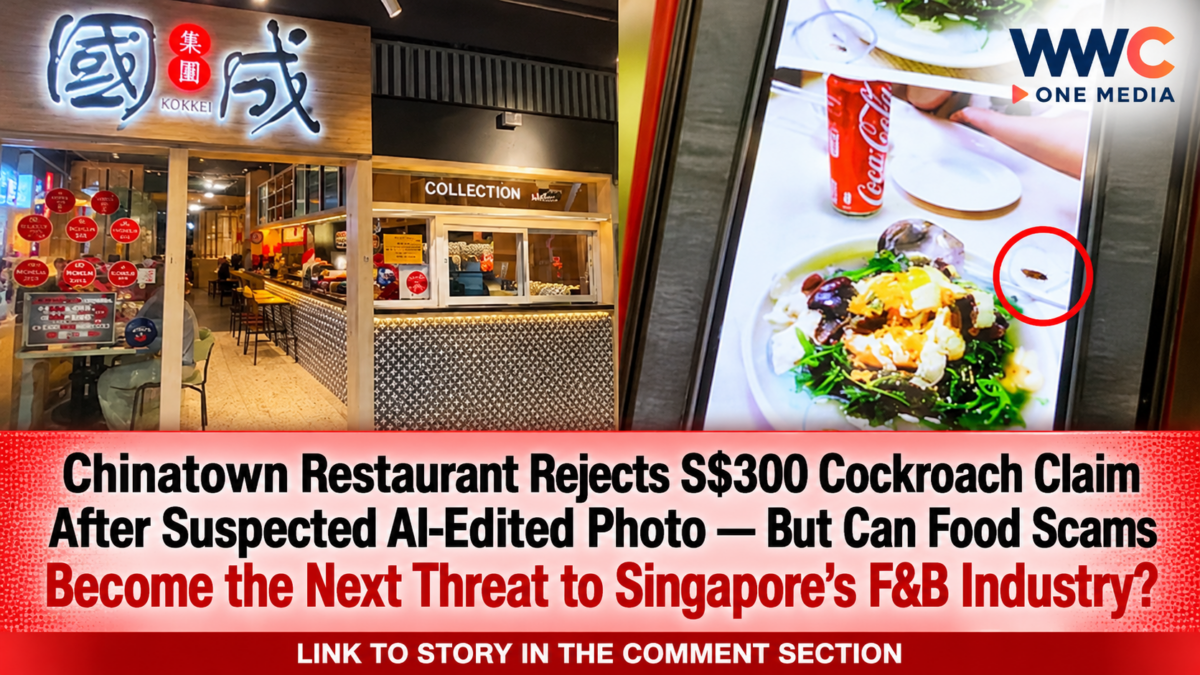
A Chinatown restaurant has lodged a police report after allegedly being targeted by a person who claimed to have found a cockroach in a dish and demanded S$300 in compensation, only for the restaurant owner to discover what he believed were multiple inconsistencies in the complaint — including a photograph apparently taken from an existing Google review and digitally altered.
The incident involving Kok Sen Restaurant on Keong Saik Road has raised a broader concern for Singapore’s food-and-beverage industry: as businesses increasingly rely on online reviews, messaging platforms and social media, could manipulated images and false complaints become a new form of commercial pressure?
According to reports, restaurant owner Huang Zhaoqiang, 50, received a WhatsApp complaint at around 8am on Oct. 31 from someone who claimed to have eaten at the restaurant the previous day and discovered a cockroach in a dish.
The complainant allegedly sent photographs and a receipt showing a bill of slightly more than S$110 before asking for S$300 in compensation.
A S$300 demand quickly raised questions
Huang initially reacted as a restaurant operator might reasonably be expected to.
He reportedly apologised and told the complainant that the restaurant would take responsibility while investigating what had happened.
But the situation changed when the person allegedly refused to give the restaurant time to investigate.
According to Huang’s account, the complainant said the money was urgently needed and demanded immediate payment. The person allegedly threatened to report the matter to authorities and publish the allegations online if the restaurant did not pay.
That combination of an alleged food complaint, an immediate financial demand and a threat of public exposure prompted the owner to look more closely at the evidence.
The case is particularly notable because it follows another Singapore restaurant dispute in which a diner claimed to have found a cockroach in char kway teow and later sought S$5,000 in compensation. That earlier case involved sharply conflicting accounts from the diner and restaurant, demonstrating why allegations involving food contamination should not automatically be treated as established facts before evidence is examined.
WWC ONE MEDIA previously examined a separate Singapore food dispute in “Diner Questions Dark Substance Found on Crab at Singapore Restaurant,” where a diner questioned the restaurant’s explanation for a dark substance found around a crab. In that case too, the available information did not independently establish that the substance was a contaminant, highlighting the importance of separating a customer’s allegation from a confirmed food-safety finding.
Diner Questions Dark Substance Found on Crab at Singapore Restaurant
The photograph became the biggest red flag
The most significant discovery allegedly came when Huang compared the photograph supplied by the complainant with images already publicly available online.
According to reports, the restaurant owner found that one of the photographs appeared to be identical to an image attached to a recent Google review of Kok Sen.
The dish, the diner’s arm and a can of Coke reportedly appeared in the same positions.
But one important element appeared different.
A cockroach had allegedly been added to part of the image.
Huang believed the photograph had been digitally manipulated, reportedly using AI or image-editing technology to insert the insect into an otherwise existing restaurant photograph.
The allegation has not been independently established by authorities, so the photograph should be described as suspected manipulation, rather than definitively calling it an AI-generated fake.
That distinction matters.
Digital editing technology can now make photographs appear convincing enough that businesses may need to verify the original source of an image before accepting it as evidence of a food-safety incident.
The receipt allegedly contained another contradiction
The photograph was not the only issue that reportedly caught the owner’s attention.
The complainant allegedly claimed to have visited Kok Sen on Oct. 30.
However, Huang reportedly noticed that the receipt supplied with the complaint was dated Oct. 22.
That discrepancy became another reason for him to question whether the alleged visit had actually occurred as described.
Reports also said the person was communicating through a Malaysian phone number, had activated disappearing messages on WhatsApp and communicated only in English.
None of those details, individually, proves that a scam occurred.
But taken together with the alleged photograph and receipt discrepancies, they reportedly contributed to Huang’s decision not to make the requested payment.
The restaurant chose to involve police
Rather than pay the S$300, Huang reportedly told the complainant that he would contact the police.
The restaurant subsequently lodged a police report.
The owner said he decided to share the experience partly as a warning to other restaurants and hawkers, particularly because businesses could potentially face reputational damage even when a complaint turns out to be questionable.
Kok Sen reportedly has 22 CCTV cameras covering its premises, according to Huang, giving the restaurant an additional source of evidence that could potentially help establish whether the alleged customer was actually inside the restaurant and what happened during the claimed visit.
The case therefore illustrates why businesses should preserve original records when facing serious complaints rather than relying solely on screenshots or photographs supplied by a complainant.
Food-safety complaints must still be taken seriously
The suspected scam angle should not obscure an equally important point: genuine food-safety complaints require immediate attention.
Restaurants have a responsibility to maintain clean premises, follow proper food-handling practices and respond appropriately when customers report potential contamination.
The Singapore Food Agency has previously emphasised that food operators are responsible for maintaining hygiene and safe food-preparation practices.
In a separate July case involving an alleged cockroach found in fried rice from a Kampung Admiralty restaurant, the SFA said it was looking into the matter and noted that enforcement action could be taken if sufficient evidence of breaches were found.
That is fundamentally different from a situation in which a restaurant believes evidence has been fabricated.
The challenge for businesses is therefore to take every complaint seriously without automatically accepting every allegation as proven.
Why manipulated food photographs could become a bigger problem
The Kok Sen incident also highlights a new problem created by increasingly accessible image-editing technology.
For years, restaurants have dealt with negative reviews, misleading photographs and exaggerated social-media claims.
AI-assisted editing potentially adds another layer.
A photograph that appears to show contaminated food can be emotionally powerful. Customers may react before a restaurant has time to investigate, and a viral image can damage a business’s reputation within hours.
That creates an uncomfortable incentive structure.
A restaurant could feel pressured to pay a relatively small amount simply to prevent a potentially damaging online accusation from spreading.
But if businesses routinely pay demands without verifying complaints, it could encourage more bad-faith claims.
The opposite approach — dismissing every unusual complaint as a scam — carries its own risks, because genuine food-safety incidents can and do occur.
The real solution is evidence.
Singapore’s F&B sector has already faced other forms of fraud
Food businesses are not strangers to scams.
Singapore police have previously warned F&B operators about fraudulent restaurant reservation schemes in which fake customers made large reservations and then persuaded businesses to purchase supposedly pre-paid items from fake suppliers.
In some cases, victims were shown forged payment screenshots before being instructed to make payments themselves.
That earlier scam demonstrates how criminals can exploit the normal operating procedures of restaurants.
The alleged Kok Sen incident represents a different potential model: instead of exploiting suppliers or reservations, the pressure is allegedly built around customer complaints, photographs and reputational risk.
If such tactics spread, restaurants could find themselves having to verify not only payments and reservations, but also the authenticity of digital evidence supplied during disputes.
Another warning from Singapore’s recent food disputes
The timing of the Kok Sen case is particularly striking because Singapore has seen several highly publicised restaurant disputes involving alleged foreign objects in food.
In September, Al Majlis in Serangoon faced a customer’s claim that a cockroach had been found in char kway teow. The diner said the incident occurred on Aug. 22 and later sought S$5,000 compensation.
The restaurant disputed the circumstances and said the claim was made significantly after the alleged incident alongside a financial demand. The restaurant also said it had regular hygiene checks and third-party pest-control treatments.
That case remains an example of why social-media allegations should be approached carefully when the accounts of the customer and restaurant differ.
The Kok Sen incident goes one step further because the restaurant owner alleges that the supporting photograph itself may have been manipulated.
What businesses should learn from the incident
For restaurants, the most important lesson may be simple: preserve evidence before making decisions.
That can include keeping CCTV footage, retaining original receipts and transaction records, recording customer complaints, preserving original photographs and checking whether photographs supplied by complainants appear elsewhere online.
Businesses should also avoid treating a screenshot or edited photograph as definitive proof without examining its source.
At the same time, restaurants should maintain proper channels for legitimate complaints and cooperate with regulators or law enforcement where appropriate.
For customers, the lesson is equally important.
A food-safety complaint should be reported promptly, with the original food, receipt and photographs preserved whenever possible. Public accusations and financial demands should not replace proper investigation.
The bigger issue is trust
Restaurants operate on trust.
Customers trust that the food is safe.
Restaurants trust that complaints are made honestly.
Platforms such as Google Reviews and social media depend on users believing that photographs and accounts broadly reflect real experiences.
If manipulated evidence becomes more common, all three sides could suffer.
A genuine customer with a legitimate complaint may face greater scepticism.
A restaurant facing a genuine problem may find itself accused of dismissing customers.
And the public may become increasingly unsure about which viral food-safety stories are real.
That is why the Kok Sen case is potentially bigger than a S$300 dispute.
It is a warning about what happens when digital evidence becomes easy to manipulate but reputational damage remains very real.
The question Singapore’s restaurants may now have to answer
Kok Sen’s police report means the allegations can ultimately be assessed through the appropriate authorities rather than social media alone.
For now, the restaurant’s claims about the photograph, receipt and complainant remain part of an ongoing account rather than a final finding of criminal wrongdoing.
But the incident nevertheless raises an uncomfortable question for Singapore’s F&B industry:
As AI-generated and digitally manipulated images become increasingly convincing, how can restaurants protect themselves from fraudulent complaints without making genuine customers feel that their food-safety concerns are being ignored?
That may be the more important issue left behind by this alleged S$300 scam.