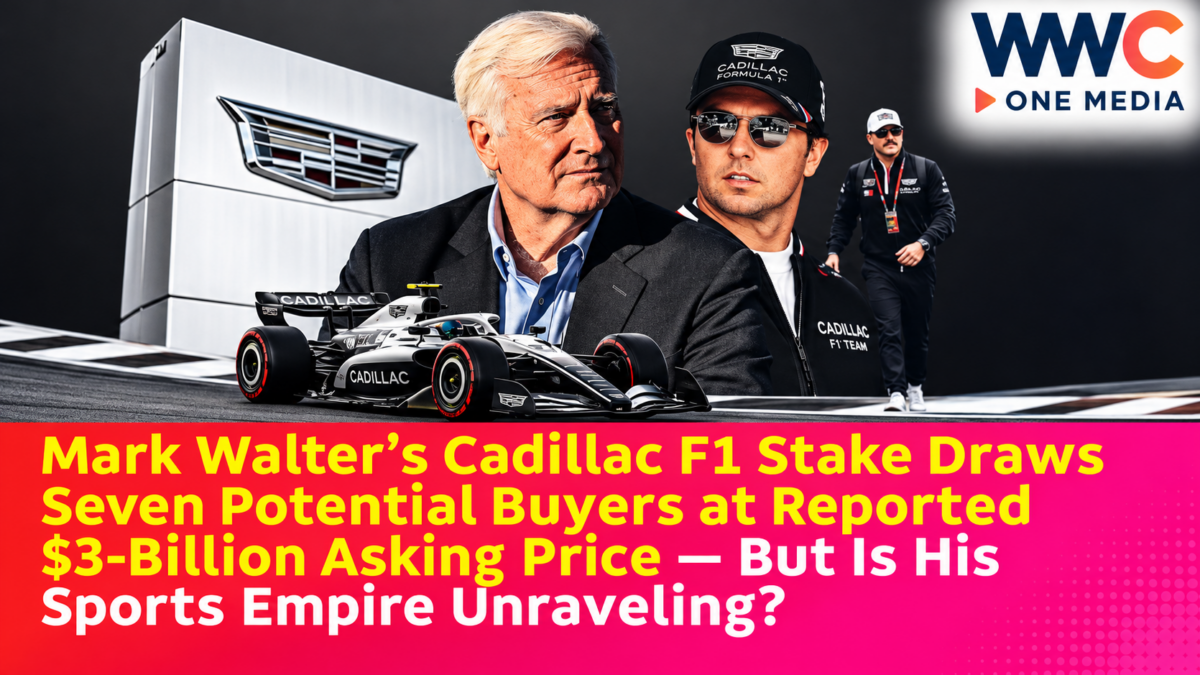
NEW YORK / MANILA — November 3, 2026. Billionaire sports investor Mark Walter is facing another major turning point in his multibillion-dollar sports empire as prospective buyers circle his controlling interest in the Cadillac Formula 1 team, potentially extending a series of asset sales involving some of the world’s most recognizable sporting franchises.
According to Bloomberg’s November 2 report, buyers have expressed interest in Walter’s stake in the newly established Formula 1 operation.
Separate reporting by Sportico indicates that Walter is seeking at least $3 billion for his interest in Cadillac F1, with at least seven potential buyers considering a transaction.
The development represents a dramatic reversal from August, when Walter’s investment group, TWG Global, publicly rejected reports that it was considering selling Cadillac or other motorsport holdings.
The latest speculation comes after Walter exited his Los Angeles Lakers ownership position and sold his interest in English football club Chelsea.
He is also reportedly exploring a sale of the WNBA’s Los Angeles Sparks.
The activity has attracted greater attention because Walter and companies connected to his financial empire are facing federal investigations and civil litigation involving alleged financial and disclosure irregularities.
Walter’s companies have denied wrongdoing and said they are cooperating with authorities.
The bigger question is whether the potential Cadillac sale represents an ordinary restructuring of a valuable sports portfolio — or another sign that financial pressure is reshaping one of America’s most ambitious sports ownership empires.
Cadillac F1 Attracts Buyers Just Months Into Its Debut Season
Cadillac entered Formula 1 in 2026 as the championship’s 11th team.
The operation was developed through a partnership involving General Motors and TWG Motorsports, an organization connected to Walter’s TWG Global investment group.
The project brought an American automotive brand onto the Formula 1 grid with the ambition of establishing a competitive long-term racing operation.
The team’s arrival followed a complicated approval process involving Formula 1’s commercial leadership, motorsport regulators and General Motors.
Cadillac secured its entry ahead of the 2026 season.
Its first campaign has involved experienced drivers Sergio Perez and Valtteri Bottas.
The team uses Ferrari power units while General Motors prepares to introduce its own Formula 1 engine program, currently targeted for 2029.
Those arrangements are important because they demonstrate that Cadillac is more than a licensing or branding project.
It is an ongoing motorsport business requiring engineering facilities, personnel, research, manufacturing capabilities and long-term capital commitments.
Even a change in ownership would not necessarily end the team’s racing operations.
But it could influence future investment decisions, corporate governance and strategic priorities.
Sportico Reports At Least Seven Interested Buyers
Sportico reported on November 2 that at least seven parties were interested in acquiring Walter’s Cadillac Formula 1 stake.
The publication cited unnamed people familiar with the situation.
Bloomberg separately reported that potential buyers had begun circling the team.
However, neither report establishes that a binding purchase agreement has been signed.
The identity of the potential bidders has not been conclusively verified in the reporting reviewed.
Nor has the exact percentage of Cadillac F1 ownership potentially available for purchase been publicly detailed.
The reported $3-billion-plus figure concerns Walter’s stake or the interest being marketed.
It should not automatically be described as an independently confirmed valuation of every ownership interest in the team.
The amount also remains an asking-price report, not a completed transaction price.
Any eventual deal could involve negotiations over valuation, ownership structure, voting rights, financing and approvals.
Until an agreement is announced, the outcome remains uncertain.
Why Cadillac’s Reported $3-Billion Asking Price Matters
Formula 1 teams have become increasingly attractive to investors as the sport expands its commercial reach.
Revenue opportunities include sponsorship agreements, broadcasting distributions, technical partnerships, merchandise and other commercial arrangements.
The championship’s popularity in the United States has also grown.
That increased attention has helped attract financial investors and business groups seeking exposure to high-profile global sporting assets.
Cadillac offers a distinctive opportunity because of its association with General Motors.
A buyer could gain exposure to a newly established American Formula 1 team with substantial branding potential.
But a franchise’s headline value is not the same as its annual profit.
Teams require continuous investment in engineering, drivers, staff, research and infrastructure.
Cadillac’s debut season is particularly expensive because the operation is still building the capabilities needed to compete against established teams.
Prospective buyers would therefore need to consider both the franchise’s potential long-term value and its near-term funding requirements.
TWG Previously Denied That Cadillac Was for Sale
The new reporting is especially significant because TWG Global previously issued a direct denial.
In August, the company said its Cadillac Formula 1 stake and other motorsport interests were not for sale.
Reuters reported the denial on August 20 and again covered TWG’s position on August 27.
The statements came as speculation intensified about Walter’s sports assets and federal investigations involving his financial businesses.
TWG also rejected suggestions that it was selling assets at distressed prices to obtain capital.
Its representatives emphasized that the company continued to see value in its sporting investments.
The November 2 reports indicate that potential buyers are now considering a transaction despite those earlier statements.
However, a change in reported circumstances is not proof that the August denial was false when issued.
Investment decisions can change.
And outside buyer interest does not necessarily establish that a company has formally initiated a sale process.
As of the reporting reviewed, TWG had not independently confirmed the reported $3-billion asking price or publicly announced a completed sale.
Walter’s Lakers Exit Was Valued at $12.5 Billion
The possible Cadillac transaction follows a major change in Walter’s basketball investments.
In August, Walter agreed to sell his Los Angeles Lakers ownership position in a transaction valuing the franchise at approximately $12.5 billion.
The buying group was led by investor Joshua Kushner and former Disney chief executive Bob Iger.
The transaction was remarkable because Walter had acquired majority ownership of the Lakers roughly a year earlier in a deal valuing the franchise at about $10 billion.
The reported valuation increase illustrates the enormous financial value attached to major professional sports teams.
But the $12.5-billion figure refers to the value of the franchise as a whole.
It does not mean Walter personally received that entire amount in cash.
His actual proceeds depend on the stake sold and the transaction’s financing and other terms.
The Lakers sale nevertheless became a key development in the restructuring of his sports holdings.
Chelsea Sale Adds Another Major Exit
Walter also sold his ownership interest in Chelsea Football Club.
The Premier League club had been controlled through a consortium involving Clearlake Capital, Todd Boehly and other investors.
In September, Clearlake moved to consolidate its ownership by purchasing the interests of Walter and Boehly.
The combined interests were reportedly valued at approximately £950 million.
WWC ONE MEDIA covered the development in Chelsea’s £950-Million Ownership Shake-Up Ends the Boehly Era — But Stamford Bridge Is Still the Biggest Decision.
The article examined the ownership transition and Chelsea’s continuing questions involving its stadium, finances and governance.
Walter’s Chelsea exit is significant because it shows that the reshaping of his sports portfolio extends beyond American franchises.
However, the circumstances of the Chelsea transaction should not automatically be treated as identical to the reported Cadillac situation.
Each asset has different partners, governance arrangements and contractual restrictions.
Los Angeles Sparks Could Be Next
Another potentially significant transaction involves the WNBA’s Los Angeles Sparks.
Bloomberg reported in October that Walter was exploring the sale of the franchise and its associated training facility.
The reported target price exceeded $700 million.
The proposal includes a new training complex in El Segundo, California, reportedly built at a cost of approximately $150 million.
The facility is expected to open ahead of the 2027 WNBA season.
A successful sale at the reported price would be notable for the growing valuation of women’s professional sports teams.
However, the transaction has not been confirmed as completed.
The potential asking price includes more than the basketball franchise alone.
It should therefore not be directly compared with standalone team valuations without accounting for the associated property and facilities.
The Sparks report adds to the impression that Walter is reconsidering several holdings acquired over many years.
Federal Investigations Add Pressure to Walter’s Financial Empire
The asset-sale developments are unfolding alongside scrutiny of Walter’s broader business operations.
Federal prosecutors and the Securities and Exchange Commission have been investigating financial relationships involving businesses associated with Walter, including insurance operations and investment-management entities.
Reporting by Reuters, Bloomberg and the Financial Times has described questions involving affiliated investments, disclosures and the use of assets connected to insurance policyholders.
WWC ONE MEDIA previously examined the investigations in Mark Walter’s Top Executives Give Prosecutors Firsthand Accounts — And the Investigation Is Reaching Deeper Into His Financial Empire.
The article explored reported testimony and interviews involving senior executives associated with Walter’s businesses.
These investigations are relevant because they may influence how investors assess his financial group and its access to capital.
However, the existence of investigations does not establish criminal liability.
TWG Global has denied wrongdoing and stated that its businesses have acted properly.
No finding of fraud against Walter should be presented as established solely on the basis of these reports.
The Insurance Business Is a Major Part of the Story
Walter’s financial holdings extend well beyond professional sports.
His business interests include asset management, insurance-related investments and private financial transactions.
The insurance operations have attracted particular scrutiny because insurers manage assets backing obligations to policyholders.
Regulators pay close attention to investments involving affiliated companies because such arrangements may create conflicts of interest.
The key questions involve whether investments are appropriately valued, disclosed and consistent with applicable rules.
Reuters previously reported that TWG was working with regulators on changes to certain insurance-related holdings.
The company also rejected claims that asset sales represented an emergency liquidation.
That distinction matters.
The timing of Walter’s sports sales and the investigations may be connected to broader capital-management decisions, but the reporting reviewed does not conclusively establish the financial motivation behind each transaction.
It would be inaccurate to state that prosecutors ordered Walter to sell Cadillac F1 or that proceeds from a prospective sale have been earmarked for a particular regulatory settlement.
No such completed order or arrangement was verified.
Is the Los Angeles Dodgers Franchise Also at Risk?
Walter remains closely associated with Major League Baseball’s Los Angeles Dodgers.
The franchise is one of the most valuable sporting assets in the United States.
Its success on the field and commercial strength have made it a central part of Walter’s ownership legacy.
Speculation has emerged about whether the Dodgers could eventually be sold as his wider sports portfolio changes.
However, Walter and TWG have repeatedly denied plans to sell the baseball club.
Reuters reported in August that TWG specifically said no Dodgers sale process had begun.
Walter also reiterated his commitment to retaining the team in recent comments reported by sports media.
That position remains important.
The potential sale of Cadillac F1 does not prove that the Dodgers are for sale.
The two businesses have different ownership structures and commercial circumstances.
Future plans may change, but speculation should not be reported as a confirmed Dodgers transaction.
Cadillac’s Sporting Results Remain a Challenge
The possible ownership change comes during Cadillac’s first season in Formula 1.
A new team faces substantial competitive obstacles.
Established teams have years of experience developing chassis, aerodynamic systems, race strategies and operational processes.
Cadillac has been building those capabilities while competing against manufacturers and teams with much longer histories.
Its 2026 campaign has been difficult.
The team has struggled to score championship points, and reliability and competitiveness remain significant challenges.
The presence of experienced drivers Sergio Perez and Valtteri Bottas gives the operation valuable knowledge.
But a competitive Formula 1 car depends on far more than driver ability.
It requires coordinated engineering, manufacturing, simulation, strategy and investment.
A prospective buyer would inherit both the commercial potential of the Cadillac brand and the cost of developing a stronger racing team.
Valtteri Bottas Brings Experience and Global Attention
Cadillac’s driver lineup is one of its principal assets.
Valtteri Bottas has extensive Formula 1 experience, including race victories during his time at Mercedes.
He has also attracted attention for his interests outside motorsport.
WWC ONE MEDIA covered one unusual episode in Valtteri Bottas Cycles 350km From Sepang to Singapore Ahead of F1 Grand Prix.
The report described Bottas’ long-distance cycling journey between race events.
The story illustrates how an established driver can generate publicity beyond race results.
For a new Formula 1 operation, recognizable drivers may help attract audiences and sponsors.
But popularity alone does not guarantee strong commercial results.
Cadillac still needs to improve its on-track performance and establish a durable competitive identity.
Cadillac’s Entry Is Already Affecting the Formula 1 Grid
The team’s arrival has changed the structure of the championship.
With Cadillac joining in 2026, Formula 1 expanded to 11 teams.
That creates additional competition for championship points, sponsors, technical personnel and commercial attention.
WWC ONE MEDIA previously covered an incident involving Cadillac during the Spanish Grand Prix in Carlos Sainz Hit With Home-Grand-Prix Penalty — Now He’ll Start the Spanish GP From 20th.
The report detailed how Williams driver Carlos Sainz received a penalty following an incident involving Cadillac’s Bottas.
Although unrelated to the ownership negotiations, it illustrates that Cadillac is already a fully participating competitor in Formula 1.
The team is subject to the same sporting regulations and competitive demands as other constructors.
Any ownership change would therefore take place within an active racing organization rather than a project that exists only on paper.
What Would a New Owner Actually Be Buying?
Potential buyers must evaluate several elements of Cadillac’s business.
The first is participation in Formula 1 itself.
Entry into the championship is valuable because opportunities to acquire an established team or secure a new grid place are limited.
The second is the team’s brand and relationship with General Motors.
The Cadillac name offers recognition beyond the racing community.
The third is its physical and technical infrastructure.
These assets include engineering facilities, personnel, development programs and operational arrangements.
The fourth is access to sponsorship and commercial revenue.
But prospective investors must also understand the costs and obligations.
A Formula 1 team requires sustained research and development, salaries, travel, equipment and manufacturing spending.
The sport’s financial regulations place limits on certain expenses, but they do not eliminate the substantial cost of operating a competitive organization.
Buyers would also need to evaluate contractual relationships with General Motors, power-unit suppliers and other partners.
Without the full ownership and financial agreements, no definitive assessment of the proposed stake’s value can be made.
Could a New Investor Accelerate Cadillac’s Progress?
A financially capable new owner could potentially provide additional resources or strategic expertise.
That may support the team’s infrastructure and long-term planning.
But an ownership transaction would not automatically improve performance.
Formula 1 success depends on technical development, team organization, regulatory compliance and the ability to attract skilled personnel.
Even substantial investment may take several seasons to produce results.
The 2026 season is still Cadillac’s first.
A new owner would need to decide whether to maintain the existing strategy or pursue changes in management and operations.
Any major restructuring could create opportunities but also disrupt the team’s development.
For fans, continuity may be as important as new capital.
What the Report Means for Formula 1’s Growing Commercial Value
Cadillac’s reported $3-billion asking price reflects the increasing financial appeal of Formula 1 franchises.
The sport has expanded its global audience, developed new markets and attracted investors who view teams as scarce entertainment assets.
A limited number of grid positions can increase the strategic value of ownership.
But scarcity does not guarantee profitability.
The value of a Formula 1 team is influenced by sponsorship contracts, commercial revenue distributions, competitive results and future growth expectations.
Buyers also consider the cost of maintaining operations and improving performance.
The reported interest in Cadillac shows that investors remain attracted to Formula 1 even when a team has yet to establish a successful competitive record.
However, there is no completed transaction proving that an investor is willing to pay the full reported asking price.
That remains a question for future negotiations.
What Happens Next?
The next development will be whether Walter or TWG Global formally confirms a sale process.
Potential buyers may seek detailed financial records and information about the team’s ownership agreements.
Any negotiations could also involve General Motors and other stakeholders.
The parties would need to determine the precise interest being transferred, the price and any governance changes.
Depending on the transaction structure, additional regulatory or motorsport approvals could be required.
The reported seven interested parties may not all proceed to formal bids.
Some could withdraw after reviewing the financial details.
Others may propose purchasing a smaller stake or arranging a partnership rather than a complete controlling-interest acquisition.
Until a definitive agreement is announced, the reported $3-billion figure remains a potential asking price rather than a realized transaction.
The Bigger Question: Is Walter Reshaping His Empire or Retreating From Sports?
Mark Walter’s sports holdings once appeared to be expanding across an extraordinary range of franchises and competitions.
His interests included the Dodgers, Lakers, Chelsea, the Sparks and Cadillac Formula 1.
Now several of those investments have been sold or are reportedly being considered for sale.
The transition is taking place while his financial businesses face regulatory and legal scrutiny.
But the motive behind each asset transaction must be evaluated carefully.
Walter’s companies have denied wrongdoing and rejected the idea of an indiscriminate sale of assets.
The latest reports show that potential buyers are interested in Cadillac F1.
They do not establish that a transaction has been completed or that the owner has been forced to sell.
For Formula 1, the situation demonstrates the growing commercial appeal of racing franchises.
For Walter, it raises broader questions about the future structure of his sports investment portfolio.
As at least seven prospective buyers reportedly examine Mark Walter’s Cadillac Formula 1 interest at an asking price of $3 billion or more, will the billionaire unlock another extraordinary sports valuation — or could the latest potential exit signal a much deeper transformation of his once-expanding sports empire?