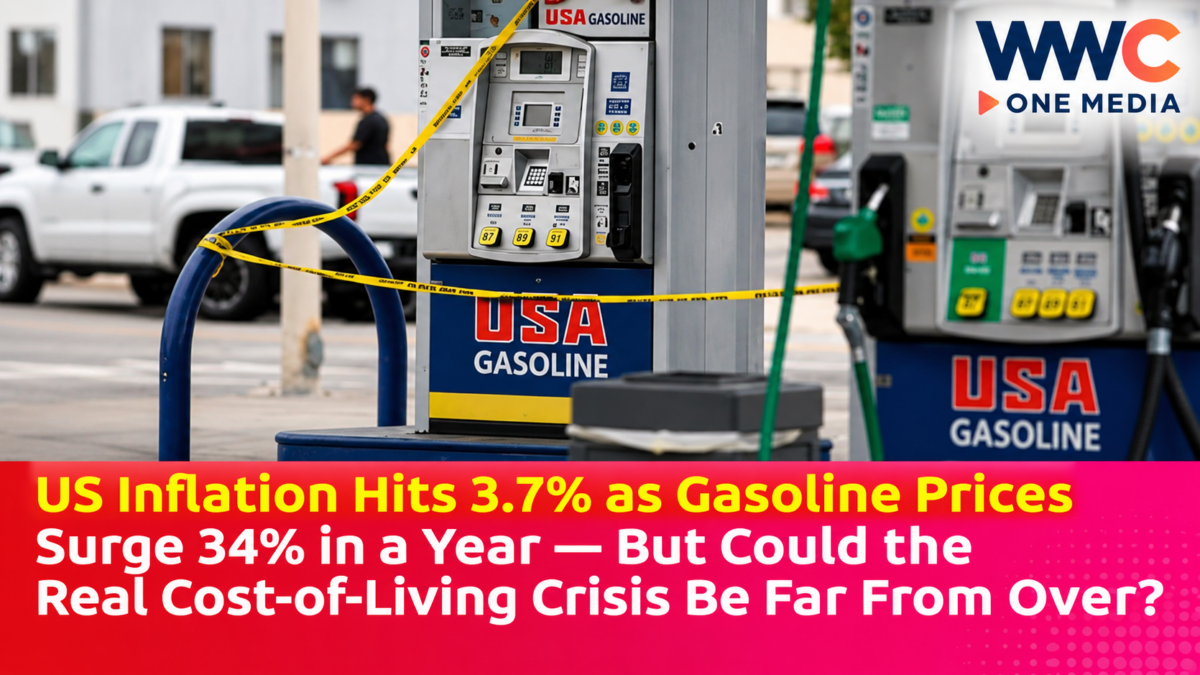
WASHINGTON / MANILA — November 3, 2026. American households are facing renewed financial pressure as consumer prices rise at their fastest annual pace in months, with gasoline, household energy and everyday necessities exposing the widening gap between official inflation statistics and the cost of maintaining a family’s standard of living.
The latest US Consumer Price Index report shows that overall prices increased 3.7% in September 2026 compared with a year earlier, accelerating from 3.4% in August.
The increase comes as higher energy costs, geopolitical instability and persistent price pressures complicate the Federal Reserve’s efforts to control inflation.
According to the US Bureau of Labor Statistics, energy prices jumped 20.4% over the preceding 12 months, while gasoline prices surged 34.2%.
Fuel oil recorded an even more dramatic annual increase of 74.2%.
Those increases help explain why many consumers continue feeling financially squeezed even when other categories experience slower inflation.
The numbers also expose an important economic reality.
A lower inflation rate does not necessarily mean that prices are falling. It usually means that prices are increasing more slowly.
With the United States heading into its November 3 midterm elections, inflation has again become a central issue for households, investors and policymakers.
But the larger question is whether America can contain rising living costs without forcing consumers and businesses to absorb another round of higher interest rates.
US Consumer Prices Rise at Fastest Pace in Months
The September 2026 Consumer Price Index showed renewed acceleration in American inflation.
Headline consumer prices rose 0.6% from August and 3.7% compared with September 2025.
The monthly increase followed a 0.4% rise in August.
Economists surveyed by Reuters had expected a 3.6% annual increase, meaning the actual reading exceeded the median forecast.
Much of the renewed pressure came from the energy sector.
According to official data, the energy index increased 5.2% during September alone.
Gasoline prices rose 9.1% on the seasonally adjusted monthly measure.
These figures demonstrate how quickly energy-market disruptions can influence consumer inflation.
But the price changes were not limited to gasoline.
Costs across several household spending categories continued increasing, although at different rates.
Energy Prices Are Driving a New Inflation Shock
The energy component of the Consumer Price Index has become a major source of concern.
September’s official annual figures showed:
- Energy prices increased 20.4%.
- Gasoline prices increased 34.2%.
- Fuel oil prices increased 74.2%.
- The broader motor-fuel category increased 34.9%.
These increases have consequences far beyond the cost of filling a car’s fuel tank.
Businesses use energy to transport goods, operate equipment, heat buildings and deliver services.
Higher energy expenses can therefore affect supply chains and production costs.
Companies may absorb some of those increases through lower profit margins.
Others may eventually pass additional expenses on to consumers.
The extent of those effects depends on competition, contracts, demand and individual business conditions.
Higher oil prices do not automatically cause every product to rise by the same percentage.
Nevertheless, elevated energy costs can make it more difficult for inflation to return toward central-bank targets.
WWC ONE MEDIA previously examined the threat in US Inflation Set to Surge as Gasoline Prices Climb — But a Bigger Fed Interest Rate Shock Could Be Coming.
The report explored how higher gasoline prices were influencing expectations for US inflation and Federal Reserve policy.
Why the Price Index Matters More Than One Headline Number
The Consumer Price Index measures changes in the average prices paid by consumers for a representative basket of goods and services.
That basket includes categories such as food, shelter, transportation, energy, healthcare and recreation.
Each category carries a weight based on its estimated share of consumer spending.
Consequently, a sharp price increase in a heavily weighted category can have a significant influence on headline inflation.
However, the CPI is an aggregate measure.
It does not mean every household experiences exactly the same rate of inflation.
Someone who drives long distances may be affected more heavily by gasoline prices.
A household with large rent expenses may be more sensitive to shelter costs.
Families with different consumption patterns can therefore experience different changes in their actual living expenses.
A detailed price index provides a more complete picture than the headline inflation rate alone.
It allows readers to examine which categories are contributing most to rising costs and which are experiencing slower increases or actual declines.
Food Inflation Remains a Household Concern
Food prices continued increasing during September, although less sharply than energy prices.
The Bureau of Labor Statistics reported that the overall food index rose 2.5% from a year earlier.
Food purchased for home consumption increased 1.8%.
Restaurant and other food-away-from-home prices rose 3.5%.
These different figures illustrate why food inflation can vary according to spending habits.
A household that frequently eats outside the home may experience different cost increases from a family purchasing most meals at grocery stores.
Some categories also moved in opposite directions.
Dairy-product prices declined 0.7% over the year.
Meat, poultry, fish and egg prices recorded a relatively modest 0.3% annual increase.
Fruits and vegetables, meanwhile, rose 3.7%.
These differences are important because the headline food inflation rate can conceal substantial variation between individual products.
For consumers, actual grocery spending depends on which products they buy and how their purchasing patterns change.
Falling Inflation Does Not Mean Prices Return to Earlier Levels
One of the most common misunderstandings about inflation concerns the difference between prices and the inflation rate.
Suppose a household spent $100 on a basket of goods in one year.
If prices rose 10%, that basket would cost $110 the following year.
If inflation subsequently slowed to 3%, the same basket would cost $113.30, assuming the basket and price measurement remained comparable.
The inflation rate would have declined sharply, but the price level would still be higher.
That distinction explains why consumers can continue feeling financial pressure even after inflation moderates.
To return prices to their original level, the economy would need an actual decline in the price index, known as deflation, or specific price declines in the goods the household purchases.
Sustained deflation across the economy can also create economic problems, particularly when consumers delay spending and debt burdens become harder to manage.
Central banks generally seek low and stable inflation rather than permanent declines in the overall price level.
Core Inflation Suggests Underlying Pressure Has Not Disappeared
Economists also examine core inflation, which excludes food and energy because those categories can experience particularly large short-term price movements.
In September, US core CPI rose 0.3% from the previous month.
Its annual rate increased to 2.6%, compared with 2.4% in August.
The increase indicates that price pressures were not entirely restricted to energy markets.
However, core CPI should not be confused with the Federal Reserve’s preferred inflation measure.
The central bank formally targets 2% inflation using the Personal Consumption Expenditures Price Index.
The PCE index differs from CPI in its category weights, coverage and calculation.
That distinction matters when comparing official inflation statistics with monetary policy decisions.
The Federal Reserve considers multiple economic indicators, including core inflation, employment, wages, economic growth and financial conditions.
A single CPI report can influence expectations, but it does not determine monetary policy on its own.
Federal Reserve Faces Another Difficult Interest Rate Decision
Rising inflation has complicated the Federal Reserve’s attempt to balance price stability with economic growth.
Higher interest rates can reduce borrowing and spending, which may help ease inflationary pressures.
However, tighter monetary policy also increases the cost of credit for businesses and consumers.
Mortgage borrowers, companies financing expansion and households using variable-rate loans may be particularly sensitive to higher rates.
In September, the Federal Reserve increased its benchmark interest-rate target range by 25 basis points to 3.75%–4.00%.
The decision marked a significant shift after an earlier period of easing.
The higher-than-expected September inflation reading subsequently strengthened concerns that additional monetary tightening could become necessary.
But further rate increases are not guaranteed.
The outlook depends on new inflation reports, economic activity, labor-market conditions and the Federal Reserve’s assessment of future risks.
For consumers, the central challenge is that controlling inflation through interest rates can involve a financial cost of its own.
Producer Prices Signal Pressure Beyond Consumer Energy Bills
Consumer prices are not the only indicator of inflation.
The US Producer Price Index measures changes in prices received by domestic producers.
According to the Bureau of Labor Statistics, producer prices increased 1.3% in September, the largest monthly rise since March 2022.
The index was 6.3% higher than a year earlier.
Reuters reported that the increase was the largest annual gain since December 2022.
The producer-price surge suggests businesses were confronting rising costs and prices across a range of goods and services.
However, producer prices do not translate mechanically into consumer prices.
Companies may reduce margins, change sourcing arrangements or adjust product prices over time.
Some price increases may also be absorbed elsewhere in the supply chain.
Nevertheless, persistent producer-price pressure can complicate the outlook for consumer inflation.
The Middle East Conflict Has Complicated the Inflation Outlook
International energy markets have become a major factor in the US inflation debate.
The conflict involving Iran has disrupted oil shipments and increased uncertainty around the Strait of Hormuz.
The waterway is a strategically important route for global petroleum exports.
Threats to shipping can increase insurance costs, transport expenses and the perceived risk of future supply shortages.
These developments have contributed to volatile crude oil and refined-product prices.
A lasting diplomatic settlement could reduce some of that pressure.
However, a temporary decline in crude prices does not necessarily translate into an immediate reduction in consumer energy costs.
Retail gasoline prices depend on refining, distribution, taxes, inventories and regional supply conditions.
The latest inflation data therefore demonstrate how international geopolitical events can influence the financial circumstances of households far from the conflict itself.
The Cost-of-Living Crisis Is Also Hitting the Philippines
Although US and Philippine inflation are measured using separate consumer price indexes, both countries are experiencing pressure from higher living costs.
According to the Philippine Statistics Authority, annual headline inflation reached 7.2% in September 2026, up from 6.1% in August.
Food and non-alcoholic beverages increased 6.7% year on year.
Transportation inflation reached 14.6%.
Prices in the housing, water, electricity, gas and other fuels category rose 8.4%.
The figures show that Philippine households are facing particularly strong pressures involving essential expenses.
WWC ONE MEDIA examined the risks in Philippines Faces Broader, Stickier Inflation Wave as Food, Fuel and Labor Costs Rise.
The report highlighted the possibility that higher operating costs and transportation expenses could affect broader categories of consumer spending.
The Philippine experience is not identical to that of the United States.
Exchange rates, local food production, energy-import dependence, wage conditions and monetary policy differ.
Nevertheless, the two economies illustrate how energy shocks can influence consumer prices across international markets.
Philippine Inflation Could Reach 8.1% in October
Philippine policymakers are also preparing for another potentially difficult inflation reading.
On October 30, the Bangko Sentral ng Pilipinas forecast that annual inflation for October could range from 7.1% to 8.1%.
The forecast reflects higher electricity prices, transportation fares and fuel costs.
Lower prices for selected agricultural products could partially offset those pressures.
WWC ONE MEDIA explored the latest warning in Philippine Inflation Could Hit 8.1% as Fuel, Electricity and Transport Costs Surge — But Will the BSP Be Forced Into Another Rate Hike?.
The upper end of the BSP’s estimate would represent a further acceleration from September.
However, the 8.1% figure is a forecast, not an official October inflation result.
The Philippine Statistics Authority is scheduled to release the actual October data on November 5.
The distinction between a forecast and a confirmed statistic is essential for accurate reporting.
BSP’s Rate Increase Adds to Borrowing Pressure
The Philippines has already responded to elevated inflation through tighter monetary policy.
On October 22, the Bangko Sentral ng Pilipinas raised its benchmark policy interest rate by 50 basis points to 5.50%.
The increase exceeded economists’ expectations for a smaller adjustment.
WWC ONE MEDIA previously covered the decision in BSP Stuns Markets With a 50-Basis-Point Rate Hike — What Happens Next to Loans, Prices and the Peso?.
The rate increase was intended to help contain inflation expectations and reduce the risk of persistent price pressures.
For borrowers, higher policy rates can influence loan costs, although the impact depends on individual contracts and bank pricing decisions.
For businesses, tighter credit conditions can affect investment and working-capital expenses.
For households, the combination of higher consumer prices and more expensive borrowing can create additional financial strain.
The BSP faces a challenge similar to that confronting the Federal Reserve: restoring price stability without unnecessarily weakening economic growth.
Why Climate Risks Could Make Food Inflation Worse
Energy prices are not the only source of inflation uncertainty.
Agricultural production remains vulnerable to extreme weather.
Droughts, flooding and prolonged heat can damage crops, reduce yields and disrupt food transportation.
The Philippines faces additional concern over a potentially strong El Niño event affecting agricultural output and water supplies.
WWC ONE MEDIA examined the issue in El Niño Emerges as Biggest Threat to Philippine Inflation as Prices Surge.
The report explained how weaker harvests could influence rice, vegetables and other household necessities.
However, weather forecasts do not establish that specific food-price increases will occur.
The eventual impact depends on rainfall conditions, crop production, imports, inventories and policy responses.
The risk nevertheless reinforces why inflation cannot always be controlled through interest rates alone.
What Consumers Should Watch in the Next Inflation Reports
The next US inflation reports will help show whether September’s acceleration was temporary or part of a more persistent trend.
Economists will be watching energy prices, core inflation and changes in major household spending categories.
Producer prices may also provide clues about cost pressures affecting businesses.
For the Philippines, the November 5 inflation release will establish whether October’s official rate accelerated further.
The details will matter as much as the headline.
Food inflation, transportation expenses and utility costs may move differently.
The most useful way to understand inflation is therefore to look beyond a single percentage.
Consumers should distinguish between annual price changes, monthly movements and cumulative increases over several years.
A high inflation rate signals rapid price growth.
A lower inflation rate signals slower price growth.
Actual price declines require a different outcome.
The Bigger Question: When Will Households Finally Feel Relief?
The latest inflation figures reveal why the cost of living remains a major economic concern.
In the United States, overall consumer prices increased 3.7% year on year in September.
Energy prices rose more than 20%, with gasoline prices increasing approximately 34%.
Producer prices also accelerated, indicating substantial pressure across parts of the economy.
In the Philippines, September inflation reached 7.2%, while policymakers warned that October inflation could climb even higher.
Both countries face the challenge of managing energy shocks, household expenses and borrowing costs.
Central banks can respond through interest rates, but they cannot directly resolve every supply disruption or geopolitical risk.
For consumers, meaningful financial relief will depend on a combination of lower price pressures, stronger incomes, stable energy markets and effective economic policy.
As America’s inflation rate reaches 3.7% and gasoline prices climb more than 34% in a year, will the world’s largest economy find a path back to affordable living — or could higher energy costs, stubborn inflation and another Federal Reserve rate increase deliver a new financial shock to households and businesses?