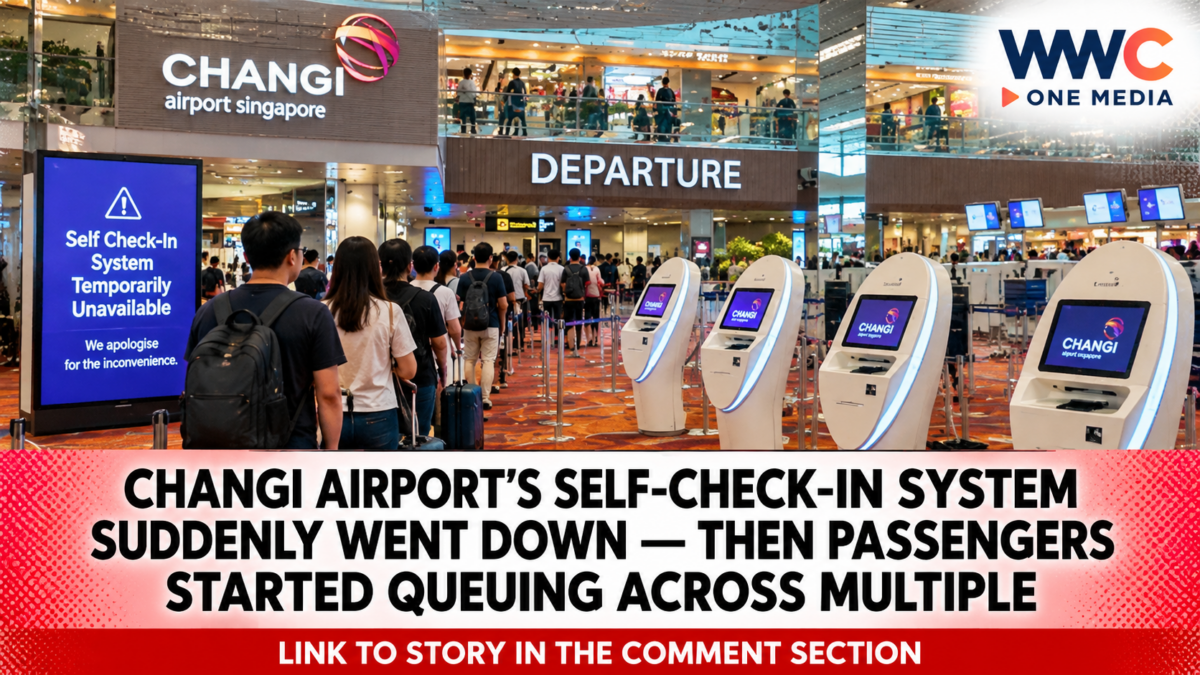
A global disruption to Advance Passenger Processing systems temporarily knocked out some self-service check-in kiosks at Changi Airport, forcing affected airlines to process passengers manually. No flights were reported delayed because of the incident.
SINGAPORE — Travellers arriving at Changi Airport on Nov. 2 expecting a quick trip through automated check-in instead found themselves facing queues after a global systems disruption temporarily affected self-service check-in facilities across the airport.
The disruption began at about 8.30am and affected some airlines at multiple terminals, preventing some passengers from completing self-service check-in or printing their boarding passes.
Changi Airport Group (CAG) said the problem was caused by a global disruption to Advance Passenger Processing (APP) systems, adding that airports elsewhere were also affected.
Affected airlines switched to manual check-in procedures while airport ground staff assisted passengers.
CAG said check-in services for all affected airlines returned to normal at around 11am, meaning the disruption lasted at least two and a half hours.
It wasn’t a full Changi Airport shutdown
Despite the images of queues and inactive kiosks circulating from the airport, Changi itself did not shut down.
The disruption affected some airlines and some self-service check-in functions, rather than every passenger at every terminal.
The Straits Times reported that Singapore Airlines’ self-service kiosks at Terminal 3 appeared to be functioning normally during its morning checks.
At Terminal 2, most automated kiosks were also operating when reporters visited around 1.30pm.
This distinction is important for travellers because describing the incident as a “Changi Airport outage” or “airport shutdown” would give the wrong impression.
The problem was more specific: a global disruption involving the passenger-processing system used by airlines affected the ability of some carriers to complete automated check-in procedures.
What is Advance Passenger Processing?
Advance Passenger Processing, or APP, is part of the information systems used by airlines to transmit and validate passenger information for border-control and travel-authorisation purposes.
When the system is unavailable, airlines can face difficulties completing the normal automated processing required during check-in.
That helps explain why some passengers could not simply use the kiosk and continue on their way.
Instead, airline staff had to take over parts of the process manually.
Lianhe Zaobao reported that APP normally allows airlines to transmit passengers’ passport and travel information for real-time checks related to border-control and travel requirements.
The outage was therefore more than a simple broken kiosk screen.
The kiosks were one visible part of a wider system problem.
Multiple terminals were affected
The disruption was visible in several parts of Changi Airport.
At Terminal 3, The Straits Times observed that Garuda Indonesia’s automated check-in kiosks were not operating during its morning visit.
Passengers travelling on Garuda Indonesia flight GA829 to Jakarta were directed into another queue.
The flight was scheduled to depart at 11.45am.
Importantly, the flight ultimately departed as scheduled, and The Straits Times’ check of Changi’s flight information showed no flights delayed because of the kiosk disruption.
At Terminal 4, some self-service kiosks serving Korean Air, Cathay Pacific and Sun PhuQuoc Airways were also reported to be unavailable.
At one point, passengers had to use manned check-in counters instead.
Meanwhile, most automated check-in facilities at Terminal 2 were operating normally later in the day.
Xiamen Airlines passengers faced one of the longest queues
One of the clearest signs of the disruption appeared at Terminal 1.
After 12.45pm, a queue involving roughly 50 Xiamen Airlines passengers stretched toward the terminal’s drop-off area.
Passengers were waiting to complete check-in and baggage procedures manually.
The airline had four to five regular manned counters operating, along with two counters for SkyPriority passengers.
One family told The Straits Times that they waited about 35 minutes at the check-in counter.
Their flight to Fuzhou via Xiamen Airlines was scheduled for 3.30pm, giving them several hours before departure.
The situation demonstrates how even a relatively short technology disruption can produce visible congestion when automated systems are replaced by manual processing.
Scoot experienced about 45 minutes of disruption
Scoot was another airline affected by the incident.
The low-cost carrier said its check-in services at Terminal 1 experienced a disruption lasting about 45 minutes on the morning of Nov. 2.
The airline deployed additional staff at manned check-in counters to assist passengers.
Check-in operations subsequently resumed and its self-service kiosks were restored.
8world reported that one Scoot passenger was given a printed slip from the kiosk directing her to complete check-in at a manned counter.
She reportedly waited about 10 to 15 minutes and said staff were helpful in resolving the issue.
Other airlines were affected too
Reports identified disruptions involving several airlines, including:
- Cathay Pacific
- Korean Air
- Scoot
- Xiamen Airlines
- Garuda Indonesia
- Sun PhuQuoc Airways
- China Southern Airlines
The extent of the disruption differed by airline and terminal.
Some carriers were able to restore their automated systems relatively quickly, while others continued using manual counters for longer.
The Straits Times also observed SITA personnel troubleshooting affected kiosks.
SITA is a global aviation technology provider that supplies IT infrastructure, data-network and communications services to airlines.
Passengers were worried — but flights kept moving
The biggest concern for many travellers was whether the check-in disruption would cause them to miss their flights.
One passenger interviewed by The Straits Times said he was unsure whether he would make his flight because the queue was moving slowly.
His flight was scheduled to depart about 90 minutes later.
However, the flight ultimately departed on schedule.
That is an important part of the story.
The kiosk disruption created queues and inconvenience, but available reporting does not show that it caused flight delays at Changi Airport.
CAG said ground staff were deployed to help airlines and passengers during the disruption.
This wasn’t the first major technology disruption at Changi
The latest incident may remind some travellers of the much larger global IT outage that hit airports around the world in July 2024.
That earlier incident affected airlines and airport systems globally and caused long queues at Changi, with some airlines forced to manage check-in manually.
CNA reported at the time that passengers faced lengthy queues at Changi’s terminals while airport staff assisted travellers affected by the global IT disruption.
The difference is significant.
The Nov. 2, 2026 disruption was linked specifically to a global APP systems disruption, whereas the 2024 incident involved a much broader technology outage affecting organisations around the world.
The two incidents should therefore not be treated as the same event.
Changi is becoming increasingly dependent on automation
The incident also highlights a broader transformation taking place at airports.
Self-service check-in, automated baggage handling, biometric processing and digital travel documents have become increasingly important parts of the passenger journey.
Changi has invested heavily in automated systems designed to reduce queues and make airport processing more efficient.
But the Nov. 2 disruption demonstrated the flip side of that convenience.
When an underlying system fails, passengers can quickly be pushed back toward traditional manned counters.
The technology may make everyday travel faster, but it also means a disruption can have consequences across multiple airlines and terminals.
Changi’s digital passenger journey keeps expanding
The airport’s reliance on digital systems extends beyond check-in.
Singapore has also been upgrading its digital arrival procedures.
WWC One Media previously reported on the enhanced MyICA Singapore Arrival Card, which introduced additional languages and passport-scanning functionality designed to make pre-arrival submissions easier for travellers.
READ MORE: Travellers Reminded to Update MyICA App for Enhanced Singapore Arrival Card
These systems are designed to reduce paperwork and improve passenger flow.
But the Changi incident illustrates why reliable infrastructure and contingency procedures remain equally important.
The airport is also dealing with rising passenger demand
Changi’s technology systems are being used against the backdrop of strong international travel demand.
VnExpress reported that Changi handled 17.4 million passengers in the third quarter of 2026, up 0.4 per cent year on year.
That makes the reliability of automated passenger-processing infrastructure increasingly important because even a relatively short disruption can create queues when large numbers of travellers are moving through the airport.
Changi was also named the world’s best overall airport in the 2026 World Airport Awards, according to VnExpress.
The latest disruption therefore stands out precisely because it affected an airport widely recognised for its efficiency and technology.
Changi has faced other recent passenger disruptions
The airport has dealt with other unexpected incidents in recent months.
WWC One Media previously reported on a volcanic-ash disruption that affected Singapore-Jakarta flights in September.
In that case, Changi Airport itself did not close. Instead, flights were cancelled because Jakarta’s Soekarno-Hatta International Airport was unable to safely handle aircraft affected by the volcanic ash situation.
That distinction again shows why airport disruption headlines need to be precise.
A flight disruption involving Changi does not necessarily mean Changi Airport itself has closed.
Other recent Changi stories have focused on security
Changi has also been dealing with issues unrelated to flight operations.
In October, WWC One Media reported on Singapore actor and singer Glenn Yong’s concerns about an airport security frisking experience.
Changi Airport confirmed that it was aware of his social-media posts and said it was looking into the matter.
READ MORE: Glenn Yong Raises Concerns Over Uncomfortable Frisking Experience at Changi Airport
The incident was separate from the Nov. 2 technology disruption, but both stories involve an increasingly important part of the modern airport experience: how passengers interact with increasingly complex systems while travelling through one of the world’s busiest aviation hubs.
Changi is also expanding its international network
At the same time, the airport continues to expand its connectivity.
Singapore Airlines recently returned to Madrid after more than two decades, with the new service operating through Barcelona.
That expansion means more passengers, more airlines and more digital processing systems operating within the same airport ecosystem.
The greater the connectivity, the greater the importance of resilient technology.
What passengers should take away from the outage
The Nov. 2 disruption has already been resolved, according to CAG.
Travellers should therefore not interpret the incident as an ongoing airport-wide outage.
The main lesson is instead that automated check-in is not always guaranteed to be available.
When systems fail, passengers may be redirected to manned counters and could face longer queues.
For that reason, travellers with an imminent departure should continue to check their airline’s official flight information and allow sufficient time for airport procedures.
The bigger question is what happens when the next outage hits
Changi Airport’s latest disruption lasted only a few hours.
But it showed how quickly a global technology problem can move from an invisible systems issue to a very visible passenger problem.
A few lines of failed code or an unavailable backend service can translate into dozens of manual counters, longer queues and anxious passengers watching the clock.
The airport recovered.
The affected airlines restored their services.
And, based on available reporting, no flights were delayed because of the disruption.
But the incident offers a reminder that the future of air travel is increasingly digital — and when the digital systems fail, airports still need people ready to step in.
For the passengers who arrived at Changi on Monday morning expecting a seamless self-service journey, that fallback was the difference between an inconvenience and a much bigger travel disruption.