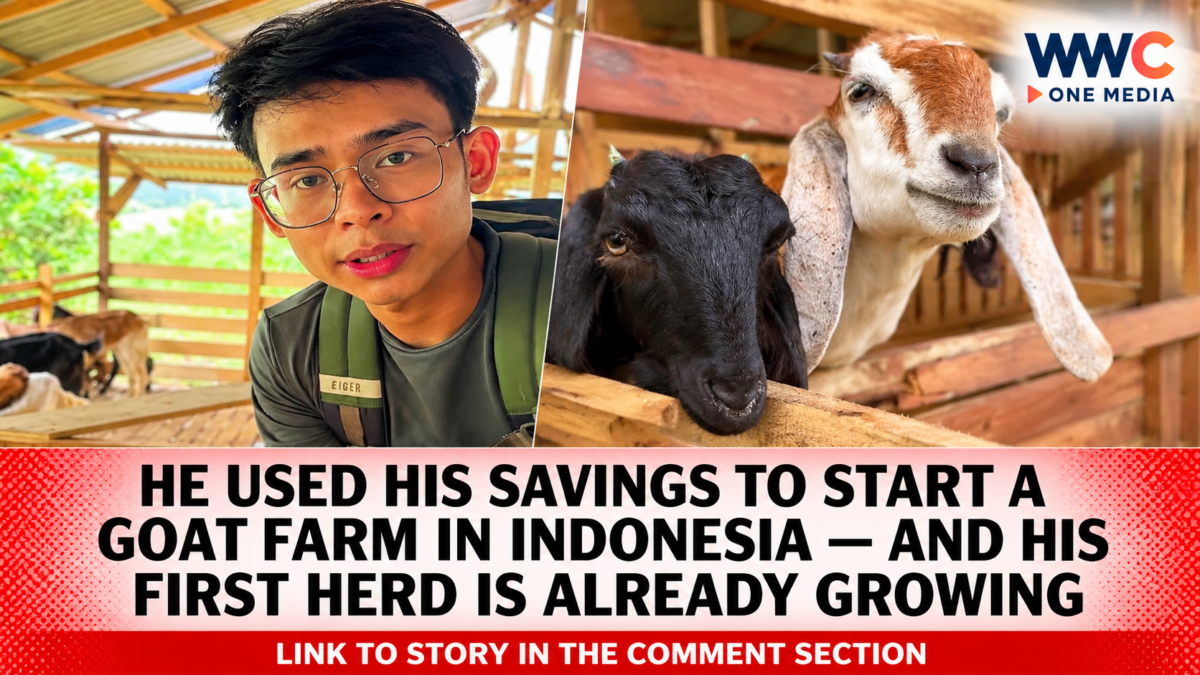
A 28-year-old Singaporean with no previous livestock-farming experience has turned an unexpected opportunity in West Kalimantan into a new cross-border business — starting with about 40 goats and a personal financial gamble.
SINGAPORE — For most people, an unused piece of land in Indonesia might be easy to overlook.
For Muhammad Hakim Roslee, it became the starting point for a completely new career direction.
The 28-year-old Singaporean has used his personal savings to help establish a goat-farming business in West Kalimantan, Indonesia, despite having no prior experience in livestock farming.
The venture, called The Shepherd Council, began operating in late August after Hakim and his partners spent about two months preparing the site, sourcing construction materials, comparing prices and hiring workers.
The story was first reported by AsiaOne and subsequently detailed by Singapore’s Berita Harian, which interviewed Hakim about his motivations, business plans and the challenges of running a farm across national borders.
From Singapore’s Pasir Ris to a goat farm in Kalimantan
Hakim works as a digital engagement officer at Masjid Al-Istighfar in Pasir Ris.
His move into farming began in early June, when a friend told him that a driver in Indonesia had an unused plot of land that could potentially be developed into a goat farm.
The opportunity came at a time when Hakim had already been thinking about starting a business.
Rather than waiting until he had extensive farming experience, he decided to learn along the way.
He partnered with his friend and an Indonesian business partner to develop the operation, although he has not disclosed how much of his personal savings was invested.
His parents were initially concerned about the decision to start a business overseas. According to Berita Harian, they became more supportive after he explained his plans and the purpose behind the venture.
Hakim also said that seeing young Malay/Muslim entrepreneurs share their business journeys on TikTok encouraged him to try something outside his usual field.
The farm currently has about 40 goats
The Shepherd Council’s first herd consists of roughly 40 goats.
About 15 adult goats are being prepared for aqiqah, a religious practice associated with the birth of a child.
Another 25 young goats are being raised for eventual sale for korban, the Islamic sacrificial ritual associated with Hari Raya Haji.
The business expected to officially launch its aqiqah service in November, according to the Berita Harian report published on Nov. 1, 2026.
Hakim handles marketing and digital content for the venture.
His Singaporean partner focuses on business planning and logistics, while their Indonesian partner oversees the farm’s daily operations and livestock care.
That division is particularly important because Hakim is not permanently based at the farm.
He plans to travel to Indonesia several times a year, particularly before Hari Raya Haji, to monitor the operation.
Why the religious livestock market matters
The business is entering a market that already connects Singaporean consumers with livestock farms in neighbouring countries.
In May 2026, The Straits Times reported that increasing numbers of Singaporean Muslims were travelling to Johor to participate in korban, with livestock operators describing a rise in demand from Singaporean customers.
One Johor goat farm reported about 300 Singaporean korban bookings during the four-day Hari Raya Haji period in 2026, while the farm’s owner said demand from Singaporeans had increased by about 20 per cent over the previous five years.
The trend is not limited to Johor.
Singapore’s korban system has also historically relied heavily on overseas livestock and slaughter arrangements.
In 2025, thousands of overseas korban orders were placed through Singapore’s mosque network, with livestock commonly handled overseas before meat was chilled, packed and transported to Singapore.
That wider ecosystem provides context for why a farm supplying goats for aqiqah and korban could see an opportunity in the regional market.
But Hakim’s venture is still at an early stage.
Farming across borders is not an easy shortcut
The business faces practical challenges that go far beyond raising goats.
Hakim told Berita Harian that animal feed and livestock purchases are among the major operating expenses.
Cross-border money transfers can sometimes be delayed, while differences in dialect and language can create misunderstandings when discussing operational matters.
The farm has also been affected by haze in Kalimantan.
The Indonesian team has responded by taking precautions and providing medication and healthcare to keep the animals healthy.
Those challenges highlight an important reality: starting a farm overseas may provide access to land and different operating conditions, but it also introduces another layer of logistical and management risks.
Hakim isn’t the only Singaporean looking overseas for farmland
His story comes as other Singaporeans increasingly explore farming opportunities outside the tightly land-constrained city-state.
A Channel NewsAsia report in April 2026 profiled Singaporeans who had moved into farming in Johor, Malaysia.
One example was Imran Aljunied, co-founder of A Little Wild, a 55-hectare farm that produces crops including pineapple, banana, cocoa, pepper and lemongrass.
CNA reported that several Singaporeans had ventured into rural Johor because of cheaper land, larger available plots and the opportunity to build businesses of their own. Its reporting identified at least six Singaporean-owned farms in rural parts of Johor, although there are no official statistics covering the total number.
The broader agricultural shift has also attracted attention from investors and agritech companies.
The Straits Times reported in January 2026 that Singapore farmers were looking to Johor for cheaper land and energy, including through plans connected to the Johor-Singapore Special Economic Zone.
Hakim’s goat farm is different in scale and location, but it fits into this broader regional pattern: Singapore-based entrepreneurs are looking beyond the island for agricultural opportunities that are difficult to pursue at home.
The timing also comes with a food-security angle
Singapore imports the vast majority of its food, making supply resilience an important national issue.
That is why developments in regional agriculture matter beyond individual businesses.
WWC One Media has previously reported on Singapore’s efforts to strengthen food-supply resilience, including an exercise in which the Singapore Food Agency tested the movement of emergency food stocks from warehouses to retail outlets.
Related WWC One Media coverage:
Singapore Tests Emergency Food Supplies as SFA Prepares for Major Disruptions
Singapore has also continued expanding domestic food production. In September 2026, the country’s fourth egg farm broke ground on a S$110 million project expected to begin production in 2028.
Related WWC One Media coverage:
Singapore’s Fourth Egg Farm Finally Breaks Ground — And It Could Change the Country’s Egg Supply
The contrast is notable: while Singapore invests in producing more food within its limited land area, individual entrepreneurs are also looking outward to neighbouring countries where larger agricultural spaces are available.
The haze connection adds another layer
Hakim’s farm is located in Kalimantan, a region that has been affected by recurring haze episodes.
That does not mean his business is connected to the causes of Indonesia’s forest fires. His report specifically describes the farm as being affected by haze rather than causing it.
The distinction is important.
WWC One Media has extensively covered the 2026 regional haze crisis, including the impact of smoke from Indonesian fires on Singapore’s air quality.
Related WWC One Media coverage:
Singapore’s Haze Crisis Spikes as PSI Turns Unhealthy — But the Smoke Threat From Indonesia May Not Be Over
Another WWC report examined Singapore’s investigation into companies potentially connected to Indonesia’s fires, highlighting how complex cross-border environmental issues can become.
Related WWC One Media coverage:
Indonesia Fires Trigger Major Singapore Investigation — What Authorities May Uncover About the Companies Behind the Haze
These developments provide important regional context for any Singaporean entrepreneur operating an agricultural business in Indonesia.
His bigger goal goes beyond selling goats
For Hakim, the farm is not simply about livestock.
He told Berita Harian that his long-term ambition is to build a successful business that can give him greater financial independence and allow him to spend more time on dakwah, or Islamic outreach, without depending entirely on income associated with that work.
He also hopes eventually to expand the number of goats and supply livestock to other religious teachers who provide aqiqah and korban services.
That means the current herd of roughly 40 goats could eventually become the foundation of a much larger operation.
But for now, the business is still proving itself.
There is no guarantee that a small livestock operation will become profitable, and Hakim has not publicly disclosed the amount of his initial investment or projected revenue.
What is clear is that he has chosen a very different route from the conventional Singapore career path.
He started with an unused plot of land, a small herd, business partners and a willingness to learn a completely unfamiliar industry.
And if The Shepherd Council succeeds, those first 40 goats could end up being only the beginning.