MANILA, Philippines — October 31, 2026
A Filipino artisan-gift supplier’s public complaint against two government agencies has triggered official responses, raising questions about how quickly small businesses are paid for goods commissioned for major international events.
AmiananPH, a business working with artisans in Northern Luzon, accused the Commission on Higher Education (CHED) and Department of Energy (DOE) of rushing orders for ASEAN-related activities without making advance payments.
The supplier alleged that CHED had failed to settle an obligation for approximately nine months, while its DOE transaction remained unpaid weeks after delivery.
But the dispute has since taken an important turn.
The DOE announced on October 30 that it had completed payment processing and delivered a check to AmiananPH. The agency maintained that payment was made within the 30-working-day period specified in its procurement terms.
Meanwhile, CHED Chairperson Shirley Agrupis pledged to personally oversee a review of the separate transaction handled by CHED Regional Office IV.
The developments, reported by Bilyonaryo, Interaksyon, Daily Tribune and DZRH, have shifted attention from the supplier’s original complaint to a wider question about government procurement.
If small businesses are expected to meet urgent public-sector deadlines, should they also have greater certainty about when they will be paid?
“Ni Piso Walang Downpayment”: Supplier Takes Complaint Public
AmiananPH raised its concerns through social media posts on October 29, saying government agencies had pressed the business to complete handcrafted souvenir orders for ASEAN-related activities.
The company said it had financed production without receiving advance payments.
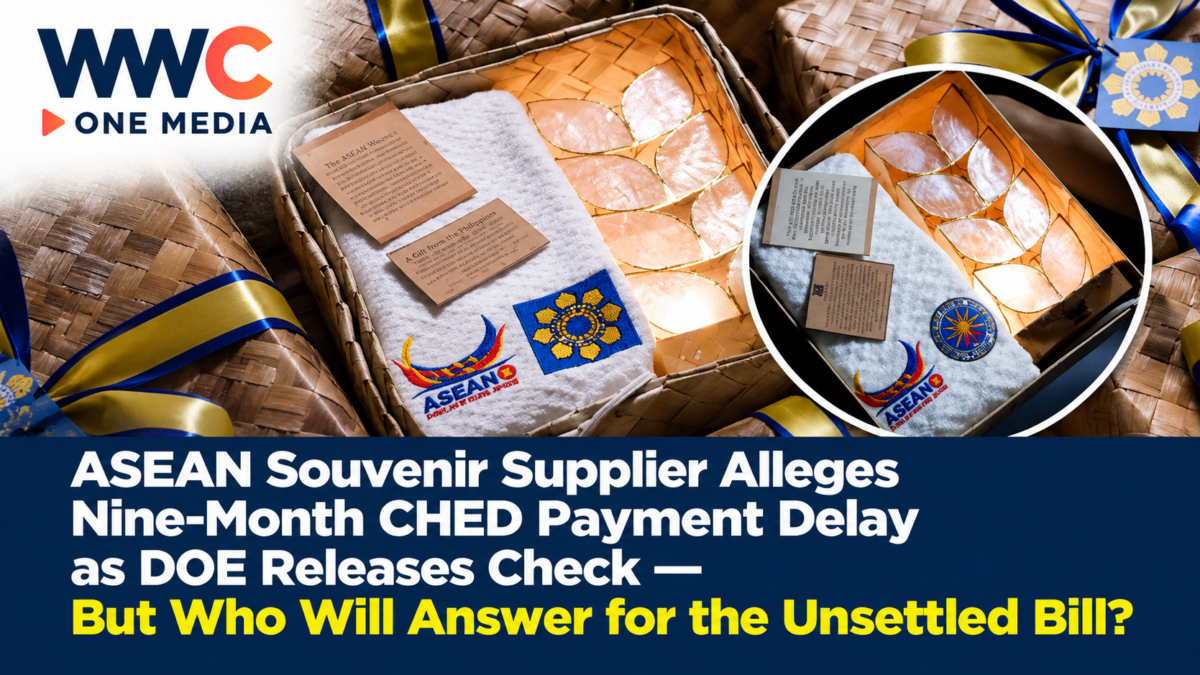
According to reports, the items included handcrafted Capiz lamps and personalized Inabel towels associated with Philippine artisan traditions.
The supplier complained that efforts to collect payment had required repeated follow-ups with government personnel.
It also expressed concern about the livelihood of artisans and partner communities that depend on its business.
For small manufacturers, the financial impact of a disputed or delayed payment can be substantial.
Materials must be purchased, workers compensated and production expenses covered before an invoice is collected.
Unlike a large company with extensive financing resources, a small artisan supplier may have limited working capital available for simultaneous orders.
The amount involved in the AmiananPH transactions has not been publicly established in the reviewed reporting.
That makes it inappropriate to assign a peso value to the alleged unpaid obligations.
DOE Says Payment Was Completed October 30
The Department of Energy issued a response on Friday evening, October 30, confirming that it had processed payment and delivered a check to the supplier.
The agency said the payment covered handcrafted gift sets prepared for the ASEAN Ministers on Energy Meeting, held in Pasay City from October 5 to 9.
AmiananPH said it delivered the items on October 4 and had understood that payment could be expedited within approximately 15 days.
The DOE disputed the suggestion that the payment was overdue under the governing procurement documents.
It maintained that its Terms of Reference allowed 30 working days for payment processing and that the October 30 delivery of the check was within that period.
The agency also said it had maintained communication with the supplier about the status of payment.
Earlier reporting indicated that AmiananPH had confirmed receiving notice that the check was ready shortly after its complaint became public.
The difference between the supplier’s account and the DOE’s explanation is significant.
A payment may feel delayed to a business expecting an expedited settlement while still falling within the written contractual deadline cited by the agency.
Determining whether any commitment was breached would require examining the actual purchase documents, delivery records, invoice receipt and agreed payment terms.
The latest reporting supports the conclusion that DOE completed its payment processing and delivered the check, not that DOE still owed an unpaid amount on October 31.
CHED Chair Orders Review of Separate Nine-Month Claim
The supplier’s complaint against CHED remains a separate matter.
AmiananPH alleged that payment related to an earlier souvenir order had remained unsettled for approximately nine months.
Interaksyon reported that the transaction involved CHED Regional Office IV, rather than a procurement ordinarily approved directly by the chairperson’s office.
CHED Chairperson Shirley Agrupis acknowledged the concern and committed to obtaining information from the regional office.
She said the circumstances would be reviewed and appropriate action taken if issues were identified.
CHED also encouraged suppliers to bring procurement concerns to the chairperson’s office.
The commission emphasized transparency, accountability and fair treatment of businesses dealing with government.
As of the reports reviewed for October 31, there was no independently verified public confirmation that the disputed CHED payment had been completed.
There was also no final finding establishing misconduct by any CHED official.
The review must establish the relevant transaction documents, whether the order was properly accepted, when payment became due and what may have caused the delay.
Why the Story Matters to Filipino Artisans
AmiananPH’s complaint has attracted attention partly because the business works with communities producing Filipino cultural goods.
Handcrafted gifts may involve specialized materials, weaving, embroidery and decorative work.
A business that supplies these products often acts as a link between individual artisans and larger buyers.
When payment is uncertain, the consequences may extend through that supply chain.
An enterprise may have less money available for its next order, while the artisans and communities supporting it may face disruptions to future work.
That does not establish that specific workers have already gone unpaid in this case.
It does explain why the supplier identified cash flow and the livelihoods of partner communities as central concerns.
The broader issue is whether public procurement procedures adequately account for the financial limitations of small domestic suppliers.
Philippine Procurement Law Requires Accountability
Republic Act No. 12009, or the New Government Procurement Act, provides the legal framework for government procurement.
The law emphasizes transparency, accountability, efficiency, competition and value for money.
It also recognizes different procurement methods, including Small Value Procurement.
Under Section 34, Small Value Procurement is available for eligible transactions within applicable monetary thresholds and procedural requirements.
However, the use of a small-value procurement method does not automatically establish that a supplier is entitled to a down payment.
Whether advance payment is permitted or required depends on the applicable contract, procurement rules and supporting documentation.
Similarly, a late-payment allegation cannot be determined solely by counting the days between delivery and a public complaint.
An accurate assessment needs the contractual payment period and evidence showing when the complete billing documents were submitted and accepted.
In this case, the DOE has cited a specific processing period, while CHED has undertaken to review its regional transaction.
Those two official responses should be evaluated independently.
The Incident Adds to Calls for Government Spending Transparency
The controversy has emerged amid growing public demands for clearer records of how government funds are approved and disbursed.
WWC ONE MEDIA previously examined this issue in Rica Peralejo Backs QR Codes for Public Funds — But Will Government Make Every Peso Traceable?.
That report explored proposals for making government spending records easier for citizens to access, including procurement information, fund releases and payment status.
A system that clearly records the status of valid supplier invoices could also help businesses understand whether a payment is awaiting documentation, approval, processing or release.
Public transparency alone cannot settle a contractual dispute.
But reliable records may reduce uncertainty and make it easier to establish where a transaction stands.
Procurement Oversight Has Become a National Debate
The AmiananPH complaint is distinct from larger controversies involving government purchasing.
Nevertheless, it arises in an environment where procurement accountability has become a major public issue.
WWC ONE MEDIA previously covered concerns about government purchasing in 1,500 Fire Trucks Set to Arrive — But the BFP Procurement Controversy Is Raising Bigger Questions.
That article examined separate allegations involving fire-truck prices and procurement practices.
The fire-truck controversy does not establish wrongdoing in the AmiananPH transactions.
The connection is the wider public interest in ensuring that government procurement decisions are transparent, properly documented and fairly implemented.
Questions about procurement are not limited to whether government purchases were necessary.
They also concern whether suppliers were selected properly, contracts were followed and payments were processed in accordance with applicable rules.
The ₱7.2-Trillion Budget Debate Makes Transparency Even More Relevant
Government spending oversight also extends to Congress.
WWC ONE MEDIA reported on calls for greater public access to budget negotiations in Lacson Wants Cameras Rolling During ₱7.2-Trillion 2027 Budget Talks, Even During Suspensions.
The report discussed proposals to increase transparency during deliberations on the proposed 2027 national budget.
The legislative budget process and an individual supplier payment are different matters.
Yet both highlight an important principle: the public should be able to distinguish between approved allocations, actual contractual obligations and payments that have been disbursed.
Even when funding has been approved, additional procedures may be required before a particular supplier can be paid.
Clearer records can help prevent misunderstandings and identify genuine administrative problems.
Private-Sector Procurement Offers Another Point of Comparison
Supplier relationships are also receiving greater attention outside government.
WWC ONE MEDIA recently covered PLDT and Smart Tighten ESG Rules for Suppliers as Sustainability Moves Deeper Into Procurement.
That report examined how a major Philippine telecommunications group is expanding supplier assessments to include sustainability, workplace conditions and other governance considerations.
Private-sector supplier programs and public procurement operate under different requirements.
However, both demonstrate that purchasing relationships involve more than obtaining goods at an acceptable price.
Communication, documentation and fair treatment can affect the long-term viability of supplier networks.
For government agencies seeking to support local enterprises, reliable procurement relationships may be especially important.
What Still Needs to Be Established?
Several important questions remain unanswered in the publicly available reporting.
For CHED, the key issues concern the date of the original order, the contractual payment terms, the status of required billing documents and the reason the supplier says payment has remained outstanding for months.
For DOE, the competing accounts concern the supplier’s expectation of expedited processing and the 30-working-day deadline cited by the agency.
The agency’s announcement that it delivered a check on October 30 is a significant development.
For both transactions, the precise amounts involved have not been disclosed in the reviewed reports.
There is also no verified basis to conclude that the lack of an advance payment was itself unlawful.
A fair review should consider the documentation and provide both the supplier and agencies an opportunity to substantiate their positions.
The Bigger Question: Can Small Businesses Afford to Supply Government?
The AmiananPH controversy illustrates the financial pressures that can arise when small businesses accept government orders tied to fixed event deadlines.
Suppliers may have to purchase materials and complete production before receiving payment.
That arrangement may be manageable for well-capitalized companies.
For smaller enterprises, it can create significant cash-flow pressure, particularly when expectations about payment timing are unclear.
Government agencies have legitimate responsibilities to verify deliveries, check documentation and protect public funds.
But those safeguards must also operate efficiently enough to support fair commercial transactions.
The challenge is finding a system that provides accountability without creating unnecessary uncertainty for legitimate suppliers.
The Bottom Line
Filipino artisan supplier AmiananPH accused CHED and DOE of failing to pay promptly for souvenir orders associated with ASEAN activities.
The DOE subsequently announced that it completed payment processing and delivered a check on October 30, maintaining that the transaction remained within the contractual 30-working-day processing period.
CHED Chairperson Shirley Agrupis, meanwhile, committed to reviewing the supplier’s separate complaint involving a regional procurement transaction allegedly unsettled for approximately nine months.
No public finding of fraud or corruption has been established.
The case now raises broader questions about payment documentation, realistic processing timelines and the treatment of smaller businesses supplying government institutions.
As the DOE says it has settled its transaction while CHED reviews a much older payment complaint, one question remains: Will the controversy lead to clearer and fairer government procurement practices—or will Filipino small businesses continue risking their working capital to meet urgent public-sector deadlines?