PARIS, France — October 31, 2026
France’s mounting debt problems have triggered another major warning from international credit markets after Fitch Ratings unexpectedly revised the country’s sovereign credit outlook to negative, raising new concerns about the financial stability of Europe’s second-largest economy.
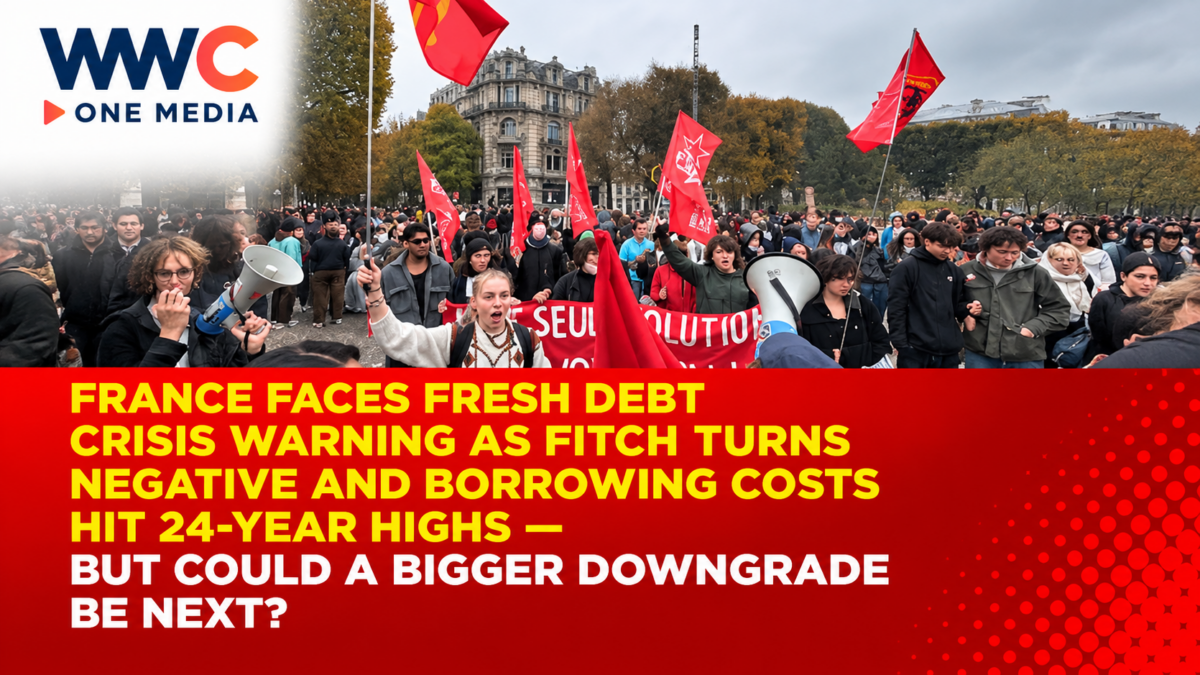
The decision, announced on Friday, October 30, comes as France struggles with slowing economic growth, escalating government borrowing costs, widespread public protests and political divisions threatening efforts to approve a credible national budget.
According to Bloomberg and Reuters, Fitch maintained France’s sovereign credit rating at A+ but changed its outlook from stable to negative, citing worsening fiscal conditions and uncertainty surrounding the government’s ability to reduce its budget deficit.
The move places renewed pressure on Prime Minister Sébastien Lecornu’s government, which faces a difficult battle to convince lawmakers to support spending restrictions and additional revenue measures.
France’s debt burden could reach 124% of gross domestic product by 2028, according to Fitch’s latest projections, compared with 115.7% in 2025.
Meanwhile, government bond yields have surged to levels not seen in approximately 24 years, increasing the cost of financing the country’s substantial public debt.
The warning arrives just months before France’s 2027 presidential election, when political disagreements over spending, taxes and pensions could further complicate efforts to restore fiscal discipline.
But with the French economy unexpectedly shrinking and investors demanding higher interest rates, could the ratings warning be the beginning of an even more serious European debt crisis?
Fitch Issues Unscheduled Warning as France’s Fiscal Outlook Deteriorates
Fitch’s October 30 decision was particularly significant because it came outside the agency’s normal sovereign review schedule.
Its previous review in August had maintained a stable outlook.
Since then, however, weaker economic performance, higher government borrowing costs and worsening deficit projections have increased concerns about the sustainability of France’s public finances.
Fitch pointed to several interconnected problems.
Government debt is increasing faster than previously projected.
Economic growth is struggling to recover.
Borrowing costs have risen substantially.
And political fragmentation makes it difficult for the government to implement fiscal reforms.
The agency also expressed concern about the social environment, with protests and public resistance making spending restraint increasingly challenging.
Under Fitch’s revised assessment, France would need cumulative fiscal adjustments equivalent to approximately 3.5% of GDP to stabilize its debt burden, compared with a previous estimate of 3.0%.
That represents a considerable challenge for a country already facing high taxes, substantial public spending commitments and limited political consensus.
Despite these concerns, Fitch affirmed the A+ rating.
France continues to benefit from a large, diversified economy, established institutions, eurozone membership and a resilient financial sector.
However, those strengths may not be sufficient to prevent a downgrade if debt dynamics continue deteriorating.
France’s Public Debt Could Reach 124% of GDP by 2028
One of the most alarming elements of Fitch’s assessment is the projected increase in France’s government debt.
The ratings agency expects public debt to climb from approximately 115.7% of GDP in 2025 to around 124% by 2028.
The debt-to-GDP ratio measures the size of government debt relative to a country’s annual economic output.
When debt grows faster than the economy, that ratio increases.
A rising ratio does not automatically mean a country is insolvent.
However, it can indicate that stabilizing public finances is becoming more difficult, particularly when the government is already running large budget deficits.
France’s fiscal challenge is compounded by weak growth.
If economic output increases slowly, the government has fewer opportunities to reduce its debt ratio through expanding tax revenues and a larger economic base.
At the same time, higher borrowing costs mean an increasing portion of public resources must be devoted to interest payments.
Fitch expects France’s government interest burden to rise from approximately 2.5% of GDP in 2025 to 3.3% by 2028.
That increase could place additional pressure on spending priorities, including healthcare, education, infrastructure and social protection.
The risk is a difficult cycle in which high debt produces higher financing costs, which then make future deficits more expensive.
WWC ONE MEDIA previously examined this issue in France’s Borrowing Costs Near 5% as Central Bank Chief Sounds Alarm — But the Bigger Threat Is a Debt Trap Politics May Struggle to Escape.
That report explored how rising government bond yields threaten to squeeze France’s fiscal flexibility and increase pressure for spending reforms.
French Borrowing Costs Surge to Highest Levels Since 2002
Financial markets have already begun reflecting growing concern about France’s fiscal outlook.
Reuters reported that French 10-year government bond yields recently exceeded 5.14%, reaching their highest level since 2002.
Bond yields represent the return investors demand when purchasing government securities.
When investors become more concerned about inflation, political instability or fiscal sustainability, they may require higher yields to compensate for those risks.
For France, that has created a significant financing challenge.
The country’s existing stock of debt includes obligations issued at lower interest rates.
As those bonds mature, the government may need to refinance them at higher prevailing yields.
That process can gradually increase the cost of servicing public debt.
Another important indicator is the difference between French and German government bond yields.
German sovereign bonds are widely used as a benchmark for relatively low-risk borrowing in the eurozone.
According to Bloomberg, the spread between French and German 10-year government yields widened to approximately 178 basis points during October, compared with about 85 basis points at the beginning of September.
A basis point equals one-hundredth of a percentage point.
The widening spread indicates that investors have demanded substantially more compensation to hold French government debt relative to German securities.
Although the spread eased to approximately 165 basis points on October 30, it remained elevated.
The market reaction suggests that France’s fiscal problems are becoming a major source of financial uncertainty.
France’s Economy Unexpectedly Shrinks as Inflation Accelerates
The Fitch warning followed disappointing economic data released on October 30.
France’s national statistics institute, INSEE, reported that gross domestic product contracted by 0.1% during the third quarter of 2026.
Economists surveyed by Reuters had expected modest growth of approximately 0.1%.
The contraction followed stagnation during the second quarter, according to the latest reporting.
The weakness creates additional difficulties for the government.
Slower economic activity can reduce tax collections and increase spending pressure.
Businesses may delay investments when economic conditions are uncertain.
Households may also become more cautious about spending as inflation, unemployment concerns and financial uncertainty affect confidence.
According to Le Monde and the Financial Times, weakness in investment and international trade contributed to the latest contraction.
At the same time, inflation accelerated in October, complicating the economic outlook.
Rising prices can erode purchasing power and reduce consumer spending.
They can also limit the European Central Bank’s ability to lower borrowing costs if inflation remains elevated.
The combination of weak growth and persistent inflation is particularly challenging because policies designed to control inflation can further restrain economic activity.
For France, the result is a difficult economic environment in which both fiscal consolidation and economic recovery have become harder to achieve.
Prime Minister Lecornu Faces a High-Stakes 2027 Budget Battle
France’s immediate political challenge is securing parliamentary approval for its 2027 budget.
Prime Minister Sébastien Lecornu’s government has proposed measures intended to reduce the annual budget deficit to approximately 5.0% of GDP next year.
However, Fitch expects the deficit could remain around 5.5% of GDP in 2027.
The difference reflects concerns that weaker economic growth and political concessions may undermine the government’s plans.
France’s deficit is also expected to reach approximately 5.4% of GDP in 2026.
These levels remain well above the European Union’s normal reference threshold of 3% of GDP.
The government’s proposed approach involves restricting spending and increasing revenues.
But the political environment is deeply divided.
Lecornu does not command a reliable parliamentary majority capable of passing controversial fiscal measures without negotiations.
Opposition parties from across the political spectrum have resisted elements of the government’s plans.
With the presidential election approaching in 2027, political parties have incentives to distinguish themselves rather than accept unpopular compromises.
Some opposition figures favor changes to pension rules, while others advocate tax reforms or alternative spending priorities.
For the government, this creates a challenging balance between restoring fiscal credibility and maintaining political support.
If lawmakers reject substantial elements of the proposed budget, the government may struggle to demonstrate the deficit reduction required to reassure rating agencies and investors.
France’s Finance Minister Calls for a Responsible Budget
French Finance Minister Roland Lescure acknowledged Fitch’s decision and emphasized the importance of passing a credible budget before the end of 2026.
The government aims to bring the deficit down to 5% of GDP in 2027.
Officials have argued that restoring confidence in public finances is essential to maintaining stable borrowing conditions.
However, even achieving the government’s target would leave France with a deficit above the European Union’s standard fiscal threshold.
The challenge is therefore not limited to approving one annual budget.
France must demonstrate that its debt burden can eventually stabilize through a combination of economic growth, fiscal reforms and sustainable spending policies.
This is particularly important because financial markets increasingly focus on whether governments can implement promised measures rather than merely announce them.
Fitch’s warning suggests that political credibility has become an essential part of France’s credit assessment.
Moody’s Had Already Warned About France’s Financial Outlook
Fitch is not the only major credit-rating agency expressing concern.
On October 23, Moody’s Ratings maintained France’s sovereign credit rating at Aa3 while keeping its outlook negative.
Moody’s decision temporarily spared France an actual downgrade.
However, its assessment also reflected uncertainty surrounding the country’s fiscal outlook and political ability to implement reforms.
The agency assumed that France would eventually approve a budget containing measures to reduce its deficit.
It also anticipated that borrowing pressures and social tensions would ease over time.
These assumptions remain uncertain.
Fitch’s subsequent move reinforces the perception that France’s financial challenges are becoming more difficult to resolve.
The two agencies use different methodologies and rating scales, but both now have negative outlooks on France.
Importantly, neither the October 23 Moody’s action nor the October 30 Fitch action constitutes an actual reduction in France’s sovereign credit rating.
A negative outlook indicates an elevated possibility of a downgrade if circumstances worsen.
Fitch has indicated that another review should take place by the end of February 2027.
That creates a potentially important deadline for France’s fiscal credibility.
Public Protests Add Pressure to an Already Fragile Government
France’s financial problems are unfolding amid widespread social unrest.
Large demonstrations have challenged government policies, with public anger reflecting concerns over living costs, public services and the distribution of economic burdens.
Reuters reported that additional protests were planned during the weekend following Fitch’s October 30 announcement.
Political leaders face a difficult dilemma.
Spending cuts and tax increases may reassure investors, but they can also generate opposition among households and businesses.
Measures that appear financially necessary may become politically difficult to implement.
This can weaken confidence in the government’s ability to deliver fiscal consolidation.
Fitch specifically identified political fragmentation and a difficult social environment as obstacles to sustained reform.
The situation is becoming increasingly sensitive as France approaches its presidential election.
Budget negotiations may consequently become an early test of the country’s broader political direction.
Europe’s Debt Problems Are No Longer Limited to France
The French situation has implications for the wider eurozone.
France is one of Europe’s largest economies and a major issuer of government bonds.
Its borrowing costs influence financial-market expectations across the region.
Other European governments are also managing elevated debt burdens, higher interest expenses and demands for additional spending on defense, infrastructure and public services.
WWC ONE MEDIA explored these challenges in Europe’s Debt-Heavy Governments Bow to Bond Market Pressure — But a Bigger Fiscal Reckoning Could Be Ahead.
The report examined how bond-market volatility is putting pressure on indebted European governments to demonstrate credible fiscal management.
However, the financial positions of individual eurozone countries differ considerably.
Some governments have stronger economic growth, lower deficits or more favorable debt profiles.
It would therefore be misleading to conclude that all European countries face the same level of sovereign risk.
France’s difficulties are especially significant because of its economic size, political influence and importance to European capital markets.
Could the European Central Bank Intervene?
As government bond yields rise, attention is increasingly turning to the European Central Bank.
The ECB is responsible for monetary policy across the eurozone.
Its central mandate is to maintain price stability.
It also has instruments designed to address certain forms of financial-market fragmentation that could interfere with the transmission of monetary policy.
However, the ECB cannot simply guarantee low borrowing costs for every heavily indebted government.
Potential interventions involve legal, economic and policy conditions.
This creates a complicated challenge.
If French government bond yields rise because investors perceive genuine fiscal risks, monetary authorities must distinguish those concerns from disorderly market conditions that could threaten the functioning of monetary policy.
The issue is especially important as the ECB faces renewed inflation pressures and uncertainty about future interest rates.
WWC ONE MEDIA previously examined these challenges in Christine Lagarde to Leave ECB Nine Months Early as Inflation Hits 3.8% — But Who Will Save Europe From Its Next Economic Crisis?.
The report highlighted the difficult balance between containing inflation, protecting economic growth and maintaining confidence in European financial markets.
For France, however, credible national fiscal measures remain essential regardless of the ECB’s monetary policy decisions.
Is France Heading Toward a Sovereign Debt Crisis?
Fitch’s warning has renewed comparisons with the eurozone sovereign debt crisis of the early 2010s.
During that period, several European countries faced severe borrowing pressures and financial instability.
However, France’s present circumstances should not automatically be equated with an imminent default or bailout.
The country continues to have access to financial markets.
Its economy remains large and diversified.
It possesses established institutions and benefits from eurozone membership.
Fitch’s decision to retain its A+ rating recognizes these strengths.
Nevertheless, the current trajectory presents risks.
If debt continues rising while economic growth remains weak, investors could demand even higher borrowing costs.
That would increase debt-servicing expenses and reduce the government’s fiscal flexibility.
Political gridlock could further undermine confidence if budget reforms are repeatedly delayed or weakened.
An actual crisis is not inevitable, but the financial warning is significant.
Europe’s Common Debt Debate Could Become More Urgent
France’s fiscal problems are also relevant to discussions about how the European Union should finance long-term investment.
The EU previously established its NextGenerationEU recovery program, involving approximately €806.9 billion in financing.
The initiative demonstrated that European governments could collectively borrow to address shared economic challenges.
However, expanding common borrowing remains politically controversial.
Supporters argue that joint financing could help Europe invest in defense, infrastructure, energy security and advanced technology.
Critics warn that shared borrowing does not eliminate financial obligations and may create disagreements over repayment responsibilities.
WWC ONE MEDIA examined the issue in EU Borrowed €807 Billion to Fight Covid — But Its Next Debt Battle Could Decide Whether Europe Can Compete With America and China.
France’s fiscal outlook demonstrates why European leaders must consider not only how to raise investment capital, but also how to ensure that public borrowing remains sustainable.
What the France Credit Warning Means for Global Investors
The Fitch outlook revision could influence investor perceptions of European financial markets.
Government bond yields are important benchmarks for pricing other financial assets.
Higher sovereign borrowing costs can affect business financing, banking conditions and investment decisions.
French banks, insurers and investment funds may also be exposed to changes in government bond prices.
However, the impact depends on portfolio holdings, capital buffers, hedging arrangements and broader market conditions.
An increase in bond yields does not automatically mean the French banking sector is facing a crisis.
For international investors, the main question is whether the government can restore confidence without unnecessarily weakening economic growth.
Currency markets may also react to changes in eurozone fiscal conditions and expectations for European Central Bank policy.
But the euro’s movements depend on numerous factors, including international interest-rate differentials and global financial conditions.
France’s fiscal problems are one important element of that broader picture.
Why the Philippines and Asia Should Pay Attention
France’s deteriorating fiscal outlook is relevant to investors and businesses outside Europe.
European financial-market volatility can influence international capital flows, currencies and financing conditions.
Higher yields in major developed economies may make investors more selective about emerging-market assets.
For the Philippines and other Asian economies, potential effects could include changes in international borrowing conditions and portfolio investment flows.
Trade and investment relationships with European companies may also be affected if European economic growth weakens.
However, the impact is neither automatic nor uniform.
Domestic monetary policy, inflation, economic performance and investor confidence remain important in determining financial outcomes across Asia.
The key lesson is that prolonged budget deficits and rising interest expenses can become more difficult to manage when global borrowing conditions tighten.
What Happens Next for France?
Several developments will determine whether Fitch’s negative outlook leads to an actual sovereign credit downgrade.
The first is the outcome of the government’s 2027 budget negotiations.
A credible budget agreement could reassure investors that France remains capable of addressing its fiscal problems.
The second is economic growth.
If GDP continues stagnating or contracting, deficit reduction will become more difficult.
The third is the direction of government bond yields.
Lower borrowing costs could ease pressure on debt-servicing expenses, while additional increases would make fiscal consolidation more challenging.
Political stability is another important factor.
France’s ability to implement reforms will depend heavily on parliamentary cooperation and the outcome of its upcoming presidential election.
Finally, the next rating assessments will provide important tests of investor expectations.
Fitch has indicated that it expects to review France again by the end of February 2027.
Any rating action will depend on developments between now and then.
The Bigger Question: Can France Restore Confidence Before Its Debt Burden Becomes Even Harder to Control?
France’s fiscal challenges have reached a pivotal stage.
For years, successive governments have struggled to balance demands for public spending with the need to restrain deficits.
Now higher borrowing costs and weaker economic growth are making that balance increasingly difficult.
Fitch’s decision highlights the seriousness of the problem.
The agency has not downgraded France’s sovereign rating, but it has issued a clear warning that the country’s fiscal trajectory is becoming more vulnerable.
For Prime Minister Lecornu, securing a credible budget may be essential to preventing further damage to market confidence.
For investors, the central issue is whether France can stabilize its debt burden while maintaining economic and political stability.
And for the wider European Union, France’s experience is a reminder that even major developed economies must retain the confidence of global capital markets.
The Bottom Line
Fitch’s October 30 decision to revise France’s credit outlook to negative represents a significant warning about the country’s deteriorating fiscal position.
Public debt is projected to reach approximately 124% of GDP by 2028.
Government borrowing costs have climbed to their highest levels since 2002.
Economic activity has weakened, while political divisions threaten efforts to approve a credible 2027 budget.
France retains its A+ sovereign credit rating and substantial economic strengths, but the risks surrounding its financial outlook have increased.
As Paris faces growing pressure from bond investors, rating agencies and voters, one question now hangs over Europe’s second-largest economy: Can France restore confidence before mounting debt costs force an even more painful financial reckoning?