MUMBAI / NEW DELHI — October 30, 2026. A decade ago, mobile internet access was expensive enough that millions of Indians had to think carefully before streaming a video, downloading an application or making a video call.
Today, India is one of the world’s largest mobile broadband markets, and Reliance Jio is at the center of that transformation.
The telecommunications company launched commercial services in September 2016 with free voice calls, promotional data offers and a nationwide fourth-generation network designed around internet use.
Its strategy forced competitors to reconsider pricing, accelerated mobile broadband adoption and helped create the connectivity infrastructure supporting India’s expanding digital economy.
The scale of the change is extraordinary.
Industry research shows that the average price Indian consumers paid for a gigabyte of mobile data fell from approximately ₹228 in fiscal 2016 to ₹7.90 in fiscal 2026.
Over the same period, India’s mobile broadband customer base expanded from roughly 132 million to more than 1 billion.
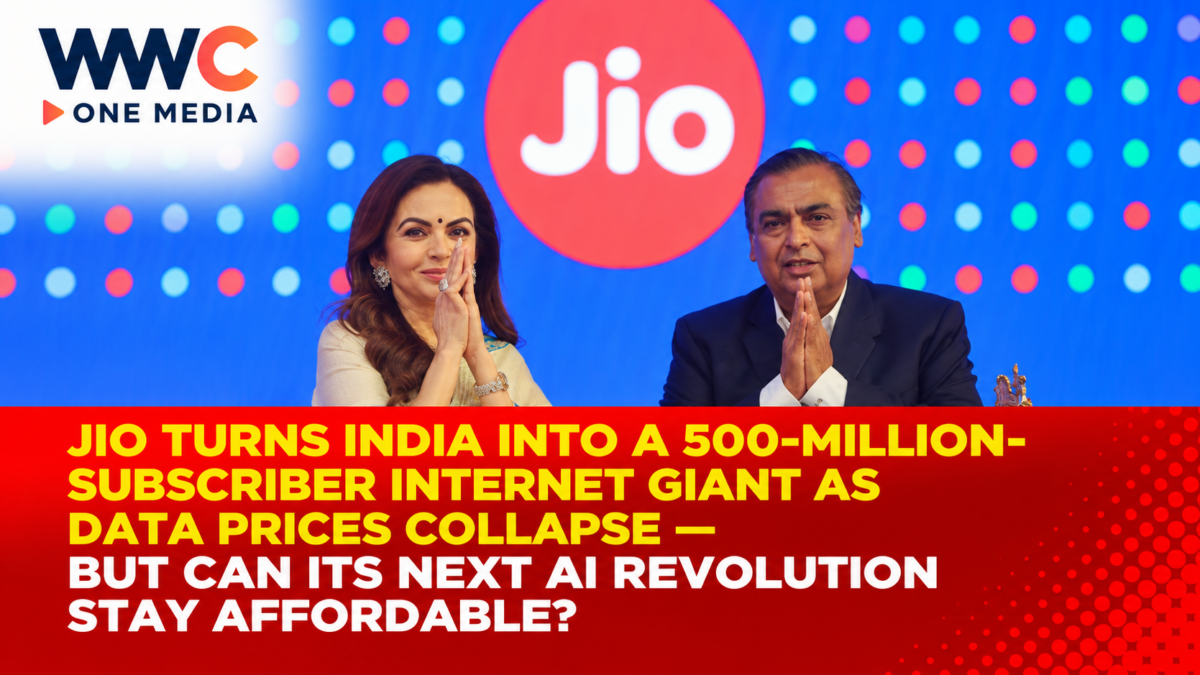
Reliance reported that Jio alone served more than 524 million customers by March 2026, including over 268 million 5G subscribers.
The transformation helped make online payments, video entertainment, digital commerce and mobile learning increasingly accessible.
But the next decade could be more challenging.
Jio has helped make mobile internet affordable for hundreds of millions of people. Can it now turn that enormous network into an AI-powered digital economy without making connectivity more expensive or reducing consumer choice?
How Reliance Jio disrupted India’s telecom industry in 2016
When Jio entered the Indian market in September 2016, the telecommunications industry looked dramatically different.
Mobile broadband was less widespread, average data consumption was low and many customers relied on older network technologies.
Existing operators such as Bharti Airtel, Vodafone and Idea Cellular had developed extensive businesses around voice calls, text messages and data services.
Jio approached the market differently.
Rather than gradually upgrading a legacy network, it launched an all-IP fourth-generation platform.
Voice calls were carried over the network using Voice over LTE technology.
The company introduced a promotional welcome offer that provided free voice and data services to attract customers.
The results were immediate.
Reliance announced that Jio had enrolled 16 million customers in its first 26 days.
The launch intensified competition and prompted other carriers to reduce prices or introduce more generous data allowances.
Within a few years, India’s mobile internet market had been transformed.
India went from expensive data to some of the world’s cheapest connectivity
The price decline is one of the clearest ways to measure the transformation.
An Analysys Mason industry report prepared in 2026, using data from India’s Telecom Regulatory Authority, shows that average customer spending per gigabyte fell from approximately ₹228 in fiscal 2016 to ₹7.90 in fiscal 2026.
That represents a decline of roughly 96.5%.
These are market-wide average figures, not the exact prices charged by Jio to every customer.
The decline reflects a combination of Jio’s aggressive entry, competitive responses, network investment and technological advances.
The lower prices allowed customers to consume far more data without facing the same financial constraints.
Internet use became increasingly practical for everyday activities rather than an expensive optional service.
The result was a market where streaming, messaging, online classes and digital transactions could reach much larger audiences.
Mobile broadband adoption increased nearly eightfold
India’s mobile broadband customer base expanded from approximately 132.2 million in fiscal 2016 to 1.002 billion in fiscal 2026, according to the Analysys Mason report.
That represents an increase of roughly 7.6 times.
The figure measures mobile broadband customers across India’s industry, not Jio subscribers alone.
The distinction matters.
India’s telecom transformation was driven by network operators, smartphone manufacturers, developers, government initiatives and increasingly affordable digital services.
Jio played a major catalytic role, but it did not independently create every new user or application.
Its commercial strategy helped accelerate a wider technological shift.
The expansion also occurred during a period of rising smartphone ownership and investment in telecommunications infrastructure.
For many households, the smartphone became the primary way to access the internet.
Jio became one of the world’s biggest mobile networks
Reliance’s fiscal 2025–26 annual report provides a measure of Jio’s scale.
As of March 2026, the company reported more than 524 million total subscribers.
It also reported over 268 million 5G users and more than 27 million fixed-broadband connections.
The company said its network carried approximately 241 exabytes of data during the financial year.
An exabyte is equivalent to one billion gigabytes.
These figures illustrate the immense scale of demand for internet connectivity.
However, subscriber counts are not the same as unique individuals using the internet.
Customers can hold more than one connection, and different industry reports may define subscribers differently.
Jio’s figures are nevertheless substantial evidence of the business’s rapid expansion.
Cheap data changed how Indians used smartphones
The consequences of cheaper data extended well beyond mobile network revenue.
Video streaming became more accessible to customers who previously faced high usage costs.
Students gained easier access to educational content and recorded lessons.
Small businesses could promote products through social media and communicate with customers using messaging applications.
Digital creators gained access to a much larger domestic audience.
Consumers increasingly used mobile applications to shop, pay bills, arrange transport and manage services.
These changes also encouraged technology companies to design products for mobile-first users.
For a country with a large population and significant differences in income, reducing the cost of internet access helped expand opportunities for digital participation.
But affordability was only one factor.
A suitable device, reliable coverage, digital literacy and relevant applications were also necessary.
India’s digital payments boom benefited from better connectivity
India’s digital payments infrastructure expanded rapidly during the same period.
The Unified Payments Interface, or UPI, helped simplify bank-to-bank transfers and merchant transactions.
Mobile connectivity made those services more convenient and widely usable.
The development illustrates how telecommunications infrastructure and public digital systems can complement each other.
But Jio should not be credited with creating or operating UPI.
India’s National Payments Corporation developed the payments infrastructure, while participating banks, application providers, merchants and regulators supported adoption.
Jio’s contribution was helping expand access to the inexpensive data connections that made mobile digital services easier to use.
The broader economic impact came from many organizations building upon increasingly accessible connectivity.
The benefits were accompanied by industry consolidation
Jio’s aggressive commercial strategy also had costs for competitors.
Operators that relied on higher prices faced pressure to reduce tariffs while continuing to invest in expensive telecommunications networks.
Some smaller companies exited the market or were absorbed into larger businesses.
Vodafone India and Idea Cellular combined operations as the industry consolidated.
Researchers at the London School of Economics raised concerns about the effect of Jio’s market entry on employment, competition and industry concentration.
An earlier analysis published in Economic & Political Weekly questioned the competitive implications of Jio’s launch strategy.
The concerns deserve attention.
Low prices can benefit consumers substantially, but long-term competition also depends on having enough financially sustainable operators to maintain investment and consumer choice.
A market dominated by a small number of companies may eventually face different competitive pressures from those that existed when a disruptive new entrant first arrived.
Is India’s era of ultra-cheap mobile data ending?
Although mobile data remains much more affordable than it was before 2016, prices have not continued falling indefinitely.
In June 2024, Jio announced tariff increases ranging from approximately 12.5% to 25.1% across selected mobile plans.
Airtel and Vodafone Idea also announced increases.
Telecom research firm Analysys Mason noted that operators were increasingly focused on improving average revenue per user after years of substantial network investment.
This is a critical development.
Jio initially gained market share through highly attractive pricing.
As its business matured, the company faced greater pressure to generate sufficient revenue to maintain networks, deploy 5G and expand broadband services.
Consumers may continue benefiting from inexpensive data compared with a decade earlier while still facing periodic tariff increases.
The challenge is keeping prices affordable without undermining the investment needed to maintain network quality.
Jio’s financial model now depends on more than subscriber growth
Jio’s enormous customer base creates opportunities for additional revenue, but it also makes continued expansion more complicated.
A company serving hundreds of millions of customers cannot assume that subscriber growth will continue at its initial pace.
Instead, it may seek greater value from existing relationships.
That can involve moving customers from 4G to 5G, expanding home broadband, developing enterprise services and offering additional digital products.
Reliance’s March 2026 disclosures reported an average revenue per user of about ₹214 a month.
ARPU measures average monthly revenue generated per user under the company’s reporting methodology.
It is not the cost of a gigabyte of mobile data.
Higher ARPU can reflect changing tariffs, more premium customers and greater adoption of services.
For investors, it is an important measure of the network’s commercial development.
For consumers, it raises the question of whether additional services deliver enough value to justify higher spending.
The expansion into 5G represents a second transformation
Jio’s initial revolution centered on making fourth-generation mobile internet widely available.
Its next major opportunity is 5G.
The company reported more than 268 million 5G customers by March 2026.
Fifth-generation networks can support faster speeds, lower latency and improved capacity.
That creates opportunities for streaming, gaming, enterprise connectivity, industrial applications and cloud-based services.
However, 5G adoption does not automatically produce higher productivity or income.
The benefits depend on service quality, affordable devices and applications that make productive use of the connection.
For some users, faster video streaming may be the most immediate advantage.
For businesses, the opportunity may involve automation, connected equipment and more reliable digital operations.
Jio’s success will depend on how widely these additional capabilities are adopted.
Home broadband is becoming another major growth engine
Jio is also expanding beyond mobile phones.
Its fixed-broadband services include fiber connections and JioAirFiber, which uses wireless technology to provide home internet access.
By March 2026, the company reported approximately 27.1 million fixed-broadband subscribers.
Growth in home connectivity could provide important opportunities for digital work, entertainment, online education and small-business services.
But expanding fixed broadband requires different infrastructure and operating capabilities from providing mobile connectivity.
Customers also expect reliable installation, support and consistent performance.
The economics of serving densely populated urban buildings can differ substantially from those of reaching smaller towns and rural communities.
The next phase of India’s digital inclusion therefore depends partly on improving service outside the largest metropolitan areas.
Artificial intelligence could become Jio’s next major business
Reliance is positioning Jio as a platform for delivering artificial-intelligence services.
The company’s annual report identifies AI, cloud computing and digital applications as areas of strategic opportunity.
Management has argued that extensive connectivity infrastructure can help distribute AI services to households and enterprises.
That creates a business opportunity beyond selling mobile data.
Customers may eventually use network-connected AI tools for education, productivity, customer service, business management and other applications.
But the economic model remains uncertain.
Developing and operating AI services requires computing capacity, electricity, software and security infrastructure.
Some products may be bundled with existing subscriptions, while others could involve additional fees.
The crucial question is whether AI adoption expands opportunities without recreating the affordability barriers that Jio helped reduce for internet access.
Global AI infrastructure costs may challenge the next phase
Artificial-intelligence services depend on powerful computing infrastructure.
Bank of America Global Research has forecast that worldwide spending on data centers could reach approximately $2.1 trillion by 2028.
WWC ONE MEDIA examined that forecast in Bank of America Predicts $2.1-Trillion AI Data Center Explosion by 2028 — But Could a Global Power Shortage Bring the Entire Boom Crashing Down?.
The projection concerns global infrastructure investment, not a confirmed Jio spending commitment.
Nevertheless, it illustrates the financial requirements facing companies that want to provide AI services at enormous scale.
Data centers require advanced processors, cooling equipment and dependable electricity.
The ability to provide those services affordably may become a major competitive advantage.
But offering low-cost AI products will require a sustainable business model.
Network scale alone does not guarantee profitability.
What India’s digital transformation means for the Philippines
India’s experience offers useful lessons for telecommunications companies and policymakers in the Philippines.
Both countries have large populations of mobile-first internet users and businesses increasingly dependent on digital connectivity.
The expansion of affordable mobile broadband can help support education, entrepreneurship, public services and economic participation.
But sustained progress also requires dependable infrastructure and fair competition.
WWC ONE MEDIA previously examined the challenge in PLDT’s Butch Jimenez Honored for Corporate Leadership After Nearly 25 Years — But Can His Legacy Help Transform the Telecom Giant?.
That report discussed the changing expectations facing a major Philippine telecommunications provider as consumers demand better network quality and businesses embrace digital services.
India’s experience demonstrates the potential impact of affordable data.
But it does not mean the Philippines can reproduce Jio’s commercial strategy without considering its own market conditions, regulatory system, geography and infrastructure costs.
Digital inclusion requires more than affordable internet
Even when connectivity becomes cheaper, people may lack the skills or resources needed to benefit fully from digital technology.
The same challenge is visible in government services.
WWC ONE MEDIA reported on Philippine LGUs Lag in AI Readiness as Skills, Internet and Funding Gaps Hold Back Adoption.
The article examined findings from the Philippine Institute for Development Studies showing that many local government units still face significant obstacles to adopting AI tools.
Those barriers include inadequate last-mile connectivity, limited budgets and shortages of relevant technical skills.
The situation highlights a wider lesson from India’s internet revolution.
Providing access is only the beginning.
Turning connectivity into economic opportunity also requires education, institutional readiness and useful digital services.
Growing demand for cloud and AI technology could support Asian manufacturers
An expanding digital economy can also increase demand for data storage, processors and other technology equipment.
Companies in neighboring countries may benefit from investment in cloud computing and AI infrastructure.
WWC ONE MEDIA explored one example in Toshiba Bets Billions on Philippine AI Storage Expansion — But the Bigger Prize Is a Fight for the Global Data-Center Market.
That report examined Toshiba’s plans to expand high-capacity storage manufacturing in the Philippines.
The project is not a Jio investment and should not be presented as a direct consequence of India’s mobile internet expansion.
But the two developments are part of a broader regional shift toward increasingly data-intensive economic activity.
More connected consumers and businesses create demand for platforms, storage, computing services and communications infrastructure.
The next test is balancing affordability and profitability
Jio’s first decade demonstrated that an aggressive reduction in data costs could reshape consumer behavior.
But the next decade will require a different balance.
The company must maintain service quality, invest in new infrastructure and develop digital products while remaining accessible to price-sensitive customers.
Competitors must also be financially strong enough to invest in better services.
Regulators face the challenge of promoting competition without discouraging necessary infrastructure spending.
Consumers will evaluate the results through actual network performance, affordability and service quality.
For Jio, the transition from a disruptive telecommunications entrant to a dominant digital platform brings greater responsibilities.
It must show that scale can produce innovation and value without unduly limiting choice.
The bigger question: Can Jio repeat its revolution in the AI era?
Reliance Jio helped change the economics of India’s mobile internet market.
Its 2016 launch accelerated competition, encouraged widespread broadband adoption and created opportunities for millions of users and businesses.
A decade later, the company’s network serves more than half a billion customers.
India has more than one billion mobile broadband connections, and the average cost of data has fallen dramatically from pre-Jio levels.
Those achievements represent a major transformation in digital accessibility.
But the next stage may be more complicated than the first.
AI applications require expensive computing infrastructure, while telecom operators face pressure to raise revenue and finance continued network expansion.
Competition concerns also remain important.
Jio has helped make internet access an everyday necessity for hundreds of millions of Indians. But as the company enters a new era of 5G, cloud computing and artificial intelligence, the biggest question is whether it can democratize the next generation of technology as successfully as it helped democratize mobile data—or whether the price of staying connected will begin rising again.