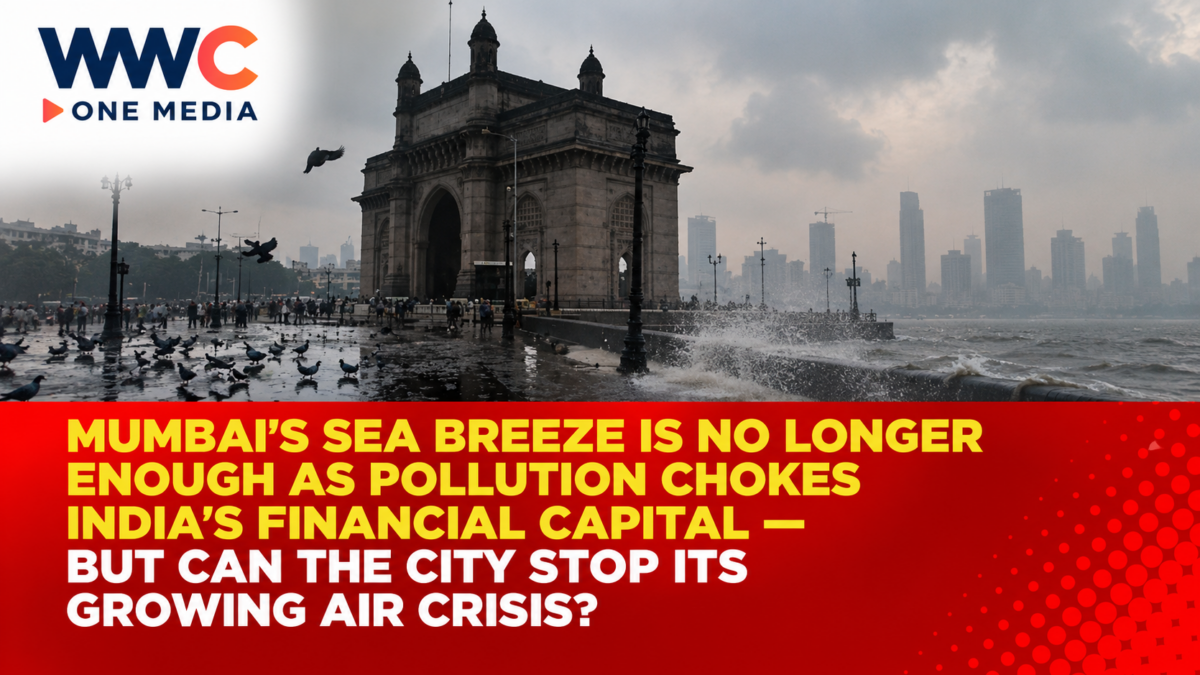
MUMBAI / MANILA — October 30, 2026. Mumbai has long enjoyed a natural advantage over many of India’s inland cities: its location beside the Arabian Sea, where coastal winds can help disperse airborne pollutants.
But that advantage is proving increasingly unreliable.
India’s financial capital is confronting renewed concerns over deteriorating air quality as extensive construction, road dust, vehicle emissions and unfavorable weather conditions combine to create unhealthy episodes of haze.
A Bloomberg report published October 30 examines how Mumbai’s coastal geography is no longer providing the protection residents might expect.
The growing problem presents a serious challenge for a city undergoing one of its largest infrastructure transformations in decades.
New transport links, commercial towers, housing developments and redevelopment projects promise economic benefits.
But building a modern financial center also requires protecting the health and quality of life of the people who work and live there.
Mumbai’s growing pollution problem raises a difficult question: Can India’s financial capital continue its construction boom without sacrificing the environmental advantages that helped make it an attractive place to live and do business?
Mumbai’s coastal location is no longer a guarantee of clean air
Coastal winds can improve air quality by moving pollutants away from densely populated neighborhoods.
However, their effectiveness depends on wind direction, wind speed and atmospheric conditions.
When air movement becomes weak, pollution can accumulate near the ground.
Mumbai’s municipal government has acknowledged that longer periods of calm weather can contribute to episodes of elevated pollution.
That is particularly concerning when emissions from vehicles, building sites and industrial activities remain high.
Mumbai’s geography offers some natural benefits, but it cannot eliminate pollution generated within the metropolitan area.
The city must therefore reduce emissions at their sources rather than relying on the sea breeze to disperse them.
Construction dust has become a major concern
Mumbai is experiencing extensive infrastructure development.
Major projects include railway and metro expansion, road improvements, commercial redevelopment and construction of residential buildings.
These investments are intended to improve connectivity, create jobs and support long-term growth.
However, construction activities can release substantial quantities of dust.
Demolition, excavation, material transport and exposed soil all contribute to the problem.
Municipal authorities have repeatedly identified construction and demolition as important sources of deteriorating air quality.
The city introduced pollution-control guidelines in October 2023 and revised them in October 2024.
The measures require construction sites to use barriers, protective coverings, water spraying and other dust-control systems.
But the effectiveness of regulations ultimately depends on implementation and enforcement.
What scientific studies reveal about Mumbai’s pollution
Research commissioned by the Maharashtra Pollution Control Board provides important evidence about the sources of Mumbai’s air pollution.
A source-apportionment study found that resuspended road dust was a major contributor to PM10 pollution.
PM10 refers to airborne particles with diameters of 10 micrometers or less.
These particles can originate from road surfaces, construction activity and other sources.
The study also found that fine-particle pollution, known as PM2.5, had a more complicated composition.
Secondary aerosols and marine-related sources contributed significantly to measured PM2.5 at the locations studied.
That finding does not mean all marine aerosols are toxic industrial pollutants.
It shows why scientific source identification matters: different types of particles require different control strategies.
The study also identified significant contributions from vehicle emissions to nitrogen oxides.
Mumbai’s air-quality challenge cannot be solved through construction restrictions alone.
It requires a broader response involving transport, industry, waste management and urban planning.
Why PM2.5 pollution is a serious health concern
Fine particulate matter is especially important because small particles can enter deep into the respiratory system.
Exposure to air pollution is associated with increased risks of respiratory and cardiovascular disease.
The health consequences depend on concentration, duration and individual susceptibility.
Children, older adults and people with existing heart or lung conditions may be particularly vulnerable.
A citywide AQI reading can provide useful information, but pollution levels vary across neighborhoods and times of day.
Residents near congested roads, construction sites or industrial facilities may experience different exposure levels from those living in less polluted locations.
This makes transparent, reliable and geographically detailed monitoring essential.
The goal should be to reduce population exposure rather than simply produce favorable average readings.
October’s haze has raised public concern
Residents have increasingly discussed poor visibility, dust and deteriorating air quality during October.
Local accounts describe hazy skylines and concerns about exposure near major roads and construction projects.
These experiences are consistent with the pollution mechanisms documented in municipal studies.
However, individual photographs and personal accounts do not establish a precise citywide pollution trend.
An image showing an obscured skyline may reflect a combination of haze, humidity and meteorological conditions.
The appropriate response is to examine official monitoring data from consistent locations and comparable time periods.
Without such data, claims that Mumbai has reached its highest pollution level ever would be premature.
Mumbai’s construction boom creates an economic dilemma
Infrastructure is essential to a growing metropolitan economy.
Improved roads, rail systems and public transportation can reduce travel times and support business activity.
Modern office space and housing can also improve economic opportunities.
But construction that proceeds without adequate pollution controls can impose costs on surrounding communities.
Dust can affect nearby homes, businesses and public spaces.
Traffic congestion can increase vehicle emissions.
And extensive building activity can intensify pressure on municipal services.
The challenge is not choosing between development and environmental protection.
It is ensuring that infrastructure projects are designed and managed to limit avoidable harm.
This lesson is relevant to developing economies throughout Asia.
WWC ONE MEDIA has previously explored the tension between economic development and environmental responsibility in Philippine Mining Under Scrutiny: Can Damaged Landscapes Become Thriving Communities Again?.
Although that report concerns mining rather than urban air pollution, both issues demonstrate the importance of environmental safeguards during industrial development.
India’s financial capital faces a quality-of-life challenge
Mumbai is central to India’s financial system.
It hosts major banks, financial institutions, multinational companies and business services.
A city’s attractiveness to workers and investors depends on more than economic growth.
Reliable transportation, accessible housing, public health and environmental quality also affect long-term competitiveness.
Severe pollution can create inconvenience and health risks for residents.
Businesses may face additional costs associated with air filtration, employee well-being and building maintenance.
However, the available reporting does not establish a specific amount of investment Mumbai has lost because of the October 2026 pollution episode.
It would be inaccurate to assign a financial loss without credible evidence.
The broader risk is that deteriorating environmental conditions can weaken the benefits of otherwise successful urban development.
Can better transport infrastructure eventually improve air quality?
Large transportation projects can create pollution during construction but potentially reduce some emissions after completion.
Expanded public transit may allow commuters to replace private vehicle journeys.
More efficient road systems may also reduce certain forms of congestion.
But these benefits are not automatic.
Road expansion can encourage additional traffic, while new transport facilities require careful integration with existing services.
To assess environmental gains, policymakers need to examine actual changes in vehicle use, emissions and travel behavior.
WWC ONE MEDIA has examined related infrastructure constraints in Weak Power Grids Put Philippine Industrial Projects at Risk as Investors Demand Reliable Electricity.
That story concerns energy reliability rather than Mumbai’s air pollution, but illustrates why the quality of underlying infrastructure matters as much as the scale of new investment.
For Mumbai, the corresponding challenge is delivering new infrastructure while controlling the environmental consequences of constructing and operating it.
Industrial growth needs stronger environmental safeguards
Mumbai’s experience reflects a wider issue across fast-growing economies.
Industrial production, construction and urban development can support prosperity.
But poorly managed growth can also increase pollution and environmental damage.
Regulators must balance investment needs with enforceable standards.
WWC ONE MEDIA previously examined changing industrial strategies in Global Steel Market Fractures as Trade Barriers Force a New Industry Playbook.
Although the focus of that report is international steel trade, large industrial supply chains face growing questions about operating costs, regulatory compliance and sustainability.
The connection to Mumbai is broader: economic competitiveness increasingly depends on infrastructure and industry that can operate without imposing excessive environmental burdens.
What Mumbai authorities are doing about construction dust
The Brihanmumbai Municipal Corporation has introduced detailed air-pollution mitigation requirements.
Among the measures are perimeter barriers at construction sites, protective coverings during demolition and water spraying to limit airborne dust.
Guidelines also address vehicles transporting building materials.
Construction sites are required to take steps to prevent dust from escaping into surrounding neighborhoods.
Some provisions require monitoring systems and allow municipal officials to inspect compliance.
These are meaningful regulatory tools.
However, the existence of rules does not prove that every construction site follows them.
The city needs consistent inspections, accurate monitoring and transparent enforcement outcomes.
Public confidence will depend on whether the measures produce sustained improvements in actual pollution levels.
Mumbai’s coastline faces environmental pressures beyond air pollution
The city’s coastal environment presents additional challenges.
Mumbai’s beaches and waterways are affected by urban waste, sewage, runoff and industrial activity.
Research by scientists at India’s National Institute of Oceanography has documented microbial contamination concerns at selected recreational beaches.
That research is separate from the October 30 air-pollution story.
However, it demonstrates that coastal geography does not automatically guarantee environmental protection.
Air pollution and marine pollution involve different pathways and controls, but both require consistent management.
For a major coastal metropolis, environmental policy must address the entire urban system.
What the Philippines can learn from Mumbai
The challenges facing Mumbai are relevant to rapidly developing Philippine cities, especially Metro Manila.
Urban construction, traffic, infrastructure development and industrial activity can contribute to pollution when environmental safeguards are insufficient.
The lesson is not that Mumbai and Manila have identical pollution conditions.
Their geography, weather, emissions and regulatory systems differ.
Rather, Mumbai illustrates the importance of combining infrastructure expansion with effective environmental monitoring.
Cities should measure pollutants consistently, identify their sources and enforce controls suited to local conditions.
Public transport, cleaner construction practices and better waste management can support long-term urban sustainability.
The benefits depend on how well policies are implemented.
What would it take to restore Mumbai’s air quality?
A lasting improvement would require several coordinated measures.
Construction and demolition sites would need reliable dust controls.
Road maintenance and cleaning could help reduce resuspended particles.
Vehicle emissions would need to be addressed through transport and emissions policies.
Industrial facilities and waste-burning sources would also require appropriate oversight.
Air-quality monitoring would need to be sufficiently accurate and accessible to guide decisions.
Finally, pollution-control enforcement must be consistent rather than limited to periods of unusually high public concern.
The city’s own environmental reports already identify many of these priorities.
The main challenge is translating the technical guidance into measurable results.
The bigger question: Can India’s richest financial city afford to ignore its air?
Mumbai is a powerful symbol of India’s economic ambitions.
Its financial institutions, growing infrastructure and dense commercial districts reflect the country’s rapid transformation.
But the city is increasingly confronting the environmental consequences of that growth.
Its coastal location remains an advantage, yet natural air circulation cannot reliably compensate for unchecked pollution.
Construction dust, traffic emissions and unfavorable weather can overwhelm the benefits of sea breezes.
For residents, the issue is fundamentally about health and quality of life.
For policymakers, it is a test of whether urban expansion can become more sustainable.
For businesses, it raises questions about the long-term attractiveness of a city where economic opportunity and environmental stress increasingly coexist.
Mumbai’s coastline helped shape its rise as India’s financial capital. But as pollution threatens that natural advantage, the question is becoming unavoidable: can the city clean up its air while continuing to grow—or will the environmental price of development become too high for residents to ignore?