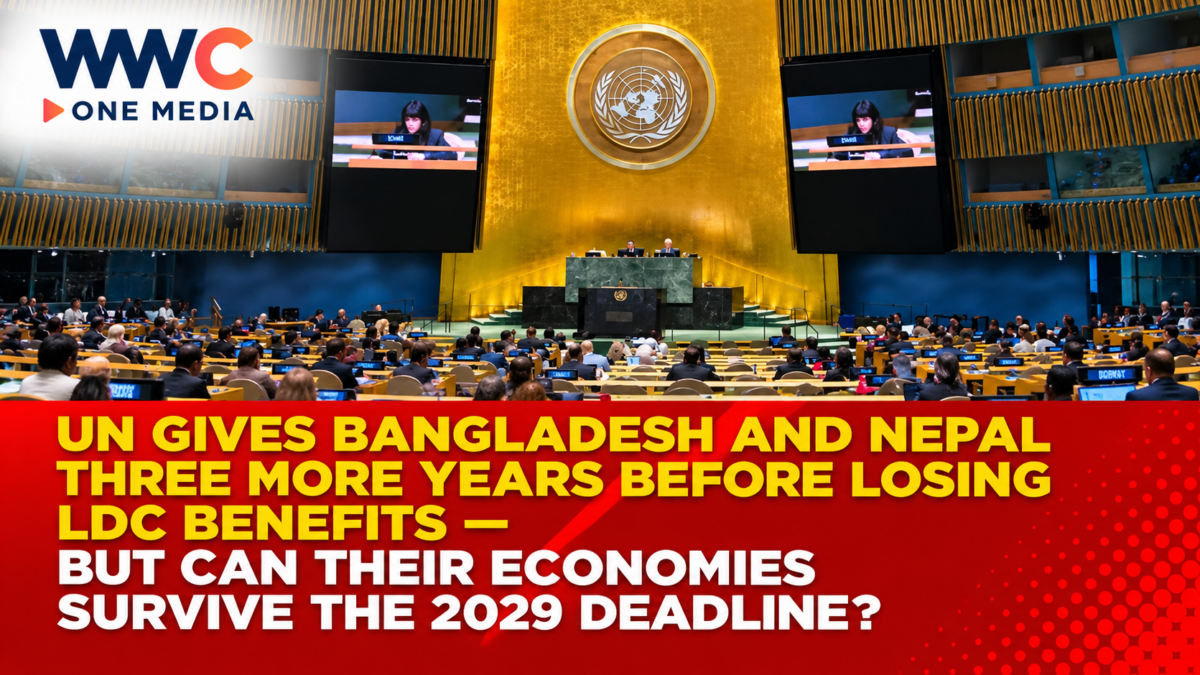
NEW YORK / DHAKA / KATHMANDU — October 30, 2026. Bangladesh and Nepal have secured a major economic reprieve after the United Nations General Assembly agreed to postpone their graduation from the Least Developed Countries (LDC) category by three years, giving both South Asian nations until November 24, 2029, to prepare for the loss of special international support.
The decision, reached during the UN General Assembly’s 81st session, extends a transition originally scheduled to end on November 24, 2026.
It follows months of lobbying and requests for additional preparation time from both governments, which cited fragile economic conditions, global trade uncertainty, climate disasters and continuing disruptions to energy and supply chains.
The extension is particularly important for Bangladesh’s export-dependent garment industry and Nepal’s smaller, more vulnerable economy.
Graduation from LDC status represents progress toward stronger economic and human development. But it can also reduce access to trade preferences and other international support measures.
For governments and exporters, the stakes are substantial.
The next three years could determine whether Bangladesh and Nepal enter a new stage of development with stronger economies—or face higher trade costs and investment challenges before they are ready.
UN approves three-year delay in a major South Asian economic decision
The General Assembly adopted a resolution extending the preparatory period for Bangladesh and Nepal until November 24, 2029.
The measure followed a joint initiative by the two governments and recommendations from the United Nations Committee for Development Policy.
It was approved by consensus during the assembly’s 81st session.
The decision recognizes that although both countries have made enough progress to qualify for graduation, they still face economic vulnerabilities that could undermine a successful transition.
The original graduation timetable was approved in November 2021, when the UN granted Bangladesh, Nepal and Laos an extended five-year preparation period because of the extraordinary disruption caused by the COVID-19 pandemic.
The new decision applies to Bangladesh and Nepal.
It does not establish a new 2029 graduation date for Laos.
The distinction matters because the UN’s graduation process involves separate assessments, national circumstances and decisions for each country.
What does graduation from LDC status actually mean?
The United Nations classifies some countries as least developed based on a combination of income, human development and economic or environmental vulnerability.
Graduation occurs when countries satisfy established criteria and complete the required review and preparation process.
The three main indicators are gross national income per capita, the Human Assets Index and the Economic and Environmental Vulnerability Index.
Human development measures include elements related to health and education.
Vulnerability assessments consider the structural challenges countries face, including exposure to economic and environmental shocks.
Leaving the LDC category is generally considered a development achievement.
It signals progress in economic capacity and human welfare.
But the classification is also linked to special support measures, which can include preferential trade treatment, technical assistance and access to certain forms of development support.
Consequently, graduation can bring both recognition and new economic responsibilities.
Why Bangladesh asked the UN for more time
Bangladesh is one of the world’s most significant exporters of ready-made garments.
Its clothing factories supply international retailers and employ large numbers of workers.
The country’s export model has benefited from trade arrangements that provide preferential access to certain overseas markets.
Graduation can change the legal basis for those preferences.
Bangladesh requested additional preparation time because it faces continuing financial and industrial challenges.
The government identified the need to strengthen macroeconomic stability, improve financial institutions, diversify exports and increase the competitiveness of domestic manufacturers.
Officials also cited external shocks, including conflict-related energy disruptions and uncertainty over international trade rules.
The country’s request was examined through the UN Committee for Development Policy’s enhanced monitoring process.
The committee concluded that an extension could be appropriate if accompanied by meaningful and measurable reforms.
The UN’s decision therefore provides additional time, not an exemption from the need to prepare.
Bangladesh’s garment exporters face a major trade-policy challenge
For Bangladesh, one of the most important questions concerns the future of preferential access to overseas markets.
The European Union is a major destination for Bangladeshi apparel.
LDC-specific arrangements have allowed eligible products to enter the EU under favorable conditions.
Graduation does not necessarily cause every preference to disappear immediately on the graduation date.
Some trading partners offer transition periods, while other arrangements depend on eligibility requirements and separate negotiations.
Nevertheless, uncertainty over future tariffs can influence investment decisions.
Garment manufacturers operate on relatively tight margins and compete with producers in Vietnam, India, Cambodia and other countries.
A higher tariff can reduce competitiveness unless exporters improve productivity, lower other costs or negotiate different commercial arrangements.
The three-year delay gives manufacturers more time to prepare.
It does not guarantee that every preferential arrangement will remain available indefinitely.
The WTO’s warnings add urgency to Bangladesh’s reforms
The extension comes during a period of unusually intense disruption in international trade.
Tariffs, geopolitical rivalry and shifting supply chains are changing the commercial environment for developing economies.
WWC ONE MEDIA examined the challenge in The WTO Says the Global Trade Order Is Facing Its Biggest Disruption in 80 Years.
The article discussed the risk that growing trade fragmentation could reduce international economic opportunities.
For Bangladesh, that uncertainty complicates the transition out of LDC status.
Manufacturers must consider not only the eventual loss of special preferences but also possible changes in tariffs and rules affecting all exporters.
This makes improved productivity, infrastructure and export diversification especially important.
A successful transition will require the country to compete increasingly on quality, efficiency and reliability rather than relying heavily on preferential access.
Bangladesh’s energy crisis threatens industrial competitiveness
Another immediate challenge is the cost and reliability of energy.
Bangladesh has experienced disruptions to liquefied natural gas supplies linked to the Middle East conflict.
Gas shortages and expensive replacement cargoes can affect electricity generation and industrial production.
Those pressures are particularly important for manufacturing businesses that need dependable power to meet international delivery schedules.
WWC ONE MEDIA recently covered the issue in Bangladesh Seeks More US LNG as Qatar Supply Crisis Deepens.
That report examined Dhaka’s efforts to diversify fuel suppliers and strengthen energy security.
The new UN extension could give Bangladesh additional time to address such vulnerabilities.
But purchasing more imported fuel does not automatically solve affordability problems.
The government must also consider electricity infrastructure, industrial efficiency and the financial sustainability of energy procurement.
Why Nepal also needed a three-year extension
Nepal faces a different set of economic challenges.
The Himalayan country is landlocked, making international trade heavily dependent on road networks, border infrastructure and transit arrangements with neighboring countries.
Its economy also relies substantially on remittances, tourism and agriculture.
Nepal had been scheduled to graduate in November 2026 after demonstrating progress in key development indicators.
However, officials argued that the economy remained vulnerable to external shocks.
The government formally requested additional preparation time in May 2026.
Its concerns included disruptions to international supply chains, geopolitical uncertainty, the possible effect on remittances and insufficient preparedness for the loss of certain LDC-specific support measures.
The UN Committee for Development Policy supported an extension linked to an improved, time-bound transition strategy.
Nepal now has another three years to strengthen institutions and productive capacity.
Climate disasters reveal Nepal’s continuing vulnerabilities
Nepal’s exposure to natural disasters has complicated its development efforts.
Floods, landslides and damage to mountain transport infrastructure can interrupt trade and essential services.
WWC ONE MEDIA previously examined one example in Floods Cut Nepal’s Lifeline to China: Festival Goods Stranded, Prices Could Be Next to Surge.
That report explored the consequences of damaged border roads and bridges for importers, traders and communities.
Such disruptions highlight the structural disadvantages faced by landlocked and mountainous economies.
A country may meet international development thresholds while still struggling with infrastructure that can be severely damaged by a single disaster.
The UN’s extension recognizes that economic resilience requires more than improvement in national statistics.
It also requires dependable roads, stronger institutions and the ability to withstand unexpected shocks.
Nepal’s trade corridors remain an economic priority
Cross-border infrastructure is central to Nepal’s development strategy.
China and India are important commercial partners, while access to ports and reliable overland routes influences the cost of imported goods.
WWC ONE MEDIA reported on changes to customs arrangements in China Shifts Zhangmu Border Crossing Near Nepal as Flood Disaster Reshapes Himalayan Trade Routes.
The article examined efforts to adapt border operations following severe transport disruptions.
For Nepal, better customs procedures and more resilient infrastructure can help reduce trade costs.
Those improvements may become even more important after LDC graduation.
Businesses that lose some tariff preferences may need to compete through faster delivery, higher productivity and better access to international markets.
The additional time provides an opportunity to address those weaknesses before the new deadline arrives.
Nepal has a formal smooth transition strategy
Nepal’s Smooth Transition Strategy was adopted in 2024.
The plan identifies several priorities, including macroeconomic stability, trade and investment, economic transformation, productive capacity, climate resilience and social inclusion.
The new UN deadline gives authorities more time to implement that strategy.
However, plans alone will not guarantee a successful graduation.
The country needs measurable improvements in institutional capacity, infrastructure, investment conditions and export competitiveness.
Officials will also need to coordinate reforms with businesses, development partners and communities.
The purpose of the extension is to make graduation sustainable rather than simply postpone a difficult decision.
Does the extension mean the two countries have failed?
No.
The decision does not erase Bangladesh’s or Nepal’s previous development achievements.
Bangladesh has made substantial progress in income, human development and other graduation indicators.
Nepal has also satisfied the required criteria, including progress in human development and economic and environmental vulnerability measures.
The UN recognizes that countries can meet graduation thresholds while remaining exposed to serious risks.
In that sense, the extension reflects a difference between statistical eligibility and practical readiness.
A country may qualify to graduate but still face challenges in adapting its economy to reduced international support.
The three-year delay is intended to help both governments protect the development gains already achieved.
What international benefits could eventually change?
LDC graduation may affect several forms of support.
Trade preferences are among the most commercially important.
Certain international agreements also provide LDC-specific flexibilities or technical assistance.
Some support measures may continue for a transition period after formal graduation, depending on the institution or trading partner involved.
Other assistance can remain available under separate development or income-based criteria.
Therefore, it would be inaccurate to say that Bangladesh and Nepal would lose every trade benefit, development grant or financing facility immediately upon graduation.
The precise effects depend on the applicable agreements.
That complexity is one reason both governments want more time to prepare.
Negotiating continued market access and understanding the rules of different international programs will be important parts of their transition.
Why the extension matters to other Asian economies
The decision has implications beyond Bangladesh and Nepal.
Other developing economies also face challenges involving trade preferences, climate shocks, infrastructure and international financing.
The outcome demonstrates that the UN’s development classifications are not intended to ignore extraordinary economic conditions.
But it also reinforces the expectation that governments use additional preparation periods to strengthen resilience.
For export-oriented Asian economies, changes in Bangladesh’s trade preferences could eventually influence competition in apparel and manufacturing.
Nepal’s transition may provide lessons for other landlocked countries seeking to expand international trade.
The wider lesson is that development must be supported by productive industries and durable institutions, not only improved classification indicators.
What about the Philippines?
The Philippines is not classified as an LDC and is not subject to this graduation decision.
Its trade relationships, tariff arrangements and development-financing eligibility are governed by different rules.
However, the issue remains relevant for Philippine businesses competing in international export markets.
Changes in preferential access for major apparel producers such as Bangladesh may affect competitive conditions over time.
The Philippines also faces similar strategic questions around export diversification, energy costs, infrastructure and resilience to global economic shocks.
The UN decision illustrates how international trade rules can influence investment and industrial development.
It does not create an immediate new tariff or trade preference for Philippine exporters.
What must Bangladesh and Nepal achieve before 2029?
The most important challenge is turning the additional preparation time into measurable economic improvements.
For Bangladesh, priorities include strengthening the banking system, improving energy reliability, attracting investment and expanding exports beyond garments.
Maintaining competitive access to international markets will also be essential.
For Nepal, priorities include stronger trade infrastructure, improved productive capacity, disaster resilience and greater economic diversification.
Both governments will need to work with development partners and domestic businesses.
Their success will depend on reforms, financing and practical implementation.
The deadline has changed, but the eventual transition remains an important policy objective.
The bigger question: Will three more years be enough?
The UN’s decision gives Bangladesh and Nepal a valuable opportunity to protect decades of progress.
The extension will allow them to continue preparing for the loss or modification of LDC-specific international support while confronting unusually difficult global conditions.
For businesses, the new timeline offers greater planning certainty.
For governments, it provides additional room to strengthen institutions, improve competitiveness and negotiate future trade arrangements.
But delaying graduation cannot solve structural economic weaknesses on its own.
If power supplies remain unreliable, transport infrastructure remains vulnerable or export industries fail to diversify, the same risks could persist in 2029.
Bangladesh and Nepal have secured three additional years before graduating from the world’s least-developed-country category. But the real test begins now: can they transform that reprieve into stronger economies before the deadline returns—or will the vulnerabilities that prompted the delay remain unresolved?