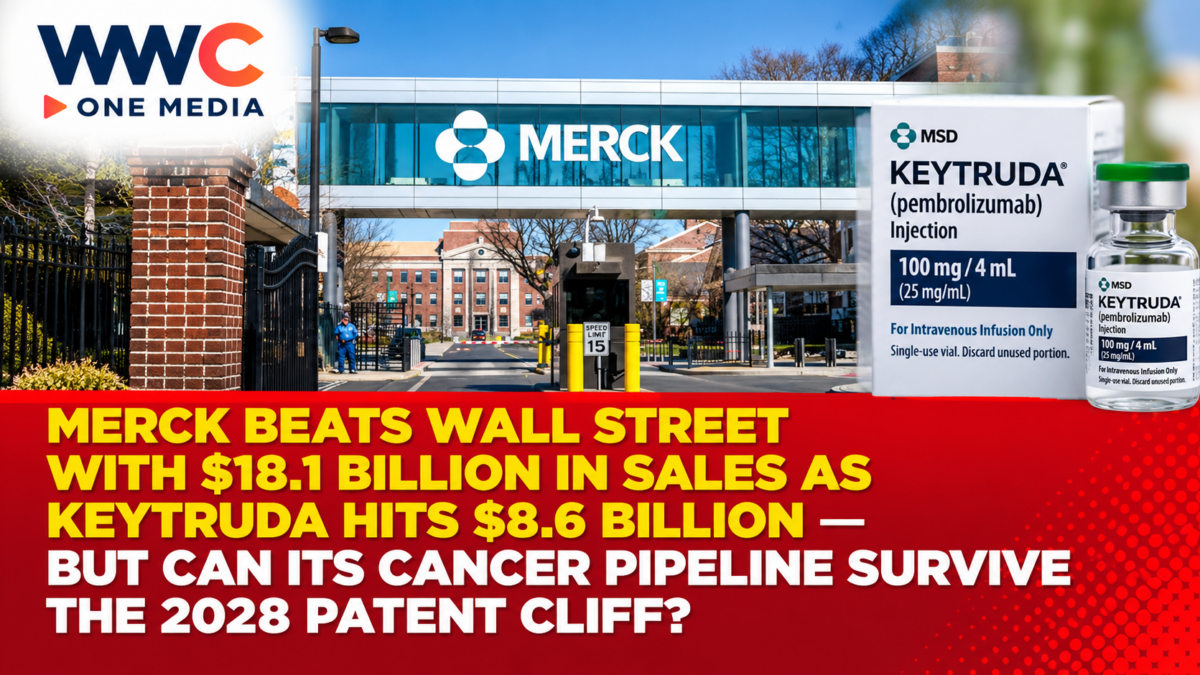
RAHWAY, New Jersey — October 30, 2026. American pharmaceutical giant Merck & Co. has beaten Wall Street’s third-quarter expectations, generating more than $18 billion in revenue as demand for its cancer medicines, vaccines and newer treatments helps support the company’s ambitious plans for its next era of growth.
Merck reported worldwide sales of $18.085 billion for the quarter ended September 30, a 5% increase compared with $17.276 billion a year earlier.
Adjusted earnings reached $2.49 per share, exceeding analysts’ average forecast of approximately $2.08, according to Reuters.
The performance was driven primarily by the blockbuster cancer medicine Keytruda, which generated $8.601 billion in sales, including revenue from its newer injectable formulation.
Gardasil vaccine sales increased 14% to nearly $2 billion, while Winrevair, a treatment for certain adults with pulmonary arterial hypertension, delivered 93% sales growth.
Merck also raised its full-year revenue and adjusted earnings forecasts.
But behind the stronger results lies one of the largest strategic challenges facing the pharmaceutical industry.
Keytruda, the medicine responsible for nearly half of Merck’s quarterly revenue, faces a major loss of US patent protection beginning in 2028.
That puts extraordinary pressure on Merck’s pipeline of experimental cancer therapies, cardiovascular medicines and other treatments to create new sources of revenue.
Merck beats analysts’ sales and earnings forecasts
Merck’s third-quarter results exceeded expectations on both major financial measures.
Revenue reached $18.085 billion, compared with the approximately $17.3 billion forecast by analysts surveyed by LSEG.
Adjusted earnings were $2.49 per share, significantly above the approximately $2.08 market estimate cited by Reuters.
However, the company also reported a decline in net income.
GAAP net profit fell 12% to $5.065 billion from $5.785 billion a year earlier.
This illustrates why a strong adjusted earnings result should not automatically be interpreted as an increase in every profitability measure.
Merck’s financial report also identified a timing benefit of approximately $550 million from pharmaceutical purchases taking place earlier than expected.
That contribution is important when assessing the sustainability of revenue growth.
Sales brought forward from a future period may strengthen one quarter without necessarily representing an equivalent increase in underlying patient demand.
Investors should therefore consider both the headline growth rate and the factors influencing the timing of reported sales.
Keytruda generates $8.6 billion in just three months
Keytruda remains the financial foundation of Merck’s pharmaceutical business.
Worldwide revenue from Keytruda and Keytruda Qlex reached $8.601 billion, increasing 6% year on year.
The medicine is an immunotherapy designed to help the immune system recognize and attack certain cancer cells.
It is approved for use in multiple cancer types and treatment settings, subject to the relevant indications and patient eligibility requirements.
Merck attributed its latest growth partly to continued adoption in earlier-stage cancers, including certain forms of breast, cervical, head and neck, and bladder cancer.
Demand also remained strong in several advanced cancer indications.
The product’s quarterly sales represented approximately 47.6% of Merck’s total worldwide revenue.
That concentration is commercially impressive, but it creates a strategic vulnerability.
If future competition significantly reduces Keytruda sales or pricing, Merck will need other products to compensate.
Keytruda Qlex adds $830 million to the cancer franchise
One of Merck’s more important commercial developments is the expansion of Keytruda Qlex.
The newer formulation allows the medicine to be administered under the skin rather than through a traditional intravenous infusion for approved uses.
Keytruda Qlex generated approximately $830 million in third-quarter sales.
Those sales are already included in the broader $8.601-billion Keytruda franchise total.
They should not be added to that figure again.
The new administration method could provide greater convenience in some treatment settings and help Merck retain customers as its original Keytruda formulation approaches increased competition.
However, different formulations may have distinct regulatory and patent protections.
The success of Qlex does not guarantee that the entire Keytruda business will avoid the financial effects of future biosimilar competition.
The ultimate impact will depend on regulatory approvals, pricing, reimbursement and adoption by healthcare providers.
The 2028 patent cliff threatens Merck’s biggest revenue engine
The most important long-term issue facing Merck is the approaching loss of key US patent protection for Keytruda beginning in 2028.
Patent expiration can allow rival drugmakers to pursue competing versions of established medicines.
For complex biological therapies such as Keytruda, those competitors would generally need to develop biosimilars and satisfy applicable regulatory requirements.
The process is different from introducing an ordinary generic copy of a small-molecule medicine.
Nevertheless, increased competition can eventually reduce prices and market share.
The financial consequences could be substantial because Keytruda is such a large contributor to Merck’s earnings.
Chief Executive Robert Davis has emphasized the company’s efforts to develop a broader portfolio that can sustain growth after the patent transition.
Merck previously estimated that its emerging products could generate more than $70 billion in annual revenue by the mid-2030s.
Davis indicated in October that the company expects to increase that forecast as additional pipeline and acquisition opportunities develop.
However, the figure remains a long-term company projection.
It should not be described as revenue already secured.
Gardasil vaccine sales rebound 14%
Merck’s vaccine portfolio also contributed to the stronger quarter.
Revenue from Gardasil and Gardasil 9 reached $1.995 billion, up 14% from approximately $1.749 billion a year earlier.
The vaccines protect against certain types of human papillomavirus, or HPV, associated with several cancers and other conditions.
Merck attributed the sales increase primarily to favorable US public-sector purchasing patterns and higher net pricing.
That means the revenue growth should not automatically be interpreted as a 14% increase in the number of people vaccinated.
Purchasing schedules and prices can significantly influence reported quarterly vaccine revenue.
Vaccine availability and recommended use also vary according to national regulatory approvals and public health policies.
Gardasil’s performance was nevertheless an encouraging development for Merck after earlier periods of weaker vaccine sales in certain international markets.
Winrevair sales surge 93% as Merck diversifies
Winrevair was another major contributor to the quarter.
The medicine generated $694 million in revenue, up 93% from $360 million in the corresponding period last year.
Winrevair is used for certain adults with pulmonary arterial hypertension, a serious condition involving elevated blood pressure in the arteries supplying the lungs.
Growth reflected stronger demand, purchasing patterns and expanding adoption in international markets, including Europe and Japan.
For Merck, Winrevair represents an increasingly important source of revenue outside oncology.
But the product remains much smaller than Keytruda.
It will take several successful products, potentially across different therapeutic areas, to offset the long-term financial challenge posed by a major decline in the Keytruda franchise.
That is why Merck continues investing heavily in cancer research, cardiovascular medicines and immunology.
Moderna cancer vaccine delivers encouraging Phase 3 results
One of Merck’s most closely watched research programs involves its partnership with Moderna on an individualized mRNA cancer therapy called intismeran autogene, also known as V940.
The experimental treatment is designed around genetic mutations found in an individual patient’s tumor.
It is being studied in combination with Keytruda to help reduce the risk of cancer returning after surgery.
At the October 2026 European Society for Medical Oncology Congress, Merck and Moderna presented additional Phase 3 findings from their INTerpath-001 trial.
Reuters reported that the treatment combination was associated with a 42% relative reduction in the risk of melanoma recurrence or death compared with Keytruda alone in the studied population.
That represents an encouraging clinical development.
However, the percentage is a relative risk reduction over the study’s follow-up period.
It does not mean 42% of patients were cured, nor does it establish that the treatment will prevent every recurrence.
The individualized cancer vaccine remains experimental and requires regulatory review before commercial use.
The manufacturing challenge remains enormous
WWC ONE MEDIA previously examined the program in Merck and Moderna’s Personalized Cancer Vaccine Shows Major Promise — But a Six-Week Manufacturing Challenge Could Determine How Fast Patients Get It.
Unlike conventional medicines produced in standardized batches, the experimental therapy must be manufactured for individual patients based on the genetic characteristics of their tumors.
That creates significant challenges involving tumor sequencing, sample transportation, manufacturing and timely delivery.
Merck has discussed efforts to shorten the approximately six-week production process.
But a faster manufacturing system has not yet been established as a guaranteed commercial capability.
For patients, future availability will depend on regulatory approval, clinical eligibility, manufacturing reliability and affordability.
For investors, the question is whether a scientifically promising personalized treatment can eventually become a commercially sustainable product.
Merck’s new cancer drug receives priority review
Another potentially important addition to the pipeline is sacituzumab tirumotecan, or sac-TMT.
The experimental antibody-drug conjugate is being studied in several cancers.
Antibody-drug conjugates combine a targeted antibody with a medicine intended to damage cancer cells.
Merck reported positive Phase 3 data in certain patients with advanced or recurrent endometrial cancer.
The US Food and Drug Administration accepted a biologics license application for priority review based on the results.
The regulatory agency has assigned a June 15, 2027 target decision date.
Priority review means the agency aims to complete its evaluation on an accelerated timetable.
It does not mean approval has already been granted.
Merck is also discussing the possibility of an earlier decision.
Any future launch would depend on regulatory authorization, the approved label and commercial preparations.
Januvia’s sales decline shows what happens after exclusivity ends
The consequences of patent expiration are already visible in Merck’s diabetes business.
Sales of Januvia and Janumet fell 39% to $380 million during the third quarter.
Merck attributed the decline primarily to generic competition following the loss of market exclusivity in the United States.
The downturn provides a practical example of the financial pressures that can emerge when competing medicines enter the market.
However, Januvia and Keytruda involve different pharmaceutical technologies and competitive environments.
The scale and timing of any future Keytruda decline cannot be predicted simply by applying Januvia’s sales percentage.
Nevertheless, the experience reinforces why Merck is accelerating the development of replacement revenue sources.
Why Merck is investing billions in acquisitions
Merck has expanded its portfolio through acquisitions, licensing arrangements and internal research.
Recent transactions include Cidara Therapeutics and Terns Pharmaceuticals, along with a global licensing agreement involving SciBrunch.
The company identified substantial one-time charges associated with those transactions in its 2026 financial outlook.
The Cidara acquisition accounts for a $9-billion charge, while the Terns transaction accounts for approximately $5.7 billion.
The SciBrunch licensing agreement adds a $400-million charge.
These transactions help explain why Merck’s full-year adjusted earnings guidance appears substantially lower than its third-quarter adjusted earnings alone might suggest.
They also demonstrate the company’s willingness to invest heavily to build future product franchises.
However, acquisition prices and research expenditure do not guarantee future drug approvals or successful commercial launches.
Clinical trials, regulation, manufacturing and competition remain important risks.
Merck raises 2026 revenue and earnings guidance
Merck now expects full-year 2026 sales of between $66.8 billion and $67.3 billion.
The previous range was $66.3 billion to $67.3 billion.
The company therefore increased the lower bound by $500 million and raised the midpoint by $250 million.
Merck also increased its non-GAAP earnings-per-share forecast to $2.77–$2.82, compared with its previous estimate of $2.66–$2.76.
The updated EPS guidance includes the significant acquisition-related and licensing charges disclosed during the year.
Investors should distinguish these forecasts from Merck’s quarterly earnings.
Annual results will depend on the remaining quarter’s performance and the accounting effects of its transactions.
The outlook is also influenced by currency movements and tax assumptions.
Management expects moderate revenue growth in 2027, partly offset by generic competition and other losses of exclusivity affecting certain products.
Keytruda’s growth rate is also expected to moderate.
Pharmaceutical competition extends far beyond cancer treatments
Merck’s efforts to build a more diversified business come as other pharmaceutical giants invest aggressively in new medicines.
Eli Lilly and Novo Nordisk, for example, are competing to develop next-generation obesity treatments.
WWC ONE MEDIA examined that research race in Lilly and Novo Bet on Amylin as Next Obesity-Drug Battleground After GLP-1 Boom.
Those treatments involve different diseases and technologies from Merck’s cancer medicines.
Nevertheless, the competition illustrates a central issue across the pharmaceutical industry.
Companies must continually invest in research because successful products eventually face competitive challenges and changing medical needs.
An established medicine can generate billions of dollars in annual revenue, but its commercial position is rarely permanent.
The long-term winners are likely to be companies that can repeatedly turn scientific advances into approved treatments with sustainable demand.
Southeast Asia faces its own advanced-medicine infrastructure challenge
The emergence of individualized cancer therapies also raises questions about future access in Southeast Asia.
Personalized treatments require specialized laboratories, genetic testing, carefully coordinated logistics and regulated manufacturing.
WWC ONE MEDIA previously examined related infrastructure questions in AcroMeta Targets Southeast Asia With Technology That Could Transform Cell Therapy Logistics.
The proposed technology discussed in that report involves cellular logistics and is not a Merck cancer-vaccine partnership.
Nevertheless, it illustrates the wider challenge of moving sensitive biological materials between research facilities and treatment centers.
For the Philippines, future access to advanced cancer treatments would depend on regulatory authorization, medical infrastructure, affordability and the availability of qualified specialists.
Merck and Moderna’s experimental therapy should not be described as a currently approved or routinely available cancer treatment in the Philippines.
What investors should watch after Merck’s earnings beat
Several factors will determine whether Merck can sustain its financial performance beyond Keytruda’s patent transition.
The first is continued demand for Keytruda and its Qlex formulation.
The second is the growth of newer products, particularly Winrevair and other recently launched treatments.
Third is the outcome of late-stage clinical trials and regulatory reviews involving the company’s cancer pipeline.
Fourth is Merck’s ability to convert expensive acquisitions into approved, commercially valuable medicines.
Finally, shareholders will be monitoring the approach of biosimilar competition and the effect of other patent expirations.
The company’s strong third-quarter performance provides financial resources to support its strategy.
But Merck must demonstrate that the investments can generate lasting results.
The bigger question: Can Merck build its future before Keytruda’s patent protection weakens?
Merck’s latest results show why it remains one of the pharmaceutical industry’s major players.
Its quarterly revenue exceeded $18 billion.
Keytruda generated more than $8.6 billion in sales.
Gardasil rebounded, Winrevair expanded rapidly and management raised its annual guidance.
The company is also advancing experimental treatments that could eventually improve care for patients with difficult diseases.
But the approaching Keytruda patent cliff creates an urgent commercial challenge.
Merck cannot rely indefinitely on the exceptional performance of one medicine.
Its strategy now depends on developing enough successful products to replace revenue that could come under pressure after 2028.
Merck has proved it can beat Wall Street today. But whether its cancer vaccine, newer medicines and multibillion-dollar acquisitions can protect the business from tomorrow’s patent cliff remains the decisive question for its next decade.